Understanding the Unique Position of the US Citizen IMG in Pediatrics
As a US citizen IMG (international medical graduate) or an American studying abroad, you occupy a very specific space in the pediatrics residency landscape. You share characteristics with both US MD/DO seniors and non‑US IMGs—but you’re evaluated slightly differently than each group.
Programs often see US citizen IMGs as:
- Familiar with US culture and healthcare expectations
- Potentially more flexible with visas (you don’t need one)
- Still requiring reassurance about clinical training quality, communication, and readiness for US healthcare
For pediatrics specifically, program directors tend to highly value:
- Genuine comfort with children and families
- Strong communication and empathy
- Evidence of teamwork and reliability
- Consistency of interest in pediatrics (not a backup plan)
Pre‑interview preparation is your chance to deliberately showcase these strengths and address any concerns before you ever log into Zoom or walk into a conference room. This guide will walk you step‑by‑step through how to prepare for interviews for a pediatrics residency as a US citizen IMG, from research and self‑reflection to mock interviews and logistics.
Step 1: Know Your Story and Your “Why Pediatrics”
Before you worry about specific interview questions residency programs might ask, you need to be crystal clear on your own narrative.
Clarify Your Overall Narrative as a US Citizen IMG
Programs will almost certainly ask:
“Tell me about yourself” and “How did you end up going to medical school abroad?”
As an American studying abroad, your answer should:
Acknowledge the path openly
- Avoid sounding defensive or apologetic.
- Present your route as a thoughtful decision, even if it evolved over time.
Connect your path to strengths
Examples:- “Studying in [Country] gave me broad exposure to resource‑limited settings, which has made me more adaptable and resourceful.”
- “Living abroad strengthened my cultural humility and communication skills, which are essential when working with diverse pediatric populations in the US.”
Reassure about US readiness
- Mention US clinical experience (USCE) you’ve had.
- Highlight familiarity with EMR systems, team‑based care, and common pediatric guidelines.
Exercise: Write a 2–3 minute “origin story” that covers:
- Your background and where you grew up
- Why you chose medicine
- Why you chose to attend medical school abroad
- How that experience shaped you positively as a future pediatrician
Practice saying this out loud until it feels conversational, not memorized.
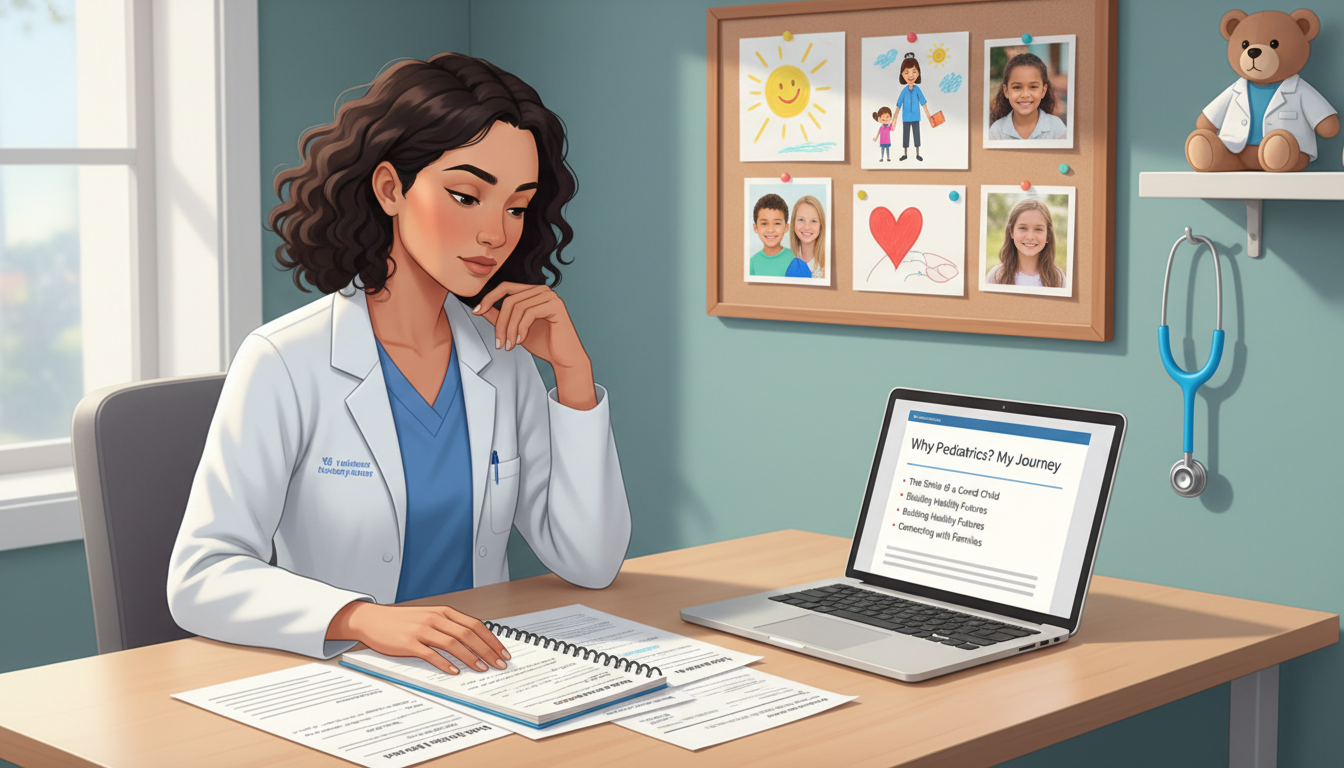
Develop a Powerful “Why Pediatrics” Answer
In the peds match, your commitment to children and families is scrutinized closely. Your “Why Pediatrics” must be:
- Specific to children and families
- Grounded in real experiences
- Future‑oriented (how you see yourself as a pediatrician)
Weaker answer:
“I like working with kids; they’re resilient and fun.”
Stronger answer:
“I chose pediatrics because I love the longitudinal relationships with children and families and the opportunity to influence lifelong health habits. During my pediatrics rotation in [Hospital], I followed a child newly diagnosed with type 1 diabetes—seeing the trust their parents placed in the team, and watching that child adapt over weeks, showed me how meaningful it is to guide families through both crises and everyday developmental milestones.”
Action steps:
- List 3–5 specific pediatric encounters that deeply influenced you.
- For each, write:
- What happened
- What you felt
- What you learned about pediatrics and about yourself
- Distill these into 1–2 polished stories you can use in answers.
Step 2: Research Programs and Build a Targeted Strategy
Pre‑interview preparation is much more effective when it’s tailored. Generic, vague praise of programs is obvious and unimpressive. As an IMG, demonstrating that you understand the program and its context helps counter any hesitation about fit.
Understand What Pediatric Programs Typically Value
Across pediatric residencies, common priorities include:
- Commitment to underserved or vulnerable child populations
- Interest in advocacy, public health, or school/community outreach
- Comfort with acute care plus chronic and preventive care
- Teamwork with nurses, social workers, therapists, and other disciplines
- Strong communication with parents and caregivers
Many programs’ websites and social media accounts explicitly highlight:
- Community outreach clinics
- Advocacy days at the state capitol
- Quality improvement projects involving patient safety or vaccination rates
- Diversity, equity, and inclusion initiatives
As a US citizen IMG, you should look for areas where your experiences abroad enrich these themes (e.g., global health, working with immigrant families, bilingual skills).
How to Research Each Program Effectively
For each program where you have an interview:
Website deep dive (20–30 minutes):
- Program mission, values, and educational philosophy
- Patient population (urban vs rural, underserved, immigrant communities, etc.)
- Rotation structure (community hospital rotations, continuity clinic model)
- Scholarly tracks: advocacy, global health, primary care, hospitalist, subspecialty
- Faculty or chief residents’ interests
Look at publicly available data and impressions:
- FREIDA
- Program’s social media (Twitter/X, Instagram, sometimes TikTok)
- Virtual open house recordings (if available)
- Any information on prior IMGs in the program
Document your findings: Create a one‑page summary per program including:
- 3 reasons you’re genuinely interested
- 2 aspects of your background that align well
- 3 program‑specific questions you can ask on interview day
This “cheat sheet” becomes invaluable during residency interview preparation when you’re juggling multiple programs.
Connect Your IMG Background to Program Priorities
As an American studying abroad, you can highlight:
- Cultural adaptability and communication across languages or systems
- Comfort treating diverse populations (relevant to many US pediatric centers)
- Resource‑conscious decision‑making that still prioritizes child safety
- Unique perspectives that enrich team discussions
Example tailored talking point:
“Your program’s strong focus on caring for children from immigrant families resonates with my experience training in [Country], where I worked in clinics serving refugees and families facing significant social barriers. I’d love to bring that experience to your continuity clinic population.”
Step 3: Master Core Pediatrics Residency Interview Questions
While every conversation is different, there are common interview questions residency programs repeatedly use—especially in pediatrics. Thoughtful, specific, and structured answers can help you stand out.
Common General Questions (With a Pediatrics IMG Lens)
“Tell me about yourself.”
- 60–90 seconds
- Structure: Present (what you’re doing now) → Past (key experiences) → Future (peds career goals)
- Briefly integrate: US upbringing, IMG training, and pediatric focus.
“Why pediatrics?”
- Use your pre‑developed stories—don’t be generic.
- Include at least one specific patient or experience.
“Why this program?”
- Reference: mission, patient population, specific tracks, or curriculum features.
- Connect them to your background (e.g., “As a US citizen IMG who trained with a large underserved pediatric population, I’m especially drawn to…”).
“Tell me about a challenging patient or situation.”
- Use a pediatric case when possible.
- Show empathy for both the child and the family.
“What are your strengths and weaknesses?”
- Strengths: pick those relevant to pediatrics (e.g., patience, communication, reliability).
- Weaknesses: choose something real but improvable (e.g., initial discomfort with delegating); show your plan to improve.
Pediatrics‑Specific Questions to Expect
“What do you enjoy most about working with children?”
- Move beyond “they’re cute.”
- Emphasize development, resilience, relationships with families, and opportunity to shape long‑term health.
“Tell me about a time you had to communicate difficult news to a parent.”
- Show how you were honest yet compassionate.
- Highlight how you checked for understanding and emotional response.
“How do you handle an anxious or upset parent?”
- Discuss active listening, validating emotions, explaining your clinical reasoning, and partnering in decisions.
“What are your long‑term career goals in pediatrics?”
- Whether primary care, hospitalist, or subspecialty, show openness to learning but a genuine connection to pediatric patient care.
Behavioral Questions and the STAR Technique
For behavioral questions (“Tell me about a time when…”), use STAR:
- Situation – Concise background
- Task – Your role
- Action – What you did (focus heavily here)
- Result – Outcome + what you learned
Example (conflict on a team):
- S: “During my pediatrics rotation, our team disagreed about discharging a child with asthma.”
- T: “As the student, I needed to clarify the plan and ensure safety without overstepping.”
- A: “I reviewed the chart, guidelines, and discussed with the resident, asking if we could confirm the parents’ understanding of inhaler use and follow‑up. I proposed a short teaching session with the nurse.”
- R: “We delayed discharge by a few hours to complete education and confirm medication access. The parents later shared they felt more confident managing at home. I learned how speaking up respectfully can improve pediatric patient safety.”
Pre‑interview, write out STAR answers for:
- A mistake or near‑miss
- Conflict with a colleague
- A time you received critical feedback
- A time you went above and beyond for a patient/family

Step 4: Practice Delivery, Not Just Content
Knowing what to say is only half of residency interview preparation. How you say it—your confidence, warmth, and clarity—matters tremendously in pediatrics, where communication is central.
Set Up Mock Interviews
Aim for at least 3–5 mock interviews before your first real one:
- With faculty or advisors who understand the peds match
- With residents, ideally in pediatrics
- With peers, focusing on timing and clarity
Ask for honest feedback on:
- Clarity and conciseness
- Use of concrete examples rather than vague claims
- Eye contact and nonverbal communication
- Any unintentional defensiveness when you discuss being an IMG
For virtual interviews, simulate the setup exactly:
- Same room and background
- Same camera, microphone, and platform if possible
- Same interview attire
Use Structured Practice for Common Questions
Create a practice schedule:
- Day 1–2: “Tell me about yourself,” “Why pediatrics?”
- Day 3–4: Behavioral questions + pediatric scenarios
- Day 5: Program‑specific “Why us?” answers for several programs
- Weekly: Full 30–40 minute mock session
Record yourself (video) and review:
- Do you interrupt? Talk too fast?
- Do you smile occasionally and appear approachable?
- Do you show genuine enthusiasm for pediatrics?
Manage Nerves and Performance Anxiety
Even experienced speakers get nervous. As an American studying abroad, you may also feel extra pressure to prove yourself. Use:
Pre‑interview routine (10–15 minutes before):
- Deep breathing (4‑7‑8 technique or box breathing)
- Quick posture and facial relaxation check
- 2–3 positive affirmations grounded in fact:
“I’ve cared for many pediatric patients successfully.”
“I bring valuable international experience and cultural perspective.”
During interview:
- Pause briefly before answering; it signals thoughtfulness.
- If you don’t understand a question, ask for clarification:
“Just to make sure I answer you clearly, are you asking about…?”
Step 5: Optimize Logistics, Professionalism, and Program Fit Signals
Effective pre‑interview preparation also includes all the “small stuff” that quietly communicates reliability and professionalism.
Technical and Environmental Setup (for Virtual Peds Interviews)
Pediatrics programs care about your ability to connect. Your virtual interview environment should help, not distract.
- Camera angle: Eye‑level, showing head and upper torso.
- Lighting: Soft, front lighting; avoid backlight from windows.
- Background: Neutral, tidy; a subtle pediatric touch (like a small bookshelf with a children’s book) is fine but not required.
- Internet: Test your connection; have a backup plan (phone hotspot if needed).
Do at least one full trial with the exact setup you’ll use.
Professional Appearance and Demeanor
- Dress code: Conservative professional attire (suit jacket or blazer). Understated colors are safest.
- Body language:
- Sit upright but not rigid.
- Nod occasionally to signal engagement.
- Maintain eye contact by looking at the camera when speaking.
Pediatrics often values warmth and humanity. You can smile and be personable; you don’t need to be overly formal or robotic.
Prepare Strong, Specific Questions to Ask Programs
Your questions should reflect insight into their program and genuine interest in pediatrics, not just generic curiosity.
Example categories:
Education and mentorship:
- “How does your program support residents who are interested in advocacy or community pediatrics?”
- “Can you tell me about mentorship opportunities for residents exploring hospitalist versus subspecialty paths?”
Patient population:
- “What are the main challenges your pediatric population faces, and how are residents involved in addressing those?”
Support for IMGs / transition to US training:
- “Do you have other residents who trained abroad, and how does the program support their transition to your system?”
Avoid questions that focus only on salary or vacation at the expense of patient care or education during your limited time.
Pre‑Interview Checklist for the Peds Match
1–2 weeks before:
- Review each program’s one‑page summary.
- Update your CV with any new activities, publications, or presentations.
- Prepare or revisit a concise explanation of any red flags (gaps, attempts, leaves).
Night before:
- Confirm time zones and platform (Zoom, Thalamus, etc.).
- Lay out interview clothes.
- Print or open:
- Program summary
- List of questions to ask
- Your ERAS application and personal statement
Morning of:
- Log in 15–20 minutes early.
- Silence phone notifications.
- Have water nearby and a notepad (if you like).
FAQs: Pre‑Interview Preparation for US Citizen IMGs in Pediatrics
1. As a US citizen IMG, will programs treat me differently during pediatrics interviews?
Programs know you don’t need visa sponsorship, which is a logistical advantage. However, they may still have questions about:
- Quality and structure of your international medical training
- Your familiarity with US healthcare systems
- Your English communication and documentation skills
Pre‑interview preparation can address this by highlighting:
- US clinical experiences (core or elective pediatrics rotations)
- Comfort with EMRs, team‑based care, and US guidelines
- Examples where you effectively communicated with families and teams
Your goal is to come across as someone who just happens to have trained abroad but is otherwise fully ready for a US pediatrics residency.
2. How can I best explain why I went to medical school abroad without sounding defensive?
Keep your answer simple, honest, and future‑focused:
- Briefly state your reason (opportunity, cost, timing, or other factors).
- Emphasize what the experience added to your development (cultural competence, resourcefulness, exposure to diverse pediatric conditions).
- Transition quickly to how you prepared for the US system (USMLE, USCE, peds‑focused experiences).
Avoid over‑justifying your choice or criticizing US schools. Program directors mostly want to see maturity, insight, and readiness—not an apology.
3. What pediatrics‑specific experiences should I highlight during interviews?
Prioritize:
- US pediatrics rotations (inpatient, outpatient, NICU, PICU)
- Volunteer or advocacy work with children (camps, schools, shelters, community health outreach)
- Quality improvement or research in pediatric topics
- Leadership roles related to children or community health (student groups, projects)
When describing them, tie back to:
- Skills: communication, empathy, teamwork, child‑ and family‑centered care
- Values: advocacy for vulnerable children, commitment to safety and prevention
4. How many mock interviews should I do before my pediatrics residency interviews?
Aim for at least 3–5 focused sessions:
- 1–2 with faculty/advisors or residents (for content and professionalism)
- 1–2 with peers (for repetition and confidence)
- 1 full “dress rehearsal” using the exact virtual setup you’ll use on interview day
Use these to refine:
- “Tell me about yourself”
- “Why pediatrics?” and “Why this program?”
- Behavioral answers with pediatric examples
Treat early interviews as real but also as learning opportunities. After each one, take 5–10 minutes to jot down what you were asked, what went well, and what to improve. Over time, your answers and confidence will become more natural, helping you present the strongest version of yourself in every pediatrics residency interview.