Why Pre‑Interview Preparation Matters So Much for US Citizen IMGs
For a US citizen IMG or American studying abroad, the residency interview is often the single most important part of the family medicine residency application. Your scores and application get you in the door; the interview decides whether you match.
Family medicine programs in particular care deeply about:
- Communication skills
- Empathy and professionalism
- Fit with the program culture and community
- Commitment to primary care and continuity relationships
These are traits that don’t fully show on paper. Thoughtful pre‑interview preparation is how you showcase them clearly and confidently.
This guide walks you step‑by‑step through how to prepare for interviews as a US citizen IMG targeting a family medicine residency. You’ll learn how to research programs, organize logistics, prepare high‑impact answers to common interview questions residency faculty ask, and practice effectively so you can walk into each FM match interview calm, authentic, and ready.
Step 1: Understand the Family Medicine Interview Landscape
Before you drill into details, you need a clear understanding of what family medicine programs are actually looking for and how that affects your residency interview preparation.
What Family Medicine Programs Look for
Across programs, faculty often emphasize four core domains:
Commitment to Family Medicine
- Why family medicine and not internal medicine, pediatrics, or EM?
- How do you see yourself contributing to primary care in the US?
- Have you demonstrated sustained interest (FM rotations, continuity clinic, community work)?
Communication & Interpersonal Skills
- Ability to build rapport quickly
- Clear, empathetic communication with diverse patients
- Professional collaboration with staff and colleagues
Reliability & Work Ethic
- Can they trust you with their patients?
- Do you follow through, handle feedback, and learn from mistakes?
Fit With Program Mission
- Community‑oriented vs. academic focus
- Underserved/urban vs. rural/frontier
- Interest in full‑scope practice, OB, procedures, or specific populations
As a US citizen IMG, you may be scrutinized a bit more for:
- Readiness to transition to US clinical practice
- Communication skills in an American healthcare context
- Understanding of the US healthcare system and primary care challenges
- Evidence that you can adapt quickly and contribute positively
Knowing these expectations will guide your preparation: what to emphasize, what examples to choose, and what gaps to address openly and constructively.
Unique Considerations for US Citizen IMGs
Common concerns programs may have (spoken or unspoken):
- Limited or late US clinical experience
- Unfamiliarity with EMR systems used in the US
- Gaps in medical education timeline
- Questions about why you studied abroad
Your goal in pre‑interview preparation:
- Anticipate those concerns
- Address them proactively with clear, confident stories
- Reframe your IMG background as a strength (resilience, adaptability, cross‑cultural skills)
Step 2: Strategic Program Research (Beyond the Website Homepage)
Thorough program research is the foundation of personalized, high‑impact interviews. It also helps you avoid generic answers that sound the same at every program.
Build a Program Research Template
Create a simple spreadsheet or document with one tab or page per program. Include:
- Basic Details
- Program name, ACGME number, location, community type (urban/suburban/rural)
- Interview date and format (virtual vs. in‑person)
- Mission & Focus
- Mission statement
- Populations served (underserved, immigrant, rural, academic)
- Areas of emphasis (OB, geriatrics, sports medicine, addiction, behavioral health)
- Curriculum Highlights
- Inpatient vs. outpatient balance
- Continuity clinic structure
- EMR system
- Any unique tracks (global health, community medicine, leadership, research)
- Faculty & Resident Culture
- PD and APD backgrounds: FM interests, publications, social media presence
- Resident wellness initiatives
- Call schedule, duty hours, benefits that reflect program values
- Outcomes
- Fellowship placement
- Graduates’ practice settings (community clinics, FQHCs, hospitalist, rural practice)
- Your Personal “Fit” Notes
- 2–3 reasons the program genuinely appeals to you
- 2–3 ways you would add value to the program
- Specific questions you want to ask residents and faculty
This document becomes your quick‑reference before each interview and helps you tailor your answers to each program’s identity.
Where to Find Useful Information
Go beyond the top‑level program homepage:
- Program website subpages
- Curriculum
- Resident bios
- Faculty interests
- Community partners and clinical sites
- FREIDA and ACGME program pages
- Size of program, accreditation status, patient volumes
- Social media
- Program Instagram or X (Twitter): social events, community outreach, resident wellness
- Hospital or department accounts for broader institutional culture
- Virtual open houses / info sessions
- Watch session recordings if available
- Note what the PD repeatedly emphasizes—this often reflects selection priorities
For a US citizen IMG, this research helps you:
- Target programs that have a history of matching IMGs
- Identify FM match environments supportive of non‑traditional backgrounds
- Prepare targeted questions that show genuine interest and maturity
Step 3: Crafting Your Core Story and Message
Pre‑interview preparation is not about memorizing scripts. It’s about building a coherent “professional story” that you can communicate naturally in different ways depending on the question.
Define Your Core Narrative
In a few bullet points, define who you are as a future family physician:
- Identity: US citizen IMG / American studying abroad with specific cultural or personal background
- Motivation: Why family medicine genuinely fits your values and skills
- Strengths: 3–4 top qualities (e.g., patient communication, adaptability, teaching, systems thinking)
- Direction: Your long‑term goals (e.g., full‑scope rural FM, urban underserved care, women’s health, addiction medicine)
Example (for personal reflection, not to recite verbatim):
- US citizen IMG trained in [Country] with strong clinical exposure to resource‑limited primary care settings
- Drawn to family medicine because I value continuity, whole‑person care, and supporting patients over time
- Strengths: cross‑cultural communication, resilience, organized team player, comfortable with uncertainty
- Interested in urban underserved practice and possibly addiction medicine fellowship
Once this story is clear, you can adapt it smoothly for:
- “Tell me about yourself.”
- “Why family medicine?”
- “Why this program?”
- “What are your career goals?”
Develop a Flexible “Tell Me About Yourself” Answer
This is almost always the first question. You should have a structured, 60–90 second response ready:
- Brief background
- “I’m a US citizen who completed medical school at [School, Country]…”
- Key experiences leading to family medicine
- One or two pivotal clinical or personal experiences
- Strengths and what you bring
- Tie strengths to FM traits: continuity, teamwork, communication, community orientation
- Forward‑looking statement
- Short line connecting your goals to what you’re seeking in a residency
Avoid:
- Repeating your CV chronologically
- Going into excessive personal detail
- Talking for more than 2 minutes uninterrupted
Instead, give a clear snapshot that invites follow‑up questions.
Align Your Story With Family Medicine’s Core Values
When preparing your talking points and examples, consciously highlight FM‑relevant themes:
- Continuity of care
- Whole‑person and family‑centered care
- Preventive medicine and health promotion
- Community and population health
- Interprofessional teamwork
As a US citizen IMG, this alignment also shows programs that you understand the culture and priorities of US primary care, not just the clinical content.
Step 4: Preparing High‑Yield Answers to Common Residency Interview Questions
You can’t predict every question, but you can prepare for 80–90% of what you’ll face. This is the heart of effective residency interview preparation.
Use the STAR framework (Situation, Task, Action, Result) or CAR (Context, Action, Result) for behavioral questions.
Core Motivation Questions
These are almost guaranteed:
“Why family medicine?”
- Connect a few meaningful clinical or personal experiences with FM’s core values.
- Show you understand the breadth (cradle‑to‑grave, procedures, behavioral health).
- Example themes: enjoying long‑term relationships, liking variety, valuing prevention and community impact.
“Why this program?”
- Mention 2–3 specific program features (curriculum, patient population, tracks).
- Connect them to your background and goals.
- Draw on your research: “I was impressed that your residents spend half a day weekly in the community clinic serving refugee populations; my experience working with immigrant families in [City] made me excited about that opportunity.”
“Why did you attend medical school abroad?” / “Tell me about your path as a US citizen IMG.”
- Be honest but confident; avoid defensiveness.
- Briefly explain your decision, highlight what you gained (resilience, exposure to diverse health systems), and transition into how this prepares you for FM in the US.
- Example: “Learning medicine in [Country] taught me to work with limited resources and to rely on thorough histories and physical exams, which I see as essential in family medicine.”
Behavioral “Tell Me About a Time…” Questions
Prepare 6–8 strong stories you can adapt:
- Conflict with a colleague
- Difficult patient or family
- Making or witnessing a mistake
- Working under pressure
- Leadership or teaching experience
- Advocating for a patient
- Adapting quickly to a new environment (high yield for IMG)
For each story, jot down in STAR format:
- Situation: 1–2 sentences
- Task: what you were responsible for
- Action: 2–3 key steps you took
- Result: what happened, what you learned, and how you changed your practice
Keep stories concise (1–2 minutes). Emphasize reflection: what you learned and how you applied it later.
Addressing “Weaknesses” and Red Flags
As a US citizen IMG, you may have:
- Gaps between graduation and application
- USMLE challenges (repeats, low scores)
- Limited US clinical experience
Pre‑interview preparation must include clear, honest explanations that:
- Take responsibility (without self‑criticism)
- Show insight into what went wrong
- Demonstrate specific changes you made
- Provide evidence of improvement (recent performance, strong letters, current clinical work)
Example framework for a test failure:
- Briefly state what happened (no excuses)
- Identify contributing factors (e.g., balancing clinical duties and exam prep, ineffective strategy)
- Describe concrete changes (structured schedule, resources, question banks, practice exams)
- Point to improved outcomes (higher subsequent score, strong clinical evaluations)
Programs know applicants are human. They are evaluating your maturity and professionalism in handling setbacks.
Family Medicine–Specific Questions to Anticipate
- “What do you think are the biggest challenges facing primary care in the US today?”
- “How do you approach preventive care in a busy clinic?”
- “What role should family physicians play in addressing health disparities?”
- “Tell me about a continuity relationship you found meaningful.”
Prepare 1–2 current issues in US primary care (access to care, burnout, reimbursement, behavioral health integration) and be ready to discuss them in a balanced way, focusing on how FPs can positively influence these areas.

Step 5: Practicing Delivery – From Content to Confidence
Knowing what you want to say is only half the battle; how you say it determines how you’re perceived. For residency interview preparation, structured practice is essential, especially if much of your training was outside the US.
Practice Out Loud, Not Just in Your Head
Silent preparation creates an illusion of readiness. You need to hear your own voice and refine:
- Pacing
- Clarity
- Filler words (“like,” “um,” “you know”)
- Length of answers
Record 3–5 practice sessions using your phone or laptop. Listen back and adjust:
- Are your answers too long or too short? Aim for 1–2 minutes for most questions.
- Do you sound overly memorized or robotic?
- Are your main points clear and easy to follow?
Use Mock Interviews
Mock interviews simulate the pressure of the real thing and expose blind spots.
Options:
- Faculty mentors or advisors with US training
- Residency advisors at your school or US clinical site
- Residents you know in family medicine
- Structured IMG prep programs (if available and reputable)
- Peers (particularly other US citizen IMGs or IMGs with strong English and communication skills)
Ask them to:
- Use common residency interview questions
- Include at least a couple of challenging or behavioral questions
- Give honest, specific feedback on both content and nonverbal communication
Aim for at least 3–5 full mock interviews over the season.
Focus on Professional, Clear Communication
Even for native English-speaking US citizen IMGs, transitions between different health systems can subtly affect communication style. Programs watch for:
- Professional language (avoid slang, overly casual phrasing)
- Ability to explain complex ideas simply (as you would to patients)
- Listening skills (don’t interrupt; answer the actual question asked)
- Nonverbal cues
- Good eye contact
- Calm posture and gestures
- Engaged facial expression
If you’re doing virtual interviews, pay special attention to:
- Camera position at eye level
- Speaking to the camera, not the screen
- Using brief pauses and clear articulation (video can slightly distort timing)
This is all part of mastering how to prepare for interviews in the modern, often virtual FM match environment.
Step 6: Logistics, Professionalism, and the Small Details That Matter
Solid pre‑interview preparation also means eliminating avoidable problems. Logistics and professional habits send powerful signals about your reliability.
Organize Your Interview Season
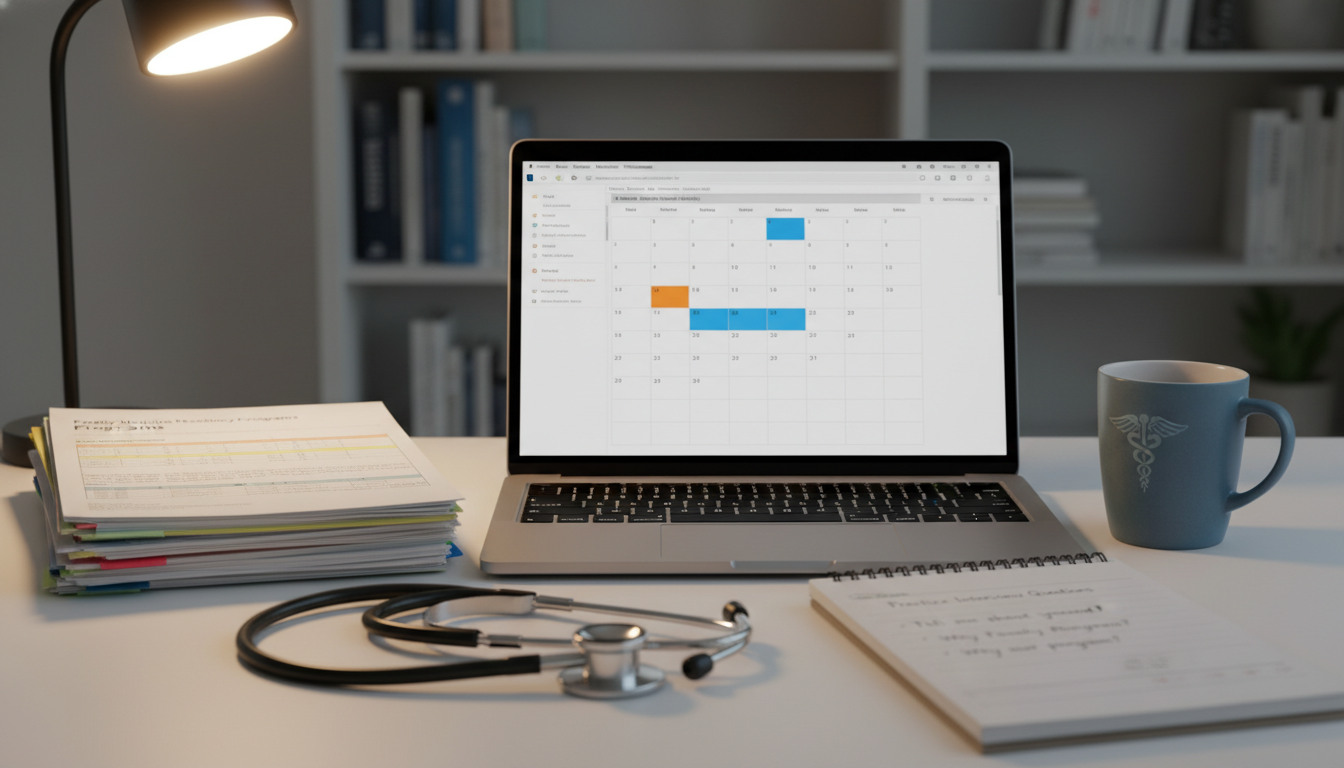
Create a centralized system (spreadsheet/calendar) for:
- Interview dates and times (including time zones)
- Platform (Zoom, Thalamus, Teams, in‑person)
- Program contact information
- Interviewer names (if provided)
- Pre‑interview socials and post‑interview thank‑you emails
- Notes after each interview (impressions, pros/cons, follow‑up items)
US citizen IMGs often juggle time differences if still abroad; double‑check all times in US Eastern time vs. your local time to avoid missed or rushed interviews.
Virtual Interview Setup Checklist
For virtual family medicine residency interviews:
Technology
- Stable high‑speed internet
- Updated Zoom/Teams/Thalamus apps
- Backup device (phone or tablet) ready
- Test microphone and camera ahead of time
Environment
- Quiet, private space
- Neutral, uncluttered background (or appropriate virtual background if necessary)
- Good lighting (ideally natural light from in front of you)
- Camera at eye level (use books or a stand to adjust height)
Professional Appearance
- Business formal attire (suit or professional equivalent)
- Minimal distractions (no busy patterns, loud jewelry)
- Test your outfit on camera to check colors and contrast
Have a printed or digital copy of:
- Your ERAS application
- Personal statement
- Program notes
- List of questions to ask
- A notepad for quick notes (but don’t look down constantly)
In‑Person Interview Preparation
If you have any in‑person family medicine residency interviews:
- Arrive in the city at least the day before
- Plan your transportation to the hospital/clinic
- Bring copies of your CV, personal statement, and any requested documents
- Wear comfortable but professional shoes (you may be touring)
Remember that every interaction counts:
- Pre‑interview dinner or virtual social
- Conversations with coordinators, residents, and even hospital staff
- Your punctuality and courtesy throughout the day
These small behaviors help overcome any initial hesitation about your IMG background by showing you function seamlessly in the US professional setting.
Step 7: Asking Insightful Questions and Closing Strong
Interviewers will almost always ask if you have any questions. This is not a formality; it’s a chance to demonstrate maturity, curiosity, and program fit.
Prepare Tailored Questions for Each Interviewer
Use your research and what you’ve heard during the day. Aim for 2–3 thoughtful questions for:
Program Director / Associate PD
- “How do you see the role of family medicine in this community evolving over the next few years?”
- “What qualities do your most successful residents tend to share?”
- “How does the program support residents who are interested in [OB/addiction medicine/sports medicine/etc.]?”
Faculty
- “How do residents receive feedback on their clinical performance?”
- “Can you describe opportunities for residents to be involved in community outreach or quality improvement projects?”
Residents
- “What do you wish you had known before starting here?”
- “How would you describe the culture among residents and between residents and faculty?”
- “What does a typical clinic week feel like in terms of pace and support?”
Avoid questions that:
- Are easily answered on the website (e.g., “How many residents do you take?”)
- Focus too early on vacation time, moonlighting, or salary
- Suggest you’re uninterested in patient care or learning
Closing the Interview
If given a chance to add anything at the end:
- Briefly summarize your interest in the program (1–2 sentences).
- Reiterate one or two ways you would be a good fit.
- Thank them for their time and insights.
Example:
“Thank you for taking the time to speak with me today. Hearing more about your focus on [e.g., underserved care and behavioral health integration] has reinforced my interest in your program. With my background working with [X population] and my goal to practice in [Y setting], I believe I would thrive and contribute here.”
After the interview:
- Write brief notes while your memory is fresh:
- Program strengths and concerns
- People you connected with
- How the program fits your goals
- Send personalized thank‑you emails within 24–48 hours:
- Mention something specific from your conversation
- Keep it professional and concise
- Reaffirm your appreciation and interest (without making promises about rank order)
FAQ: Pre‑Interview Preparation for US Citizen IMGs in Family Medicine
1. As a US citizen IMG, how can I best address concerns about my training during interviews?
Acknowledge your path directly, without defensiveness. Briefly explain why you chose to study abroad, then focus on what you gained—resilience, adaptability, experience with diverse pathology or resource‑limited settings. Emphasize recent US clinical experience, strong US letters, and concrete examples of how you’ve adapted to US healthcare systems. Prepare one or two polished, honest answers that show insight and readiness rather than apology.
2. What are the most important interview questions residency programs in family medicine will ask me to prepare for?
Prioritize: “Tell me about yourself,” “Why family medicine?”, “Why this program?”, and “Why did you study abroad/what led you to be a US citizen IMG?” Then prepare several behavioral examples (“Tell me about a time…” involving conflict, mistakes, difficult patients, working under pressure). Finally, prepare for FM‑specific topics—continuity of care, preventive medicine, community health, and challenges facing primary care in the US.
3. How can I practice effectively if I don’t have access to formal residency interview preparation services?
Use a structured self‑practice plan: record yourself answering common questions, review with a critical eye, and time your responses. Organize peer mock interviews over Zoom with other applicants, ideally including some familiar with US interviews. Seek even one or two sessions with a faculty mentor, advisor, or resident. Combine this with thorough program research and written bullet points for your main stories and you’ll still be highly prepared.
4. Do family medicine programs care about my long‑term career plans if I’m not 100% sure yet?
Programs don’t expect you to have every detail set, but they do want to see direction and thoughtful reflection. It’s fine to say you’re exploring options (e.g., full‑scope FM, OB, sports medicine, addiction, academic vs. community practice) as long as you show clear commitment to practicing family medicine in some form. Describe a few realistic paths you’re considering and how the program’s training would prepare you, and emphasize your openness to developing your interests further during residency.
With deliberate, structured pre‑interview preparation—especially around your core story, common questions, and program‑specific research—you can turn your status as a US citizen IMG into a clear strength and present yourself as a confident, committed future family physician.