Understanding the Unique Challenges for a Non-US Citizen IMG in Psychiatry
As a non-US citizen IMG (international medical graduate) applying to psychiatry residency, your pre-interview preparation matters as much as your CV. Program directors often say that once applicants reach the interview stage, “we’re no longer screening for credentials; we’re deciding who will fit our team.” For a foreign national medical graduate, this is where you can overcome paper disadvantages and stand out as a strong, well-prepared, and highly motivated future psychiatrist.
Before you focus on specific residency interview preparation techniques, it helps to understand your unique situation:
Key challenges non-US citizen IMGs often face:
- Visa-related concerns (J-1 vs H-1B; institutional sponsorship policies)
- Limited US clinical experience in psychiatry
- Cultural and communication differences (especially around sensitive topics like mental health, gender, sexuality, trauma, and autonomy)
- Stereotypes about IMGs’ communication skills or “fit” for psychiatry
- Less access to insider guidance (e.g., home program advisors, alumni networks)
Your pre-interview preparation should therefore address three parallel goals:
- Show you are clinically and academically prepared for psychiatry training in the U.S.
- Demonstrate excellent communication and interpersonal skills that are essential in a “talking specialty.”
- Reassure programs about practical issues: visa, commitment to psychiatry, long-term plans, and ability to adapt to the US system.
The sections that follow walk you step-by-step through how to prepare for interviews in a way that specifically addresses these points for the psych match.
Step 1: Strategic Research Before Any Psychiatry Interview
Thorough, targeted research is the foundation of strong psychiatry residency interview preparation. For a foreign national medical graduate, this is how you show both seriousness and insight.
1. Analyze Each Program Beyond the Basics
Don’t stop at the website home page. For each program:
Read the full website:
- Program structure (PGY-1 vs PGY-2 rotations, inpatient vs outpatient balance)
- Special tracks: research, psychotherapy, psychoanalysis, community psychiatry, addiction, child and adolescent, consult-liaison, women’s mental health, global mental health
- Call schedule and work hours
- Wellness initiatives, didactics, supervision structure
Review faculty and their interests:
- Note overlapping interests with your background (e.g., addiction, schizophrenia, global mental health, cultural psychiatry).
- Identify 1–2 faculty members whose research or clinical focus aligns with your experiences or future goals.
Explore recent program news and social media:
- Twitter/X, Instagram, or LinkedIn accounts of the department or residents
- Any psychiatry grand rounds or news articles featuring the program
- Virtual open house recordings if available
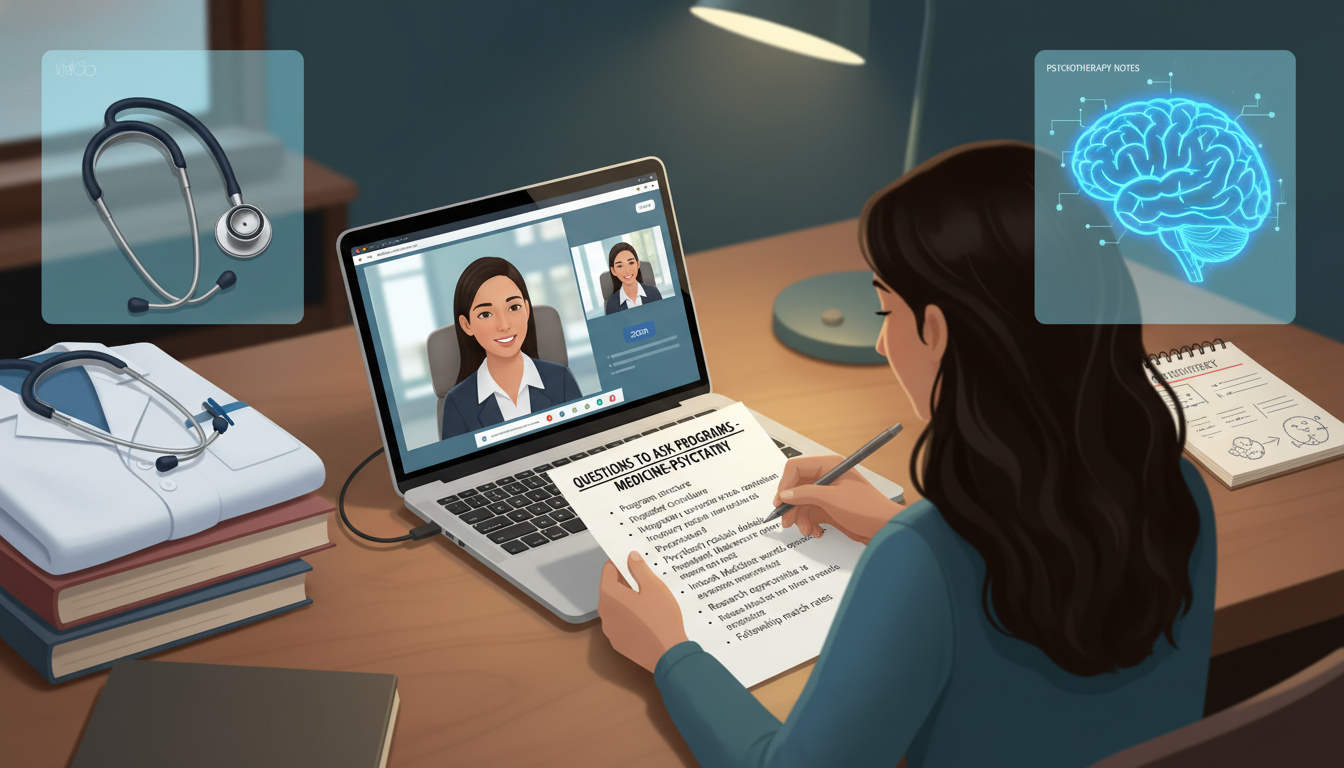
Create a brief one-page Program Snapshot for each place you will interview:
- 3–5 things that genuinely attract you
- 1–2 program strengths that match your profile
- 1–2 good questions you can ask based on your research
This will support tailored answers to “Why our program?” and help you sound specific rather than generic.
2. Clarify Visa Sponsorship and IMG-Friendliness
As a non-US citizen IMG, you must understand each program’s visa policy and IMG history before the interview:
Check if the program:
- Accepts J-1 only, or J-1 and H-1B
- Has sponsored visas for foreign national medical graduates in the last 3–5 years
- Lists current residents who are IMGs on J-1 or H-1B
If unclear from the website:
- Search FREIDA and residency forums
- Ask former applicants (via alumni networks or social media)
- Prepare a respectful, concise way to ask the program coordinator or residency leadership during or after the interview day
Knowing this ahead of time will:
- Help you avoid awkward or anxious questions during the interview.
- Allow you to answer confidently when asked about your visa needs.
Step 2: Build Strong, Psychiatry-Specific Content for Your Answers
Once you’ve done your research, focus on what you are actually going to say. For interview questions residency programs commonly ask, you should not sound memorized—but you must be organized, reflective, and psychiatry-focused.
1. Revisit Your Application and Personal Statement in Detail
Program interviewers often base questions on your own application. Before every interview:
Re-read:
- ERAS application (experiences, publications, work history)
- Personal statement
- CV
- Any additional statements you submitted (e.g., meaningful experiences, gap explanations)
Highlight:
- 3–4 key psychiatry-relevant experiences (clinical, research, volunteering)
- 2–3 formative personal experiences that shaped your interest in mental health
- Any “red flags” (gaps, failures, attempts, career changes) and think about how to explain them briefly and maturely
If you wrote your application months earlier, make sure your verbal narrative matches your written story—inconsistencies reduce credibility.
2. Craft Clear, Authentic Psychiatry “Core Stories”
For psychiatry residency interviews, expect questions like:
- “Why psychiatry?”
- “Tell me about a patient who changed the way you think.”
- “What do you find most challenging about working with psychiatric patients?”
- “Where do you see yourself in 5–10 years in psychiatry?”
Prepare core stories you can adapt across multiple questions. Each story should:
- Be specific and memorable
- Highlight qualities valuable in psychiatry (empathy, patience, curiosity about inner life, nonjudgment, resilience, team collaboration)
- Show your understanding of mental illness and psychosocial factors
- Reflect your growth or insight
Example core story framework (for “Why psychiatry?”):
- Context: Briefly describe your first or most meaningful exposure (e.g., inpatient psych unit during internship in your home country, or a US clinical experience).
- Moment of insight: What surprised or changed your view? (e.g., how quickly patients improved with the right treatment, or how stigma impacted care-seeking).
- Personal connection: What about your personality, values, or background fits psychiatry? (e.g., you enjoy listening deeply, you’re drawn to understanding complex behavior, or you have experience navigating cross-cultural mental health issues).
- Future direction: How this led to specific actions (electives, research, volunteering) and shaped your long-term vision in psychiatry.
3. Prepare for Common Psychiatry Interview Themes
For non-US citizen IMGs, many interview questions residency programs ask will also probe your adaptability and communication. Prepare structured, psychiatry-relevant responses to:
“Tell me about yourself.”
- 60–90 seconds
- Chronological, focusing on major milestones, then narrowing into psychiatry interest and current goals.
- Integrate your identity as a foreign national medical graduate positively (“My training in [country] exposed me to… which made me curious about cross-cultural approaches to mental health”).
“Why this program?”
- Mention 2–3 specific program features.
- Link each to your prior experiences or future goals (e.g., psychotherapy emphasis, community psychiatry, immigrant/refugee populations, strong CL-psychiatry, research in trauma or addiction).
“Tell me about a challenge or conflict you faced and how you handled it.”
- Use psychiatry-relevant examples when possible (e.g., managing a patient refusing treatment, handling stigma in families, interprofessional team disagreement).
- Use the STAR method (Situation, Task, Action, Result) and emphasize communication, respect, and reflection.
“Strengths and weaknesses?”
- Strengths: choose qualities clearly valuable in psychiatry—active listening, patience, being nonjudgmental, cultural sensitivity, ability to build rapport.
- Weaknesses: be honest but growth-focused (e.g., “I initially took detailed notes during patient interviews which slowed me down; I’ve developed a more structured approach to maintain efficiency while staying present with the patient.”)
“Any questions for us?”
- Always have 2–3 thoughtful, program-specific questions ready.
- Avoid questions easily answered on the website.
- Good areas: supervision style, psychotherapy training, resident autonomy, how the program supports IMGs, or mentorship for your specific career interests.
4. Plan for Sensitive and Culture-Related Topics
Psychiatry interviews may include questions about:
- Suicide, self-harm, or high-risk patients
- Substance use disorders
- Sexual orientation and gender identity
- Domestic violence, trauma, or abuse
- Patient autonomy vs. family wishes
- Confidentiality and involuntary hospitalization
As a non-US citizen IMG, your home culture may approach these topics differently. Programs want to see that:
- You can adapt to US ethical and legal standards, even if they differ from your home country.
- You are nonjudgmental and respectful of diversity in gender, sexuality, religion, and lifestyle.
- You can speak about these topics calmly and professionally.
Practice discussing challenging issues in clear, patient-centered language. If you previously worked in settings with different norms, frame your learning curve as growth, not resistance.
Step 3: Mastering Communication Skills and Cultural Fluency
In psychiatry, communication is the “procedure.” For a foreign national medical graduate, strong language and interpersonal skills can transform how you are perceived on interview day.
1. Refine Your Spoken English for a Psychiatry Setting
Even with good test scores, spoken English in a high-stakes conversation can be challenging. To prepare:
Record yourself answering common questions:
- Identify filler words, very long sentences, unclear pronunciation.
- Aim for calm pacing and shorter, well-organized sentences.
Practice live with others:
- Ask a native or near-native English speaker (friend, mentor, or resident) to do mock interviews.
- Specifically request feedback on clarity, pace, and tone.
Focus on “psychiatric communication style”:
- Warm, empathic, and nonjudgmental
- Balanced eye contact
- Reflective listening (e.g., “What I took from that experience was…”)
- Respectful phrases (“From the patient’s perspective…”, “I tried to understand what this meant for them emotionally…”)
2. Adapt to US Professional Norms
Some communication norms vary by culture. US psychiatry interviews expect:
- Moderate but controlled self-disclosure (professional, not overly personal, but willing to share motivations).
- Confidence without arrogance:
- Use “I” when appropriate (e.g., “I led”, “I contributed”) instead of only “we”.
- Clear ownership of mistakes or weaknesses:
- Avoid blaming others; emphasize learning.
If in your home culture it is less common to talk about your own achievements, deliberately practice:
- Describing your contributions.
- Highlighting your strengths.
- Sharing your ideas for future work in psychiatry.
This is not bragging—it is helping programs understand what you bring to their team.
3. Prepare Behavioral and Scenario-Based Answers
Many psychiatry programs use behavioral interview questions to assess how you think and relate:
- “Tell me about a time you had to deliver bad news.”
- “Describe a situation where you helped someone through emotional distress.”
- “How would you handle a patient who refuses medication but is not overtly dangerous?”
For each scenario:
Show empathy first, then structure:
- Acknowledge patient perspective
- Prioritize safety
- Collaborate with the patient when possible
- Involve the team and supervision appropriately
Demonstrate understanding of psychiatry principles:
- Risk assessment
- Boundaries
- Confidentiality
- Nonjudgmental stance
Practicing these aloud—especially with a mentor familiar with US psychiatry—will help your responses sound natural and clinical rather than theoretical.

Step 4: Technical and Logistical Preparation (Especially for Virtual Interviews)
Many psychiatry residency interviews remain partially or fully virtual. For a non-US citizen IMG, this adds complexity: time zones, internet stability, and professional appearance on screen.
1. Optimize Your Technical Setup
Equipment and environment:
- Reliable computer (avoid using just a phone if possible)
- Stable, high-speed internet connection
- Working camera and microphone (test both several days in advance)
- Quiet, well-lit room with a simple, non-distracting background
- Headphones or earbuds to reduce echo
Lighting and framing:
- Light source in front of you, not behind.
- Camera at eye level; your head and upper chest visible.
- Dress fully professionally (even if only your top half will show).
Platform familiarity:
- Test Zoom, Microsoft Teams, or whatever platform the program uses.
- Practice:
- Joining a meeting
- Muting/unmuting
- Checking audio/video settings
- Have a backup device and backup internet source if possible (e.g., tethering from phone).
2. Manage Time Zones and Scheduling
If you are outside the U.S., time conversions can be risky.
Always confirm:
- Interview time in program’s time zone (usually local or Eastern time).
- Conversion to your local time—double-check using at least two reliable websites or phone apps.
Prepare your body clock:
- If the interview will be at an unusual hour for you (e.g., 10 PM–1 AM), adjust your sleep gradually in the days before.
- Do a mock interview at the same time to experience how alert you feel.
3. Organize Documents and Notes
Have easily accessible (but not distracting) reference materials:
Short bullet-point list of:
- Your key talking points
- Program-specific highlights
- Questions for faculty and residents
A printed or digital copy of:
- Your ERAS application or summary
- Personal statement
- CV
Avoid reading verbatim; the notes are only for quick reminders. Make sure you maintain eye contact with the camera instead of constantly looking down.
Step 5: Mental, Emotional, and Professional Readiness
Psychiatry residency interview preparation isn’t just about content and logistics; it’s also about how grounded and authentic you feel during the process.
1. Manage Anxiety and Impostor Feelings
Many non-US citizen IMGs feel like outsiders—especially in a specialty so focused on communication. Before interviews:
- Normalize your anxiety: nearly everyone feels nervous, including US graduates.
- Reframe your identity:
- You bring global perspectives on mental health.
- You have overcome language, cultural, and systemic barriers to be here.
- This resilience is highly valued in psychiatry.
Practical strategies:
- Brief relaxation routines (deep breathing, grounding exercises) before logging into the interview.
- A short “confidence script” you tell yourself:
“I have earned this invitation. I am prepared. I will be curious, honest, and present.”
2. Professional Demeanor and Interview Day Etiquette
In psychiatry, how you present yourself is considered part of your clinical skillset.
Dress code: Business formal (suit or equivalent) in neutral, professional colors.
Body language:
- Sit upright but relaxed.
- Nod and use appropriate facial expressions to show engagement.
- Avoid fidgeting with pens, jewelry, or your hair.
Introductions and closings:
- Greet each interviewer by name if possible.
- At the end, briefly express appreciation and reinforce your interest:
- “Thank you for sharing more about your program. I especially appreciated hearing about [X]. The focus on [Y] really aligns with what I’m looking for in psychiatry residency.”
3. Post-Interview Reflection and Follow-Up
Pre-interview preparation should include your post-interview plan, because experiences from early interviews should help you improve for later ones.
After each interview day:
Take 5–10 minutes to write:
- What went well
- What felt difficult
- Questions you struggled with
- New questions or concerns about the program
Rate the program (for yourself) on:
- Educational quality
- Resident happiness and support
- Fit with your values and career goals
- Openness to IMGs and diversity
Thank-you notes:
- Some programs explicitly discourage them; follow instructions.
- If appropriate:
- Send brief, specific emails to faculty or residents who made a strong impression.
- Include 1–2 concrete details to show sincerity (not a generic template).
- No need to restate rank intentions; focus on appreciation and a short reminder of connection (“Our conversation about community mental health and immigrant populations really resonated with me…”).
Frequently Asked Questions (FAQ)
1. As a non-US citizen IMG, should I bring up my visa status during the interview?
You do not need to lead with your visa status in every conversation, but you should:
- Clearly indicate your visa needs in ERAS and any pre-interview forms.
- Be prepared to answer directly if asked:
“I will require [J-1/H-1B] sponsorship. I understand your institution currently sponsors [X], and I’m happy to provide any additional information you need.”
If visa policies were unclear before the interview, it is acceptable to ask briefly and professionally—usually to the program coordinator or program director, not to every interviewer:
- “Could you please clarify which visas your program is currently able to sponsor for incoming residents?”
2. How can I handle “Tell me about a weakness” as a foreign national medical graduate?
Choose a real but manageable weakness, then describe what you’ve done to improve. For example:
- “Early in my training, I tended to avoid speaking up in large team meetings, especially in English. I realized this could limit my advocacy for patients. I started preparing my points in advance and intentionally contributing at least once in each meeting. Over time, this has become more natural, and I feel more confident participating in interdisciplinary discussions.”
This shows insight, growth, and adaptability—key traits for psychiatry.
3. Will my accent be a disadvantage for psychiatry residency interviews?
An accent alone is not a barrier, as long as you are clearly understandable. Many outstanding psychiatrists in the U.S. are IMGs with accents. To minimize any communication concerns:
- Practice speaking at a slightly slower pace.
- Enunciate, especially when discussing complex ideas.
- Ask mock interviewers to specifically comment on clarity.
- If asked to repeat yourself, respond calmly and repeat without apologizing excessively.
Programs are less concerned about accents and more focused on your ability to connect, listen, and communicate effectively with patients and teams.
4. How psychiatry-specific should my answers be compared to general medicine answers?
For the psych match, it’s important that your responses feel grounded in psychiatry, not just generic medicine. When answering:
- Use examples from psychiatric settings when possible.
- Highlight psychiatric concepts: therapeutic alliance, stigma, biopsychosocial model, boundaries, transference/countertransference (if appropriate), and multidisciplinary collaboration.
- Show genuine interest in understanding patients’ inner experiences, not only their diagnoses.
You are still expected to be a well-rounded physician, but your interview should leave no doubt that psychiatry is your clear, primary commitment.
By investing deliberate effort into this pre-interview preparation—content, communication, cultural fluency, logistics, and emotional readiness—you significantly improve your chances of a successful psychiatry residency interview performance as a non-US citizen IMG. The interview is your opportunity not just to be evaluated, but to demonstrate the depth, resilience, and unique perspective you bring to the future of psychiatry.