Understanding the Transitional Year Landscape as a Non-US Citizen IMG
Transitional Year (TY) programs can be a powerful pathway for a non-US citizen IMG (international medical graduate) to enter the U.S. residency system. Before you even start formal residency interview preparation, you need to understand exactly what you’re applying for and how program directors see your application.
What is a Transitional Year Residency?
A Transitional Year residency is a one-year, broad-based clinical training program that:
- Usually serves as a preliminary year before:
- Neurology
- Anesthesiology
- Radiology/IR
- PM&R
- Dermatology
- Ophthalmology
- Radiation Oncology
- Offers a mix of:
- Inpatient internal medicine
- General surgery or surgical subspecialties
- Emergency medicine
- Electives (often quite flexible)
Program directors expect TY residents to be:
- Clinically safe and dependable interns
- Fast learners who adapt quickly
- Professional, reliable, and easy to work with
- Able to handle varied rotations and changing teams
This context should shape how you prepare for interviews and how you present yourself.
Unique Considerations for Foreign National Medical Graduates
As a foreign national medical graduate, you face additional layers of evaluation beyond clinical competence:
- Visa sponsorship (J-1 vs H-1B)
- Clinical readiness in the U.S. system
- Communication skills and cultural adaptation
- Logistical reliability (are you likely to get your visa on time, show up, transition smoothly?)
In pre-interview preparation, you must be ready to clearly, calmly, and confidently address:
- Your visa status and needs
- Your reason for choosing the U.S. system
- How you’ve adapted to U.S. clinical culture (if you’ve had USCE)
- Your long-term specialty plans and how TY fits into that
Being proactive about these topics can set you apart from other non-US citizen IMGs and reassure programs about common concerns.
Strategic Preparation Before You Receive Invitations
Most applicants start serious residency interview preparation only after invitations arrive. As a non-US citizen IMG applying to a Transitional Year program, you gain a major advantage by starting much earlier.
1. Clarify Your Story and Career Direction
Program directors will want to quickly understand:
- Who you are
- Why you’re in the U.S. system
- Why you’re doing a Transitional Year
- What you’ll do after TY
Before interview season:
Write a one-page “career narrative” for yourself that answers:
- Why did you choose medicine?
- Why do you want to train in the U.S. specifically?
- What specialty are you ultimately pursuing?
- Why does a Transitional Year make sense for you?
- What have you done to prepare for that specialty and for U.S. training?
Condense it into a 60–90 second summary (this will become your “Tell me about yourself” answer).
Check alignment:
- Does your narrative match:
- Personal statement?
- ERAS application?
- LORs?
- Are there contradictions (e.g., PS strongly about IM but you’re applying TY + Radiology)?
- Does your narrative match:
Consistency across documents makes you appear focused and reliable.
2. Strengthen Your Understanding of the U.S. Clinical System
Even before interview invitations, show you’re serious and informed:
- Learn the basics of:
- Inpatient team structure (attending, senior resident, interns, students, APPs, nursing)
- Typical intern responsibilities
- EHR systems, order entry, note-writing expectations
- Duty hours, call schedules, sign-outs, night float
- Use free/low-cost resources:
- AHRQ TeamSTEPPS resources on communication
- Online IM and EM case discussions (e.g., online M&M-style cases)
- Hospital YouTube channels explaining rounds, handoffs, etc.
Programs worry whether a foreign national medical graduate can adapt quickly. Demonstrating familiarity with the environment—through your answers, examples, and wording—helps reduce that concern.
3. Create a Targeted TY Program List and Research Template
Before interview season, build a structured way to research programs so you don’t scramble later.
Create a spreadsheet that includes:
- Program name and NRMP code
- Location and hospital type (community vs university vs hybrid)
- Visa sponsorship type (J-1 only, J-1 + H-1B, no visa)
- Required vs flexible rotations
- Elective time available
- Affiliated advanced specialties (e.g., Radiology, Anesthesia, Derm)
- Program size and call structure
- IMG-friendliness:
- % current residents who are IMGs
- History of sponsoring non-US citizen IMG
- Contact details and notes
Use program websites, FREIDA, and resident bios to fill this in. Later, this database will help you:
- Prioritize which interviews to attend (if you get multiple on the same date)
- Ask smart, tailored questions during interviews
- Answer “Why our program?” more convincingly

Mastering Core Residency Interview Preparation
Once interview invitations start appearing, you must quickly move into focused, high-yield residency interview preparation. Transitional Year interviews often feel more “generalist” than categorical specialty interviews, but that doesn’t mean they’re easier.
1. Build Strong Core Answers to Common Residency Questions
You should develop, practice, and refine answers to the most common interview questions residency programs ask—especially those that matter for TY and for IMGs.
Essential General Questions
- “Tell me about yourself.”
- “Why medicine?”
- “Why the U.S. for residency?”
- “Why Transitional Year?”
- “What are your long-term career goals?”
- “What are your strengths and weaknesses?”
- “Tell me about a challenge or failure and what you learned from it.”
- “Describe a conflict with a team member and how you handled it.”
- “Tell me about a time you made a mistake in patient care.”
For each, prepare:
- A clear structure:
- Situation – what was happening?
- Task – what was your role?
- Action – what did you do?
- Result – what happened and what did you learn?
- A U.S.-relevant perspective: Show you understand safety culture, communication, and teamwork.
- A TY-relevant connection: Emphasize adaptability, broad clinical interests, and willingness to rotate widely.
Transitional Year–Specific Angles
Programs may ask:
- “You’re planning for [Radiology/Anesthesiology/etc.]. Why not do a preliminary medicine/surgery year instead of TY?”
- “How do you see this TY program helping you succeed in your advanced specialty?”
- “Are you open to primary care or hospitalist work if your plans change?”
- “How will you handle a year that includes rotations not directly related to your specialty?”
Prepare answers that:
- Show appreciation for broad-based training
- Emphasize building strong clinical fundamentals
- Highlight your respect for all specialties you’ll rotate through
- Avoid giving the impression that TY is just a formality or “gap year”
2. Address the IMG and Visa Context Proactively
As a non-US citizen IMG, you must be ready for:
- Direct questions:
- “What is your visa status?”
- “Do you need visa sponsorship?”
- Indirect concerns:
- Will you get your visa on time?
- Are you comfortable with cultural differences?
- Will communication be an issue?
Prepare:
- A clear, concise visa explanation, for example:
- “I am currently in [country]. I will require J-1 visa sponsorship. I have already reviewed the ECFMG process and understand the documentation and timelines involved.”
- Evidence of planning:
- Mention that you’ve:
- Reviewed typical DS-2019 processing timelines
- Followed ECFMG guidelines
- Prepared key documents (passport validity, degree verification, etc.)
- Mention that you’ve:
- Examples of adaptation:
- Clinical electives, observerships, or research in the U.S.
- Experiences working in multicultural teams
- Specific moments where you adapted to a new system or culture
You want to sound informed, realistic, and calm—not anxious or uncertain.
3. Practice with Realistic Mock Interviews
Mock interviews are the single most powerful tool in residency interview preparation.
Who to practice with:
- U.S.-based physicians you know (ideally in academic settings)
- Residents from your target specialties or TY programs
- Alumni from your medical school now in the U.S.
- Professional coaching services (if affordable and reputable)
How to structure practice sessions:
- 30–40 minutes of questions
- 10–15 minutes of feedback
- Repeat with different interviewers if possible
Ask for feedback on:
- Clarity and organization of your answers
- Accent and speed (too fast? too soft?)
- Use of specific examples vs. general statements
- Non-verbal communication:
- Eye contact (for video: looking at camera occasionally, not only at your own image)
- Posture
- Facial expressions (engaged, professional, not flat or overly anxious)
Consider recording practice sessions (with permission) and reviewing them yourself. Many IMGs improve dramatically after seeing themselves on video once or twice.
Optimizing for Virtual Interviews: Technical and Cultural Readiness
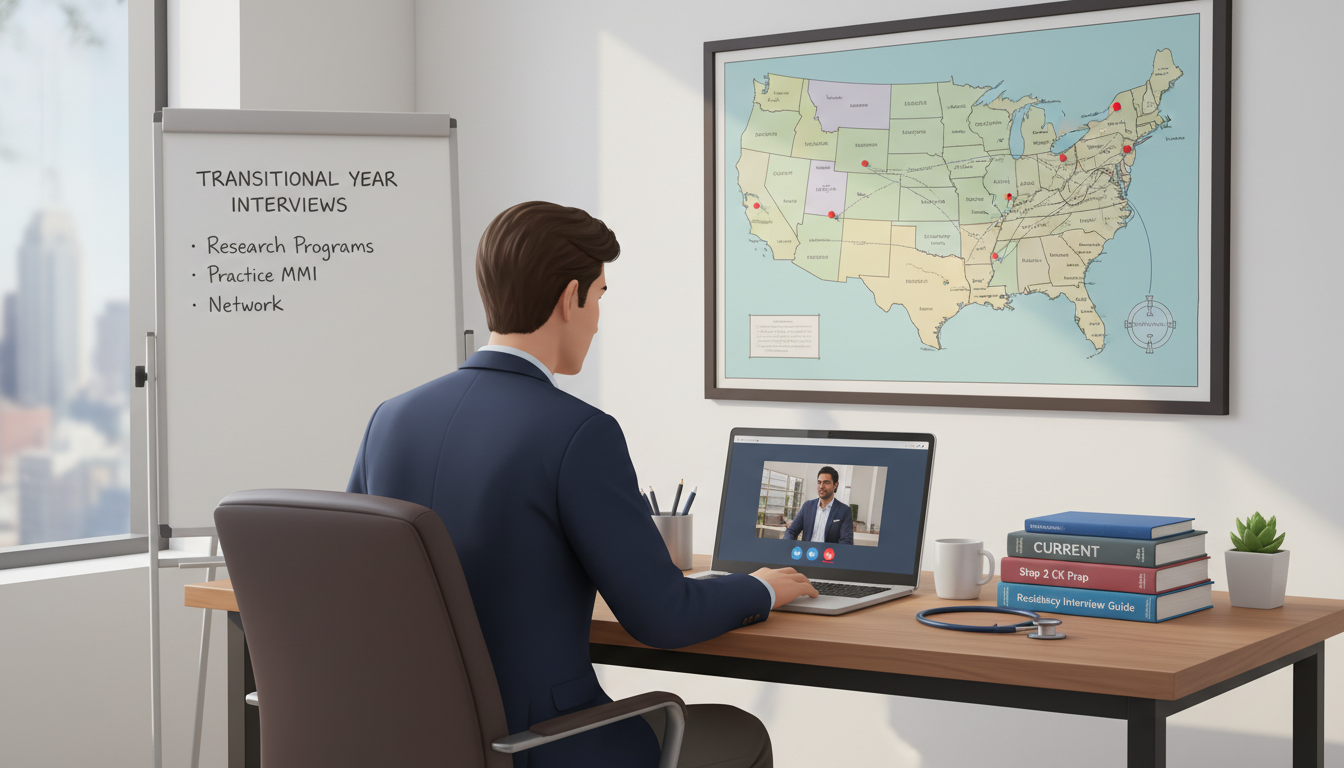
Most TY interviews are now virtual, which creates new challenges but also unique advantages for IMGs living abroad.
1. Technical Setup and Backup Planning
As a non-US citizen IMG, you may be in a country with variable internet quality or power stability. Programs will not always understand these challenges, but they will notice disruptions.
Minimum technical checklist:
- Stable high-speed internet (test via speedtest.net; aim for ≥10 Mbps upload)
- Laptop over phone, if possible
- External or decent built-in webcam
- Headset or earbuds with microphone
- Quiet, private space
Backup plans:
- Identify a second location (friend’s house, co-working space, hotel business center) with stable power and internet.
- Have a secondary device ready (phone or tablet with Zoom/Teams app installed).
- Prepare a brief email template to the program in case of power or internet failure:
- Apologize
- Explain briefly
- Offer alternate contact (phone/WhatsApp) and ask to reschedule if needed
Programs understand occasional technology issues if you handle them calmly, professionally, and with advance preparation.
2. Professional Environment and Presentation
Your interview background and appearance should quietly signal that you are serious and professional.
Visual environment tips:
- Plain or simple background (neutral wall, bookshelf, tidy workspace)
- Good front-facing light (natural light from a window, or ring light)
- No visible bed, messy shelves, or distracting posters
- Camera at eye level (use books or stands if needed)
Personal presentation:
- Professional attire:
- For most: suit jacket or blazer, collared shirt/blouse
- Conservative colors (navy, black, grey)
- Minimal accessories
- Grooming:
- Hair neat and away from face
- Facial hair trimmed, if applicable
This is especially important for a foreign national medical graduate, as programs sometimes unconsciously scrutinize professionalism more closely for IMGs.
3. Cultural and Communication Nuances
Knowing how to prepare for interviews also means learning the “unspoken rules” of American professional culture.
Politeness and formality:
- Use titles unless invited otherwise:
- “Dr. Smith” rather than “John”
- “Thank you for taking the time to speak with me today.”
- Avoid speaking over interviewers; brief pauses are acceptable.
- Clarify if you don’t understand a question:
- “Could you please repeat or rephrase the question?”
Length and structure of answers:
- Aim for 60–90 seconds for most answers.
- Use clear signposting:
- “There are two main reasons…”
- “First…, Second…”
- Avoid very long stories with too much background.
Non-verbal cues (even virtually):
- Nod occasionally while listening
- Look into the camera periodically
- Smile naturally when appropriate
Practicing with U.S.-based interviewers will help you calibrate tone and style.

Presenting Yourself as a High-Value TY Candidate
Transitional Year programs want residents who will strengthen their team, not just “occupy a spot” for a year. Your pre-interview preparation should focus on how to clearly show your value.
1. Emphasize Reliability and Work Ethic
TY interns often:
- Cover multiple services across the hospital
- Rotate night shifts and weekends
- Float between teams
Programs need to believe you will show up, work hard, and be dependable.
In your examples, emphasize:
- Times you took extra responsibility:
- Staying late for patient care
- Taking on additional tasks for the team
- Evidence of resilience:
- Managing high patient loads
- Working in resource-limited settings
- Specific behaviors that show reliability:
- Always finishing notes
- Following up on results
- Clear handoffs and communication
Link these experiences to how you would function as a TY intern.
2. Highlight Adaptability and Breadth
As a foreign national medical graduate, you may already have experience adapting to different health systems or working conditions—this can be a strength.
Use examples showing:
- Rapid adjustment to new hospitals, teams, or roles
- Learning new protocols or EMR systems quickly
- Comfort working with surgeons, internists, emergency physicians, etc.
Explain how this prepares you for a TY program, where:
- Rotations change frequently
- Each team may have different expectations and styles
- You must remain flexible and positive
3. Connect TY Training to Your Long-Term Specialty
Whether your advanced specialty is already secured or you’re still applying, programs want to see a clear plan.
Describe:
- The skills you want to gain in the TY year that will help in your future field:
- For Radiology: strong exam skills, pattern recognition in imaging, understanding indications/contraindications
- For Anesthesiology: pre-op assessment, hemodynamics, managing acute medical conditions
- For PM&R: neuro exam, musculoskeletal evaluation, multidisciplinary care
- For Derm/Ophtho: internal medicine foundation, ED triage, inpatient consult management
- How you will use elective time:
- ICU, EM, sub-specialty rotations relevant to your field
- Research or quality improvement related to your future specialty
Programs prefer applicants who have a thoughtful plan rather than vague ambitions.
4. Prepare Insightful, Program-Specific Questions
When they ask, “Do you have any questions for us?” it’s another part of your residency interview preparation test.
Develop a list of program-specific, non-generic questions, such as:
- About structure:
- “How are the rotations balanced between inpatient medicine, surgery, ER, and electives?”
- About support:
- “How do you support TY residents who are also preparing for board exams or advanced specialty milestones?”
- About culture:
- “Can you describe the learning environment and feedback culture for interns?”
- About IMGs/visa:
- “I’m a non-US citizen IMG. How has your program supported previous foreign national medical graduates through visa and relocation processes?”
Avoid questions easily answered on the website. Tailor a few questions to each program’s unique features (affiliations, elective options, size, etc.).
Final Pre-Interview Checklist for Non-US Citizen IMGs Applying to TY
In the days to weeks before each interview:
Documents and logistics:
- Confirm interview date, time zone (convert carefully from U.S. time to your local time)
- Test your video platform (Zoom/Teams) with a friend
- Print or have accessible:
- Your ERAS application
- Your personal statement
- A one-page summary of your CV
- Program notes (key facts, questions)
- Prepare a notepad and pen for the interview
Content and practice:
- Review your core answers to:
- “Tell me about yourself.”
- “Why medicine/U.S./TY?”
- “Strengths and weaknesses.”
- “Conflict, challenge, mistake” stories.
- Refresh details of your research and major experiences
- Practice 1–2 short mock interviews the week of the real interview
Mindset:
- Sleep adequately the night before (as much as your time zone and anxiety allow)
- Plan to log in 10–15 minutes early
- Remind yourself:
- They already liked your application enough to invite you
- The goal is mutual fit, not perfection
- Being calm, kind, and teachable matters as much as having perfect answers
FAQs: Pre-Interview Preparation for Non-US Citizen IMGs in Transitional Year
1. As a non-US citizen IMG, how much should I talk about my visa during interviews?
Address visa needs clearly and briefly if asked, or if the program’s website mentions limitations. You do not need to lead with it, but you must be honest and prepared.
Example approach:
- “I will require J-1 visa sponsorship. I’ve already reviewed the ECFMG sponsorship process and timelines and I’m prepared to complete all necessary steps promptly.”
Avoid long, anxious explanations. Show that you’ve done your homework and can manage the process responsibly.
2. How is interview preparation different for Transitional Year compared to categorical specialties?
Core residency interview preparation is similar, but for a TY program you must:
- Emphasize breadth and adaptability over deep specialty focus
- Clearly explain why TY is the right structure for your career
- Show genuine interest in all rotations, not just those related to your ultimate specialty
- Clarify how you’ll use the year strategically (electives, ICU, ED, etc.)
Programs want to know you will be fully engaged in the entire year, not just passing through.
3. What if I don’t have much U.S. clinical experience before interviews?
Many non-US citizen IMGs succeed without extensive USCE if they prepare thoughtfully.
To compensate:
- Emphasize:
- Strong clinical training in your home country
- Exposure to diverse pathology and resource-limited care
- Any shadowing, observership, or telemedicine experiences with U.S. teams
- Learn and use U.S. clinical language:
- “Sign-out,” “rounds,” “cross-cover,” “night float,” “attending,” etc.
- Show you’ve studied U.S. systems (through readings, webinars, guidelines)
- Highlight adaptability to new systems (e.g., working in different hospitals)
Programs mainly worry about adaptation and safety; address those concerns directly.
4. How can I answer “Why this TY program?” if I’m not yet sure where my advanced spot will be?
Focus your answer on what you know and can genuinely commit to:
- The program’s strengths:
- Balanced rotations
- Strong teaching culture
- ICU/ED exposure
- Elective flexibility
- Your goals for the year:
- Building solid inpatient medicine/surgery skills
- Gaining experience with acutely ill patients
- Improving communication and teamwork in the U.S. system
- How the program aligns with likely pathways:
- “Whether I ultimately go into Radiology or Anesthesia, this TY program’s strong ICU and ED rotations will help me build the acute care foundation I need.”
You don’t need every detail of your future mapped out; you do need a clear, thoughtful rationale linking this specific TY program to your training goals.
By preparing early, practicing deliberately, and addressing the unique concerns programs may have about a foreign national medical graduate, you can turn interviews from a source of anxiety into an opportunity to clearly show that you are ready, reliable, and an excellent fit for a Transitional Year residency.