Understanding the IR Interview Landscape as a Non-US Citizen IMG
Interventional Radiology (IR) is one of the most competitive specialties in the US, and this is even more true for a non-US citizen IMG or foreign national medical graduate. Before you prepare answers and rehearse your pitch, you need to understand the context in which program directors will evaluate you.
Why IR Is Uniquely Competitive
Interventional Radiology residency (Integrated IR/DR) combines cutting-edge imaging, hands‑on procedures, and longitudinal patient care. Programs are small, often with 1–3 residents per year, and many are deeply integrated into high-profile academic centers. This creates:
- High applicant-to-position ratios
- Preference for strong US clinical experience and letters
- Close attention to visa requirements and long-term viability
Many programs receive hundreds of applications but only interview a small fraction. For a non-US citizen IMG, you must assume that every interaction—your emails, ERAS application, and especially your interview—is heavily scrutinized.
How Programs View Non-US Citizen IMGs
Programs consider three broad areas when evaluating a non-US citizen IMG:
Clinical readiness and adaptability
- Experience in US health systems (electives, observerships, research fellowships)
- Comfort with electronic health records, multidisciplinary care, and US clinical culture
Evidence of IR commitment
- IR-focused research, case reports, or QI projects
- Shadowing, away rotations, IR interest group involvement
- Clear understanding of IR as a specialty (workflow, lifestyle, scope, and future directions)
Visa and long-term plans
- Whether you need a J-1 or H-1B visa, and your understanding of the implications
- Likelihood of staying in the US for fellowship and practice
- Perceived logistical “friction” (sponsorship cost, timing, restrictions)
Recognizing these lenses helps you tailor your pre-interview preparation to specifically address potential concerns.
Step 1: Strategic Background Preparation (4–6 Weeks Before Interviews)
This is the deep work you do before any individual interview invitations: strengthening your IR narrative, understanding the IR match landscape, and organizing your application story.
Clarify Your IR Career Narrative
Before you practice any interview questions for residency, you must articulate why IR—specifically IR in the US—fits you as a non-US citizen IMG.
Ask yourself:
- Why IR over diagnostic radiology, surgery, or cardiology?
Be specific. Mention:- Love for image-guided procedures and minimally invasive techniques
- Enjoyment of solving complex problems in real-time
- Satisfaction from longitudinal care (e.g., oncologic IR, PAD, portal hypertension)
- What are the 2–3 key moments that led you to IR?
- A powerful patient interaction during an IR procedure
- A research project that introduced you to IR workflows
- A mentor who modeled the IR lifestyle and practice
Turn these into a brief “IR journey” story:
“My interest in IR grew from a third‑year rotation where I followed a patient with HCC from initial diagnosis to TACE and follow‑up. Watching the IR team manage both the technical and longitudinal aspects of his care showed me the unique blend of procedural expertise and patient relationships that I hadn’t seen in other fields…”
Refine this narrative now; you’ll use it in “Tell me about yourself,” “Why IR?” and “Why not just DR?” questions.
Analyze Your IR-Relevant Experiences
Make a written inventory of your IR-relevant profile so you can reference it naturally:
Clinical experiences:
- US-based IR electives or sub-internships
- IR exposure in your home country (angiography suites, oncology, vascular, trauma)
- Rotations that demonstrate procedural affinity (surgery, cardiology, anesthesia, ICU)
Research and scholarly work:
- IR projects (embolization, ablation, vascular interventions, neurointerventions)
- Radiology or imaging-related work transferable to IR
- Quality improvement projects (radiation safety, PACS workflow, consent processes)
Leadership and collaboration:
- IR interest group leadership
- Multidisciplinary tumor board participation
- Teaching experiences showing communication skills
For each experience, identify:
- What you did (concrete actions)
- What you learned (skills, habits, professional values)
- How it applies to IR training
You’ll reuse these details to answer behavioral questions and demonstrate maturity and readiness for an interventional radiology residency.
Understand the IR Match and Program Types
Structured knowledge of the IR match (IR/DR integrated pathway) helps you speak intelligently during interviews and ask stronger questions.
Know these basics:
IR/DR Integrated Residency
- 6-year program post-medical school
- Combines DR and IR training with progressive responsibility
- Leads to dual certification in DR and IR
Independent IR Residency
- 1–2 years after DR
- You may interact with these residents and faculty; understanding this pathway shows sophistication.
ESIR (Early Specialization in Interventional Radiology)
- A DR track with accelerated IR exposure
- Shows you understand alternate routes and have thought beyond just “getting in”
Also research:
- Recent IR match trends (NRMP data): IMG match rates, fill rates, competitiveness
- General IR scope: oncology, vascular, trauma, hepatobiliary, women’s health, venous interventions, etc.
Being comfortable with these concepts helps you sound informed and seriously invested in IR, not just in “a competitive specialty.”
Step 2: Deep Dive Into Each Program (2–3 Weeks Before Specific Interviews)
Once you have invitations, your residency interview preparation needs to shift from general to program-specific. A non-US citizen IMG must show that each program is not just “one of many” but a thoughtful choice.

Build a Program Research Sheet
Create a 1–2 page document for each program (Word, Google Doc, or Notion). Include:
Core Features
- Size of the program (IR and DR residents per year)
- Type: academic vs community, quaternary referral vs regional center
- Main IR clinical strengths (oncologic IR, PAD, trauma, transplant, complex venous)
- Notable IR faculty (program director, chair, major researchers)
Training Environment
- Case volume and variety (high trauma? high cancer center referral?)
- Presence of specialized clinics (PAD clinic, venous clinic, women’s health IR)
- Longitudinal clinic expectations for IR residents
- Call structure and DR vs IR exposure distribution across years
Scholarly and Career Opportunities
- Ongoing IR research areas: embolization, TIPS, Y-90, thrombectomy, new devices
- Access to IR-focused conferences, tumor boards, multidisciplinary clinics
- Graduate outcomes: academic practice vs private practice; fellowships; visas
IMG and Visa Friendliness
- History of taking IMGs (check resident bios)
- Visa types sponsored (often in FAQ, GME pages, or via email)
- International-looking faculty or alumni paths similar to yours
Keep each sheet updated and open while you interview. This preparation allows you to tailor your answers and ask specific, informed questions.
Turn Research Into Talking Points
Use your research to prepare 3–4 “fit statements” per program:
- “I’m particularly excited that your program has a strong oncologic IR presence and a dedicated HCC clinic, because my prior research was in locoregional therapies for liver tumors.”
- “Your high trauma volume and collaboration with surgery and critical care align with my interest in acute interventions and multidisciplinary care.”
You can then plug these into:
- “Why our program?”
- “What are you looking for in an IR residency?”
- “Where do you see yourself in 5–10 years?”
Prepare Meaningful Questions for Each Interviewer
Program directors and faculty expect thoughtful questions that go beyond what’s on the website. Aim for 3–5 strong questions per program, and adapt them depending on who you’re speaking to:
For Program Directors:
- “How has the integration of IR/DR training changed the role of IR residents in your department over the last 3–5 years?”
- “What features distinguish graduates from your program in terms of readiness for independent IR practice?”
For Faculty:
- “How do residents get involved in your research area, particularly [device trials, embolization techniques, venous interventions]?”
- “What do you see as the biggest challenge for IR trainees in the next few years, and how is your program addressing that?”
For Current Residents:
- “Can you walk me through a typical IR rotation week—both in the procedure room and clinics?”
- “How supportive is the program of residents pursuing academic vs private practice careers, especially those on visas?”
Having these prepared beforehand reduces stress and demonstrates genuine engagement.
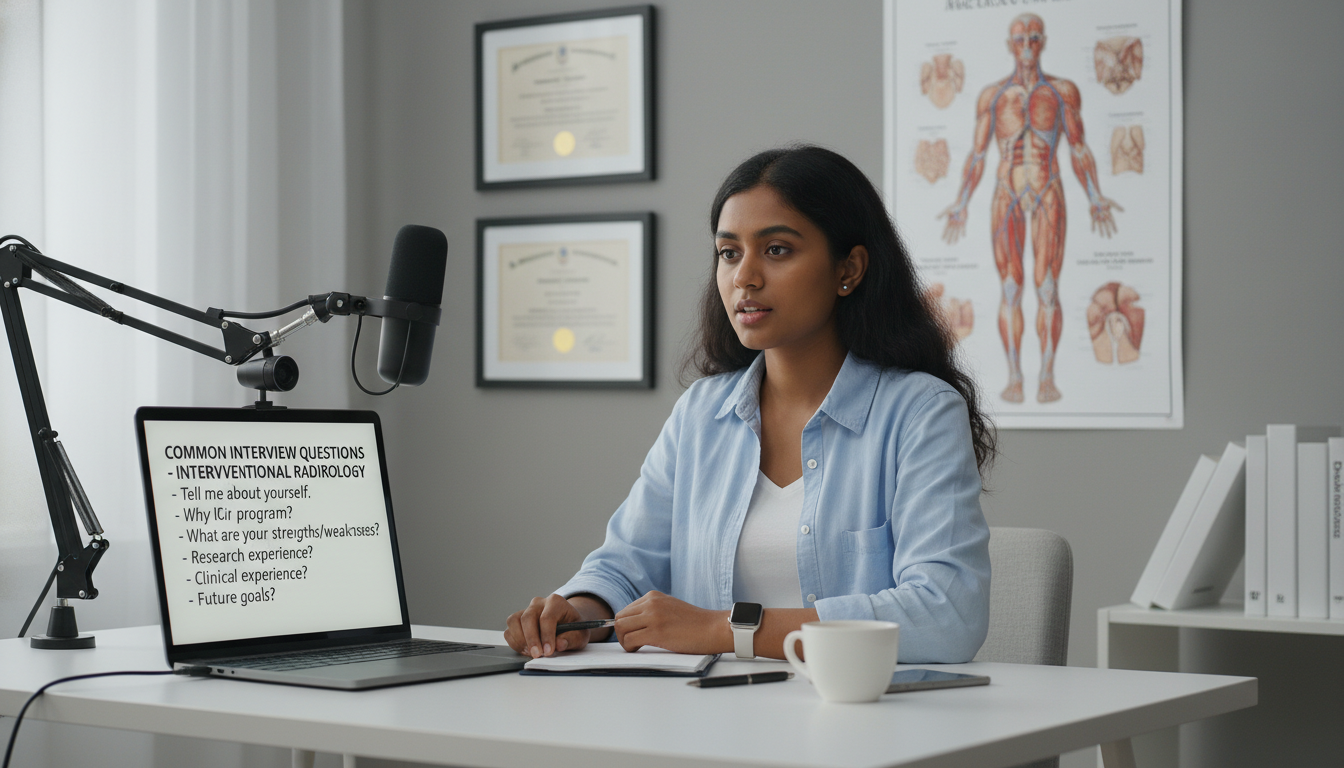
Step 3: Mastering Common Residency Interview Questions (With an IR Lens)
A major part of how to prepare for interviews is to anticipate and practice high-yield interview questions residency programs consistently ask. As a non-US citizen IMG, you must also address additional dimensions: cultural adaptation, communication, and visa-related transparency.
High-Yield General Questions (With Sample Angles)
“Tell me about yourself.”
- Structure: Present → Past → Future
- Present: Who you are now (final-year student/graduate with IR interest)
- Past: 2–3 experiences that shaped you (clinical, research, personal background)
- Future: IR/DR path and long-term goals in US practice
Example structure:
“I’m a non-US citizen IMG from [country] with a strong interest in interventional oncology and minimally invasive vascular care. During my clinical years, I found myself most engaged when I could combine imaging with direct patient impact, which led me to seek out IR electives and research. Over the last two years, I’ve worked on [IR project], and completed [US experience]. Long term, I see myself practicing in an academic IR setting where I can lead clinical services and mentor future trainees, ideally within a program like yours that has strong [X] focus.”
“Why Interventional Radiology?”
Anchor your answer in:- Patient impact and minimally invasive innovation
- Integration of imaging, procedural skill, and clinical follow-up
- Concrete experiences: cases, mentors, research
Brief but specific:
- Name 1–2 procedures that fascinated you (TACE, TIPS, thrombectomy, uterine fibroid embolization)
- Tie your personality traits to IR: enjoy precision, calm under pressure, team-based environment, longitudinal relationships
“Why not just Diagnostic Radiology?”
- Emphasize love for procedures + patient contact
- Respect DR but clarify your identity as a proceduralist-clinician
- Show understanding that IR includes clinic, consults, and inpatient management
Example angle:
“I appreciate the diagnostic side and know that strong image interpretation is foundational to IR, but I’m most energized when I can translate that imaging knowledge into an immediate procedural plan and then follow that patient through their course.”
“Why did you choose this program?”
- Use your program research sheet
- Mention:
- Specific clinical strengths (oncology, vascular, transplant)
- Educational culture (resident autonomy, structured curriculum)
- IR research areas aligned with your interests
- Ideally, reference something recent: a publication, conference talk, or innovation.
“What are your strengths and weaknesses?”
For strengths, choose those aligned with IR:- Calm and methodical under pressure
- Strong teamwork and communication across disciplines
- Persistence in complex problem-solving (device navigation, access challenges)
- Data-driven mindset from research background
For weaknesses:
- Use a genuine, manageable area (e.g., delegating tasks, speaking up early in large groups)
- Show active improvement (courses, mentorship, deliberate practice)
- Avoid critical red flags (unreliability, lack of empathy)
IMG- and Visa-Specific Questions
As a foreign national medical graduate, expect questions like:
“Tell me about your transition to the US healthcare system.”
- Discuss:
- US electives/observerships or research experiences
- Differences you observed (documentation, patient autonomy, interprofessional collaboration)
- Steps you took to adapt: reading guidelines, communicating with nurses, learning EMR
- Discuss:
“How do you handle language or cultural differences with patients?”
- Acknowledge diversity of US patients
- Emphasize:
- Clear communication strategies (teach-back method, avoiding jargon)
- Sensitivity to cultural beliefs about procedures and pain
- Willingness to ask clarifying questions rather than assume
“What are your visa needs and long-term plans?”
- Be honest and concise:
- “I will require J-1 sponsorship.” or “I am eligible for H-1B and would prefer that if possible.”
- Clarify that you have researched pathways:
- Mention awareness of waiver requirements, long-term academic vs community practice aspirations
- Convey stability:
- “I intend to pursue a long-term career in IR in the US, ideally in an academic or high-volume center where I can continue clinical practice and research.”
- Be honest and concise:
Behavioral and Scenario-Based Questions
IR is a high-stakes, team-based specialty. Be ready for:
“Describe a time you made a mistake in a clinical setting.”
- Use the STAR method (Situation, Task, Action, Result)
- Show:
- Recognition of error
- Taking responsibility
- Learning and system improvement (e.g., checklist use, earlier escalation)
“Tell me about a conflict you had in a team and how it was resolved.”
- Focus on:
- Active listening
- Seeking common ground
- Protecting patient safety and professionalism
- Focus on:
“You’re in the middle of a complex procedure and a complication occurs. How do you respond?”
- Even if you haven’t independently run procedures, highlight:
- Staying calm
- Informing the team and supervisor immediately
- Prioritizing patient safety and clear communication
- Even if you haven’t independently run procedures, highlight:
Preparing 6–8 strong stories in advance (teamwork, leadership, failure, conflict, ethical dilemma, communication challenge, time management, adaptation) gives you flexible material to answer most behavioral questions.
Step 4: Practical Logistics and Communication Skills
Content preparation is only half of residency interview preparation. As a non-US citizen IMG, you must also handle time zones, technology, and communication nuances.
Technical Preparation for Virtual Interviews
Most IR interviews remain virtual or hybrid. Do the following at least 1 week before your first interview:
Test your setup:
- Reliable laptop or desktop (avoid phone)
- Stable internet connection (consider wired or backup hotspot)
- Functional webcam and microphone
- Backup device ready (tablet or second laptop)
Environment:
- Neutral, uncluttered background; good lighting in front of you
- Quiet space, no interruptions (inform family/roommates)
- Professional attire (suit or equivalent, conservative colors)
Platform Familiarity:
- Test Zoom, Microsoft Teams, or Webex in advance
- Check time zones carefully and convert accurately
- Have meeting links and schedules organized (folder or calendar invites)
Communication Clarity and Accent Concerns
Many non-US citizen IMGs worry about their accent or speed of speech. Programs care more about clarity than accent.
Practice:
- Slowing down slightly and pausing between key ideas
- Short, structured answers using:
- “Firstly… secondly… finally…”
- STAR (Situation, Task, Action, Result) for stories
- Recording yourself answering 10–15 common questions, then:
- Listen for unclear phrases
- Adjust pronunciation for commonly misunderstood words
- Focus on trimming filler (“um,” “like,” “you know”)
Consider 1–2 mock interviews with:
- A mentor or attending physician
- A senior resident or fellow in IR/DR
- Professional services if available through your school
Ask specifically for feedback on:
- Clarity
- Conciseness
- Professionalism and confidence
Organizing Documents and Notes
Have the following ready:
- PDF versions of your:
- ERAS application
- Personal statement
- CV
- List of publications and abstracts
- A 1-page “snapshot” of:
- Main experiences
- 6–8 prepared stories
- 3–5 key points you want every program to remember about you
Do not read from your notes, but keep them nearby for quick mental refresh during breaks.
Step 5: The Day-Before and Morning-Of Checklist
Final pre-interview preparation is about execution and mindset.
Day-Before Checklist
- Review:
- Program research sheet
- Interview schedule and interviewer names/titles
- Your prepared questions for the program
- Lightly rehearse:
- “Tell me about yourself”
- “Why IR?”
- “Why our program?”
- Prepare:
- Outfit (wrinkle-free, professional)
- Charging cables, headphones, backup internet plan
- Health:
- Aim for adequate sleep
- Avoid last-minute heavy cramming; focus on calm, not perfection
Morning-Of Routine
- Log in 15–20 minutes early to test audio/video
- Keep water and a notepad nearby
- Turn off notifications on your devices
- Quickly scan:
- Names and roles of interviewers
- 2–3 unique program strengths to mention
- Mentally rehearse 2–3 key messages you want to convey, such as:
- “I am deeply committed to IR as a long-term career.”
- “I bring a strong work ethic, adaptability, and collaborative mindset from my international training.”
- “I am eager to train in a high-volume, academically oriented IR environment where I can contribute clinically and academically.”
Finish with 1–2 minutes of slow breathing or a short mindfulness exercise to reduce anxiety and maintain composure.
FAQs: Pre-Interview Preparation for Non-US Citizen IMGs in IR
1. As a non-US citizen IMG, how can I compensate for limited US clinical experience in IR?
Highlight any US experience you do have (observerships, research positions, virtual electives) and draw parallels from your home-country clinical work. Emphasize transferable skills:
- Comfort with procedures or acute care from surgery/ICU/ED
- Experience in multidisciplinary teams
- Research or QI projects that show analytical thinking and systems awareness
During interviews, explicitly express your eagerness to learn EMR workflows, US guidelines, and hospital systems. Show that you understand there will be a learning curve and that you’ve already started climbing it.
2. How should I discuss my visa needs without hurting my chances in the IR match?
Be honest, concise, and informed. State clearly which visa you need (J‑1 or H‑1B) and avoid overexplaining. Signal that you’ve done your homework:
- Acknowledge you understand the general limitations and obligations
- Emphasize your long-term plan to stay in IR practice in the US
- Avoid sounding uncertain about staying or frequently shifting career goals
Programs appreciate clarity and maturity around this topic; what hurts more is confusion or evasiveness.
3. What if my research is not strictly IR-focused—will that count against me?
Non-IR research can still be very valuable. During interviews:
- Explain how your research built skills applicable to IR:
- Critical appraisal of evidence
- Data analysis
- Writing and presenting
- Understanding imaging or procedural outcomes
- If you have done radiology, oncology, vascular, or procedural research, explicitly connect it to IR themes.
Then express a clear intention to transition your scholarly work into IR areas once in residency. Programs are looking for people who can engage with academic work, not only those who already have IR-only publications.
4. How can I stand out among many strong applicants in interventional radiology residency interviews?
Distinction usually comes from a combination of:
- Clear, compelling IR narrative: Origin story, concrete experiences, and specific future goals
- Mature self-awareness: Honest reflections on strengths, weaknesses, and growth
- Program-specific alignment: Showing you’ve done deep research and can articulate why this IR program suits you
- Professional presence: Calm, structured communication; respectful curiosity; and evidence of resilience and work ethic
- Unique experiences: International background, language skills, unusual projects, leadership roles, or community involvement
Use your identity as a non-US citizen IMG as a strength: highlight the adaptability, perseverance, and cultural awareness gained from training across systems. When combined with targeted preparation and genuine enthusiasm for IR, this can make you a memorable and compelling candidate in the IR match.