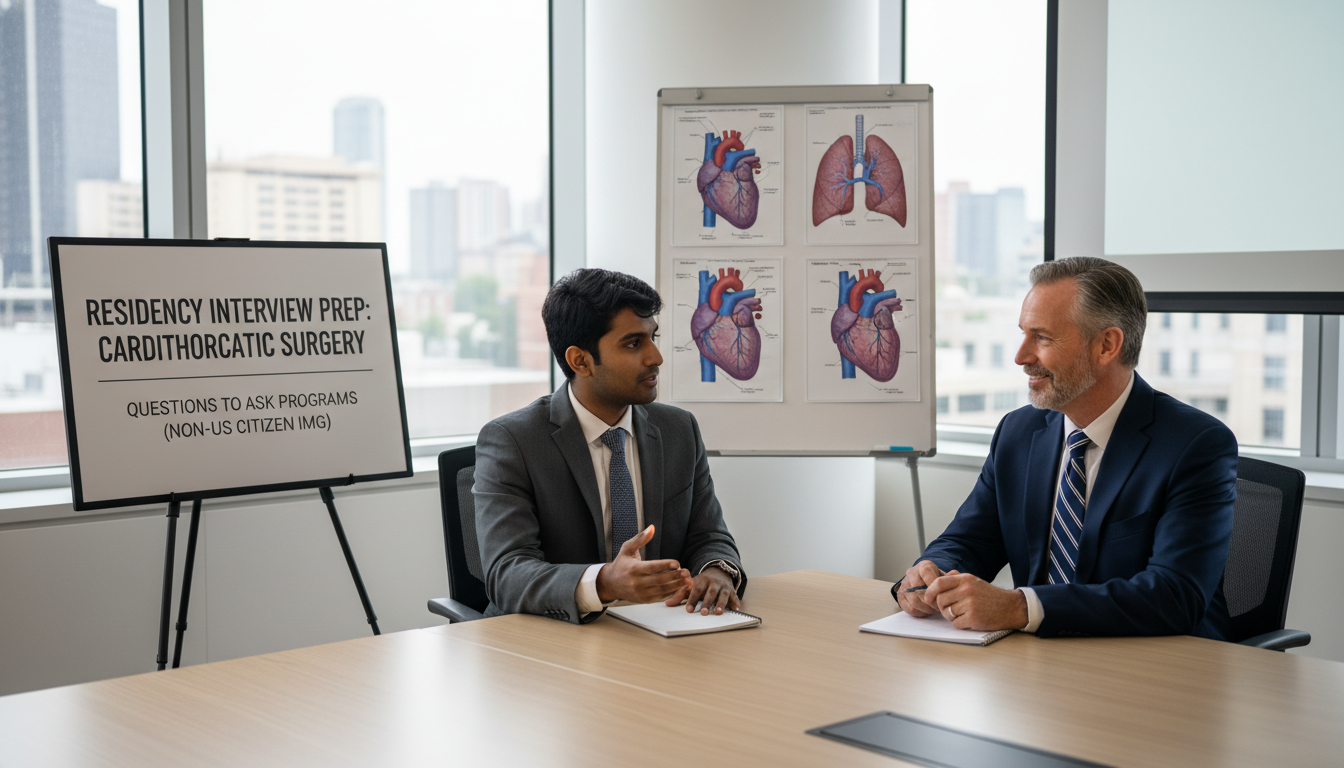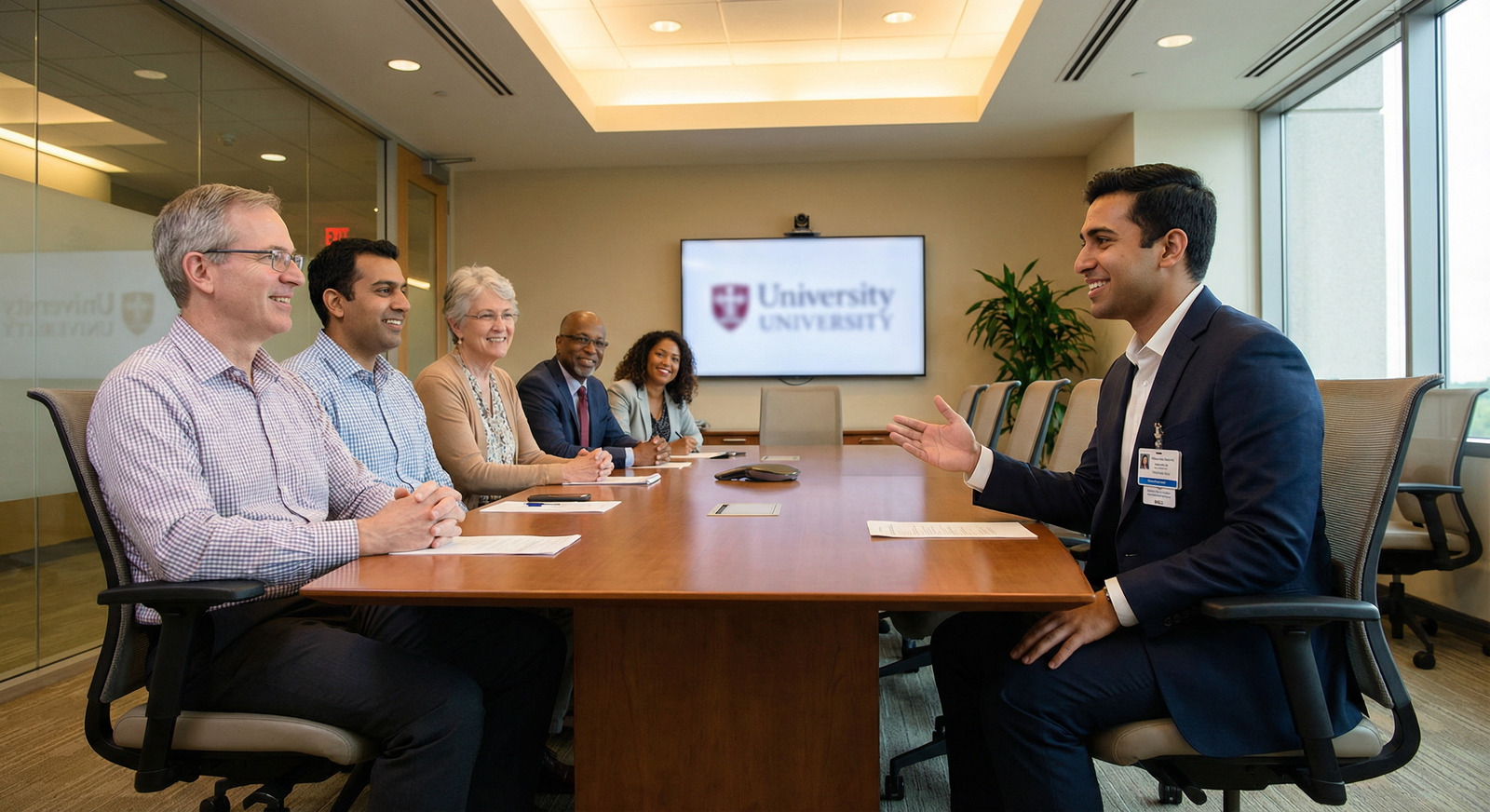
Understanding Your Unique Position as a Caribbean IMG
If you’re a Caribbean medical school graduate aiming for a vascular surgery residency in the U.S., your interview strategy must be sharper and more intentional than most. The questions you ask programs can:
- Signal your maturity and insight into a demanding specialty
- Clarify whether a program is realistically supportive of Caribbean IMGs
- Reveal how well an integrated vascular program will position you for your long-term goals
For a Caribbean medical school residency applicant, especially in a competitive field like vascular surgery, asking strong, targeted questions can sometimes matter as much as how you answer theirs.
Your goals when preparing questions:
- Demonstrate insight into vascular surgery as a career
- Show you understand the challenges of being an IMG in a surgical field
- Evaluate whether the culture, structure, and support will help you thrive
Use this guide to build a personalized list of interview questions for them—program directors, faculty, and residents—that goes far beyond generic “What is your call schedule?”-type questions.
Core Strategy: How to Approach Questions as a Caribbean IMG
Before diving into specific questions to ask residency programs, it helps to frame your approach.
1. Align Questions With Your Story
As a Caribbean IMG, you may already be prepared to explain your path and why you chose your school. Your questions should reinforce the same themes:
- Commitment to high-acuity surgical care
- Ability to adapt and work hard
- Interest in research, outcomes, and innovation in vascular surgery
- Desire for mentorship and support as an IMG
Example: If in your personal statement you emphasized your interest in limb salvage and underserved care, your questions should probe how the program approaches those areas.
2. Be Explicitly Curious About IMG Support
Programs that routinely take Caribbean IMGs usually have:
- Better onboarding structures
- Faculty who understand non-traditional paths
- A more deliberate approach to visa and licensing challenges
Your questions can tactfully uncover whether a program is truly comfortable training IMGs, especially from Caribbean medical schools, without sounding defensive or insecure.
3. Ask Different Questions to Different People
Use the same core themes, adapted to each audience:
- Program Director: Big-picture philosophy, outcomes, and expectations
- Faculty: Clinical training, operative experience, feedback and evaluation
- Residents (especially IMGs): Culture, workload, reality vs. what’s advertised
- Coordinator/Administrative Staff: Logistics, visas, onboarding, exam support
Keep a short written list and prioritize 3–5 high-yield questions per interaction; you likely won’t have time for everything.

High-Yield Questions to Ask the Program Director
When deciding what to ask a program director, your goal is to understand the philosophy, outcomes, and support structure of the program—especially as they relate to an integrated vascular program and Caribbean IMG applicants.
A. Questions About Program Culture and Philosophy
“How would you describe the identity and mission of this vascular surgery residency?”
- Why this matters: Reveals what the program values (research, volume, community service, complexity of cases, etc.) and whether that aligns with your goals.
“What do you think differentiates your integrated vascular program from others?”
- Why this matters: Helps you understand whether the program emphasizes open vs. endovascular, early autonomy, or particular disease areas.
“What personal and professional qualities make a resident particularly successful here?”
- Caribbean IMG angle: Listen for traits like resilience, adaptability, and work ethic. These align naturally with your background—and you can reinforce them in conversation.
B. Questions About Caribbean Medical School Residency Experience
“How has your experience been with graduates from Caribbean medical schools or other IMGs in your program?”
- Why this matters: You’re probing both history and attitude. Programs with positive experiences will highlight success stories.
“What kind of support do you have in place for residents from non-U.S. medical schools as they transition into your program?”
- After asking, look for: Structured bootcamps, early mentorship, orientation to EMR and hospital systems, and guidance for adapting to U.S. surgical culture.
“Are there any specific challenges that Caribbean IMGs have faced here, and how have you worked with them to overcome those challenges?”
- A strong program will be honest and concrete, not vague or dismissive.
C. Questions About Operative Exposure and Training Structure
“Can you walk me through how operative responsibility and autonomy progress across the years of training?”
- For an integrated vascular program, you want clarity on when you step from mostly general surgery exposure into majority vascular cases.
“How do you ensure residents achieve comprehensive exposure to both open and advanced endovascular procedures?”
- Especially important in vascular surgery residency, where case mix and technology access vary widely among programs.
“Given the evolving nature of vascular technology, how does your program adapt to new techniques and devices?”
- Shows your awareness of an evolving field and your desire to stay current.
D. Questions About Outcomes and SGU Residency Match–Type Results
Even if you didn’t attend SGU specifically, you can still think in “SGU residency match” terms: outcomes, fellowship match, and board success.
“How have your graduates done in terms of board pass rates, fellowships (for 0+5 programs that transition), and academic vs. private practice careers?”
- Comparison point: A strong vascular surgery residency will know these numbers.
“What recent changes have you made to the program, and what prompted those changes?”
- Good signs: Changes driven by resident feedback, ACGME updates, or outcomes analysis.
“When residents struggle—academically, clinically, or personally—what systems are in place to support them?”
- As a Caribbean IMG, you want concrete resources, not just “our door is always open.”
Questions to Ask Faculty: Clinical Training, Mentorship, and Expectations
Faculty give you a ground-level view of how training really works in the OR and clinics. Aim for questions that show serious engagement with vascular surgery as a specialized discipline.
A. Questions About Vascular Case Mix and Complexity
“What is the typical mix of open vs. endovascular cases for residents at different stages of training?”
- Listen for: Early meaningful participation, not just retracting on big cases.
“How involved are residents in complex cases like thoracoabdominal aneurysm repair, hybrid procedures, or redo bypasses?”
- This separates programs with high-end vascular volume from those doing mostly bread-and-butter disease.
“Do residents get exposure to niche areas like venous disease, dialysis access, and advanced limb salvage, or are those handled separately?”
- Caribbean IMGs often appreciate broader exposure for flexible career planning.
B. Questions About Mentorship and Professional Development
“How is mentorship structured here—do residents choose mentors, or are they assigned?”
- Strong programs often offer both formal (assigned) and informal (chosen) mentorship models.
“If I’m interested in an academic career or outcomes research in vascular surgery, how would you help me get there?”
- Particularly valuable if you’re coming from a Caribbean medical school where research options may have been more limited.
“Can you describe how feedback is given to residents, both formally and informally?”
- You want regular, actionable feedback, not just end-of-rotation evaluations.
C. Questions About Expectations and IMG Adaptation
“What expectations do you have for interns and junior residents in terms of independence, decision-making, and communication with attendings?”
- As an IMG, clarity helps you adjust to U.S. norms, which may differ from your clinical experiences abroad.
“For residents joining from non-U.S. schools, have you noticed any common areas where they need extra orientation during the first year?”
- Use this to later describe how you’ve already worked to prepare in those areas (documentation, EMR, consult notes, etc.).
“How do you see the field of vascular surgery evolving over the next 5–10 years, and how are you preparing residents for that?”
- This kind of forward-looking question makes you stand out as someone thinking beyond just ‘getting a spot.’

Questions to Ask Residents: Culture, Reality, and Day-to-Day Life
Residents provide the most honest, unfiltered insight. This is also where you’ll get the best sense of how a Caribbean IMG actually fits into the program.
A. Questions About Culture and Support
“How would you describe the overall culture here—from intern year through senior years?”
- Listen for: Collaboration vs. competition, psychological safety, faculty approachability.
“Are there current or recent residents from Caribbean medical schools or other IMGs? How have they integrated into the team?”
- Follow-up: “What has helped them succeed here?”
“How do residents support each other when things get tough—long stretches of call, personal issues, exam stress?”
- Vascular surgery is demanding; you want a program that recognizes that reality.
“Have you ever considered leaving the program? If so, why, and what kept you here?”
- A courageous but powerful question, best for more candid, late-day conversations.
B. Questions About Workload and Operative Experience
“What does a typical day look like for an intern here? For a senior resident?”
- Ask for specifics: start time, pre-rounding, OR time, call, documentation, sign-out.
“Do you feel the operative experience you get matches what was promised on interview day?”
- You’re testing for alignment between recruitment and reality.
“Is there competition among residents for cases, or is there enough operative volume for everyone?”
- Critical in a small vascular surgery residency, where case allocation really matters.
“When do you feel you started making independent decisions that changed patient management?”
- Early exposure to decision-making is as important as operative numbers.
C. Questions About Exams, Research, and Long-Term Outcomes
“How does the program support you in preparing for ABSITE and vascular boards?”
- Look for: Dedicated review sessions, access to question banks, protected study time.
“Is it feasible to do research here as a resident? How many residents typically publish or present at meetings?”
- As a Caribbean IMG, research can be a differentiator, especially if you had fewer opportunities earlier.
“Where have recent graduates gone after finishing—academics, private practice, further fellowships?”
- Even for integrated vascular programs, some go on to specialized fellowships or advanced endovascular training.
Special Considerations for Caribbean IMGs: Logistics, Visas, and Transition
Beyond clinical training, you must clarify whether the program can realistically support your immigration status, licensing pathway, and transition needs.
A. Questions for Program Director or Coordinator
“What types of visas have you sponsored recently for residents, and are there any limitations I should be aware of?”
- Directly relevant if you’ll need a J-1 or H-1B. Get honest, up-to-date information.
“Does your institution have any restrictions on hiring residents who are not U.S. citizens or permanent residents?”
- Important for long-term planning, especially if considering advanced training at the same institution.
“How do you help incoming residents—especially IMGs—navigate credentialing, state licensing, and onboarding before July 1?”
- You’re looking for structured administrative support, not last-minute chaos.
B. Questions About Transition to U.S. Training
“Do you provide any preparatory bootcamps, simulation sessions, or EMR training for new interns?”
- Caribbean IMGs often benefit from dedicated time to learn institutional workflows before clinical duties escalate.
“How do you handle differences in clinical documentation and note-writing styles for residents coming from international schools?”
- Shows that you’re proactively thinking about adapting to U.S. standards.
“Are there any additional supports (e.g., mentorship, academic skills workshops) specifically aimed at helping IMGs succeed?”
- A positive sign: programs that have deliberately built infrastructure for diverse backgrounds.
How to Personalize and Prioritize Your Questions
You’ll never have time to ask everything. The key is customization and prioritization.
1. Match Questions to the Stage of Your Application
- Early in interview season: Ask broader questions about culture, philosophy, and structure.
- Later in the season: Compare specific details between programs—call schedules, operative logs, research output, and graduate outcomes.
2. Build a “Core 10” List
Create a core list of ~10 questions you care about most, balanced across:
- Culture and IMG support
- Operative experience and autonomy
- Outcomes (boards, jobs, fellowships)
- Logistics (visa, onboarding, exams)
Rotate which ones you ask depending on time and who you’re speaking with.
3. Use Questions to Subtly Showcase Your Strengths
Each question is also an opportunity to reinforce your value as a Caribbean IMG candidate:
After asking about limb salvage:
“I’m particularly interested in CLI and limb preservation; during my rotations I saw…”After asking about EHR training:
“I’ve already been familiarizing myself with common U.S. documentation standards to smooth that transition.”
This turns “interview questions for them” into a two-way demonstration of readiness and insight.
4. Take Notes—But Be Discreet
- Jot down quick keywords between sessions, not during intense eye contact moments.
- Create a simple spreadsheet afterward to compare programs on the factors that matter most to you.
Putting It All Together as a Caribbean IMG in Vascular Surgery
As a Caribbean medical school residency applicant targeting vascular surgery—one of the most rigorous and specialized surgical paths—your questions must show:
- Deep understanding of what vascular surgeons actually do
- Awareness of the training demands of an integrated vascular program
- Mature reflection on your unique IMG journey and what support you need to excel
Use this article as a foundation, but don’t memorize scripts. Instead:
- Pick 15–20 questions that truly matter to you.
- Adjust their wording so they feel natural in your voice.
- Align them with your personal statement, CV, and long-term goals.
Programs will remember the applicant who not only answered well, but who asked thoughtful, insightful, and clearly personalized questions—especially when that applicant comes from a non-traditional route like a Caribbean medical school and is aiming for a highly specialized field like vascular surgery.
FAQ: Questions to Ask Programs for Caribbean IMG in Vascular Surgery
1. How many questions should I plan to ask during each vascular surgery residency interview?
Plan 3–5 strong questions per conversation (program director, faculty, and residents). You may have multiple interviewers, but time is limited. It’s better to ask a few well-chosen, thoughtful questions than to rush through a long list. Always keep a few “backup” questions in case your primary ones are answered during the presentation or earlier discussion.
2. Is it appropriate to ask directly about Caribbean IMGs and visa sponsorship?
Yes—as a Caribbean IMG, you should be clear and direct. It’s entirely appropriate to ask:
- “What has your experience been with residents from Caribbean medical schools?”
- “What visas do you typically sponsor for residents?”
Ask these questions professionally and without apology. You’re gathering essential information to make informed decisions about your future.
3. What should I avoid asking during a vascular surgery residency interview?
Avoid:
- Questions easily answered on the program website (e.g., “How long is your program?”).
- Overly personal questions about other residents or faculty.
- Questions focused only on lifestyle without acknowledging the intensity of vascular surgery (e.g., “How easy is it to leave early?”).
Instead, frame lifestyle questions professionally: “How does the program help residents maintain sustainability and prevent burnout in such a demanding specialty?”
4. How can I use my questions to stand out as a Caribbean IMG?
You stand out when your questions:
- Show specific knowledge of vascular surgery (case mix, endovascular technology, limb salvage, aortic disease).
- Reflect self-awareness about transitioning from a Caribbean medical school to a U.S. surgical environment.
- Connect to your long-term goals (academics, underserved care, research, leadership).
For example:
“I’m particularly interested in outcomes research on limb salvage in underserved populations. How have residents with similar interests been supported here?”
This signals both depth of thought and a forward-looking mindset—exactly what competitive vascular surgery programs are hoping to see.