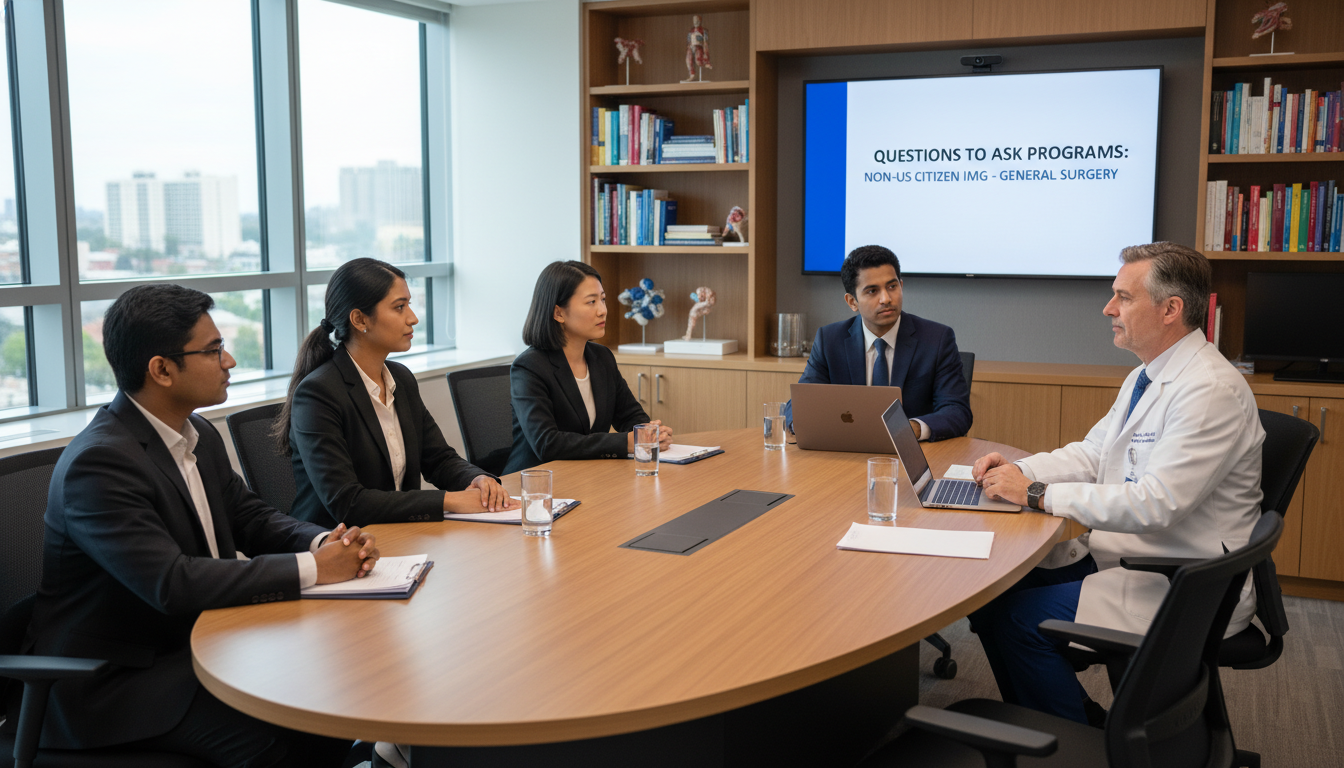
As a non-US citizen IMG (international medical graduate) applying to general surgery residency, you are not just interviewing for a position—you are interviewing for your immigration future, your surgical training, and your long-term career in the US. That means you must come prepared not only to answer questions but also to ask them.
Knowing what to ask programs, what to ask the program director, and which interview questions for them are most important can help you:
- Evaluate whether a program is truly IMG-friendly
- Clarify visa and sponsorship issues early
- Understand operative exposure, fellowship prospects, and support systems
- Avoid unwelcome surprises after you match
This guide will walk you through high-yield, strategic questions to ask during general surgery residency interviews—specifically tailored for the foreign national medical graduate.
Why Your Questions Matter Even More as a Non-US Citizen IMG
Many applicants underestimate the power of their own questions during the interview. For a non-US citizen IMG, thoughtful questions are critical for three reasons:
You have additional constraints
Visa status, ECFMG timelines, and relocation challenges add layers of complexity that US graduates may not face. You must confirm that the program can actually support you logistically and legally.You must signal maturity and professionalism
Strong, specific questions to ask residency programs show that you understand the realities of surgical training, not just the glamour of the OR.You need to detect “hidden red flags”
Programs that are vague about operative volume, fellowship outcomes, or visa sponsorship might not be the right environment for a foreign national medical graduate hoping to thrive.
Think of your questions as diagnostic tools: they reveal what the program truly offers, how you will be treated, and how well your goals match what they can provide.
Core Strategy: How to Plan Your Questions
Before diving into sample questions, it helps to organize them. A good approach is to categorize your “interview questions for them” into five domains:
- Visa and Institutional Support (critical for non-US citizen IMG)
- Training Quality and Operative Experience (general surgery–specific)
- Culture, Support, and IMG-Friendliness
- Career Outcomes, Research, and Fellowships
- City, Logistics, and Life Outside the Hospital
Within each domain, select 2–3 questions to ask the program director and 1–2 questions for residents or faculty. You don’t need to ask every question listed here; instead, choose those that best match your concerns and what you still don’t know after reviewing the program’s website.
Pro tip: Prepare a separate list for
- Program director / associate PD
- Current residents (especially IMGs)
- Program coordinator (logistics and procedures)
1. Visa Sponsorship and Institutional Support for Non-US Citizen IMGs
For a foreign national medical graduate, visa issues are non-negotiable. You should clarify everything early—ideally before the rank list.
Key Questions to Ask the Program Director or Coordinator
1. Visa Type and Consistency
- “What types of visas do you typically sponsor for non-US citizen IMG residents in general surgery (J-1, H-1B, or both)?”
- “In the last 3–5 years, have there been any changes in the type of visas you sponsor or your ability to sponsor them?”
Why this matters: Some programs appear IMG-friendly but do not consistently offer H-1B or switch visa policies unexpectedly. You need to know whether their support has been stable over time.
2. Experience with Foreign National Medical Graduates
- “Historically, how many non-US citizen IMG residents have trained in this program, and what visas have they used?”
- “Do you anticipate any limitations on visa sponsorship for the upcoming match cycles due to institutional or funding changes?”
Look for programs that can confidently describe their track record with non-US citizen IMG residents.
3. Timelines and Documentation
- “What is your typical timeline and process for initiating visa paperwork after the Match?”
- “Are there any institutional deadlines or specific requirements that foreign national medical graduates should know about (e.g., ECFMG certification by a certain date, Step 3 for H-1B)?”
Make sure the program’s required timeline matches your realistic ability to complete exams and documentation.
4. Support for Long-Term Plans
- “For residents on J-1 visas, how have previous graduates navigated waiver jobs, fellowship, or transitions to other visas?”
You don’t need a full immigration consult from the PD, but a program that has successfully supported prior IMGs through waivers or future training is a big advantage.
Questions to Ask Current IMG Residents
- “How smooth was the visa process for you?”
- “Did the GME office and program coordinator help manage paperwork, or did you feel you were on your own?”
- “Have any residents had visa issues that affected their ability to start on time, moonlight, or continue training?”
Listen for signs of disorganization, poor communication, or recurrent delays—these can make your life significantly harder.
2. Training Quality and Operative Experience: General Surgery–Focused Questions
You are aiming for a career in surgery, not just any residency position. Your questions must address operative experience, graduated responsibility, and readiness for independent practice or fellowship.
Questions to Ask the Program Director or Faculty
1. Operative Volume and Case Mix
- “How do you ensure that residents, especially at the junior level, get adequate hands-on experience in the OR rather than just retracting?”
- “Could you describe the typical case mix and operative volume for a graduating chief resident in general surgery?”
Ask follow-up questions if they give only broad statements like “our residents do very well” without numbers or examples.
2. Early Operative Exposure
- “What kinds of procedures are interns and early PGY-2 residents typically performing as primary surgeon?”
- “How is autonomy balanced with supervision at different stages of training?”
This helps you gauge whether you will truly develop technical skills, or mostly be an assistant.
3. Rotations, Outside Sites, and Trauma
- “Do residents rotate through multiple hospitals, and if so, how are cases and learning opportunities distributed across sites?”
- “What is the level of trauma exposure here (Level I vs II, volume, types of trauma) and how does that shape a general surgery resident’s experience?”
Consider your career goals: if you are thinking of trauma or acute care surgery, high trauma exposure is beneficial.
4. Remediation and Support
- “If a resident is struggling—clinically, academically, or technically—what support systems or remediation processes are in place?”
You want a program that invests in helping residents improve, not one that simply labels them as “weak” and leaves them behind.
Questions to Ask Residents
- “How much time do you actually spend in the OR vs floor/ICU vs clinics at each level?”
- “Do you feel you are getting enough operative experience to be comfortable operating independently by graduation?”
- “Are there any rotations where residents commonly feel overworked but undertrained?”
Residents’ responses here will be more candid and practical than official descriptions.
3. Culture, Support, and IMG-Friendliness
For a non-US citizen IMG, the question is not only “Will I be trained?” but also “Will I belong here?” Program culture can make or break your experience.
Questions to Ask the Program Director or Leadership
1. IMG and Diversity Track Record
- “How many current residents and recent graduates are international medical graduates, and how have they integrated into the program?”
- “What forms of formal or informal mentorship exist for IMGs or foreign national medical graduates?”
Strong programs can speak openly and positively about their IMG residents.
2. Work Environment and Wellness
- “How do you monitor resident workload and compliance with duty hours, especially during busy rotations?”
- “What resources are available if a resident feels burned out, overwhelmed, or is struggling with cultural adjustment?”
Burnout can be especially intense for IMGs who may have less local family support.
3. Professional Respect and Inclusion
- “How does the program encourage a culture of respect between residents, faculty, APPs, and nursing staff?”
- “Are there structured opportunities for residents to give upward feedback about attendings or the program environment?”
If they can describe tangible mechanisms (anonymous surveys, town halls, resident councils), that’s a good sign.
Questions to Ask Residents (Especially IMGs)
- “As a non-US citizen IMG, did you feel supported and accepted here, both professionally and personally?”
- “Have you ever felt that being an IMG or a foreign national affected your evaluations, opportunities, or interactions with faculty?”
- “How comfortable do you feel raising concerns or mistakes to leadership?”
Pay attention to tone: hesitations or vague answers may indicate underlying cultural or equity problems.

4. Career Outcomes, Research, and Fellowships
As a foreign national medical graduate in general surgery, your long-term career plans—academia, private practice, fellowship, or staying in the US—depend heavily on the program’s track record.
Questions to Ask the Program Director / Chair
1. Fellowship Placement
- “Where have your graduates gone in the last 5–10 years—both in terms of fellowships and practice settings?”
- “Are there any differences in outcomes between US graduates and non-US citizen IMG graduates from this program?”
You are listening for: transparency, pride in their graduates, and a history of subspecialty placements.
2. Research Infrastructure
- “What research opportunities are realistically accessible for categorical residents, especially those on visas?”
- “Are there protected research years or dedicated research tracks, and how have IMG residents used them?”
- “How are residents supported in developing projects—statistical support, IRB guidance, mentorship?”
If you’re interested in competitive fellowships (surgical oncology, CT, vascular, MIS), research productivity is often crucial.
3. Support for Boards and Exams
- “What is your ABSITE and board pass rate over the last few years?”
- “How does the program support residents who may need additional help, for example, with ABSITE, clinical knowledge, or language barriers?”
Programs that invest in exam prep (mock orals, review sessions, structured curriculum) can be particularly valuable to IMGs adapting to a new system.
Questions to Ask Senior Residents and Recent Graduates
- “Did you feel you had enough mentorship for your career goals—whether fellowship or going directly into practice?”
- “How easy was it to get involved in research, and how many projects or publications do most residents graduate with?”
- “How involved is the PD/chair in actively advocating for residents when applying to fellowships or jobs?”
This information will help you understand how the program supports not just your training, but also your trajectory.
5. Practical Life Issues: Location, Finances, and Daily Realities
Interview days focus heavily on clinical training, but daily life matters greatly—especially if you are new to the US.
Questions to Ask Residents
1. Housing and Cost of Living
- “Where do most residents live, and what is the typical rent range?”
- “Is the resident salary sufficient to live reasonably in this area, especially as a single-income non-US citizen IMG?”
This affects whether you can maintain a reasonable quality of life while working long surgical hours.
2. Transportation and Call
- “Do you need a car for this program, or is public transportation adequate?”
- “How far do residents typically commute, and how does that affect post-call days or late-night returns after cases?”
3. Support Systems and Community
- “Are there other IMGs or international residents here who help each other adjust?”
- “How do residents spend their limited free time? Are there activities or communities that IMGs tend to join?”
Questions to Ask the Program Coordinator
- “What paperwork and processes should an incoming non-US citizen IMG expect between Match Day and the start of residency?”
- “Are there institutional resources to help with Social Security, bank accounts, or initial settling-in for foreign graduates?”
A well-organized coordinator and GME office can significantly soften the landing for a new IMG resident.
6. How to Ask Questions Strategically (Without Overwhelming the Interview)
Having strong questions to ask residency programs is important—but so is how you ask them.
Prioritize and Customize
- Review the program’s website first and avoid asking things that are clearly answered there.
- Prepare 10–15 total questions, but plan to ask 3–6 per interview day, depending on time.
- Tailor questions: what to ask the program director should be big-picture and strategic; what to ask residents can be more practical and personal.
Be Direct but Professional
For potentially sensitive areas (visa policies, IMG treatment), it is acceptable—and necessary—to be direct:
- Instead of: “Do you like IMGs?”
Say: “As a non-US citizen IMG, I’m particularly interested in how IMGs have historically integrated into your program and what specific support structures exist for them.”
Use Open-Ended Questions
Avoid yes/no questions; instead, invite stories and examples:
- “Can you describe a time when the program supported a resident going through a difficult period?”
- “How would you characterize the relationship between residents and attendings here?”
Take Notes and Reflect
- During the surgery residency match season, you’ll interview at many programs; details blur.
- After each interview, write a brief reflection:
- How transparent were they about visa issues?
- Did residents seem genuinely supported?
- Does this environment match your needed level of structure, volume, and mentorship?
These notes will be invaluable during rank list time.
Sample Question List by Interview Role
To help you operationalize everything, here’s a concise summary of high-yield interview questions for them, grouped by whom you’re speaking with.
What to Ask the Program Director
- “What types of visas do you currently sponsor, and has that been consistent over the past few years?”
- “How have non-US citizen IMG residents historically performed and progressed in this program?”
- “How do you ensure residents gain graduated autonomy and adequate operative experience by graduation?”
- “Where have your recent graduates gone—for both fellowship and practice—and how do you support their career planning?”
- “What would you say distinguishes your general surgery residency from others, particularly from the perspective of an IMG?”
What to Ask Faculty / Attendings
- “How do you typically involve residents in the OR—especially juniors—and what do you expect from them on your service?”
- “How receptive are you to residents’ feedback regarding case selection, autonomy, or education?”
- “What qualities have you seen in successful IMG residents here?”
What to Ask Residents (Especially IMGs)
- “How has your experience been as an IMG or foreign national medical graduate in this program?”
- “How is the work-life balance realistically—how many hours do you work, and do you feel supported?”
- “Do you feel you are progressing technically and clinically at the pace you expected?”
- “Would you choose this same program again if you had to repeat the surgery residency match process?”
What to Ask the Program Coordinator / GME
- “For an incoming non-US citizen IMG, what is the typical visa, onboarding, and relocation timeline?”
- “Are there institutional resources to assist with housing, orientation to the city, and initial logistics?”
Putting It All Together: Evaluating Programs as a Non-US Citizen IMG
By the end of interview season, you should be able to answer for each program:
- Can they definitely sponsor my visa, and have they done so reliably for others?
- Will I receive the operative and academic training I need to become a competent surgeon?
- Is the culture supportive and respectful, particularly toward IMGs?
- Do their graduates—especially IMGs—go on to the kinds of fellowships or jobs I want?
- Can I imagine building a life in this city with the salary, support, and community available?
The right questions to ask programs are ultimately the ones that help you distinguish good on paper from good for you. As a non-US citizen IMG pursuing general surgery, your decision carries even higher stakes—legally, professionally, and personally. Use your questions wisely to protect your future and choose a program where you can truly thrive.
FAQ: Questions to Ask Programs for Non-US Citizen IMG in General Surgery
1. Is it okay to directly ask about visa sponsorship during the interview?
Yes. As a non-US citizen IMG, visa sponsorship is a fundamental requirement, not an optional detail. Ask respectfully and clearly:
- “What visas do you currently sponsor?”
- “Have you successfully sponsored residents on this visa type in the past few years?”
Programs are accustomed to this question, and transparent answers are a positive sign.
2. How many questions should I ask during each interview?
Aim for 2–3 questions per interaction (PD, faculty, residents), depending on time. Overall, 5–8 thoughtful, non-repetitive questions on interview day is usually appropriate. Quality and relevance matter more than quantity.
3. Are there any questions I should avoid asking?
Avoid:
- Questions whose answers are clearly on the website (e.g., “How many residents per year?”)
- Overly personal questions (salary of attendings, internal politics)
- Questions that sound like you are only interested in “visa and leaving” (e.g., “How fast can I get a green card?”) rather than training.
Instead, frame your questions around training, support, and long-term professional development.
4. What if a program is vague or evasive about IMG or visa-related topics?
Evasion or vague replies can be a significant red flag. If a program cannot clearly articulate:
- What visas they sponsor
- Their history with non-US citizen IMG residents
- Their process for handling visa paperwork
then you should strongly reconsider ranking them highly. As a foreign national medical graduate, you need predictability and institutional experience, not uncertainty.
By entering interview season with a structured list of questions to ask residency programs, you position yourself not only as a serious applicant—but as a future colleague who understands the realities of training and life as a surgeon in the US.