Why Your Questions Matter as a Non‑US Citizen IMG in Neurology
As a non-US citizen IMG or foreign national medical graduate aiming for neurology residency, the questions you ask programs are not just a formality—they are a strategic tool. Your situation is more complex than that of a US graduate: you must think about visas, institutional support for sponsorship, educational gaps in neurology exposure, adapting to a new system, and maximizing your chances in the neuro match.
Thoughtful, targeted questions:
- Help you identify programs that truly understand and support non-US citizen IMGs
- Show maturity, insight, and genuine interest in neurology
- Allow you to assess how well a program matches your goals and constraints
- Signal that you understand your unique challenges and are proactive in addressing them
This guide lays out specific, practical questions to ask residency programs—in interviews, pre-interview socials, or follow-up emails—organized by topic. It also includes what the answers might tell you and how to adapt them for your own neurology career goals.
Strategy First: How to Approach Asking Questions
Before diving into detailed lists, it helps to have a framework. Not every question is right for every moment, and you don’t want to sound scripted.
1. Prioritize Your Personal Needs
As a non-US citizen IMG in neurology, your highest‑priority issues might include:
- Visa type and sponsorship stability
- How many foreign national medical graduates the program typically takes
- Level of support for transitioning into US healthcare
- Research opportunities (especially if you’re interested in fellowships like epilepsy, stroke, neurocritical care, movement disorders)
- Long-term career goals (academic neurology vs private practice vs neurohospitalist)
Rank your priorities before interview season. This will shape which questions you must ask at each program.
2. Match the Question to the Person
Think of your neuro match interview day as multiple mini-conversations:
- Program Director / Associate PD – big-picture program culture, curriculum, visas, career outcomes
- Current Residents (especially IMGs) – day-to-day reality, hidden culture, call burden, real support for non-US citizen IMGs
- Department Chair or Vice Chair – vision of the department, research infrastructure, subspecialty strength
- Program Coordinator – logistics, onboarding, visa paperwork process, scheduling
- Faculty Interviewers – mentorship style, subspecialty training, research
You may ask about visas with the PD or coordinator, but you might ask about workload and support systems with residents.
3. Phrase Questions as Curiosity, Not Demands
Programs expect you to ask questions, but tone matters. Use open-ended phrases:
- “Can you tell me more about…”
- “How does your program approach…”
- “From your perspective…”
- “What have you found helpful for IMGs who are new to the US system?”
This shows you’re seeking understanding, not interrogating.
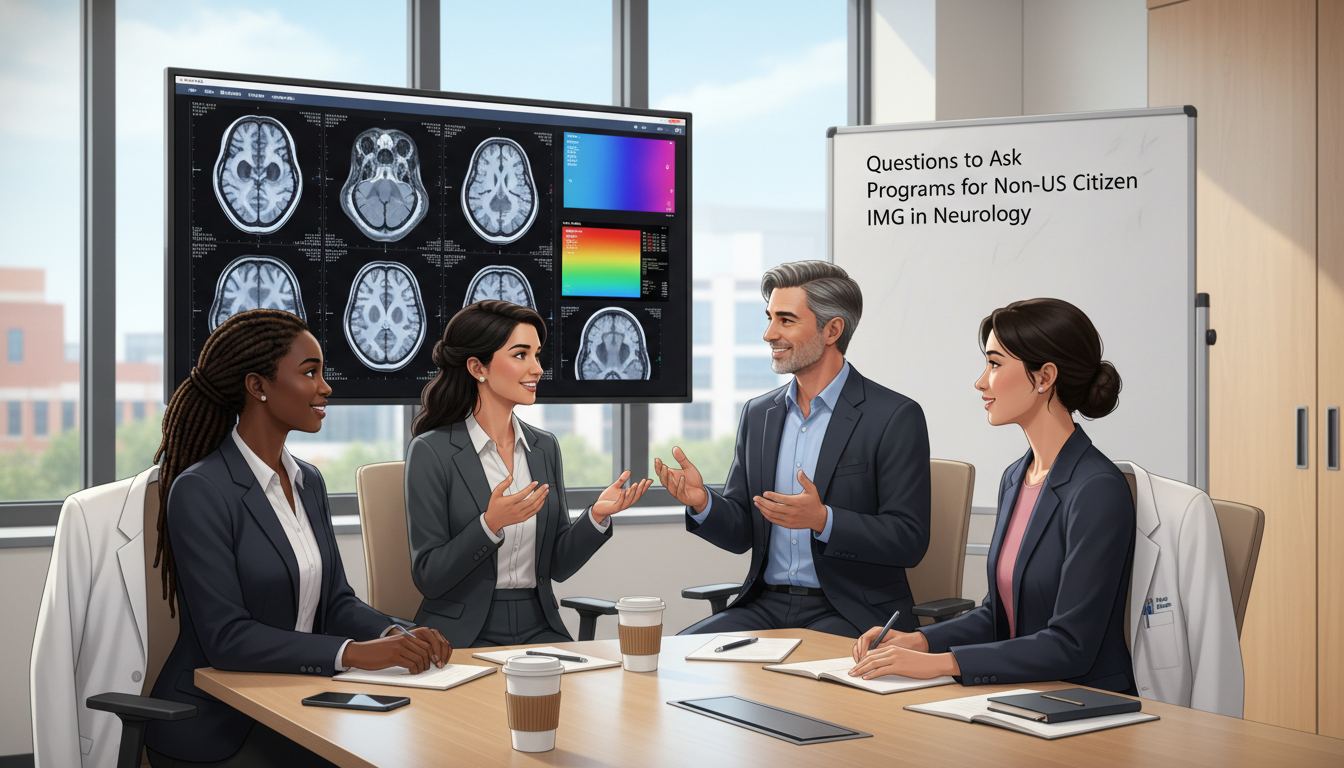
Essential Questions About Visa Sponsorship and IMG Support
This is often the most critical domain for a non-US citizen IMG. You must know whether the program can get you into the country—and keep you there safely—before anything else matters.
A. Visa Types, History, and Reliability
Questions to Ask Program Director or Coordinator
“What visa types does your program sponsor for non-US citizen IMGs (for example, J-1, H-1B)?”
- Why this matters: Some neurology programs only sponsor J-1; others may support H-1B. This has big implications for future job options and waiver positions.
“Over the last 3–5 years, how many residents have you sponsored on each visa type, and have there been any issues with renewals?”
- What you learn: The track record—are they experienced and consistent, or is sponsorship rare and risky?
“If a resident changes visa status during training (e.g., from J-1 to H-1B), how has the program handled that in the past?”
- Why: Shows whether they are flexible and supportive of evolving immigration needs.
“Does your institution provide legal or immigration support services for foreign national medical graduates?”
- Look for: Access to an institutional immigration office or attorney. This indicates seriousness in supporting international staff.
B. Match Policies and Preference for Non-US Citizen IMGs
“Approximately what proportion of your current residents are non-US citizen IMGs or foreign national medical graduates?”
- Why: Programs with a history of accepting non-US citizen IMGs usually have better systems in place and a more inclusive culture.
“Is there any institutional cap or limit on the number of visa-holding residents per year?”
- Why: Even if the PD supports IMGs, hospital rules may restrict them.
“Have there been residents who could not start due to visa issues in the past, and how did the program respond?”
- What this reveals: Transparency and problem-solving attitude, plus realistic risk.
C. Support During Onboarding and Transition
Ask these to the program coordinator or current residents (especially IMGs):
- “How does the program support residents who are new to the US healthcare system, particularly international graduates?”
- “Is there any orientation or additional early supervision tailored to IMGs to help with documentation, EMR, and communication expectations?”
- “For residents arriving close to the start date due to visa delays, how has the program accommodated them in the past?”
You want to hear examples of flexibility, structured orientation, and patience—not that they “expect everyone to be fully ready on July 1 without extra help.”
Questions About Training Quality and Neurology-Specific Experience
You are not just trying to match anywhere—you want to be a competent, confident neurologist. Your questions should cut through generic descriptions and reveal how solid the neurology training really is.
A. Core Clinical Training and Autonomy
To Program Director or Faculty
“How is responsibility and autonomy in neurology care graduated over the four years?”
- Look for: Progressive responsibility, with close supervision early on and more independence as a senior.
“Can you walk me through a typical week for a PGY-2 neurology resident on the inpatient stroke or consult service?”
- This gives insight into:
- Patient volume
- Complexity of cases
- Interactions with attendings and fellows
- Realistic workload
- This gives insight into:
“How much direct exposure do residents get to acute stroke care and neurocritical care in the first two years?”
- Clinical stroke and ICU experience are foundational in neurology.
“For an IMG who may have had limited neurology exposure in medical school, what kind of early support or feedback is available?”
- Shows whether they are accustomed to educational variability among IMGs.
B. Subspecialty Exposure and Fellowship Preparation
Neurology is highly subspecialized. Your questions should explore how well the program prepares you for areas you might pursue.
“Which neurology subspecialties are strongest at your institution, and how early in residency do we get exposure to them?”
- Listen for: Stroke, epilepsy, movement disorders, neuromuscular, MS/neuroimmunology, neurocritical care, behavioral neurology, neuro-oncology, etc.
“What proportion of your graduates enter fellowships, and which subspecialties and institutions have they matched into recently?”
- This directly measures fellowship preparation and national reputation.
“If I wanted to pursue a competitive fellowship (for example, epilepsy or neurocritical care), how would your program support me in building a strong application?”
“For non-US citizen IMGs, has visa status affected fellowship options for your graduates, and how do you help them navigate that?”
- This is critical: fellowship programs may have different visa rules.
C. Evaluating Educational Culture
“How does your program handle residents who are struggling academically or clinically? Can you share an example (anonymized) of how you supported someone?”
- You want to hear about structured remediation and mentorship, not punishment.
“How often do residents receive formal feedback, and is there any tailored feedback for IMGs adapting to US practice?”
“What recent educational changes has the program made based on resident feedback?”
- A program that evolves in response to feedback is usually healthier.
Questions to Ask About Culture, Support, and Life as a Non-US Citizen IMG
Culture often matters as much as curriculum, especially when you’re adapting to a new country and medical system.
A. Inclusion, Diversity, and IMG Friendliness
To Residents and PD
“How would you describe the culture of the neurology department, especially regarding diversity and inclusion?”
“Do you have other non-US citizen IMGs or foreign national medical graduates in the current or recent classes? What has their experience been like?”
- Follow up with residents:
- “Did you feel welcomed and supported?”
- “Any challenges specific to being an IMG that the program helped you with?”
- Follow up with residents:
“Are there any faculty members who are themselves IMGs and serve as informal or formal mentors?”
- IMG faculty can be especially valuable role models.
“How does the program support wellness, especially for residents who may not have family nearby in the US?”
- You’re looking for:
- Social events
- Formal wellness curriculum
- Mental health resources
- Understanding about cultural adjustment
- You’re looking for:
B. Communication, Team Dynamics, and Safety to Ask for Help
“As someone who trained outside the US, I know there may be an adjustment in communication style. How does your program foster a safe environment to ask questions or admit uncertainty?”
“Can you share how attendings and seniors typically respond when a resident is unsure about a case?”
- The ideal answer: collaborative, teaching-oriented, not shaming.
“Have residents ever raised concerns about microaggressions or bias related to being an IMG or non-native English speaker, and how were those concerns addressed?”
- This tests how seriously the program treats professionalism and respect.
C. Living in the Community as an International Resident
Ask current residents—especially other international trainees:
“What is it like living in this city as an international resident? Are there communities or resources that have been helpful?”
“For residents who move here from abroad, how has the program helped with things like housing, transportation, or initial settling?”
“How manageable is the cost of living on a resident salary, especially for those supporting family or sending money home?”
These are not “soft” questions. Financial and social stability greatly affect your performance and well-being in residency.
Questions About Career Outcomes, Research, and Long-Term Planning
As a foreign national medical graduate, your residency choice must support not only your training but also your long-term career and immigration strategy.
A. Career Paths and Post-Residency Outcomes
To PD or Senior Residents
“What are the most common career paths for your graduates (academic neurology, private practice, neurohospitalist, research)?”
“For your non-US citizen IMG graduates, what have they typically done after residency, and how has the program helped them secure those positions?”
- This is crucial: you want concrete examples, not vague assurances.
“Do you provide career advising specific to visa-holding residents—for example, about J-1 waivers, H-1B transitions, or job markets friendly to non-US citizens?”
“How often do alumni stay on for fellowship or faculty positions here?”
- Staying at the same institution may simplify visa and job transitions.
B. Research Opportunities and Academic Development
If you’re interested in academic neurology or competitive fellowships, ask:
“What research opportunities are available for residents, particularly in neurology subspecialties of interest?”
“Is there dedicated research time in the schedule, or is research done primarily during electives and off-hours?”
“Are there ongoing neurology research projects that residents commonly join, and how easy is it for a new IMG resident to get involved?”
- Listen for: structure (e.g., research tracks, mentorship programs) vs “you’re on your own.”
“Have non-US citizen IMGs in your program been able to present at national meetings or publish during residency, and what support did they receive?”
“If I came with prior research experience from my home country, how could I leverage that here?”
- This tests whether they value your international background.
C. Licensure, Boards, and Academic Support
“How does your program support residents in preparing for neurology board exams and any required state licensing exams?”
“For IMGs, have there been any specific challenges with licensing or credentialing, and how do you help navigate those?”
“Do you track board pass rates, and could you share recent outcomes?”
- High, stable pass rates suggest good academic scaffolding.
How and When to Ask: Practical Tactics for Neurology Interviews
Knowing what to ask is only half the battle; knowing how and when to ask is just as important.
A. Pre-Interview Preparation
- Review the website thoroughly so you avoid asking things clearly answered online.
- Make a short, prioritized list of 5–7 critical questions for each program—one set for PD/faculty, one for residents.
- Tailor questions based on what is not clear from the website: e.g., visa history, IMG support systems, specific neuro subspecialty strengths.
B. During the Interview Day
You’ll likely have multiple opportunities:
- Formal faculty/PD interviews
- Resident-only Q&A or social hour
- Program overview session
- One-on-one time with the coordinator or chief resident
Tips:
- Start with more general questions, then progress to specifics like visa and match history.
- With residents, ask more candid, culture-related questions.
- Avoid “yes/no” questions; frame them to elicit stories and examples.
Example sequence with a PD:
- “Can you tell me about the role of non-US citizen IMGs in your program?”
- “What visas do you commonly sponsor, and how has that worked out for residents recently?”
- “For your IMG graduates, what have their career paths looked like?”
C. After the Interview
It is reasonable to send a follow-up email (especially if something wasn’t clear):
- Clarify visa policies or the number of non-US citizen IMGs they currently train.
- Ask for written confirmation if something is especially important for your immigration planning.
Example professional email line:
“Thank you again for the opportunity to interview. I had one follow-up question regarding visa sponsorship: you mentioned that your neurology residency sponsors J-1 visas and has had several non-US citizen IMG residents in recent years. Could you please confirm whether H-1B sponsorship is also possible, or if the program is J-1 only?”
Keep follow-up messages brief and focused on key details.
FAQ: Common Questions from Non‑US Citizen IMGs About What to Ask Programs
1. Is it appropriate to ask directly about visa sponsorship during the interview?
Yes. For a non-US citizen IMG or foreign national medical graduate, visa questions are essential and expected. It is best to ask in a professional, matter-of-fact way, ideally to the program director or coordinator. Phrase it as: “Could you tell me what visa types your program sponsors and your recent experience with visa-holding residents?”
2. How many “questions to ask residency programs” should I prepare for each interview?
Prepare about 10–12 questions total, then expect to actually ask 5–7, depending on time. Divide them between:
- 3–4 for the program director/faculty
- 3–4 for current residents
- 1–2 for the coordinator if you have detailed logistics or visa process questions
Have a few extra in reserve in case some are answered during presentations.
3. What are good “interview questions for them” that make me stand out positively?
Standout questions show insight, self-awareness, and alignment with neurology. Examples:
- “How does your program support residents in developing into independent neurologists who are comfortable with both common and rare conditions?”
- “For non-US citizen IMGs in your program, what has helped them succeed the most, and how do you facilitate that?”
- “What changes are you most proud of in your neurology curriculum over the last few years?”
These signal genuine interest in growth and program evolution.
4. What should I avoid asking during interviews?
Avoid:
- Questions already clearly answered on the website (e.g., “How long is your residency?”)
- Early, aggressive questions about moonlighting or salary as your first topic
- Yes/no questions like “Do you like your program?” (instead ask “Can you share what you like most and what you would change?”)
- Anything that sounds like you are only interested in a visa, not the neurology training itself
By preparing thoughtful, targeted questions and using them strategically, you’ll not only gather crucial information for your neuro match decisions—you’ll also present yourself as a mature, proactive, and well-prepared candidate, exactly the kind of non-US citizen IMG that neurology programs want to train.