Choosing a psychiatry residency is one of the most important decisions of your career. For an MD graduate in psychiatry, the interview trail is not just about answering questions—it’s your best opportunity to ask strategic questions that reveal what training will truly be like and how well a program fits your goals.
This guide focuses on questions to ask programs during your psychiatry residency interviews and pre-/post-interview communications. It is written specifically for the MD graduate pursuing the allopathic medical school match and aiming for a strong psychiatry residency (“psych match”).
We’ll cover what to ask program directors, faculty, and residents; how to tailor your questions; and how to avoid common pitfalls—so you can walk away from each interview day with real, actionable information.
Why Your Questions Matter More Than You Think
Many MD graduate residency applicants underestimate how much their questions shape the interview day. Thoughtful questions:
- Show maturity, curiosity, and insight into psychiatry as a specialty
- Signal that you’re serious about this specific residency
- Help you distinguish between programs that look similar on paper
- Give you content to use when constructing your final rank list
Residency interviews can be overwhelming: tight schedules, repeated faculty introductions, and similar PowerPoint slides. Your greatest tool is a curated list of prioritized questions that you adjust in real time based on what’s already been covered.
Two key principles:
Anchor everything to your goals.
Before interview season, identify your top 3–5 priorities. Examples:- Becoming a strong psychotherapist
- Academic psychiatry or research
- Community psychiatry or public mental health
- Combined training (e.g., triple board, child, addiction tracks)
- Work–life balance, geographic needs, or family considerations
Customize your questions by audience.
- Program Director (PD): big-picture philosophy, outcomes, policies
- Faculty: supervision, teaching culture, subspecialty exposure
- Residents: actual lived experience, workload, support, morale
Core Questions for Program Directors: What to Ask the PD
Many MD graduate residency applicants wonder specifically, “What to ask program director?” This is the time to explore the vision, structure, and support systems of the program. You don’t need to ask all of these, but select those aligned with your priorities.
1. Training Philosophy and Program Direction
Use these to understand how the program thinks about psychiatry and resident development:
- “How would you describe the overarching training philosophy of your psychiatry residency?”
- “What attributes do you hope graduates of this program will consistently have?”
- “How has the program changed in the past 3–5 years, and what changes are on the horizon?”
Follow-up examples:
- If they mention psychotherapy:
“Can you give concrete examples of how psychotherapy competence is assessed across training?” - If they emphasize community psychiatry:
“What longitudinal community or public psychiatry experiences do residents have?”
These questions help you distinguish between programs oriented toward:
- Biological/academic psychiatry
- Psychotherapy and psychodynamic training
- Public/community mental health
- Forensics, addiction, or consultation-liaison (C-L) emphasis
2. Clinical Exposure and Case Mix
Understanding the breadth and depth of clinical exposure is crucial:
- “What does the typical clinical caseload look like for PGY-2 and PGY-3 residents?”
- “How would you describe the balance between inpatient, outpatient, consultation-liaison, and emergency psychiatry?”
- “What unique populations do residents work with (e.g., severe SMI, forensics, veterans, child and adolescent, perinatal)?”
Clarify specifics relevant to the allopathic medical school match candidate who may compare multiple academic programs:
- “How much exposure do residents get to integrated care (e.g., collaborative care models, primary care behavioral health)?”
- “Are there structured rotations in community mental health centers, county systems, or state hospitals?”
3. Supervision, Teaching, and Feedback
A core dimension of a psychiatry residency is how you are supervised and taught:
- “How is clinical supervision structured across the different years of training?”
- “Are there protected times for supervision (e.g., psychotherapy, medication management, longitudinal cases) that are respected in practice?”
- “How is formative feedback delivered? How often do residents receive formal evaluations and from whom?”
Dig deeper with:
- “Can you describe the formal didactic curriculum—what topics are emphasized in each year?”
- “How do you prepare residents for the psychiatry board exam, and what have your board pass rates looked like in recent years?”
4. Research and Academic Development
If you’re interested in academic psychiatry or research:
- “What structured opportunities exist for residents to engage in research?”
- “Are there protected research blocks or tracks for residents seeking academic careers?”
- “How are residents supported to present at conferences (financial support, time off, mentorship)?”
You can also ask:
- “What are some recent resident-led projects or publications that you’re especially proud of?”
- “Do you have faculty with expertise in my area of interest (e.g., psychosis, mood disorders, neuroimaging, global mental health)?”
5. Resident Well-Being, Workload, and Culture
Residency wellness directly affects your learning. Ask specifically:
- “How do you monitor and support resident well-being?”
- “What changes have you made in response to resident feedback about workload or burnout?”
- “How would you describe the culture among residents—and between residents and faculty?”
To assess workload expectations:
- “What’s a realistic range of weekly work hours on your busiest rotations?”
- “How does the program handle coverage when residents are ill or need unexpected time off?”
- “Can you describe your backup or jeopardy system?”
6. Outcomes and Graduate Paths
You want to know where graduates go:
- “What types of positions have your recent graduates taken?”
(Fellowships vs. general practice; academic vs. community.) - “What proportion of graduates pursue fellowship training (e.g., child and adolescent, addiction, forensic, C-L)? How are they supported in that process?”
- “Could you share examples of how residents with nontraditional career goals (e.g., advocacy, policy, medical education) have been supported?”
Key Questions for Residents: The Reality Behind the Brochure
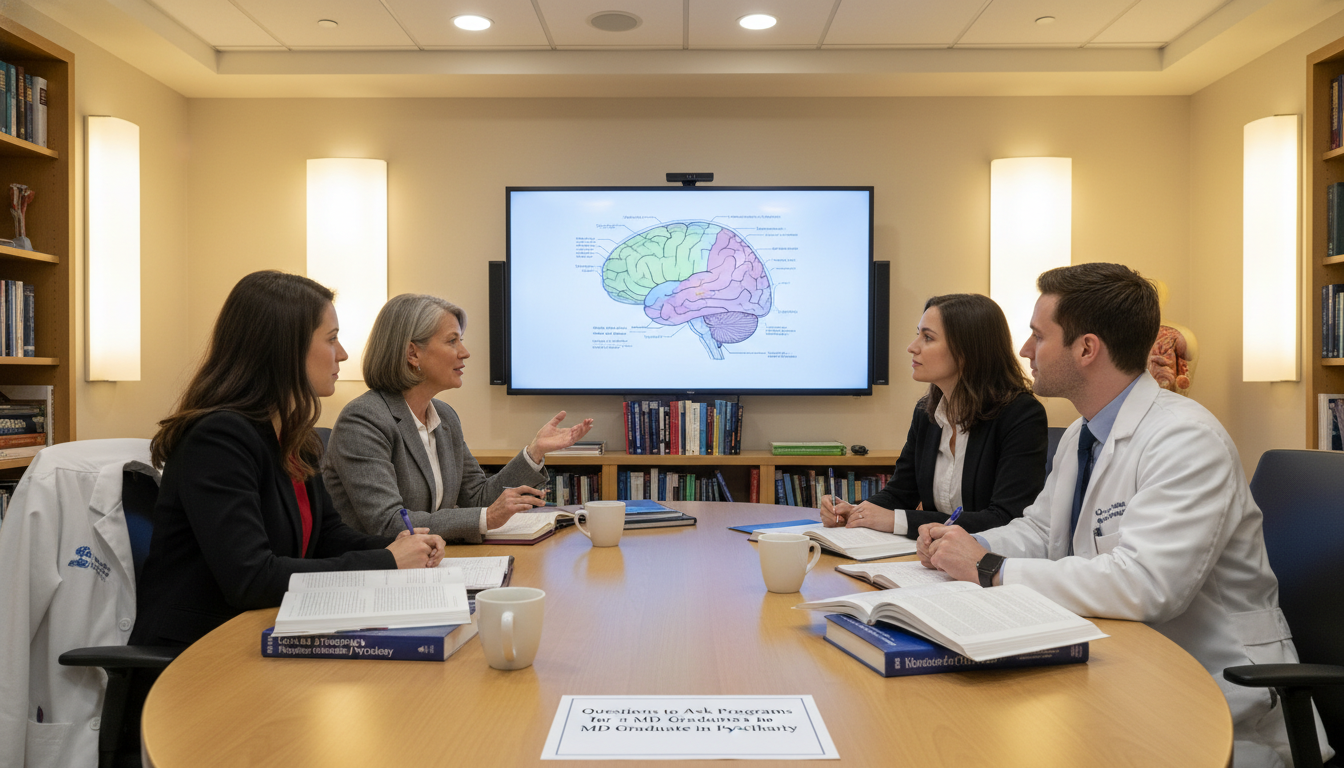
Resident Q&A sessions are often where you learn the most about a program. Your goal is to get concrete examples rather than generic answers like “we’re a family” or “we’re busy but supported.”
Use these as your primary interview questions for them—the residents.
1. Daily Life and Workload
- “Can you walk me through a typical day as a PGY-2 and a PGY-3 here?”
- “On your busiest rotation, how many hours per week do you usually work?”
- “What does call look like—frequency, intensity, and level of support?”
- “How often does work spill over into personal time or weekends beyond what’s scheduled?”
Probe with:
- “Do you feel the workload allows you to learn psychiatry well without burning out?”
- “Have there been specific rotations that felt unsustainable, and has the program addressed that?”
2. Teaching, Supervision, and Autonomy
Residents can tell you what supervision is really like:
- “How accessible are attendings when you’re on call or dealing with difficult cases?”
- “Do you feel you receive consistent, meaningful feedback on your clinical work?”
- “How much autonomy do you have at different stages of training? Are there times you’ve felt either under- or over-supervised?”
You can follow up with:
- “Are there attendings you would particularly recommend as role models for psychotherapy, psychopharmacology, or career mentorship?”
3. Psychotherapy Training and Outpatient Experience
Psychotherapy training often differentiates psychiatry programs:
- “How early do you start carrying your own psychotherapy cases?”
- “What are the main psychotherapy modalities you’re exposed to (e.g., CBT, psychodynamic, DBT, group therapy)? Are there structured seminars linked to your cases?”
- “How many long-term therapy cases does a typical resident manage, and over what duration?”
Additional targeted questions:
- “Do you feel prepared to practice psychotherapy independently by graduation?”
- “How much protected time do you genuinely get for outpatient and therapy, and is it respected or frequently interrupted?”
4. Culture, Support, and Morale
You want to know whether you’ll be happy working with these people:
- “How would you describe the resident culture here—collaborative, competitive, close-knit, more independent?”
- “Outside of work, do residents spend time together or mostly keep to themselves?”
- “How have residents and leadership handled difficult events (e.g., patient deaths, COVID surges, systemic changes)?”
To get honest answers:
- “If you had to choose this psychiatry residency again, would you? Why or why not?”
- “What are one or two things you would change about the program if you could?”
5. Logistical and Lifestyle Considerations
Residents can clarify practical details that affect day-to-day life:
- “How affordable is it to live here on a resident salary? Any neighborhoods you’d recommend?”
- “What is your commute like, and do you rotate at multiple hospitals or sites?”
- “How flexible is the program with vacation requests, parental leave, or major life events (weddings, board exams, family needs)?”
For MD graduate residency applicants with partners or families:
- “Are there other residents with families, and how do they balance childcare, school, or dual-career issues?”
- “Has the program been supportive of partners who may be in other specialties or non-medical fields?”
Specialty-Specific Questions for Psychiatry: Digging Into What Makes Psych Different
Psychiatry has unique features compared with other specialties. As a psychiatry residency applicant, you should ask questions that address therapy, systems of care, interdisciplinary work, safety, and stigma.
1. Psychotherapy and Recovery-Oriented Care
- “How does the program integrate biological, psychological, and social models of treatment rather than focusing primarily on medication?”
- “Are there opportunities for advanced or elective training in psychodynamic therapy, CBT, DBT, family therapy, or group work?”
- “How do residents learn to practice recovery-oriented, trauma-informed care?”
Ask for specifics:
- “Can you describe a longitudinal therapy clinic or continuity experience residents have?”
- “Are there faculty who are primarily psychotherapists or analysts, and how accessible are they to residents?”
2. Exposure to Subspecialties and Diverse Populations
To ensure broad training and options for fellowship:
- “What is your exposure to child and adolescent psychiatry during residency?”
- “Are there dedicated rotations in addiction, forensics, consultation-liaison, gero-psych, perinatal, or neuropsychiatry?”
- “Do residents work with underserved communities (e.g., homeless, incarcerated, refugees, rural populations)?”
If you’re eyeing a specific psych match niche:
- “If I’m interested in [forensic / addiction / C-L / child], what elective options and mentorship are available?”
- “How has the program supported residents applying to fellowships in that area?”
3. Systems, Advocacy, and Interdisciplinary Care
Psychiatry is deeply embedded in systems of care:
- “What opportunities exist for residents to engage in advocacy, policy, or systems-level quality improvement related to mental health?”
- “How much collaboration is there with psychology, social work, primary care, neurology, and other services?”
- “Are residents involved in integrated behavioral health or collaborative care models within primary care or medical specialties?”
4. Safety, Risk Management, and Difficult Situations
As a psychiatrist, you will regularly face emergencies, suicidality, and complex risk scenarios:
- “How are residents trained to manage psychiatric emergencies and high-risk situations?”
- “What safety protocols are in place for inpatient, emergency, and community settings?”
- “Are there debriefing processes or support after challenging events (e.g., patient suicide, violence, or severe self-harm)?”
These questions signal maturity and an understanding of the realities of psychiatric practice.

How to Strategically Use Your Questions Before, During, and After Interviews
You’ll generate many possible “questions to ask residency programs”—but how you deploy them matters.
1. Before the Interview: Research and Prioritize
For each program, briefly research:
- Website (curriculum, rotations, tracks)
- Program letters or recruitment videos
- Resident bios and interests
- Any known strengths (e.g., strong C-L, notable psychotherapy emphasis)
Then:
- Write down 10–15 questions you might want to ask.
- Star your top 3–5 program-specific questions (things you truly can’t leave without knowing).
- Mark questions as best suited for:
- Program Director / Associate PD
- Faculty interviewers
- Residents only
This way, you adapt in real time without scrambling.
2. During the Interview: Listen First, Then Fill Gaps
Many sessions will already cover basic information about:
- Rotation structure
- Didactics
- Call schedule
- Wellness initiatives
Avoid wasting time on questions whose answers are obvious from the website or morning overview. Instead:
- Take quick notes during program presentations and resident panels.
- Cross out questions that have already been answered.
- Use remaining time to ask your more nuanced or personalized questions.
A helpful structure:
- With the PD: big-picture training philosophy, outcomes, program changes
- With Faculty: mentorship, supervision, specialty interests, research
- With Residents: the reality of day-to-day life and culture
3. Framing Your Questions Professionally
You can ask even sensitive topics (workload, problem rotations, morale) in a professional way. For example:
Instead of:
- “Are residents overworked?”
Try:
- “On your most demanding rotations, do you feel the workload strikes a good balance between clinical volume and learning?”
- “Can you give an example of a time resident feedback led to changes in scheduling or workload?”
Instead of:
- “Do residents hate any rotations?”
Try:
- “Which rotations are known to be particularly challenging, and what support is in place to help residents succeed on them?”
4. After the Interview: Clarifying Questions and Thank-You Notes
After the interview day:
- Review your notes and highlight:
- Pros/cons
- Distinctive features
- Unanswered questions
If something significant remains unclear (e.g., psychotherapy continuity, moonlighting policies, or support for couples), it’s appropriate to send a polite follow-up email to the coordinator or PD.
You can write:
“During the interview day, I realized I didn’t get a chance to ask about X. Could you please share a bit more about how your program approaches Y?”
This keeps you informed without crossing into “love letter” territory (which may be restricted by match communication policies).
Sample Question Lists You Can Adapt
To make this concrete, here are abbreviated lists you can customize.
Top 10 Questions for a Program Director (Psychiatry)
- How would you describe your overall training philosophy in psychiatry?
- What changes have you made in the last few years based on resident feedback?
- How is psychotherapy training structured, and how do you assess competence?
- What does resident supervision look like across inpatient, outpatient, and call?
- How do you monitor and support resident wellness and work–life balance?
- What are your recent board pass rates, and how do you prepare residents for the exam?
- What structured research or scholarly opportunities are available for residents?
- How do you support residents interested in fellowships or academic careers?
- What would you say are the program’s biggest strengths—and what are you actively working to improve?
- Looking ahead 3–5 years, what is your vision for the program?
Top 10 Questions for Current Residents
- What does a typical week look like for you on your current rotation?
- How manageable are the hours, and on which rotations do you feel most stretched?
- Do you feel supported by faculty and leadership when issues arise?
- How is psychotherapy training in practice—do you feel you’re gaining real skills?
- How would you describe the resident community and program culture?
- Who are the go-to mentors here, and how easy is it to find one that fits your interests?
- How flexible is the program with scheduling, time off, and life events?
- How affordable is living here, and where do most residents choose to live?
- If you could change one thing about the program, what would it be?
- Would you choose this program again, and what type of applicant do you think thrives here?
Common Pitfalls and What Not to Ask
Even strong MD graduate applicants sometimes undermine themselves with poorly chosen questions. Avoid:
- Easily Googleable questions
- e.g., “How many residents are in your program?” when it’s on the website.
- Overly self-focused without context
- e.g., “How many days can I take off to travel?” as your first question.
- Questions that sound entitled or dismissive
- e.g., “Do I really have to do internal medicine months?”
- Highly speculative rank questions
- e.g., “Where would I stand on your rank list if I came here?”
If you want to ask about moonlighting, salary, or benefits, do so respectfully and preferably after clarifying more substantive training questions:
- “At what point in training, if any, are residents eligible to moonlight, and how does the program ensure this doesn’t interfere with learning or wellness?”
This shows you’re thinking about professionalism, not just income.
FAQs: Questions to Ask Programs for MD Graduate in Psychiatry
1. How many questions should I ask each interviewer?
Aim for 2–4 thoughtful questions per interviewer, depending on how conversational the encounter is. It’s better to ask fewer, well-targeted questions and have deeper discussion than to rush through a long list. Prioritize what you truly need to know to decide if this psychiatry residency is the right fit.
2. Is it okay if I ask the same question to different people?
Yes—and often it’s very useful. Asking a similar question to the program director, faculty, and residents can highlight differences between formal policy and on-the-ground experience. Just phrase it naturally, and if someone already answered earlier, you can preface with, “I heard X, and I’d love your perspective on that.”
3. What if I run out of questions during an interview?
Keep a short list of general yet meaningful questions you can always fall back on, like:
- “What do you enjoy most about working/training here?”
- “How has this program helped you grow as a psychiatrist?”
- “What advice would you give someone starting as a PGY-1 in this program?”
Also, you can always build questions from the conversation itself: ask the interviewer to elaborate on something they mentioned.
4. Do the questions I ask really affect my chance of matching?
They can. While content alone won’t make or break your allopathic medical school match, thoughtful, relevant questions show curiosity, insight, and professionalism—traits programs value highly. They also help you gather key details that will guide how you rank programs, which can make a real difference in where you ultimately match for psychiatry residency.
Use these frameworks and examples to build your personal list of questions to ask residency programs. Approach each interview with a clear sense of what you need from a psychiatry residency, and let your questions reflect that. This not only helps you stand out as an MD graduate applicant—it ensures you end up in a program where you can grow into the psychiatrist you want to become.