As a US citizen IMG (International Medical Graduate), you occupy a unique space in the residency landscape—familiar with the US culture and system, but often trained abroad in a different educational and clinical environment. That combination is both an advantage and a challenge, especially when it comes to residency interview preparation.
This guide focuses on pre-interview preparation strategies tailored specifically to US citizen IMGs and Americans studying abroad. It will walk you through what to do in the weeks and days before your residency interviews so you can present the best possible version of yourself.
Understanding Your Unique Position as a US Citizen IMG
Before diving into the “how to prepare for interviews,” you need clarity on where you stand and what programs may be wondering about you.
Why Program Directors Ask “Why an IMG?”
As an American studying abroad, you’re often asked—directly or indirectly—why you went to medical school outside the US. Program directors may be curious about:
- Your academic foundation (curriculum, clinical exposure, grading system)
- Your US clinical experience (USCE) and how well you understand the US healthcare system
- Your communication skills and cultural fit
- Your long-term commitment to US residency and practice
Pre-interview preparation means anticipating these concerns and having clear, confident answers ready.
How This Impacts Your Interview Strategy
For a US citizen IMG, strong residency interview preparation should focus on:
- Explaining your path: Choice of medical school abroad, what you gained, and how it prepared you.
- Demonstrating readiness: USMLE performance, USCE, letters, and familiarity with US clinical practice.
- Showing cultural and systems fluency: Comfort with US patients, teams, documentation, and professionalism.
- Positioning your IMG background as a strength: Maturity, adaptability, and global perspective.
You’re not just answering questions; you’re proactively shaping your narrative.
Building Your Core Interview Story: Who You Are and What You Want
Before you practice any specific interview questions for residency, you must define your core story. This is the foundation that will inform answers, tone, and consistency throughout your interviews.
Step 1: Clarify Your Personal and Professional Narrative
Sit down with a blank page and answer these questions in writing:
- Why did you choose medicine?
- Why did you choose to attend medical school abroad?
- How has your experience as a US citizen IMG shaped you—academically, clinically, and personally?
- Why are you pursuing this specialty?
- What are your career goals in the next 5–10 years?
Condense this into a cohesive narrative that you can adapt to questions like:
- “Tell me about yourself.”
- “Walk me through your journey to medicine.”
- “Why did you go abroad for medical school?”
- “Where do you see yourself in five years?”
Aim for authentic, specific, and positive language. Avoid sounding defensive about being an IMG; instead, emphasize:
- The opportunities your path gave you (e.g., diverse clinical exposure, independence, resilience)
- What you did to bridge any gaps (e.g., observerships, US electives, research, quality improvement)
- How all of this makes you better prepared for residency
Step 2: Align Your Story With Each Specialty
Your pre-interview preparation should include a specialty-specific narrative:
- For Internal Medicine: Emphasize complex problem-solving, longitudinal patient care, and interest in systems-based practice.
- For Family Medicine: Highlight continuity, community health, broad scope, and patient relationships.
- For Pediatrics: Showcase patience, communication, family-centered care, and advocacy.
- For Psychiatry: Reflective capacity, empathy, interest in behavior and brain, and long-term therapeutic relationships.
- For Surgery: Technical skills, teamwork under pressure, stamina, and procedural interest.
You don’t need a separate life story for each specialty—but you do need to tune your emphasis to match what that field values.

Researching Programs Strategically (Before Interview Invitations Roll In)
One of the most overlooked parts of how to prepare for interviews is early program research—before you’re stressed by back-to-back interview days.
Why Pre-Interview Research Matters More for IMGs
As a US citizen IMG, you must be especially strategic:
- Some programs have a track record of taking IMGs, including US citizen IMGs.
- Others may be more hesitant but will consider exceptional candidates.
- You often need to demonstrate knowledge and enthusiasm about a program to counter any implicit bias or hesitation.
Targeted research lets you:
- Decide which interviews are highest priority to accept.
- Tailor your “Why this program?” answers.
- Prepare smart questions that show you’ve done your homework.
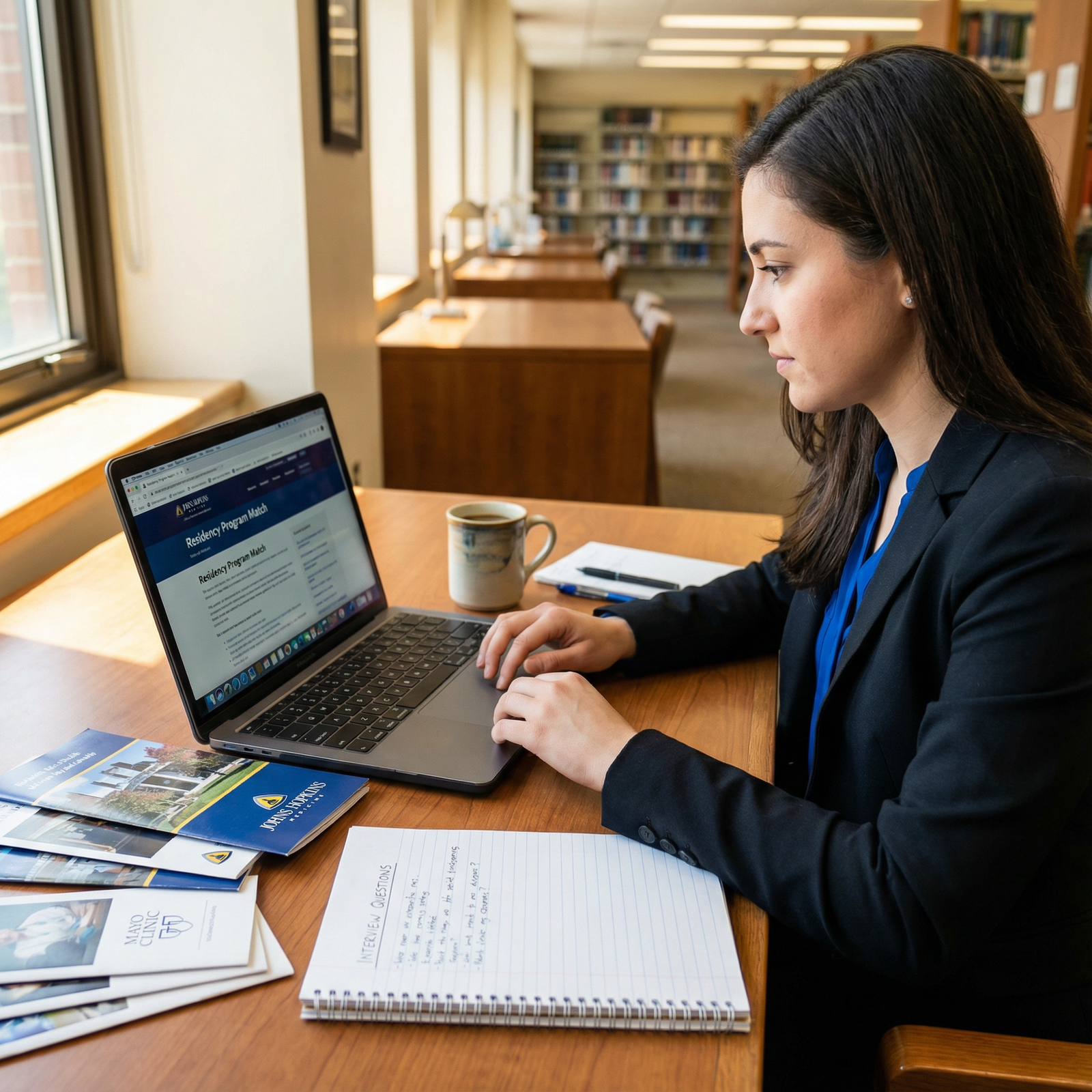
How to Research Programs Effectively
Use these sources:
Program Website
- Mission statement and values
- Curriculum structure (e.g., 4+1, night float, subspecialty rotations)
- Resident demographics (percentage of IMGs, DOs, etc.)
- Research or community outreach opportunities
- Call schedule, wellness initiatives
FREIDA and NRMP Data
- Number of positions
- Historical fill rates
- Percentage of IMGs in recent years (if available)
- Program type (community, university, hybrid)
Social Media & Virtual Presence
- Instagram, Twitter/X, or YouTube accounts showcasing residents and events
- Virtual open house recordings or information sessions
Word of Mouth
- Ask upper-year students or alumni from your school who matched there
- Reach out (professionally) to current residents via LinkedIn or email for honest perspectives
Create a Program Snapshot Sheet
For each program, create a 1-page summary (digital or printed) including:
- Program name, location, type
- Why I’m interested in this program (3–4 bullet points)
- Unique features (curriculum, patient population, research niche)
- Potential concerns or questions I want to explore
- Notable faculty or initiatives aligned with my interests
Use this during your pre-interview review the night before each interview; it’s an efficient way to refresh your memory and show up informed.
Mastering Common Residency Interview Questions (with an IMG Lens)
You will see many resources listing interview questions residency programs tend to ask. For US citizen IMGs, the key is to prioritize and tailor your preparation.
Core Questions You Must Be Ready For
At minimum, prepare structured, practiced (but not robotic) answers to:
- “Tell me about yourself.”
- “Why this specialty?”
- “Why did you go to medical school abroad?”
- “Why are you applying to this program?”
- “What are your strengths and weaknesses?”
- “Tell me about a challenge or failure and what you learned.”
- “Describe a conflict with a team member and how you handled it.”
- “Tell me about a difficult patient interaction.”
- “What are your career goals?”
- “Do you have any questions for us?”
As an American studying abroad, #3 is especially critical. You should rehearse this until you can deliver it smoothly, confidently, and without apology.
Example Framework: “Why Did You Go to Medical School Abroad?”
You might structure your answer like this:
- Context: Briefly explain the decision.
- Positive framing: Highlight the strengths of your school and training.
- Bridge-building: Describe how you complemented your education with US-focused experiences.
- Outcome: Conclude with how this path has prepared you for residency.
Example (condensed):
I knew early on that I wanted to be a physician, and when I was applying to medical school, I explored both US and international options. My school abroad offered a strong, systems-based curriculum taught in English, early clinical exposure, and a diverse patient population, which really appealed to me.
Because I always planned to return to the US for residency, I sought out US clinical experiences, worked closely with American-trained faculty, and tailored my preparation to the USMLE exams.
Training abroad pushed me to be adaptable and resourceful and involved caring for patients from many cultural and socioeconomic backgrounds. That combination of global perspective and deliberate preparation for the US system has made me very excited and ready to continue my training here.
Using the STAR Method for Behavioral Questions
For behavioral questions (“Tell me about a time when…”), the STAR method helps keep your answers clear:
- Situation – Brief background
- Task – What you needed to do or what the problem was
- Action – What you did specifically
- Result – Outcome and what you learned
Example prompt: “Tell me about a conflict with a team member.”
As a US citizen IMG, it’s powerful to choose examples that also demonstrate:
- Cross-cultural communication
- Professionalism in a new environment
- Flexibility and self-awareness
Preparing Specialty-Specific Questions
Also prepare for specialty-related interview questions residency programs may ask, such as:
- Internal Medicine: “Tell me about a complex patient you managed.”
- Family Medicine: “Describe a time you dealt with social determinants of health.”
- Pediatrics: “How do you handle anxious parents?”
- Psychiatry: “How do you care for patients who may not want help?”
- Surgery: “Tell me about a time you worked under pressure in the OR or procedural setting.”
Use your IMG background strategically—choose examples from both abroad and US rotations to show breadth.
Deliberate Practice: Mock Interviews and Feedback
Knowing how to prepare for interviews is not just about reading questions; it’s about saying your answers out loud, getting feedback, and refining your delivery.
Set Up Structured Mock Interviews
Aim for at least:
- 2–3 full-length mock interviews before interview season starts.
- Additional short practice sessions to refine specific answers.
Possible sources:
- Your medical school’s career office or dean’s office
- Alumni who matched into your target specialty
- Mentors or attendings from your US clinical experiences
- Peers applying in the same cycle (peer mock interviews work surprisingly well)
- Online coaching services (paid) if affordable and truly necessary
Ask them to simulate a real interview:
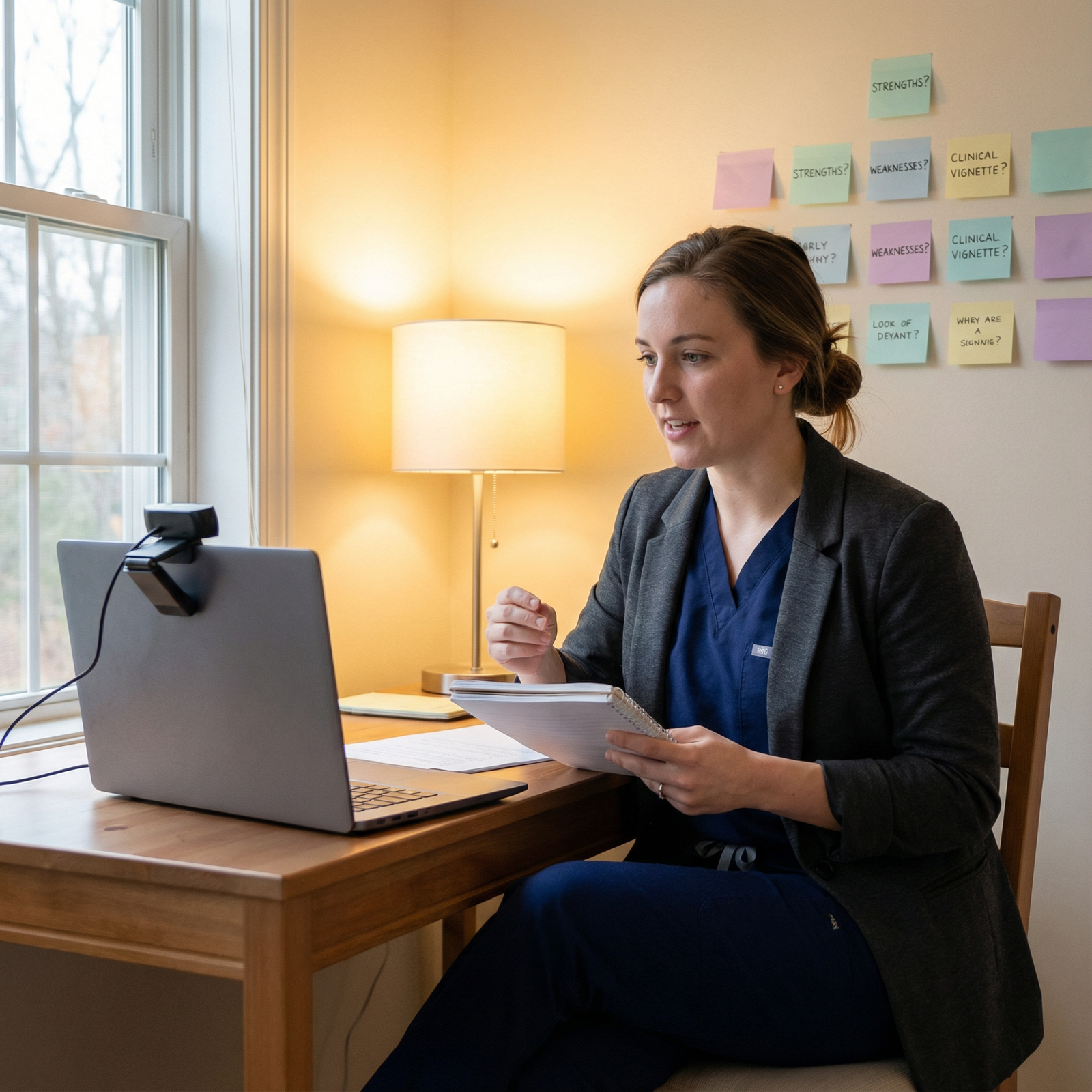
- Turn on video (for virtual interview practice).
- Dress in interview attire.
- Have them use a standard list of residency interview questions plus IMG-specific ones.
- Time the session (e.g., 30–45 minutes).
- Request 10–15 minutes of candid feedback at the end.
Record and Review Yourself
If possible, record your mock interviews (with permission):
- Watch your body language—eye contact, posture, facial expressions.
- Note speech habits—talking too fast, filler words, overly long answers.
- Evaluate whether your key messages about being a US citizen IMG are coming through clearly and confidently.
Aim to make your answers:
- Concise (1–2 minutes for most questions)
- Specific (real stories, not vague generalities)
- Positive (focus on growth, not complaints)
Practice “Spontaneous” Conversation Too
Some interviews are conversational rather than structured with formal questions. Practice:
- Explaining your path and interests in a natural, relaxed way.
- Pivoting from casual questions (“How did you like living in [country]?”) to substantive topics that still highlight your strengths and experiences.
Technical and Logistical Preparation (Especially for Virtual Interviews)
As a US citizen IMG, you may be conducting many (or all) interviews virtually, often across different time zones. Pre-interview logistics can make or break even the most well-prepared candidate.
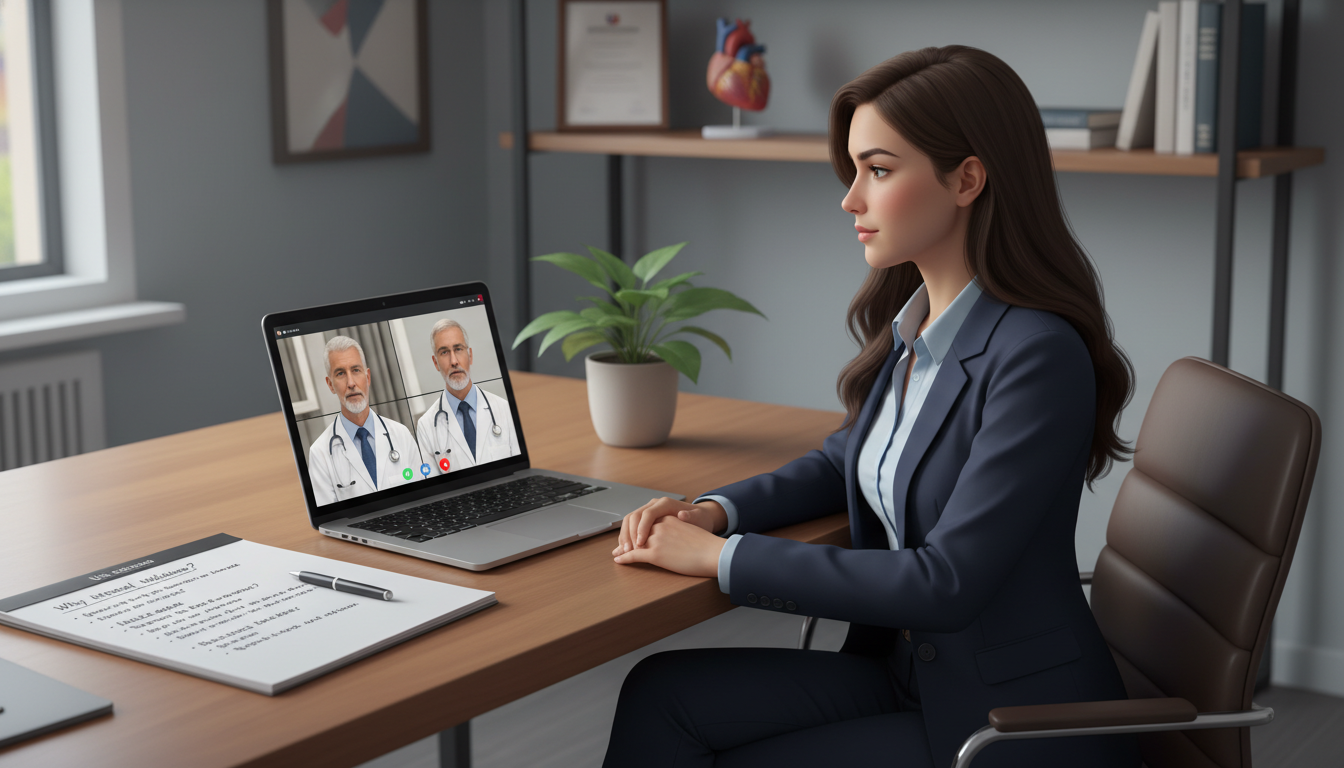
Optimize Your Virtual Interview Setup
Well before interview season:
Technology Check
- Reliable laptop or desktop (avoid using only a phone).
- Stable internet connection (consider a backup hotspot).
- Working webcam and microphone (external microphone or headphones if needed).
- Install and test Zoom, Microsoft Teams, Webex, or other platforms programs commonly use.
Environment
- Neutral, uncluttered background (plain wall or simple bookshelf).
- Good lighting (window in front of you, or ring light).
- Quiet space—coordinate with household members, roommates, or dorm mates.
- Chair and setup that allow you to sit upright comfortably for several hours.
Professional Appearance
- Business-professional attire (suit jacket, professional blouse/shirt).
- Avoid loud patterns or distracting accessories.
- Test how your outfit looks on camera.
Run a full rehearsal: sit in your interview clothes, open Zoom, check camera framing, sound, and lighting.
Manage Time Zones and Scheduling
As an American studying abroad, your interviews may be scheduled in US time zones that translate to very early mornings or late nights where you are.
Pre-interview strategies:
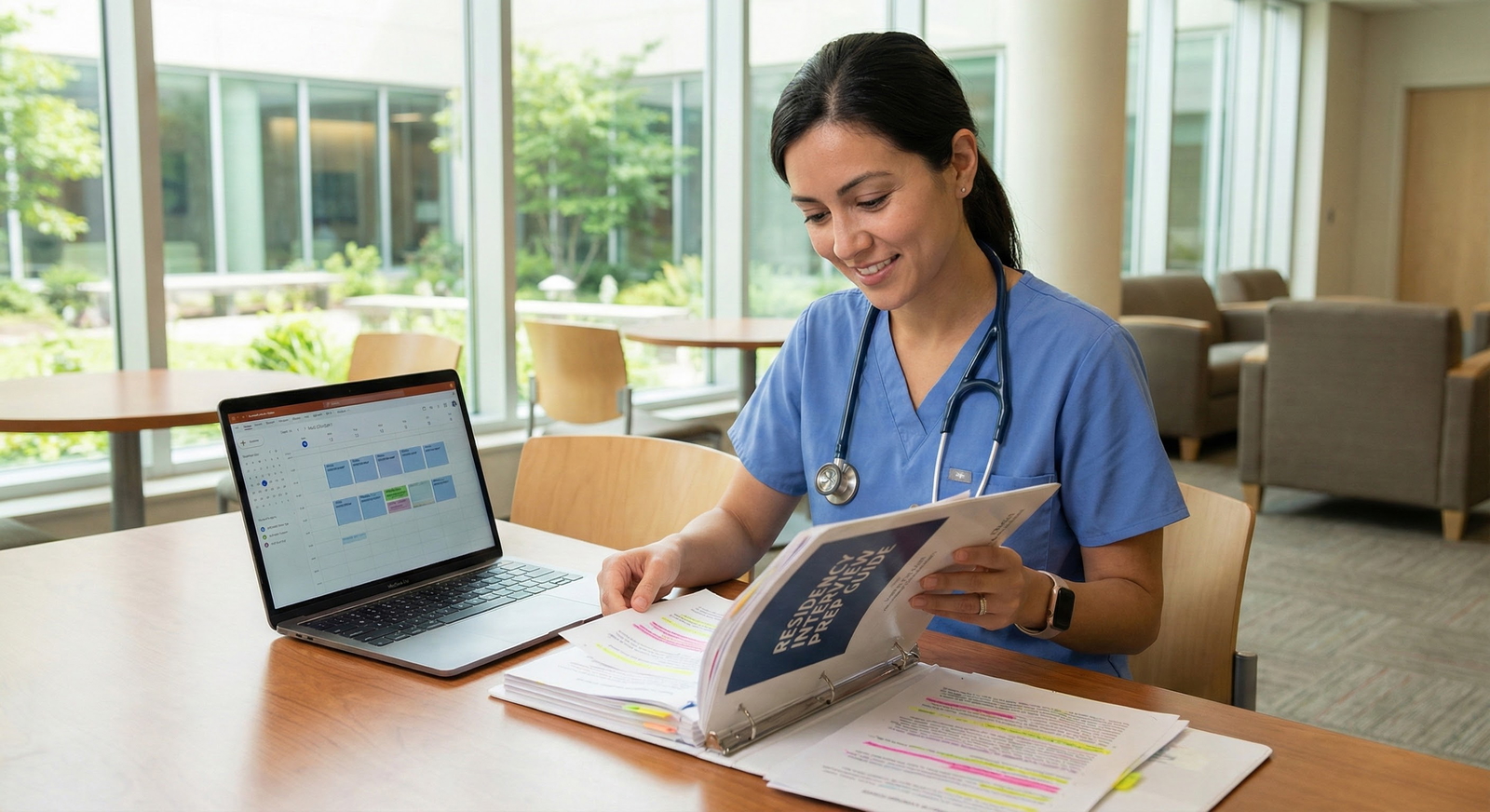
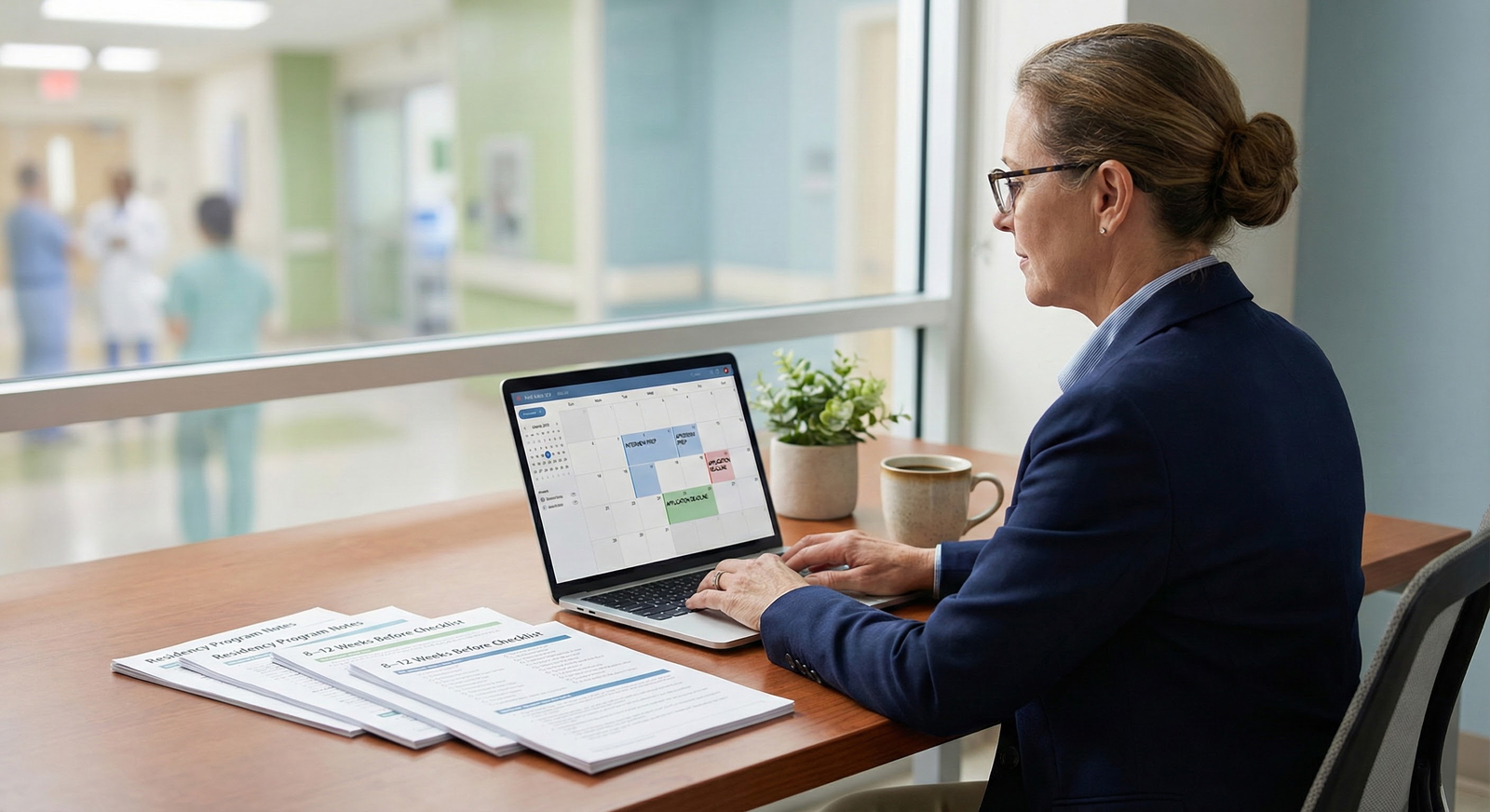
- Build a master calendar with all dates and times converted into your local time.
- Double-check time differences during daylight savings transitions.
- Block off buffer time before and after each interview.
- If your local timing is extreme (e.g., 1 AM), plan:
- Sleep schedule adjustments 1–2 days before.
- Light meals, caffeine use, and breaks to maintain alertness.
When confirming interviews, always confirm in US time zone and your local time to avoid confusion.
Prepare Your Materials and Workspace
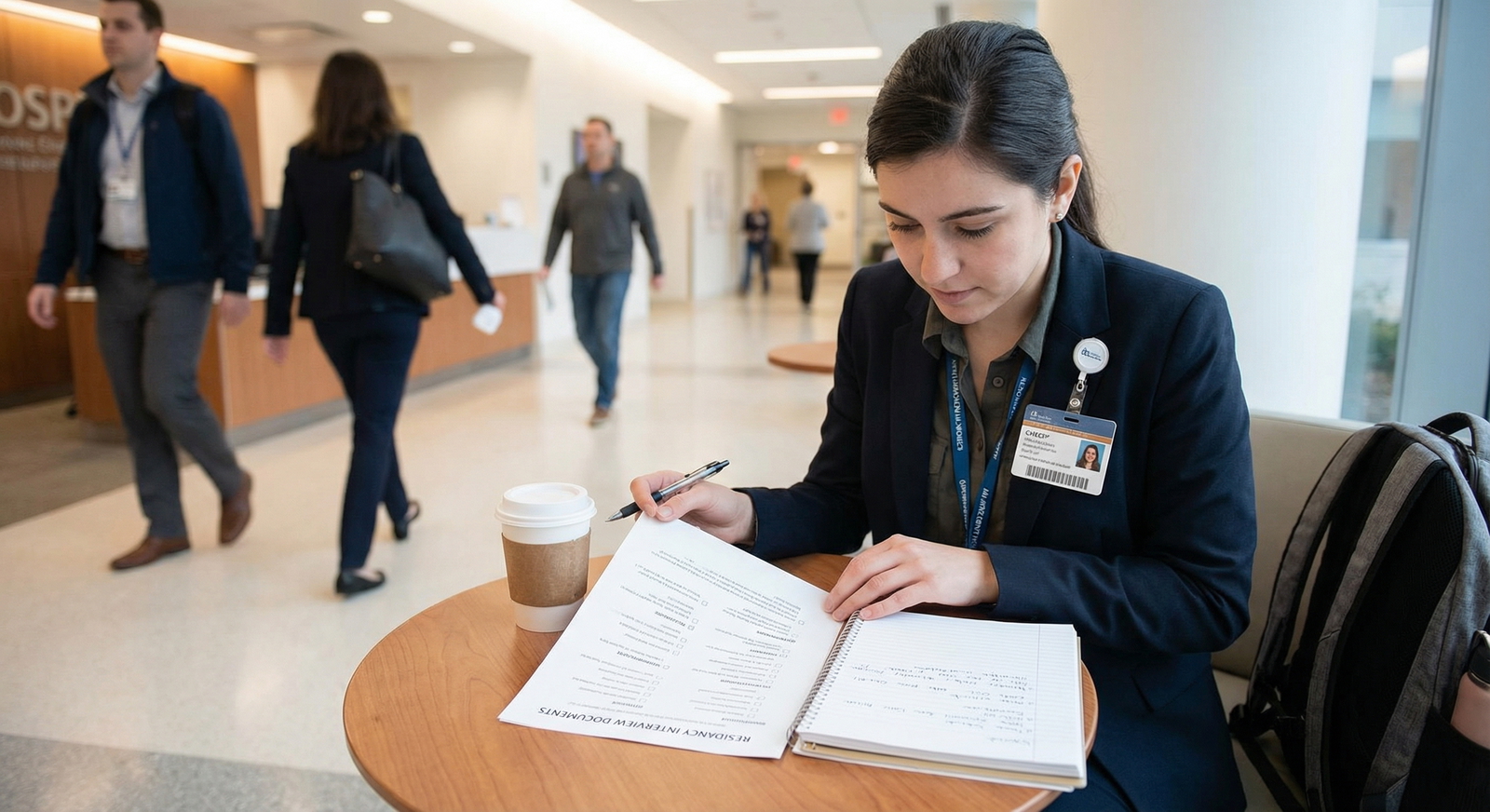
The day before each interview, lay out:
- Printed or digital program snapshot sheet
- A copy of your ERAS application and personal statement
- List of questions to ask the interviewer
- Pen and notepad
- Water within easy reach
Keep your phone on silent and out of view.
Crafting Intelligent Questions for Interviewers
Residency interview preparation isn’t complete without planning what you will ask them. Your questions reveal:
- Your understanding of the program
- Your priorities and values
- How serious you are about matching there
What Programs Want to See in Your Questions
As a US citizen IMG, thoughtful questions can help show:
- You understand US training structures.
- You’re thinking about education, patient care, and well-being, not just visas or logistics (though those are important too).
- You have genuine interest in their specific program.
Examples of Strong Questions to Ask
You can tailor these to each program:
- “How does your program support interns who may come from different medical education systems, including IMGs?”
- “Can you describe how mentorship works here—for example, for residents interested in [hospital medicine / fellowship / primary care / research]?”
- “What qualities do you think distinguish residents who thrive in this program?”
- “How has the program adapted its curriculum or wellness initiatives in response to resident feedback?”
- “What opportunities are available for residents to be involved in quality improvement or research?”
- “How are residents supported when they experience challenging clinical situations or burnout?”
Avoid questions that can easily be answered by a quick website scan—for instance, basic call schedule details or salary (unless you need clarification beyond what’s publicly available).
Mental and Emotional Preparation: Confidence Without Overcompensation
Residency interviews are stressful for everyone, but IMGs often carry extra anxiety—about bias, competitiveness, or perceived disadvantages.
Normalize Your Anxiety
Before interviews:
- Recognize that nervousness is expected and often interpreted as caring about the outcome.
- Use that energy productively: channel it into preparation and practice, not catastrophizing.
Develop a Confidence Script
Have a short script you can repeat to yourself the morning of the interview, such as:
- “I have earned the right to be here. This program saw something in me that they liked.”
- “I will focus on being authentic, professional, and engaged.”
- “I am not here to be perfect; I am here to show who I am and what I bring.”
Focus on What You Control
You cannot control:
- Program-specific IMG biases
- The competitiveness of the cycle
- How other applicants perform
You can control:
- Your preparation
- Your punctuality and professionalism
- The clarity and positivity of your narrative
- How you respond to challenging questions
By the time interview day arrives, your goal is to be able to say, “I have done everything reasonable to prepare.”
FAQs: Pre-Interview Preparation for US Citizen IMGs
1. As a US citizen IMG, will interviewers always ask why I went abroad? How should I handle it?
Many will, either explicitly (“Why did you attend medical school abroad?”) or indirectly (“Tell me about your path to medicine”). Prepare a clear, positive answer that:
- States your reasons briefly and confidently.
- Highlights the strengths of your international training.
- Emphasizes your deliberate preparation for the US system (USMLE, USCE).
- Ends with why you are now well-prepared for residency in the US.
Avoid sounding apologetic, defensive, or blaming the US system. Frame it as a thoughtful decision that helped you grow.
2. How many mock interviews should I do before the season starts?
Aim for at least 2–3 structured mock interviews with feedback, plus shorter sessions to practice specific answers. Quality is more important than quantity; one excellent mock interview with a knowledgeable mentor who gives candid feedback can be more valuable than ten superficial ones.
3. What’s the best way to practice answering “Tell me about yourself”?
Write down a 1–2 minute answer that:
- Starts with where you are now (US citizen IMG in [country/school], applying to [specialty]).
- Briefly covers your background and key steps on your path to medicine.
- Highlights 2–3 strengths or themes (e.g., resilience, leadership, interest in underserved care).
- Ends with why you’re excited about this specialty and residency training in the US.
Say it out loud multiple times, record yourself, and refine it until it feels structured but natural.
4. How early should I start residency interview preparation as a US citizen IMG?
Start your pre-interview preparation at least 1–2 months before interview invitations typically begin:
- Clarify your story and specialty motivations.
- Draft and practice answers to core questions.
- Set up your virtual interview environment.
- Complete 1–2 mock interviews early, then refine as invites arrive.
- Build your program snapshot sheets as you apply, so you’re not scrambling later.
By spreading out the work, you’ll enter interview season prepared, not panicked, and far better positioned to showcase your strengths as a US citizen IMG.