Understanding the Transitional Year Residency Landscape
Transitional year residency (TY program) interviews are distinctive because the year itself is unique. Before you work on how to prepare for interviews, you need to be clear on what programs are evaluating, and how TY fits into your long-term plans.
What Is a Transitional Year Residency?
A transitional year residency is a 1-year, broad-based clinical training program designed primarily for applicants who will continue into:
- Advanced specialties (e.g., Radiology, Anesthesiology, Dermatology, Neurology, PM&R)
- Certain subspecialty tracks (e.g., some Ophthalmology, Radiation Oncology)
- Physician-only pathways that require a preliminary or transitional year
Compared with categorical programs, TY programs often emphasize:
- Balanced exposure to multiple disciplines (medicine, surgery, emergency medicine, electives)
- Strong generalist clinical skills
- Flexibility in schedule and electives
- Professionalism and adaptability across varied clinical settings
What TY Programs Are Looking For
Before serious residency interview preparation, clarify the attributes TY program directors tend to prioritize:
- Reliability and professionalism: You will rotate across many services; programs need someone dependable.
- Clinical readiness: Solid foundation in basic clinical reasoning and patient care.
- Team fit and attitude: TY residents often support multiple departments; adaptability and collegiality are crucial.
- Alignment with career path: They want to see a coherent connection between your ultimate specialty and why a TY program makes sense.
- Resilience and wellness awareness: Many TY programs are busy; programs are wary of burnout and want to see healthy coping strategies.
Having this framework in mind will shape your answers to interview questions residency committees ask and how you portray your experiences.
Step 1: Strategic Self-Assessment Before Interview Season
Effective pre-interview preparation begins with looking inward. You need a clear, concise professional narrative that explains who you are, why a transitional year residency makes sense for you, and how you will add value to the program.
Clarify Your Career Story
Articulate these elements in 2–3 sentences each:
Your medical identity
- What kind of clinician are you becoming?
- What are your core values (e.g., curiosity, service, teamwork, innovation)?
Your long-term specialty goal
- Specify: “I am pursuing Radiology / Dermatology / Anesthesiology…”
- Emphasize what attracts you to that specialty.
Why a TY program (vs. a standard preliminary year)?
- Example angles:
- Breadth of exposure before specialization
- Desire to strengthen clinical foundations
- Interest in electives that support your specialty (e.g., ICU before Anesthesia)
- Value placed on flexibility and schedule variety
- Example angles:
Your “value proposition” for a TY program
- Two or three traits, backed by evidence:
- “I am dependable under pressure.”
- “I build strong, collaborative relationships with nurses and staff.”
- “I’m proactive about teaching and supporting peers.”
- Two or three traits, backed by evidence:
Write this out and refine it. This becomes the backbone of multiple answers—“Tell me about yourself,” “Why this program?”, and “Why a transitional year residency?”
Align Your Experiences With TY Priorities
List 5–7 key experiences that show you are ready for a transitional year:
- Rotations where you handled high patient volume or complex cases
- Situations where you rotated between different departments or roles
- Leadership in multidisciplinary teams or student groups
- Times when you adapted quickly to a new system, EMR, or institution
- Experiences that demonstrate resilience and healthy coping
For each experience, jot down:
- Context: What was happening?
- Your role: What did you actually do?
- Outcome: What changed because of your contributions?
- Reflection: What did you learn, and how will it help you as a TY resident?
You’ll use these stories repeatedly in behavior-based interview questions.
Step 2: Deep-Dive Research on Transitional Year Programs
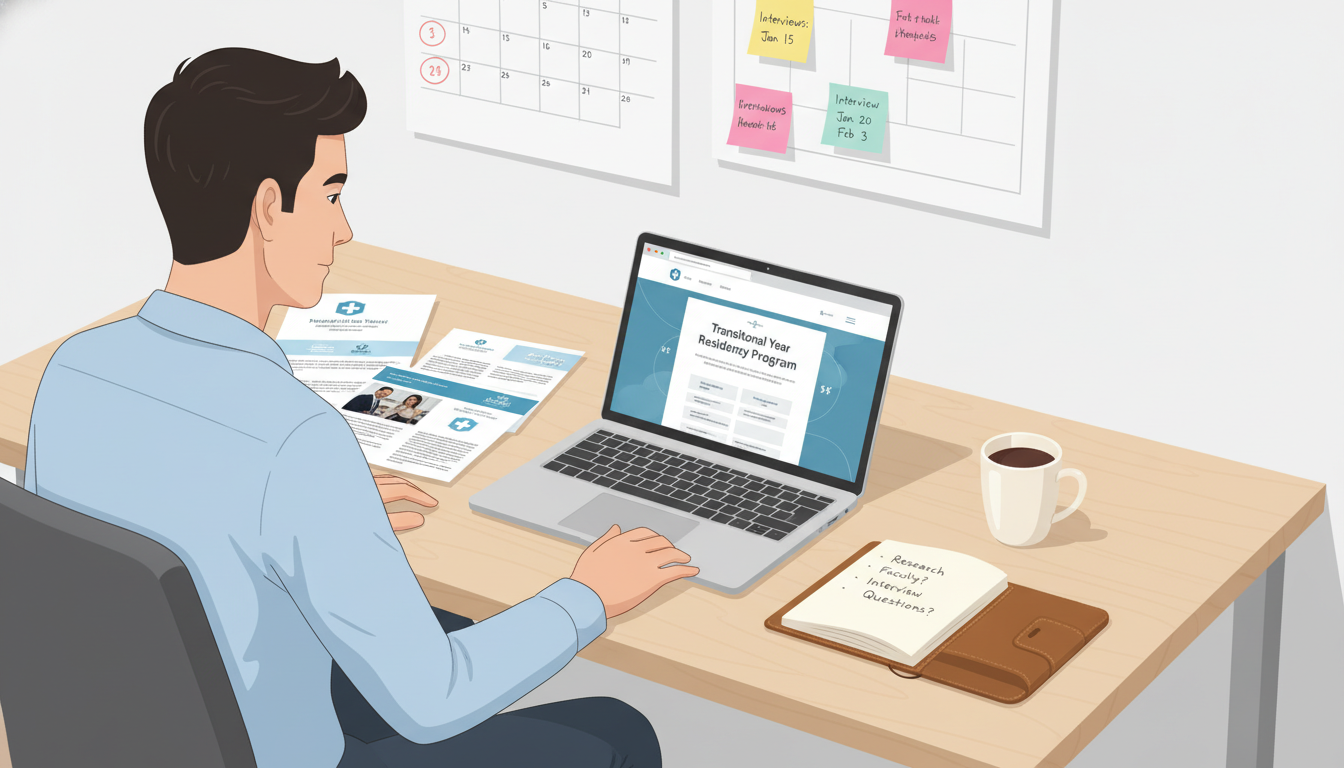
One of the most underused strategies in how to prepare for interviews is targeted research. Strong pre-interview preparation means going far beyond a quick skim of the website.
Understand Each Program’s Structure and Culture
As you review each TY program, focus on:
Curriculum and rotation distribution
- Proportion of:
- Internal Medicine
- Surgery
- Emergency Medicine
- ICU
- Electives
- Night float vs. 24-hour calls
- Continuity clinics or longitudinal experiences
- Proportion of:
Elective flexibility
- Are there dedicated elective blocks?
- Are specialty-specific electives available (e.g., Cardiology for future Anesthesiologists, Neurology for future Radiologists)?
- Any research or academic time?
Workload and wellness
- Explicit mention of wellness initiatives
- Resident support (mentorship, check-ins, retreats)
- Duty hours and call schedules
Culture and reputation
- Do they emphasize autonomy? Support? Teaching?
- Is the program integrated with categorical residents or relatively independent?
- How do they describe the “ideal resident”?
Graduate destinations
- Are many graduates matching into your specialty?
- Any historical connection to your advanced program?
Use these sources:
- Official program websites and online brochures
- FREIDA / AAMC / NRMP resources
- Social media (Instagram, Twitter/X, LinkedIn) for resident life snapshots
- Program or department videos and webinars
Create a Program-Specific Interview Sheet
For residency interview preparation, build a 1-page document for each TY program you interview with. Include:
- Program basics: Location, hospital type, size of TY class
- Curriculum highlights: Unique rotations, electives, ICU structure
- What you like about it (3–5 bullets):
- Example: “Strong elective time in ICU and ED—ideal for future Anesthesia.”
- Your potential contributions (2–3 bullets):
- Example: “Experience designing peer teaching workshops that could be adapted for intern noon conferences.”
- Program-specific questions to ask:
- Example: “How are TY residents integrated with categorical residents on medicine wards?”
Print or save this as a quick reference. Review it the night before and morning of each interview so your responses feel tailored rather than generic.
Step 3: Mastering Common Residency Interview Questions (TY-Focused)
Pre-interview preparation should include both content and delivery practice. Identify likely interview questions residency committees will ask, and adapt your answers to highlight why you’re an excellent fit for a transitional year.
Foundational Questions to Prepare
“Tell me about yourself.”
- Structure:
- 1–2 lines about your background (where you grew up or trained)
- 2–3 lines about your medical interests and key strengths
- 1–2 lines linking to your TY and specialty goals
- Example (for a future Radiologist):
I grew up in a small town and completed medical school at XYZ, where I discovered I really enjoy thinking through complex diagnostics and collaborating with teams across services. Clinically, I’ve gravitated toward rotations where I can synthesize data and help guide management—particularly during my sub-internship and radiology elective. I’m applying for a transitional year because I want broad, hands-on clinical experience and strong ward skills before starting Radiology, and I’m especially drawn to programs that emphasize diverse rotations and strong interdisciplinary teamwork.
- Structure:
“Why a transitional year residency?”
- Emphasize:
- Breadth of training before specialization
- Desire for robust clinical foundation
- How this aligns with your advanced specialty
- Avoid: “I’ve heard TY programs are easier.” Even if you value work-life balance, frame it professionally.
- Emphasize:
“Why our TY program?”
- Use your program-specific sheet:
- Mention 2–3 concrete details about the curriculum or culture.
- Link them directly to your goals and strengths.
- Use your program-specific sheet:
“What are your strengths?”
- Choose 2–3 strengths relevant to TY:
- Reliability
- Communication
- Adaptability to different teams and services
- Always accompany each strength with a brief example.
- Choose 2–3 strengths relevant to TY:
“What are your weaknesses?”
- Use a growth-oriented, non-fatal flaw:
- Over-committing, difficulty delegating, discomfort asking for help early.
- Explain:
- Specific steps you’ve taken to address it.
- Concrete improvement.
- Use a growth-oriented, non-fatal flaw:
Behavioral and Situational Questions
Residency interview preparation must include behavior-based questions, which are almost guaranteed. Use the STAR or CAR framework (Situation/Task – Action – Result, or Context – Action – Result).
Common behavioral questions for TY:
- “Tell me about a time you had to adapt quickly to a new environment or system.”
- “Describe a challenging patient interaction and how you handled it.”
- “Tell me about a time you had a conflict with a team member. How did you resolve it?”
- “Describe a situation when you were overwhelmed. What did you do?”
For each, pick scenarios that highlight:
- Transition between services or hospitals
- Working under time pressure
- Collaborating across disciplines
- Owning mistakes and correcting them responsibly
TY-Specific Angles to Keep in Mind
Because transitional year residents move across many departments, interviewers will often probe:
- How you handle ambiguity: “What do you do when you’re unsure of a plan?”
- How you integrate into different team cultures quickly
- How you manage frequent schedule changes or calls
When practicing your answers, weave in:
- “On my surgery rotation, I initially struggled with…”
- “In the ED, I learned to quickly assess and prioritize…”
- “Moving between ICU and wards taught me to adjust my communication style…”
This signals that you understand what the transitional year residency entails.
Step 4: Building a Structured Practice Plan
Knowing how to prepare for interviews is only useful if you implement it systematically. Effective pre-interview preparation requires repetition, feedback, and refinement.
Stepwise Practice Strategy
Script bullet points, not full speeches
- For each core question, write:
- 3–4 short bullets (key ideas, not full sentences).
- This prevents you from sounding robotic while ensuring you hit your main points.
- For each core question, write:
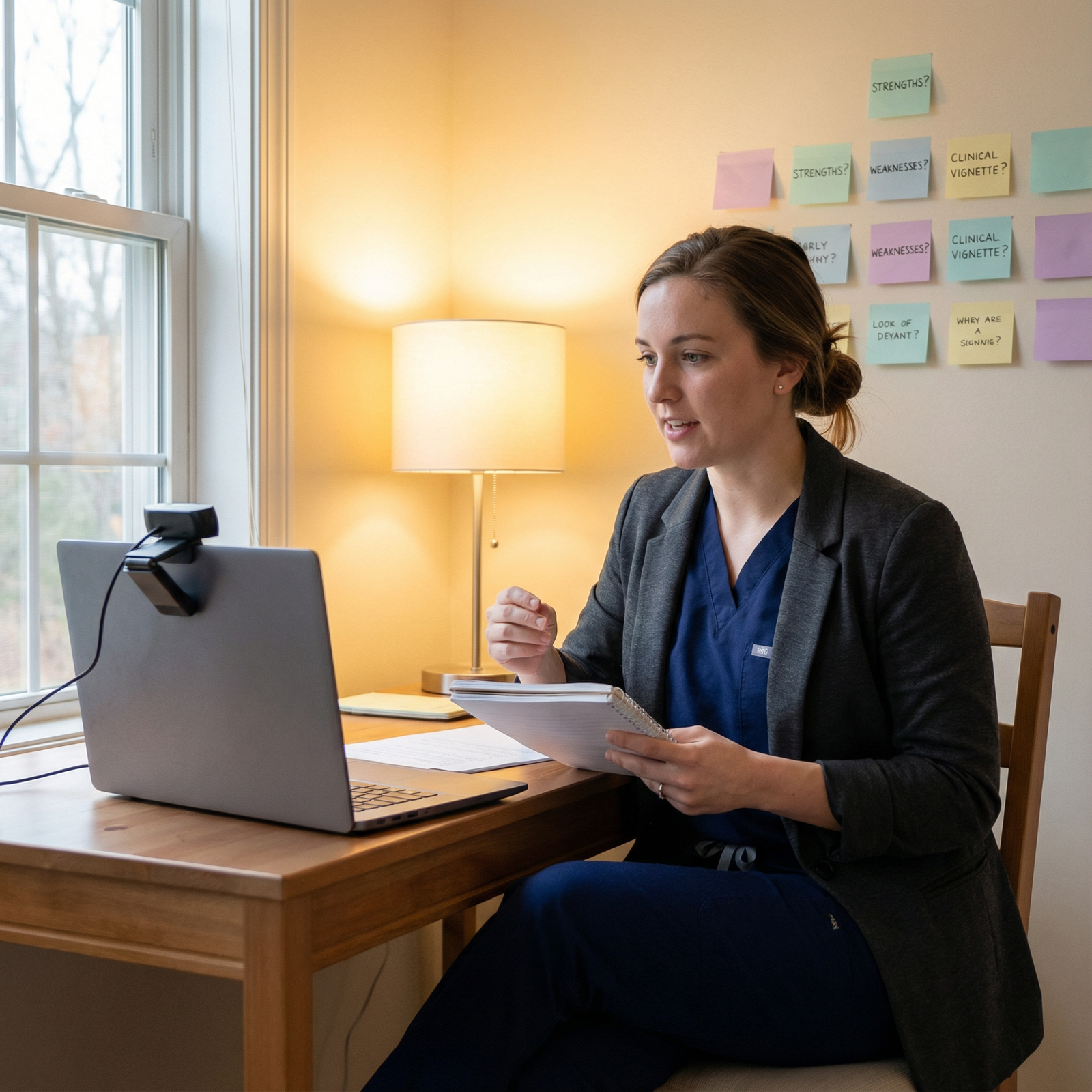
Record yourself (video and audio)
- Answer 3–5 questions at a time.
- Review:
- Filler words (“um,” “like”)
- Eye contact (camera lens, not the screen)
- Tone (confident but not arrogant)
- Pacing (avoid talking too fast under stress)
Simulate mock interviews
- With:
- Peers also applying
- Faculty advisors
- Career or residency advisors
- Ask them to role-play:
- Friendly interviewer
- Neutral, quiet interviewer
- Rapid-fire questioner
- With:
Deliberate refinement
- After each mock:
- Note 2 things to keep.
- Note 2 things to improve.
- Update bullet points accordingly.
- After each mock:
Handling Difficult Questions
Prepare in advance for more sensitive interview questions residency committees may pose:
- Low scores / leaves of absence / gaps:
- Be honest, concise, and forward-looking.
- Emphasize what you learned and how you changed your approach.
- “What will you do if you don’t match into your advanced specialty?”
- Demonstrate realistic planning without sounding pessimistic.
- Example:
I’m fully committed to pursuing Anesthesiology and have built my training and research around it. If I didn’t match, I would first seek feedback from program directors, strengthen my application with additional clinical or research experience in the field, and reapply. Regardless, during my transitional year I’d give 100% to my patients and teams, because those skills are fundamental in any path I might take.
Having these pre-thought responses makes you more composed when such questions arise.

Step 5: Logistics, Professionalism, and Interview-Day Readiness
Pre-interview preparation isn’t just about content; it’s also about logistics and professional impressions—especially in the era of virtual interviews.
Organize Your Interview Schedule and Materials
Create a master spreadsheet:
- Program name and type (TY vs. preliminary)
- Date and time (with time zones)
- Interview format (virtual vs. in-person, platform used)
- Interviewers’ names and titles (if provided)
- Key program highlights and notes
- Thank-you notes status (sent/not sent)
Prepare copies of your core documents:
- ERAS application
- Personal statement(s)
- CV
- List of research projects and presentations
- List of hobbies/interests (you’ll often be asked)
Review your own application thoroughly; you should never be surprised by something you wrote when asked about it.
Professional Appearance and Environment (Especially for Virtual)
For virtual interviews—standard for many TY programs:
Attire:
- Professional: suit jacket or blazer, dress shirt/blouse.
- Test the colors with your webcam to avoid odd glares or transparency.
Background:
- Neutral, uncluttered background (wall, bookshelf, or virtual background if needed).
- Avoid distractions (people walking behind you, bright windows).
Technology check:
- Test platform (Zoom, Teams, Thalamus, etc.) a day before.
- Check:
- Internet stability (consider wired connection if possible).
- Camera angle (eye-level, not looking down).
- Microphone clarity and volume.
- Lighting (natural light facing you or a soft ring light).
Have a backup plan:
- Phone numbers for program coordinator
- Secondary device (tablet/phone) with app installed
Mental and Physical Preparation
In the 24–48 hours before each interview:
- Sleep: Prioritize a full night’s rest.
- Nutrition: Eat light but adequate meals; avoid too much caffeine.
- Warm-up: Do a 5–10-minute vocal and posture warm-up:
- Deep breathing
- Practice a few answers out loud
- Stretching to release tension
Prepare a short pre-interview ritual:
- Skim your one-page program sheet.
- Review your top 3 strengths and 3 experiences.
- Remind yourself of one positive feedback you’ve received clinically.
This helps you show up grounded rather than anxious.
Preparing Thoughtful Questions to Ask Programs
Asking insightful questions is an important part of pre-interview preparation and signals authentic interest. Tailor your questions to transitional year residency themes:
Examples:
Curriculum and training:
- “How are TY residents integrated into multidisciplinary teams on the wards and in the ED?”
- “How much flexibility do TY residents have in designing electives relevant to their advanced specialties?”
Support and feedback:
- “How is feedback delivered to TY residents, and how often do formal evaluations occur?”
- “Are there mentorship opportunities specifically for TY residents?”
Resident life and wellness:
- “What strategies has the program found most effective in supporting TY residents’ wellness, especially given the frequent rotation changes?”
- “How does the program foster community among TY residents and categorical residents?”
Avoid questions you could easily answer by reading the website; instead, use those as a starting point and ask about details or implementation.
Frequently Asked Questions (FAQ)
1. How is residency interview preparation different for a transitional year compared to categorical programs?
For a transitional year residency, preparation must emphasize:
- Your long-term specialty goal and how a broad-based year fits into it.
- Adaptability across multiple services.
- Your ability to integrate quickly into new teams and workflows.
While many interview questions residency committees ask are similar (e.g., “Tell me about yourself,” “Strengths and weaknesses”), TY interviews more often probe your flexibility, resilience, and clarity on why a 1-year generalist experience is important to your career trajectory.
2. How early should I start pre-interview preparation for TY programs?
Begin structured preparation at least 4–6 weeks before your first interview:
- Week 1–2: Self-assessment and narrative building; identify key experiences.
- Week 2–3: Program research; create your program-specific sheets.
- Week 3–4: Practice core questions, behavioral responses, and mock interviews.
- Week 4–6: Refine answers, polish delivery, and finalize logistics and technology prep.
Starting early allows you to adjust your strategy based on feedback and feel more natural and confident by the time interviews arrive.
3. What are common mistakes applicants make when interviewing for TY programs?
Frequent pitfalls include:
- Vague or generic answers when asked “Why this TY program?” or “Why a transitional year?”
- Overemphasizing lifestyle without framing it in terms of sustainable performance and patient care.
- Not knowing their own application well, leading to hesitation when asked about research or experiences.
- Insufficient understanding of the curriculum, suggesting you haven’t done your homework.
- Lack of clear career direction—not necessarily needing a fully fixed plan, but you should articulate a coherent rationale for your intended specialty and the role of a TY program.
4. How can I show programs that I’ll be a strong team player during my transitional year?
Highlight concrete examples that demonstrate:
- Team collaboration: Times you worked closely with nurses, residents, or interprofessional teams to solve a problem.
- Communication: Situations where you clarified plans, updated families, or relayed critical information efficiently.
- Adaptability: Moving between different rotations or hospitals and quickly becoming effective.
- Reliability: Moments when your team relied on you during busy shifts, call nights, or high-volume days.
Then, explicitly connect these experiences to what TY residents actually do: supporting multiple departments, rotating frequently, and providing consistent, high-quality care in varied settings.
By approaching pre-interview preparation strategically—clarifying your narrative, researching programs deeply, crafting thoughtful answers, and managing logistics—you’ll enter each transitional year residency interview poised, prepared, and able to convey exactly why you’re the kind of resident they want on their teams.