
Understanding the Urology Residency Interview Landscape
Urology is among the more competitive specialties in the residency match, and the urology residency interview process reflects that. Unlike many other specialties, the urology match occurs earlier (through the AUA Match), compressing the timeline for application review, interview offers, and decision-making. Consequently, pre-interview preparation is not optional—it is a core component of a successful urology match strategy.
Before you practice answers or book flights, you need a clear understanding of:
- The purpose of the interview: Programs aim to assess your fit, professionalism, communication skills, maturity, and genuine interest in urology—not just your test scores.
- What is at stake: In a small specialty, impressions are shared. A strong, polished interview season can significantly improve your chances, especially if your application has any relative weaknesses.
- Your goals for each interview:
- Demonstrate that you understand what a career in urology entails.
- Show you are a collegial, hard-working team member who will thrive in their culture.
- Communicate your story clearly: who you are, why urology, and where you want your career to go.
- Gather enough information to create an accurate rank list.
This guide focuses on the pre-interview phase—everything you should do before you log into a virtual room or walk into a conference space—to position yourself for a successful urology residency interview season.
Laying the Foundation: Know Your Story Inside and Out
Interviewers frequently comment that the best applicants are not those with the “flashiest” CVs, but those who know themselves and can convey a coherent, authentic narrative. Pre-interview preparation starts with your own story.
Clarify Your “Why Urology?”
You will almost certainly be asked some variation of:
- “Why urology?”
- “What drew you to urology over other surgical specialties?”
- “When did you decide on urology?”
Reflect deeply before you practice an answer:
Identify key experiences
List 3–5 meaningful experiences that shaped your interest in urology:- A specific patient encounter (e.g., counseling a prostate cancer patient).
- A rotation or case that you found especially meaningful.
- A mentor who modeled the type of surgeon-physician you want to be.
- An exposure to urologic oncology, reconstruction, endourology, or other subspecialties.
- Experiences that highlight continuity of care, minimally invasive surgery, or quality-of-life impact.
Link experiences to values
For each experience, ask:- What aspects of urology appealed to me? (e.g., procedures, technology, anatomy, long-term patient relationships).
- What did I learn about myself? (e.g., I like hands-on, fast-paced procedures; I value having measurable impact on quality of life).
Synthesize into a concise narrative
Aim for a 60–90 second answer that:- Starts with a specific moment or early exposure.
- Connects to themes (hands-on problem-solving, longitudinal care, procedural variety, innovation).
- Ends with how those experiences make you confident and excited about a career in urology.
Example structure:
“My interest in urology began during my third-year surgery clerkship when I scrubbed into a case for obstructing kidney stones. I was struck by how a relatively short, minimally invasive procedure could transform a patient’s quality of life almost immediately. Later, during my sub-internship in urology, I saw the full spectrum—from outpatient stone management to complex oncologic cases—which confirmed that I enjoy a field that combines clinic, OR, and long-term relationships. I also found mentors in urology who valued teaching and teamwork, and I saw myself in that environment. Those experiences made it clear that urology’s blend of technical procedures, longitudinal patient care, and innovation is the right fit for me.”
Audit Your Application: Know Every Detail
Before residency interview preparation can be effective, you must be prepared to discuss anything on your application. Print or open:
- Your ERAS application
- CV
- Personal statement
- Publication list
- Abstracts and posters
- List of activities
For each item, prepare to answer:
- “Tell me more about this.”
- “What was your role specifically?”
- “What did you learn from this experience?”
- “What would you do differently now?”
Create a simple table or document:
| Item (research, volunteer, leadership) | Your role | Challenges | Outcome | Lessons learned |
|---|---|---|---|---|
| Prostate cancer QI project | Data collection, analysis, co-author | Limited data completeness | Abstract/poster at AUA | Value of teamwork, data integrity, QI methods |
This exercise:
- Refreshes your memory.
- Helps you identify themes in your application (leadership, teaching, QI, patient advocacy) that you can emphasize.
- Prevents awkward pauses when asked about “that volunteer project from four years ago.”
Prepare for Common Behavioral Questions
Many urology interviewers use behavioral and situational questions to assess judgment, resilience, and teamwork. Examples include:
- “Tell me about a time you made a mistake.”
- “Describe a conflict with a team member and how you resolved it.”
- “Tell me about a time you received critical feedback.”
- “Describe a stressful situation and how you handled it.”
Use the STAR framework (Situation, Task, Action, Result):
- Situation: Brief context.
- Task: Your role or responsibility.
- Action: What you specifically did.
- Result: Outcome and what you learned.
Pre-write bullet-point STAR responses for at least:
- One mistake or failure.
- One conflict or difficult interpersonal situation.
- One leadership situation.
- One example of resilience (burnout, heavy workload, personal challenge).
- One teaching or mentorship experience.
This level of pre-interview preparation will make you sound thoughtful and composed when questions arise.

Strategic Program Research: Going Beyond the Website
Knowing how to prepare for interviews in a competitive field like urology means researching each program with intention. Interviewers can tell when you’ve done more than just read the homepage.
Build a Program Research Template
Create a standardized one-page template (Word, Google Doc, or spreadsheet) for each program:
Program Snapshot:
- Location and primary hospital system(s)
- Program size: number of residents per year
- Length (6-year with research vs 5-year clinical, if applicable)
- Call structure (night float vs 24-hour call, PGY-1 involvement)
- Notable clinical strengths (e.g., oncology, reconstruction, pediatrics, transplant, stone disease, robotics, FPMRS)
- Research focus (basic science, outcomes, translational, QI)
- Fellowship pathways (on-site fellowships, typical fellowships matched)
Faculty & Interests:
- Program Director: background, areas of interest.
- Key faculty you might like to work with (oncology, reconstruction, endourology, pediatrics, etc.).
- Any overlapping research interests.
Resident Culture & Education:
- Morning conference structure, simulation labs, robotics training.
- Apparent culture (based on residents’ bios, social media, word-of-mouth).
- Diversity and inclusion efforts.
Questions to Ask:
- 4–6 program-specific questions (see below).
Use Multiple Information Sources
Avoid relying solely on official websites. For urology residency, consider:
- Program websites: For curriculum, faculty list, operative volume (if listed), research opportunities.
- Resident bios and photos: For insight into:
- Where residents come from (medical schools, geographic distribution).
- Scholars’ tracks or research emphasis.
- Hobbies and interests → cultural clues.
- Social media (Twitter/X, Instagram):
- Resident life posts.
- Grand rounds, journal clubs, case conferences.
- Program values and engagement with the broader urology community.
- Virtual open houses or meet-and-greets: Many urology programs host these pre-interview; attend when possible and take notes.
- Mentors and recent graduates: Ask for honest insights:
- “How would you describe the surgical training there?”
- “How is the autonomy?”
- “What is the program’s reputation in the urology community?”
Craft Thoughtful, Specific Questions
You’ll almost always be asked, “What questions do you have for me?” Generic questions waste an opportunity to show genuine interest and preparation.
Good questions are:
- Specific to the program.
- Open-ended, encouraging conversation.
- Relevant to your interests and values.
Examples tailored to urology residency:
- “I noticed your residents complete a significant number of robotic cases by graduation. How is robotic training structured across PGY years, and how early do residents get hands-on console time?”
- “I see that several graduates pursue fellowships in oncology and endourology. How does the program support residents in choosing—and preparing for—fellowship vs general practice?”
- “Could you describe how autonomy develops over the course of training, particularly in the OR and in managing call?”
- “I’m interested in outcomes research in stone disease. Are there ongoing projects or faculty I could potentially collaborate with as a resident?”
- “How do you incorporate simulation or skills labs into early surgical education?”
- “What changes or improvements has the program made in the last few years in response to resident feedback?”
Add these to your program-specific documents, and bring them (discreetly) to review before each interview session.
Polishing Your Interview Toolkit: Answers, Delivery, and Materials
Once you’ve clarified your story and researched programs, the next stage in residency interview preparation is polishing the tools you’ll use in every encounter.
Prepare High-Yield Core Answers
Some interview questions residency applicants almost universally face, especially in a competitive field like urology:
- “Tell me about yourself.”
- “Why urology?”
- “Why our program?”
- “What are your strengths?”
- “What are your weaknesses?”
- “Tell me about a time you faced a challenge or failure.”
- “Where do you see yourself in 10 years?”
- “Are you interested in fellowship?”
Develop bullet-point outlines, not scripts, for each:
Tell me about yourself:
- 60–90 seconds.
- Present-to-past-to-future structure:
- Present: who you are now (MS4 at X, applying to urology).
- Past: 2–3 key experiences that shaped your path (research, leadership, non-traditional background).
- Future: what you’re looking for in a residency and your career direction.
Strengths:
- Choose 2–3, aligned with urology:
- Work ethic and reliability.
- Technical curiosity and hands-on learning.
- Team orientation and communication.
- Resilience and adaptability.
- Provide brief supporting examples.
Weaknesses:
- Pick a genuine, but non-fatal weakness (e.g., difficulty delegating, being overly self-critical, discomfort with uncertainty).
- Show:
- Insight.
- Concrete steps you’ve taken to address it.
- Improvement over time.
Avoid over-rehearsed or cliché answers. Authenticity and self-awareness matter more than perfection.
Practice With Mock Interviews
Even the best content can fall flat if your delivery is hesitant or disorganized. Pre-interview preparation should include live practice, especially for an early urology match.
Options for mock interviews:
- Home institution:
- Ask your urology faculty mentors or residents to run a mock interview.
- Use your Dean’s office or career advising services—many have formal mock interview programs.
- Peers and co-applicants:
- Conduct structured mock sessions with timers.
- Rotate roles: interviewer, interviewee, observer/note-taker.
- Self-practice:
- Record yourself on video answering core questions.
- Evaluate your eye contact (camera), pacing, fillers (“um,” “like”), and body language.
Focus on:
- Clear, concise answers: Aim for 60–90 seconds for most questions.
- Logical structure: Beginning, middle, end.
- Calm pacing: Don’t rush; brief pauses are okay.
- Non-verbal cues: Posture, facial expression, visible engagement.
A few mock interviews can dramatically improve your confidence by the time formal urology residency interviews begin.
Refine Your Supporting Materials
Although the primary application has been submitted, you still have some materials you can refine before interviews:
CV & ERAS printout
- Have updated, neat versions available for your own reference.
- Make sure you remember dates, roles, and details.
Publication portfolio (optional)
- For applicants with several urology-related projects, consider a one-page summary of:
- Published papers.
- Manuscripts in preparation.
- Abstracts/posters (especially at AUA, SUO, etc.).
- This is primarily for your own recall, not to hand out, unless asked.
- For applicants with several urology-related projects, consider a one-page summary of:
Elevator pitches for key projects
For each major research or QI project, prepare:- 1–2 sentence overview of the problem.
- Your role.
- Main findings or impact.
- What you learned and how you would build on it.
Logistics, Technology, and Professional Presentation
A strong urology match outcome can be undermined by sloppy logistics or unprofessional appearance. Pre-interview preparation must include attention to all the “non-content” details that shape first impressions.
Organize Your Interview Season
Urology interviews often cluster in a short window. Staying organized reduces stress and mistakes.
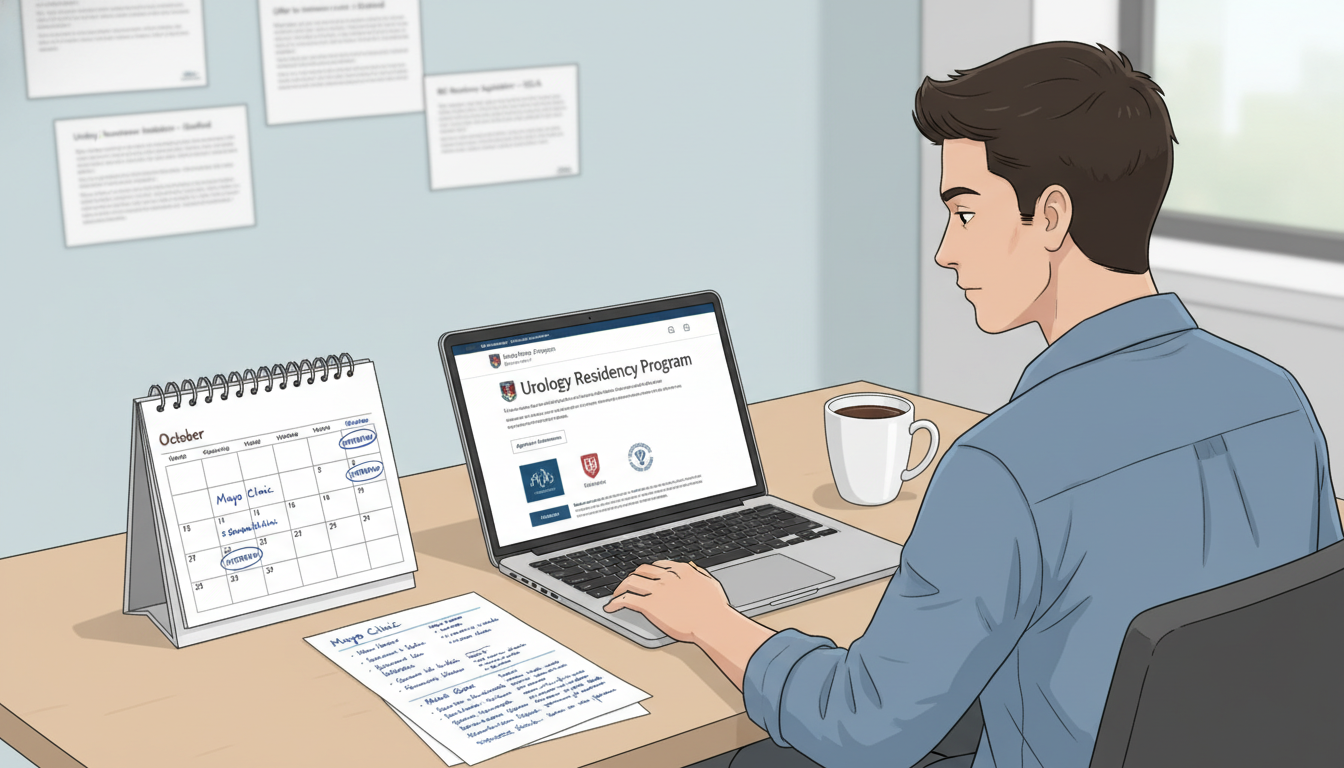
Create a master spreadsheet or calendar with:
- Program name
- Interview date(s) and time (with time zones)
- Interview format (virtual vs in-person vs hybrid)
- Interview structure (number of rooms, faculty/resident panels)
- Pre-interview social date/time and platform (Zoom, Gather, etc.)
- Contact information for the program coordinator
- Notes on hotel/travel (for in-person)
- Post-interview notes and impressions (for later ranking)
Use color-coding to track:
- Confirmed interviews
- Pending responses
- Waitlists
- Declines
Set email filters and alerts for interview invitations—urology interviews can come quickly and fill up fast.
Virtual Interview Setup
Even if some interviews are in person, many urology programs still use virtual formats. Your pre-interview preparation for virtual encounters should include:
Environment:
- Quiet, private space with minimal interruptions.
- Neutral, uncluttered background; avoid backlighting from windows.
- Good lighting from the front (desk lamp, ring light, or natural light).
Technology:
- Reliable internet connection (test at same time of day as interviews).
- Functioning webcam and microphone (often better via external mic/headset).
- Test Zoom/Webex/Teams links in advance, including account sign-in if needed.
- Rename your profile to your full name, degree (e.g., “First Last, MS4”), not a nickname.
Professional appearance:
- Dress as you would for an in-person interview: suit jacket, dress shirt/blouse, conservative tie (if wearing one), neutral colors.
- Avoid busy patterns or distracting accessories.
- Sit upright in a supportive chair; frame your face and upper torso in the camera.
Do at least one full trial run with a friend or mentor using your exact setup.
In-Person Interview Logistics
If you have in-person urology residency interviews:
- Travel:
- Arrive the night before, especially in winter climates.
- Plan buffer time for weather or delays.
- Lodging:
- Choose a hotel that allows easy access to the hospital or interview site.
- Confirm check-in/check-out times.
- What to bring:
- Printed itinerary and program details.
- A small folder with:
- Extra copies of your CV.
- A pen and small, discreet notebook.
- Comfortable professional shoes (you may walk between sites).
- Day-of:
- Aim to arrive 15–20 minutes early.
- Silence your phone completely.
- Be courteous to everyone you meet—coordinators, residents, other applicants; reputations matter and the community is small.
Mindset, Professionalism, and Posture: The Human Side of Preparation
Beyond facts and logistics, successful urology match candidates invest in their mindset and professional comportment before interviews begin.
Adopt a Professional Yet Collegial Demeanor
Urology is known for a relatively tight-knit, collegial culture. Programs want residents who are:
- Pleasant to work with.
- Team-oriented.
- Calm under pressure.
- Comfortable with a mix of serious surgical work and approachable interpersonal style.
To convey this:
- Be respectful and polite, but not overly stiff.
- Show genuine curiosity about the program and the people you meet.
- Engage residents and faculty with thoughtful conversation, not just formal Q&A.
- Avoid negative talk about other programs, specialties, or institutions.
Manage Stress and Burnout During Interview Season
The early urology match compresses a lot of pressure into a short period. Pre-interview preparation should include a realistic self-care plan:
- Use a prep schedule:
- Assign specific days to review certain programs, practice questions, or update your notes.
- Avoid late-night cramming before interviews.
- Maintain basic routines:
- Sleep as regularly as possible.
- Light exercise or walks to clear your mind.
- Quick, healthy meals instead of constant takeout or snacks.
- Build a support system:
- Check in with co-applicants, friends, family, or mentors.
- Normalize feeling nervous; everyone does.
- Reframe interviews as two-way conversations:
- You are also evaluating fit, mentorship, and lifestyle.
- This mindset often lowers anxiety and improves authenticity.
Plan Your Post-Interview Process in Advance
Even though this guide focuses on pre-interview preparation, it’s wise to plan now for how you’ll handle the period after each interview:
- Decide on a consistent way to take notes immediately after:
- Program culture and “gut feeling.”
- Strengths and weaknesses (clinical exposure, location, call schedule, fellowship outcomes).
- Notable conversations or quotes.
- Decide how you’ll handle thank-you notes:
- Some programs explicitly discourage them; respect these guidelines.
- If allowed and you choose to send them, keep them concise, specific, and genuine.
- Protect time near the end of interview season to review all your notes and reflect, rather than relying on hazy impressions.
Doing this planning before interviews start prevents decision fatigue later.
FAQs: Pre-Interview Preparation in Urology
1. When should I start preparing for urology residency interviews?
Begin serious preparation as soon as you submit your ERAS application. For urology, because the match is earlier, you should:
- Clarify your story and practice core answers in the weeks following submission.
- Start researching programs as interview invites come in and build your program templates.
- Conduct mock interviews at least 2–4 weeks before your first actual interview.
2. How specific do my career goals need to be (e.g., fellowship plans)?
You don’t need a rigid plan, but you should have a thoughtful, honest perspective. It’s fine to say:
- “I’m currently leaning toward urologic oncology but am open to other subspecialties.”
- “I’m not certain about fellowship yet, but I’m looking for a program that will expose me to a broad range of subspecialties and support me whichever path I choose.”
Programs want to see self-awareness and curiosity, not a fixed commitment.
3. What are common interview questions residency applicants in urology can expect?
Expect these categories:
- Motivation and fit:
- “Why urology?”
- “Why our program?”
- Personality and behavior:
- “Tell me about a time you faced conflict.”
- “Describe a challenge and how you handled it.”
- Academic and professional:
- “Tell me about your research.”
- “What are your strengths and weaknesses?”
- Future plans:
- “Where do you see yourself in 5–10 years?”
- “Are you thinking about fellowship?”
Prepare for each category using structured, concise stories—especially behavior-based questions.
4. How can I stand out in a competitive urology match during interviews?
You don’t need to be flashy; you need to be consistent, prepared, and authentic:
- Tell a coherent story that ties together your experiences and motivations.
- Demonstrate genuine interest in urology and in each specific program via thoughtful questions and well-informed comments.
- Show that you are reliable, team-oriented, and teachable—traits programs value heavily.
- Reflect insightfully on your experiences, including mistakes and growth.
Strong pre-interview preparation—knowing your story, researching programs deeply, practicing your delivery, and organizing logistics—allows your personality and potential as a future urologist to come through clearly.