
Understanding the Med-Peds Interview Landscape as a US Citizen IMG
Medicine-Pediatrics (Med-Peds) is a highly intentional specialty: programs look for applicants who genuinely understand and want the combined training, not those using it as a backup. As a US citizen IMG (an American studying abroad), you must prepare to show both your fit for Med-Peds and your readiness to practice in the U.S. healthcare system.
Three realities shape pre-interview preparation for a US citizen IMG in Med-Peds:
You are often less familiar to programs.
Unlike U.S. allopathic seniors, your school, grading system, and clinical context may be less known. Your interview must clarify your training quality and clinical readiness.Med-Peds programs are small and tight-knit.
Classes are small; culture and “fit” matter enormously. Interviewers often imagine working side-by-side with you for four years in both adult and pediatric settings.You must dispel biases in a short window.
Some programs may have limited experience with IMGs or Americans studying abroad. Every answer, interaction, and email becomes an opportunity to demonstrate professionalism, communication skills, and maturity.
Pre-interview preparation is therefore not just about “answering questions” but strategically shaping how programs perceive you: a capable, thoughtful, well-prepared future Med-Peds physician.
Step 1: Clarify Your Med-Peds Story and Applicant Identity
Before you ever rehearse answers, you need a clear internal narrative: who you are as a US citizen IMG and why you belong in Med-Peds.
Define Your Core Med-Peds Narrative
Programs will want to know: Why Med-Peds instead of internal medicine, pediatrics, or family medicine?
Spend focused time writing out:
Your Med-Peds “origin story”
- A few key patient encounters—one adult, one pediatric—that made you want to care for both.
- Any longitudinal experiences (e.g., free clinics seeing families, working with children with chronic conditions that continue into adulthood, transitional care clinics).
What you want to do with Med-Peds training
- Combined hospitalist? Primary care for complex kids and adults? Transitional care for congenital heart disease, cystic fibrosis, sickle cell disease, autism, or developmental disabilities?
- Academic vs community goals, global health, underserved care, rural or urban focus.
Why you need combined training specifically
- For example:
- “I’m drawn to conditions like sickle cell disease and diabetes that require lifelong management across the lifespan.”
- “I want to care for patients with childhood-onset chronic illnesses as they move into adult care, particularly in underserved communities where continuity often breaks down.”
- For example:
Turn this into a 60–90 second, conversational “Med-Peds answer” you can adapt for:
- “Why Med-Peds?”
- “Tell me about yourself.”
- “How did you decide on this specialty?”
Integrate Your US Citizen IMG Background Coherently
Being an American studying abroad raises questions programs may not verbalize but will think:
- Why did you go abroad for medical school?
- How did that shape you as a learner and clinician?
- Are you ready for U.S. residency expectations?
Prepare a concise, positive framing:
Why abroad?
Examples:- Strong family or cultural ties to that country.
- Opportunities for early clinical exposure.
- Financial or personal reasons, framed without sounding apologetic.
What you gained from the experience
- Adaptability and resourcefulness.
- Cross-cultural communication skills.
- Comfort with diverse patient populations.
- Experience with systems very different from the U.S.
How you aligned with U.S. training
- USMLE scores.
- U.S. clinical experiences (electives, sub-internships, observerships).
- Letters from U.S. attendings in both medicine and pediatrics if possible.
You should be able to answer confidently:
- “Why did you choose to attend medical school abroad?”
- “How has your experience as a US citizen IMG prepared you for residency?”
Link Your Clinical Experiences to Med-Peds
Before interviews, make a table with 6–8 clinical stories that show:
- Complex adult internal medicine cases
- Challenging pediatric cases
- Transitional care or family-oriented encounters
- Examples of teamwork, leadership, and communication
- Experiences in underserved or resource-limited settings
For each story, jot down:
- Patient/context
- Your role and actions
- What went well / what you learned
- How it relates to Med-Peds strengths (lifespan perspective, continuity, complexity, advocacy, systems thinking)
This will give you a library of examples for behavioral and clinical questions.

Step 2: Master the Core Residency Interview Question Types
Residency interview preparation is not about memorizing scripts but about building structured, genuine responses. Focus on four high-yield categories.
1. Classic Motivation Questions
These include:
- “Tell me about yourself.”
- “Why Med-Peds?”
- “Why our program?”
- “What are your career goals?”
How to prepare:
Tell me about yourself
- 60–90 seconds.
- Present-then-past-then-future framework:
- Present: Who you are now (US citizen IMG in final year, Med-Peds applicant, main interests).
- Past: Key experiences that led you here (brief education, meaningful clinical/community experiences).
- Future: Your goals in Med-Peds.
Why Med-Peds?
- Include:
- Specific features you like: dual training, complexity, continuity, transitions of care.
- One or two brief stories that sparked the choice.
- How your strengths (e.g., systems thinking, longitudinal relationships, teaching) align with Med-Peds.
- Include:
Why our program?
- Research 6–8 programs in depth before interview season.
- For each program, write:
- 3–4 specific features you genuinely value (e.g., strong Med-Peds identity, robust continuity clinics, combined Med-Peds inpatient rotations, advocacy curriculum, triple-board exposure, global health).
- How those features connect to your goals.
- Avoid generic answers that could apply anywhere.
2. Behavioral and Situational Questions
Expect questions like:
- “Tell me about a time you had a conflict on the healthcare team.”
- “Describe a time you made a mistake in clinical care.”
- “Tell me about a time you had to work with limited resources.”
- “How have you handled a difficult patient or family encounter?”
- “Tell me about a time you advocated for a patient.”
Use the STAR framework:
- Situation – Set context in 1–2 sentences.
- Task – Your responsibility or role.
- Action – What you did (focus here).
- Result/Reflection – Outcome and what you learned.
As a US citizen IMG, behavioral questions are a powerful way to show:
- That you take responsibility.
- That you communicate clearly across cultures and systems.
- That you are coachable and reflective, not defensive.
Consider including:
- One example from a pediatric setting.
- One from an adult medicine setting.
- One from U.S.-based clinical experience (if available).
3. Clinical Reasoning & Approach Questions
Med-Peds programs may probe how you think:
- “How do you approach a child with fever and rash?”
- “Describe your approach to an adult with new-onset shortness of breath.”
- “Tell me about a challenging diagnostic case you were involved in.”
You’re not expected to have all the answers, but you should:
- Be structured: history → exam → differential → workup → management.
- Prioritize safety: red flags, when to escalate care.
- Integrate patient/family context and communication.
Before interviews, quickly review:
- Common inpatient adult and pediatric complaints.
- Approach to chronic diseases across the lifespan (e.g., asthma, sickle cell disease, diabetes, congenital heart disease).
- How you would communicate uncertainty and involve seniors.
4. “Risk” and Gaps Questions (Especially Relevant to IMGs)
Programs may explore:
- “Can you explain this gap in your training?”
- “What happened with your Step exam performance?” (if applicable)
- “Why no recent U.S. clinical experience?”
- “How have you kept clinically current since graduation?”
Plan honest, concise, non-defensive responses:
- Acknowledge the issue.
- Provide relevant context without blaming.
- Emphasize growth: what you did to improve or stay sharp (extra clinical work, courses, research, Step improvement, simulation, CME).
Your goal: show that any past issue does not predict future performance.
Step 3: Researching Med-Peds Programs Strategically
Interviewers can immediately sense whether you understand their program. Smart research is one of the most powerful tools in residency interview preparation.
Build a Program Research Template
For each Med-Peds program where you have an interview, create a one-page summary with headings like:
Program Structure
- Number of residents per year.
- Balance between medicine and pediatrics rotations.
- Unique Med-Peds rotations (e.g., transition clinics, developmental clinics, combined inpatient services).
Training Environment
- Hospital type: academic, community, safety-net, children’s hospital.
- Patient population: underserved, urban, rural, specific demographics.
- Any global health or community health emphasis.
Curriculum & Opportunities
- Advocacy, QI, research expectations.
- Tracks (global health, primary care, hospitalist, academic).
- Med-Peds continuity clinic structure and location.
Culture & Support
- Evidence of Med-Peds community: retreats, mentoring frameworks, Med-Peds interest groups.
- Program director’s stated priorities (from website, welcome video, or social media).
Alumni & Outcomes
- Recent graduates’ career paths.
- Fellowships obtained (adult and pediatric subspecialties, hospitalist, primary care).
Your Connection Points
- 3–4 program-specific reasons you are a strong match.
- Questions you genuinely want to ask.
Leverage Online and Human Resources
As an American studying abroad, you might have less informal access to U.S. program “insider knowledge.” You can still close that gap:
- Use FRIEDA and program websites to understand structure and size.
- Look at Med-Peds program social media (Twitter/X, Instagram) to see resident life, advocacy, and culture.
- Attend virtual open houses or pre-interview Q&A sessions if offered.
- Reach out to:
- Med-Peds physicians or residents you’ve met during U.S. rotations.
- Alumni from your school in Med-Peds or related fields.
- National Med-Peds organizations or interest groups.
Carefully document all information to avoid mixing up details between programs.
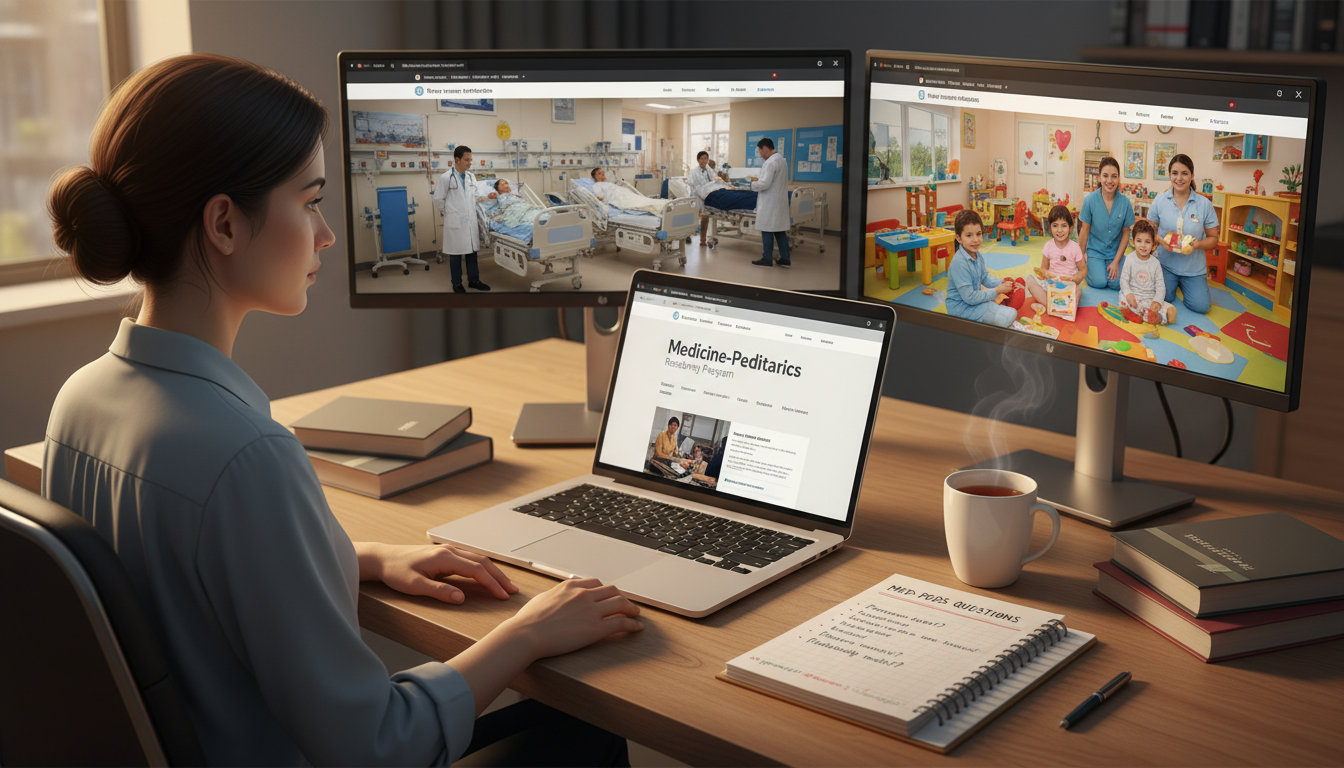
Step 4: Practicing Interview Skills – Structure, Delivery, and Logistics
Knowing how to prepare for interviews also means translating your content into confident, clear communication—especially in virtual formats.
Practice Out Loud (Not Just in Your Head)
Even if you’re fluent in English, the stakes, time pressure, and small-talk portions can be stressful. As a US citizen IMG, you’ll be judged heavily on communication clarity and professionalism.
Do the following:
Record yourself (phone or laptop) answering core questions:
- “Tell me about yourself.”
- “Why Med-Peds?”
- One behavioral question (e.g., conflict, mistake).
- “Why our program?” (practice a generic structure, then customize for each program).
Watch the recordings for:
- Pace (not too fast or too slow).
- Filler words (“um,” “like,” “you know”).
- Clarity and structure of your points.
- Nonverbal behavior: eye contact, posture, facial expression.
Refine, don’t script.
- Write bullet-point outlines, not full paragraphs.
- Aim for natural, conversational answers anchored by 2–3 key phrases you want to include.
Simulate Real Residency Interview Scenarios
Arrange mock interviews:
- With your dean’s office or career services, if available.
- With Med-Peds mentors or residents (even by Zoom).
- With peers who can ask you interview questions residency programs frequently use and give honest feedback.
Ask for specific feedback:
- Do my answers sound genuine?
- Are my explanations of “US citizen IMG” issues clear and confident?
- Do I convey Med-Peds interest convincingly?
Prepare for Virtual Interviews (Most Med-Peds Programs Use Them)
Pre-interview preparation must include technical and environmental checks:
Equipment and Setup
- Reliable laptop or desktop (avoid only using a phone).
- Stable internet connection; if possible, use a wired connection.
- External webcam and microphone if your built-in ones are poor.
- Quiet, private location with no interruptions.
Lighting and Background
- Light facing you (not behind you).
- Neutral, uncluttered background (plain wall, simple bookcase).
- Camera at eye level (use books or a stand to raise your laptop if needed).
Professional Appearance and Presence
- Dress as you would for in-person: suit or professional equivalent.
- Sit upright; center yourself in the frame.
- Maintain eye contact by looking at the camera when speaking, at the screen when listening.
Platform Familiarity
- Test Zoom, Webex, Thalamus, or whatever platform the program uses.
- Practice screen name settings (use your full name).
- Turn off distracting notifications on your device.
Logistics: Time Zones and Schedules (Crucial for IMGs Abroad)
As an American studying abroad, time differences can be significant:
- Create a time zone conversion chart for:
- Your current location.
- U.S. Eastern, Central, Mountain, Pacific times.
- Double-check interview times and calendar entries.
- Plan:
- Sleep schedule adjustments in the days before interviews.
- Backup internet solutions (second Wi-Fi network, data hotspot).
- Quiet spaces where you won’t be interrupted even at odd hours.
Step 5: Preparing Questions You Will Ask Programs
Your questions show your priorities, maturity, and how seriously you’re considering Med-Peds. Prepare 6–10 questions you can rotate through, then customize per program.
High-Yield Question Themes for Med-Peds
You can ask:
Training and Curriculum
- “How does your program ensure residents feel integrated in both the medicine and pediatrics departments?”
- “Can you describe how Med-Peds residents are supported when transitioning between adult and pediatric rotations?”
- “What kinds of Med-Peds-specific rotations or clinics do residents experience?”
Resident Support and Culture
- “How does the program support resident well-being, especially given the dual demands of Med-Peds training?”
- “Can you describe the Med-Peds community here—how close are the residents across classes?”
Career Development
- “What types of careers have recent Med-Peds graduates pursued, and how does the program support different career paths?”
- “Are there mentors who are dually trained Med-Peds faculty in my areas of interest (e.g., transitional care for congenital heart disease, global health)?”
For US Citizen IMG-Specific Concerns
- Use judgment; some of these are better asked of residents rather than PDs:
- “Have you had experience training US citizen IMGs or other IMGs in your program? Are there any particular supports in place for navigating U.S. systems?”
- “How does the program help new interns acclimate to documentation, EMRs, and U.S. hospital workflows?”
- Use judgment; some of these are better asked of residents rather than PDs:
Avoid questions easily answered on the website and avoid focusing first on salary, vacation, or moonlighting.
Step 6: Managing Pre-Interview Stress, Mindset, and Professionalism
Strong residency interview preparation includes mental and physical readiness. It’s not just what you say; it’s how centered and present you seem.
Build a Pre-Interview Routine
The week before:
- Lightly review common adult and pediatric conditions.
- Refine your Med-Peds story and top patient examples.
- Verify all interview dates, times, and technical setups.
The day before:
- Print or open:
- One-page program sheet.
- List of your own questions.
- Your ERAS personal statement (Med-Peds version).
- Your CV.
- Prepare water, light snacks if long interview blocks.
- Set two alarms if you’re in a very different time zone.
- Print or open:
The morning of:
- Dress completely in professional attire.
- Do a brief voice warm-up and a few deep breaths.
- Join the platform 10–15 minutes early.
- Have a notepad for jotting names, key points, and questions.
Adopt a Growth Mindset
- Remember: interviews are conversations, not interrogations.
- Each interaction is a chance to:
- Learn about a program.
- See if their Med-Peds culture fits you.
- Show who you are beyond scores and transcripts.
As a US citizen IMG, don’t over-focus on “proving you belong.” Instead, center on showing how your path has uniquely prepared you for Med-Peds: adaptability, resilience, cultural competence, and commitment to dual training.
Putting It All Together: A Sample Preparation Timeline
4–6 Weeks Before Interviews:
- Clarify your Med-Peds narrative and long-term goals.
- Identify 6–8 clinical stories (adult, pediatric, transitional, teamwork).
- Make initial program research templates.
- Begin mock interviews and practice core answers.
2–3 Weeks Before Interviews:
- Deepen research on scheduled programs.
- Fine-tune “Why Med-Peds?” and “Tell me about yourself.”
- Prepare question bank for programs.
- Test and refine virtual interview setup.
1 Week Before Each Interview:
- Revisit that program’s template and website.
- Customize your “Why our program?” talking points.
- Practice out loud, focusing on behavioral and Med-Peds-specific questions.
- Plan time zone and sleep schedule.
1–2 Days Before:
- Print or arrange digital copies of your materials.
- Confirm interview logistics.
- Light clinical review; don’t cram.
Day Of:
- Follow your pre-interview routine.
- Stay present; treat each interaction as a chance to connect.
- Afterward, write a brief reflection: program impressions, people you met, details for thank-you notes and rank list.
FAQs: Pre-Interview Preparation for US Citizen IMG in Medicine-Pediatrics
1. As a US citizen IMG, how can I address concerns about my training background during Med-Peds interviews?
Keep your response concise and positive:
- Explain clearly why you went abroad.
- Highlight strengths of your training (early clinical exposure, diverse pathologies, resource-limited care experience).
- Emphasize alignment with U.S. training:
- Strong USMLE scores.
- U.S. clinical electives, especially in internal medicine and pediatrics.
- Strong letters from U.S. faculty.
- Show readiness to hit the ground running in documentation, teamwork, and communication. Use specific examples of working in multidisciplinary teams and adapting to new systems.
2. What Med-Peds–specific topics should I review before interviews?
Focus on:
- Approaches to common adult and pediatric complaints (fever, respiratory distress, chest pain, abdominal pain).
- Chronic diseases that span childhood to adulthood (asthma, sickle cell disease, diabetes, congenital heart disease, cystic fibrosis).
- Concepts of transitional care: how adolescents with chronic illness move into adult systems.
- Med-Peds identity and career paths: hospital medicine, primary care, subspecialties, advocacy, global health, health systems leadership.
You don’t need fellowship-level depth, but you should show that you think naturally across the lifespan.
3. How many mock interviews should I do for effective residency interview preparation?
Quality matters more than quantity. Aim for:
- 1–2 formal mock interviews (with faculty, career advisors, or Med-Peds mentors) focused on structure and professionalism.
- 2–3 informal sessions with peers or recent residents focused on behavioral questions and Med-Peds motivation.
- Solo practice with recording for fine-tuning delivery.
After each session, adjust your answers; avoid over-rehearsing to the point where you sound robotic.
4. What are some common interview questions residency programs ask Med-Peds applicants?
Beyond standard behavioral and motivation questions, you may hear:
- “Why did you choose Med-Peds over family medicine or categorical internal medicine/pediatrics?”
- “What types of patients do you see yourself caring for in 10 years?”
- “Tell me about a patient who influenced your decision to pursue Med-Peds.”
- “How do you manage switching between adult and pediatric mindsets and care environments?”
- “What do you think will be the biggest challenge for you during dual training, and how will you handle it?”
Preparing thoughtful, structured responses to these will significantly increase your confidence and help you stand out as a serious Med-Peds applicant.
By investing in deliberate, structured pre-interview preparation—tailored to your path as a US citizen IMG and to the unique nature of Med-Peds—you position yourself as a mature, reflective candidate ready for the demands of combined adult and pediatric training. Every step you take now will make your medicine pediatrics match season more focused, less stressful, and more successful.