
What are you supposed to do when someone you respect leans in and quietly says, “I’d stay away from that program”?
Now you can’t un-hear it. It’s in your head every time you look at your rank list, every time you open ERAS, every time you see that program’s logo on Instagram.
You’re thinking:
What if I ignore the warning and end up in a toxic program for three years?
But what if I believe it and tank my chances by removing a totally fine place based on one person’s bias?
Welcome to residency rumor hell. I live here with you.
First: Why This Feels So Terrifying
Let me be blunt: residency isn’t some casual job you can just “try” and leave if it’s weird. It’s your sleep, your mental health, your board prep, your future fellowship. Every story about a malignant program hits like a jump scare.
So when an attending — someone who’s “made it,” someone who might even be writing your LOR — drops something like:
- “People don’t last there.”
- “Their residents look miserable.”
- “They chew through interns.”
- “I’ve heard awful things about that PD.”
…it feels like a siren going off. Your brain immediately goes:
- Is this the nuclear red flag I’ve been warned about?
- Did I just almost rank a place that will destroy me?
- Am I stupid if I ignore this?
And then the other side of your brain chimes in:
- But what if they’re wrong?
- What if it’s old info?
- What if this is just politics between departments?
So yeah, you’re stuck. If you ignore the warning and match there, you’ll always wonder if you walked into a disaster. If you act on it, you might throw away a solid program based on hearsay.
Let’s untangle this. Not perfectly. But enough that you can make a decision you don’t hate.
Not All Warnings Are Created Equal
The first thing I’d ask myself (after spiraling, obviously) is: What exactly did they say, and how do they know it? The details matter — a lot.
There’s a big difference between:
- “I personally rotated there last year as faculty, and the residents told me they were constantly violating duty hours and terrified of the PD.”
- “Oh, I just don’t like that place.”
- “Back when I was a resident 15 years ago, that program was malignant.”
- “Their outcomes aren’t great and I’ve heard the teaching is weak.”
Those are not the same.
Here’s what I actually trust more:
- Firsthand stories from current or very recent residents (within the last 2–3 years).
- Attendings who’ve worked with grads from that program and noticed consistent patterns: poor training, low confidence, bad culture.
- Specifics, not vague “bad vibes.”
I trust less:
- Old gossip (“Back in my day…”).
- Vague “I’ve heard it’s not great” with no examples.
- Strong opinions from people who’ve never actually interacted with the program or its residents.
So if an attending warns you, try to pin them down — kindly but clearly. Something like:
“I really appreciate you flagging that. Can I ask — is that based on your own experience there, or from residents you know, or more general reputation?”
You’re not cross-examining them. You’re just trying to figure out: Is this a data point or just noise?
The Four Big Questions I’d Ask Before Panicking
I’d run their warning through four filters:
1. How recent is the info?
Programs change. Leadership changes. New PDs come in and completely flip a culture — for better or worse.
If someone says:
- “Ten years ago they were malignant as hell.”
I’d file that as: maybe relevant, but not enough alone to take them off my list.
If they say:
- “Last year two residents transferred out.”
- “Their interns kept telling me they’re burned out and can’t get time to study.”
That’s more current. That deserves more weight.
2. How specific was the concern?
Vague:
“They have a bad reputation.”
Specific:
“They consistently violate duty hours.”
“The PD shames residents publicly.”
“Residents are scared to call in sick.”
“The fellowship match is weak and people don’t feel supported.”
Specifics you can cross-check. Vibes you can’t.
3. Does this match anything else you’ve heard?
This is huge. Is this one isolated off comment? Or is it part of a pattern?
If:
- One attending hates the place
- But residents you met there on interview day seemed genuinely happy
- And another mentor said they’ve worked with strong grads from there
…then I’d be very cautious about letting that one voice overpower everything else.
On the other hand, if you’ve heard:
- Strange awkward silence when you ask people about that program
- “They work hard” said in that tone (you know the one)
- Online whispers about high attrition
…and then an attending adds, “Yeah, I’d avoid it,” now that starts to look like a real trend.
4. What’s this attending’s bias?
Yeah, I know, they’re your letter writer, your mentor, maybe your hero. They can still be biased.
Examples I’ve seen:
- Academic attendings trash community programs because “you won’t be competitive for fellowship,” even when that’s just not universally true.
- Old-school surgeons call any program with wellness initiatives “soft.”
- People who trained at Top 10s think anything not like their training was “weak.”
So ask yourself:
- Do they hate community programs?
- Do they dismiss anything not “prestige”?
- Do they dislike certain PDs personally?
- Are they strongly loyal to a rival program in the same city?
If yes, filter appropriately.
How To Actually Investigate the Rumor Without Losing Your Mind
This is where you get to act like a semi-sane detective instead of a spiraling intern-in-advance.
Step 1: Clarify with the attending (if you feel safe doing that)
You can say:
“I’m really grateful you told me. I just want to make the most informed decision I can — is your concern more about culture, education, or leadership?”
Push for which domain:
- Culture (toxic, malignant, bullying)
- Education (weak teaching, poor board prep)
- Outcomes (bad fellowship match, poor confidence)
- Logistics (awful scheduling, under-resourced, tons of scut)
Knowing which one matters. You might tolerate a busy, chaotic place if the teaching is great. You might not tolerate humiliation and fear, no matter how shiny the name.
Step 2: Cross-check with other humans, not just Reddit
Talk to:
- Residents you know from your med school who matched there.
- Recent alumni from your school who rotated there.
- Another attending who’s a bit removed from the drama.
You don’t have to quote the warning verbatim. You can just say:
“I’ve heard mixed things about [Program X]. I’m trying to get a realistic sense of the culture there. What have you seen or heard recently?”
You want consistency. If three independent people, different institutions, all say “Yeah, people leave that place early”… that’s not nothing.
Step 3: Look at objective-ish data
No, there’s no magical “malignancy index.” But there are little breadcrumbs:
| Signal Type | What to Look For |
|---|---|
| Attrition | Residents leaving or transferring |
| Leadership Turnover | Frequent PD or chair changes |
| Resident Mood | Closed-off, guarded, or fearful |
| Schedule | Chronic 80+ hour weeks reported |
| Outcomes | Poor board pass or match support |
You can sometimes sniff this out by:
- Asking on interview day: “Have any residents left the program in the last few years?” and watching their body language.
- Checking if they’ve had multiple PDs in a short time.
- Asking residents: “If you were a med student again, would you choose this program?”
If they hesitate? That matters.
Step 4: Gut check: How did YOU feel there?
This is the part anxious people like us ignore. We love outsourcing our judgment to “people who know more.”
But you were there. Or at least on Zoom. You saw:
- How residents interacted when faculty weren’t hovering.
- Whether the PD seemed to actually like trainees or just brag about metrics.
- If the chiefs looked genuinely tired-but-supported or absolutely dead inside.
If you left interview day thinking, Huh, that felt… off, don’t gaslight yourself because one person on SDN said it was “chill.”
Likewise, if you felt good there — really good — don’t let one vague rumor bulldoze that.
When I’d Seriously Consider Dropping a Program
If I had:
- A strong warning from an attending with specific, recent, firsthand concerns
and - Confirmation from at least one other independent source
and/or - My own uneasy gut feeling or weird vibes on interview day
Then yeah. I’d probably move that program way down. Or off.
Especially if the warning is about:
- Systemic bullying
- Chronic duty-hour violations being normalized
- Residents leaving or trying to transfer
- PD retaliation when residents speak up
- Unsafe staffing
Those aren’t small things. Those are “you might lose years of your life and sanity” things.
The match is not worth that.
When I’d Keep It on the List (But With Eyes Wide Open)
On the other hand, if:
- The attending’s concern is old or vague (“back when I was a resident”, “I just don’t like them”)
- No one else has negative things to say
- Your interview day experience was actually positive
- The program fits your goals (location, training volume, patient population)
Then I’d probably keep it on. Maybe not number one. But on.
Because here’s the thing no one says out loud: every program has bad stories about it from someone. There is no perfect, drama-free institution.
You will find:
- People who hated MGH.
- People who loved small community programs everyone else trashes.
- People who survived “malignant” places and still matched great fellowships.
Is it fair? No. Is it reality? Yes.
You’re not choosing between “perfect” and “trash.” You’re choosing between imperfect options with different tradeoffs.
The Power Dynamic Problem: What If You Disagree With the Attending?
Here’s the fear under all of this:
“What if I don’t follow their warning and they think I ignored their advice? Will they sabotage me? Will they be offended?”
If they’re decent, probably not. But I get the anxiety.
If they bring it up again, you can say:
“I really appreciated your perspective — I talked to a couple of current residents there and also checked with Dr. [X] who has worked with their grads. It seems like there were issues a few years ago, but recent feedback has been more positive. I still ranked it, but I kept your concerns in mind when ordering my list.”
That communicates:
- You heard them.
- You actually did homework.
- You didn’t blindly reject their opinion.
They don’t get to control your rank list. And if they’d punish you for not obeying? That’s their problem, not yours.
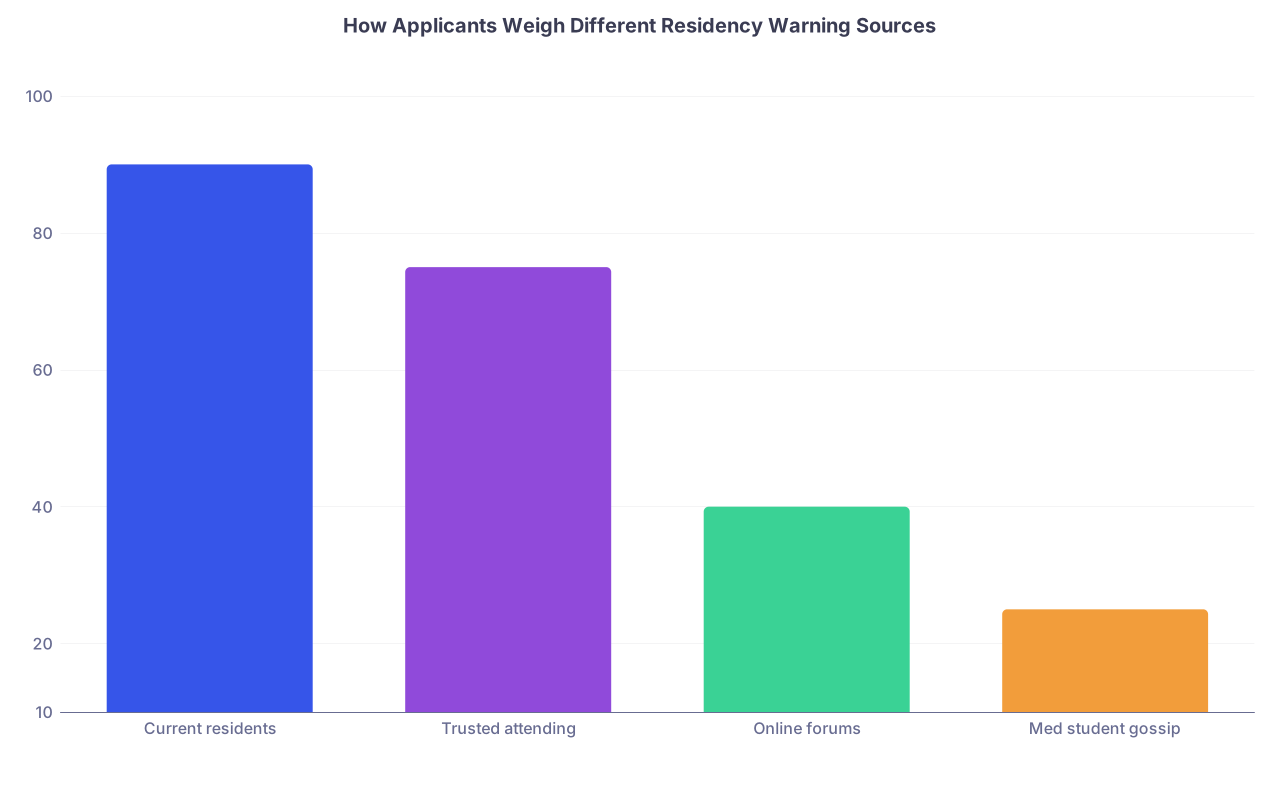
| Category | Value |
|---|---|
| Current residents | 90 |
| Trusted attending | 75 |
| Online forums | 40 |
| Med student gossip | 25 |
A Hard Truth: You Won’t Eliminate All Risk
This is the part that keeps me up at night: you can do everything right — ask around, research, trust your gut — and still end up somewhere that feels wrong once you’re actually in the trenches.
Why?
Because some things you only see when you’re signing orders at 2 a.m., or when your PD responds to the first real conflict, or when your co-residents show their true colors under pressure.
That doesn’t mean this whole exercise is pointless. It just means you’re playing probabilities, not certainties.
Your job isn’t to find a guaranteed perfect program. It’s to:
- Avoid the clear disasters
- Choose a place where the overall pattern (culture, support, training) seems solid
- Accept that every choice has some unknowns baked in
And then — and this is brutal — trust yourself enough to adapt if it isn’t what you hoped.
FAQ: Attending Rumors, Red Flags, and Your Rank List
1. What if an attending tells me, “If you rank that program, I won’t support you”?
That’s manipulative, and frankly, unprofessional. You can nod, say “Thank you, I’ll think about that,” and still do what’s right for you. If you already have their letter submitted, they can’t take it back. And if someone’s that controlling, you don’t owe them your blind obedience.
2. An attending warned me, but my interview day felt great. Which do I believe?
I’d treat it like this: your experience = one strong data point. Their warning = another. Now collect two or three more: talk to a current resident, another attending, maybe a recent grad. If most of those additional points line up with your positive impression, I’d lean toward believing what you saw and heard yourself.
3. Is it ever okay to rank a program I’ve heard is “malignant”?
Yes — but only if:
- You’ve confirmed that reputation is old or exaggerated,
- You don’t see consistent current evidence of toxicity, and
- Your alternatives are significantly worse for your life (location, support system, finances).
“Malignant” gets thrown around too loosely sometimes. You want to know: is it truly abusive and unsafe, or just very demanding?
4. Can I directly ask residents, “Is your program malignant?”
You can, but you’ll usually get a guarded answer, especially if faculty are nearby. Better: ask, “If you had to rank again, would you choose this place?” or “What kind of resident is happy here vs miserable here?” or “What’s something you wish you had known before matching here?” Their faces will tell you more than their words.
5. How much weight should I give Reddit/SDN comments about a program?
Honestly? Background noise unless it matches things you’re hearing from real-world sources. A random anonymous “this place is trash” means nothing without context. But if multiple people, over multiple years, consistently share similar, specific concerns — that’s more concerning. Don’t let a single salty post dictate your rank list.
6. I’m terrified of making the “wrong” choice. How do I live with my decision?
You won’t get rid of the fear completely. But you can make peace with this: you didn’t flip a coin. You asked questions, sought different perspectives, weighed your values, and made the best call you could with the information you had. That’s all anyone can do. Your next step is building the skills and resilience to thrive wherever you land — or, if needed, to advocate for yourself and even transfer. You’re not trapped forever.
Open your rank list right now and mark three programs: one you’re scared about because of rumors, one you quietly love, and one you’re unsure about. For each, write one sentence on why you feel that way — your own reasons, not someone else’s. Let that be the starting point for whose voice actually gets to matter in your decision.