
Most residents do not get blindsided by clinical difficulty. They get blindsided by how they are graded.
You can survive brutal call, short staffing, and chaotic services if the evaluation and feedback system is fair and transparent. What breaks people is the opposite: vague expectations, opaque committees, weaponized “professionalism” comments, and surprise remediation when everyone swore you were “doing fine.”
Let me walk you through the subtle red flags in evaluation and feedback systems that residency applicants routinely miss on the interview trail—and regret later.
1. The Core Reality: Your Experience Is What The Evaluation System Allows
Residency is not just “learning medicine.” It is operating inside a tightly controlled system of:
- Milestones
- Competencies
- Summative evaluations
- CCC (Clinical Competency Committee) decisions
- Promotion and contract renewal votes
You are not graded on “how good a doctor you are.” You are graded on how the program structures observation, documentation, and narrative about you.
The same resident could be considered “solid” in one system and “borderline” in another, purely because of:
- Who gets to write evaluations
- How often they are required to document concerns
- What the CCC is trained (or pressured) to flag
- How error/complaint events are incorporated
So when you are evaluating programs, “how they grade you” is not a minor detail. It is the skeleton that determines whether your training feels developmental or punitive.
2. High-Yield Red Flags in Evaluation Structures
Let me break this down into the system-level things that should make you pause.
2.1 No One Can Clearly Explain “How You Progress”
On interviews, you ask: “How are residents evaluated and promoted year to year?”
Responses you should consider dangerous:
- “Oh, we just kind of know who is doing fine.”
- “If you are not in trouble, you are doing fine.”
- “The CCC meets and reviews everyone, and if there is a problem, they will let you know.”
Those lines mean:
- No shared mental model of expectations
- No explicit mapping between: rotation evals → milestones → promotion decisions
- Heavy dependence on “vibes” and hallway conversations about you
In a healthy program, a chief or APD can answer in 60–90 seconds with a reasonably structured description. Something like:
- Frequency of evaluations
- Who evaluates you (attendings, fellows, nurses, peers, patients?)
- How often CCC meets
- What triggers formal remediation
If they cannot do that, the system is either incoherent or deliberately opaque.
2.2 Busywork Evaluation Volume With No Meaningful Feedback
Look for the classic “tons of eval forms, zero conversation” pattern:
- You hear “we get evaluated after every rotation and sometimes mid-rotation”
- Residents roll their eyes when you ask if the feedback is useful
- Faculty tell you “the system automatically sends evaluations; I just click through”
High volume electronic evaluations without a culture of direct feedback usually equal:
- Generic cut‑and‑paste phrases
- Everyone getting the same “meets expectations” for every domain
- No one documenting concerns until they are big enough to blow up
What this sets up: residents who think they are fine based on written evals, then get hammered at CCC when the narrative that actually matters was never in MedHub/ New Innovations. It lived in side conversations instead.
You want a system where written and spoken feedback broadly line up.
2.3 CCC Described as a Black Box
The Clinical Competency Committee is where the real grading happens. You will not be in the room when your career is discussed.
Red-flag CCC patterns:
- No resident representation at all, even as non-voting observers (some specialties/programs genuinely avoid this, but they should at least explain why and how transparency is preserved).
- Nobody can tell you what data the CCC sees: “They look at everything” is code for “we do not have a disciplined process.”
- Residents find out about “concerns” only at semiannual “milestone meetings,” never earlier.
Ask residents directly:
“How does your CCC work, and how do you find out if they have concerns about you?”
Watch for grimaces, long pauses, or “honestly, you find out late.”
3. Feedback Culture: What People Actually Say (or Don’t Say)
The structure matters, but the culture will decide how those structures are used.
3.1 “We Don’t Like To Put Negative Things in Writing”
If you hear this—run.
Phrases that mean “we hide the ball”:
- “We prefer to give constructive criticism verbally, not in the record.”
- “If you’re struggling, we’ll tell you one-on-one rather than write it down.”
- “We don’t want to hurt your chances for fellowship, so we are careful what we document.”
Sounds kind. In practice, it is a trap.
What actually happens:
- Minor concerns are whispered, never documented.
- When something serious happens (clinical error, professionalism issue, patient complaint), the CCC has no documented “trajectory” and panics.
- The first written “negative” documentation about you is suddenly major: “significant concerns,” “pattern of behavior,” “patient safety risk.”
That escalates everything to remediation/probation because there is no gradient of written evaluations.
Healthy programs document small things early, with clear plans attached. That is how you avoid “surprise career death” in PGY‑3.
3.2 Feedback That Is 90% Personality, 10% Behavior
Look for feedback language that sounds like this:
- “Comes off as not engaged.”
- “Seems disinterested.”
- “A bit too confident.”
- “Needs to fit better with team culture.”
Vague personality or “vibe” feedback, especially without specific behaviors, is a huge red flag. These phrases:
- Are heavily biased by culture, race, gender, and introversion/extroversion
- Are almost impossible to “fix” because they are not tied to observable actions
- Often become the core of “professionalism” concerns that haunt residents
Ask current residents:
- “When you get constructive feedback, how specific is it?”
- “Have you ever gotten feedback where you genuinely did not know what to do differently?”
If multiple people say “yes, all the time,” that program is not serious about behavioral feedback. It uses aesthetic judgments instead.
3.3 No Protected, Scheduled Feedback Conversations
Some programs say “we encourage feedback” and then rely purely on the good will of individual attendings.
That model fails.
Red flags:
- No scheduled mid‑rotation feedback on any core inpatient rotations
- “Yearly evaluation meeting” with PD that is just a 10‑minute milestone box-check
- Residents say the only feedback they get is “you’re doing fine” at the end of each month
This is how people hit PGY‑3 and suddenly hear: “The CCC feels you are not at the level expected for independent practice.” With no warning.
Programs that care about feedback build:
- Routine, scheduled mid‑rotation sit‑downs
- Clear agendas (what you are doing well, what to improve, concrete next steps)
- Documentation that mirrors what you actually hear
If all feedback is ad hoc, your development is left to luck.
4. Evaluation Metrics: What Counts—and What Is Weaponized
Different programs quietly stack the deck with what they choose to track.
4.1 Overweighting “Professionalism” Without Guardrails
Every program claims to value professionalism. The real question is how they define and operationalize it.
Red flags:
- Professionalism domain carries outsized weight in promotion decisions but has no clear rubric.
- Residents can cite examples where a single attending’s personality clash turned into a “professionalism concern” that followed someone for years.
- Nurses’ or ancillary staff complaints are treated as absolute truths without any process for context or defense.
You need to know:
- Is there a written professionalism policy with specific behaviors and levels (minor, moderate, severe)?
- Is there a mechanism to respond to or clarify a complaint?
- Are patterns considered over time, or does one event label you permanently?
In toxic systems, “professionalism” is a flexible hammer used when the program wants someone gone, or when bias is rationalized as “concern.”
4.2 Numerical Scores With No Calibration
Some programs love numbers: 1–9, 1–5, 1–3 scales for every competency. Looks objective. Often is not.
Red flags:
- Attendings are not trained in how to use the rating scales; they guess.
- Different services have very different scoring cultures (“Cards gives everyone 2/3, GI gives everyone 3/3”).
- Residents know which rotations “tank your average” because of scoring habits, not performance.
If numerical scores directly drive promotion or awards, and there is no calibration or benchmarking, then:
- You are at the mercy of whoever happened to be on service with you.
- “Hard graders” can harm your file for years, and the CCC will treat the numbers as objective.
Ask: “Do you provide faculty development on evaluations? Do you review and normalize scoring across services?”
If the answer is vague, be cautious.
5. What Happens When You Struggle: The Real Test of the System
Everyone is a “great program” when residents are cruising. The real culture shows when someone is in trouble.
5.1 No Clear Remediation Pathways
Some programs treat remediation as a personal failing instead of a structured process.
Red flags:
- Residents do not know what the steps are from “concern” to “remediation” to “probation.”
- Stories of people “disappearing” or suddenly not renewing their contract, with no transparent explanation.
- Vague phrases like “we handle each case individually” without any description of standard options.
You are looking for something more disciplined:
- Identified issue → written plan → time‑limited goals → reassessment → documented outcome.
If residents tell you: “Once they decide you’re a problem, that’s it,” believe them.
5.2 Legalistic, Adversarial Documentation From Day One
On the flip side, a different pattern is equally concerning.
You hear:
- “The moment there is a concern, GME and legal get involved.”
- “Every minor issue is immediately turned into a formal letter.”
- “We are very documentation-heavy to protect the institution.”
This often correlates with:
- Extremely risk‑averse leadership
- Quick escalation to probation
- Residents living in fear of minor mistakes turning into formal processes
There is a balance. You want a program that documents fairly, proportionally, and with the explicit lens of development—not just risk management.
6. Data Sources: Who Gets to Grade You?
Look carefully at where evaluation data come from and how much weight they carry.
6.1 Single-Attending Dominance on Key Rotations
Programs where one or two high‑power attendings essentially “own” certain rotations are high risk.
Red flags:
- Residents say: “If you cross Dr. X, you are done.”
- Job or fellowship letters are disproportionately controlled by a small inner circle.
- Rotation structure means you work 4 weeks with one attending and no balancing input.
One person’s bias, mood, or interaction style should not be able to tank your entire narrative.
Ask: “On intensive services, how many attendings typically evaluate a resident in a block?”
If the answer is “just one, usually,” that is structurally dangerous.
6.2 Anonymous 360s With No Safeguards
I like multisource feedback when it is done well. Many programs do not.
Red flags:
- Anonymous nursing / staff feedback heavily influences “professionalism” without any attempt at context.
- No mechanism for residents to see thematic summaries of 360 feedback—only vague labels at CCC.
- Residents can recount cases where one nurse who disliked them generated a strong negative narrative.
360 feedback should be:
- Aggregated over time
- Thematic, not anecdotal
- One piece of the puzzle, not the whole picture
If it feels like a popularity contest, that is not a professional system.
7. Questions to Ask on Interview Day (and How to Read the Answers)
Let me give you a practical script. Do not ask all of these at once; pick a handful. But listen very carefully not just to the content, but to how tightly people answer.
| Question | Healthy Signal | Red Flag Signal |
|---|---|---|
| "How are residents promoted each year?" | Clear steps, CCC process, criteria | Vague, "we just know" |
| "How early do residents hear about concerns?" | Ongoing, mid-rotation, semiannual | Only at end of year or when severe |
| "How does the program handle a struggling resident?" | Structured plans, examples | Euphemisms, secrecy |
| "Can you describe a time feedback changed the program?" | Concrete story | Blank stares, silence |
| "How does professionalism get evaluated?" | Written rubric, behaviors | Vibes, "fit," personality talk |
You should ask different stakeholders:
- Residents (especially PGY‑2, PGY‑3; they have seen the system operate)
- Chief residents (they often sit in CCC, or at least adjacent to it)
- Program leadership (PD/APDs)
Mismatch between what leadership says and how residents describe reality is itself a red flag.
8. Subtle but Serious Structural Red Flags
These are the things you only pick up if you are listening closely.
8.1 “We Rarely Fail Anyone”
Programs bragging that “no one ever fails” are not reassuring.
It usually means:
- They avoid hard conversations.
- They pass people along who are not ready, which pushes workload onto co‑residents and attendings.
- When they finally do fail or nonrenew someone, it is catastrophic and abrupt.
Competent programs sometimes graduate everyone. But they do not pretend no one ever struggles.
8.2 Programs Obsessed With National Benchmarks—but Only Upward
Watch out for places that talk constantly about:
- Board pass rates
- Fellowship match rates
- “Top tier” branding
Yet when you ask, “What happens if a resident fails boards on the first attempt?” you get tense answers.
An evaluation system over‑tuned to protect the program’s numbers will:
- Blame individual residents for systemic gaps
- Be quick to categorize someone as a “problem” if they threaten metrics
- Tend to manage people out rather than invest in them long term
Board prep support, remediation for test performance, and how they talk about past failures will tell you a lot.
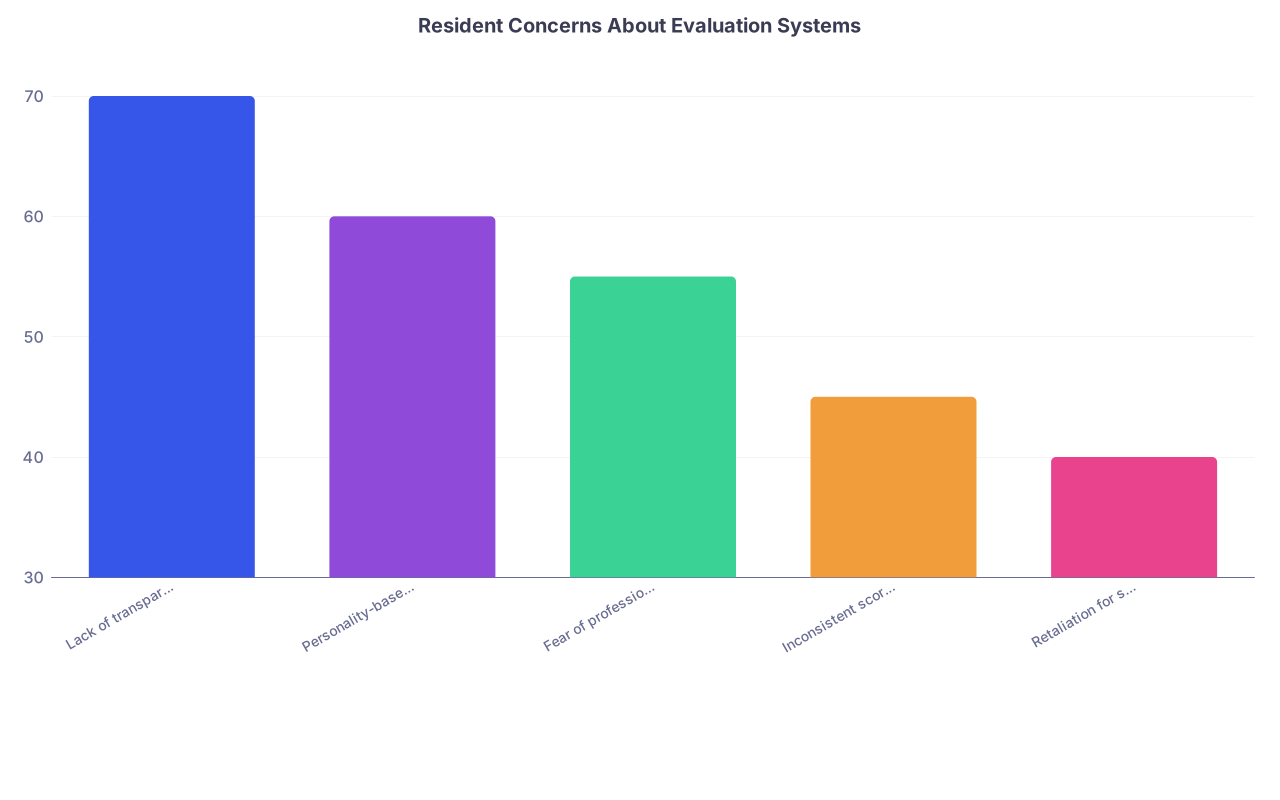
| Category | Value |
|---|---|
| Lack of transparency | 70 |
| Personality-based feedback | 60 |
| Fear of professionalism labels | 55 |
| Inconsistent scoring | 45 |
| Retaliation for speaking up | 40 |
(Values represent approximate percentage of residents who report each concern when evaluation systems are problematic, based on common survey patterns and anecdotal experience.)
9. Future Directions: Where Evaluation Systems Are Actually Improving
Not everything is dire. Some programs are genuinely moving in the right direction.
Positive trends you should look for:
9.1 Milestone Maps You Can Actually See
Programs creating:
- Individualized “milestone maps” where you can see your current level and what “next level” looks like behaviorally
- Dashboards with your aggregate evaluation data visible to you, not just CCC
- Regular check-ins framed around progress, not “gotcha” surprises
If a PD pulls up a de‑identified version of such a dashboard during your interview, that is a very good sign. They are proud of their system.
9.2 Faculty Coaching Structures
Some places are moving toward pairing residents with:
- Longitudinal faculty coaches who are not directly responsible for formal evaluation
- Semi-structured coaching meetings based on your real data
This separates “support” from “judgment,” which is healthier. Your coach can help you strategize about feedback, advocate for you, and sanity‑check what you are hearing.
9.3 Resident Input Into Evaluation Systems
Better programs invite residents into the process:
- Residents on committees that review and refine evaluation forms
- Periodic “feedback about feedback” sessions
- Real changes implemented based on resident pain points
When you ask, “Has resident feedback changed the evaluation process here in the last few years?” and they can immediately give you concrete examples, that is gold.

| Step | Description |
|---|---|
| Step 1 | Clinical Work |
| Step 2 | Direct Observation |
| Step 3 | Rotation Evaluations |
| Step 4 | CCC Review |
| Step 5 | Promotion Decision |
| Step 6 | Resident Dashboard |
| Step 7 | Coaching Meeting |
| Step 8 | Improvement Plan |
That is roughly what a sane, looped, developmental system should look like.
10. How To Protect Yourself Once You Match
You cannot re‑engineer a program’s system as an intern. But you are not helpless.
A few blunt but practical moves:
Document your own feedback.
Keep a running log (secure, private) of specific feedback you receive verbally: date, attending, what they said, what you did about it. This protects you when verbal feedback never matches what appears in writing later.Ask for specifics in real time.
When someone says, “You need to be more proactive,” you respond:
“Can you give me one or two examples from this week where I could have acted differently so I understand what you mean?”
Pin them to behaviors, not vibes.Read your evaluations regularly.
Do not wait for semiannual meetings. If the system allows you to see longitudinal comments, read them monthly. If something feels off, ask early:
“I saw this comment about X—could we talk it through? I want to address it now.”Get a mentor outside your direct chain.
Faculty who are not your PD/APD can be reality checks. Show them anonymized or summarized feedback and ask, “How serious is this? What would you do?” Experienced people can translate vague program language into real risk.
None of this makes a toxic system safe. But it gives you better eyesight inside it.
FAQ (Exactly 4 Questions)
1. Is it a red flag if a program uses a lot of “competency” and “milestone” language?
Not by itself. The ACGME framework forces everyone to use those words. The red flag is when the language exists without clarity. If they say “we evaluate you based on milestones” but cannot show you how rotation evaluations map to your milestone levels and promotion decisions, then it is just jargon wallpaper hiding a subjective process.
2. How big a deal is it if negative feedback is mostly verbal, not documented?
It is a serious problem long term. Early verbal feedback that never gets written down sounds fine until something goes wrong. Then the story becomes, “We have had longstanding concerns,” and it is your word against an invisible history. Documentation is not your enemy if it is fair and proportional; it creates a trail of growth, not just a file of sins.
3. Should I be worried if residents say they have never seen a remediation plan?
Context matters. In small programs with low turnover, maybe no one has needed one recently. But if the answer is, “People who struggle just leave,” or “We do everything informally,” that is dangerous. Healthy programs can describe, even hypothetically, how they would structure support for a struggling resident, including examples (anonymized) of when they have done it before.
4. Are resident opinions about evaluation systems reliable, or are they just venting?
Usually more reliable than leadership narratives. Residents live inside the system daily; they know how feedback actually lands and how CCC decisions feel. Yes, some individuals will be bitter if they have had a bad outcome, but when several residents independently describe the same patterns—surprise feedback, vague professionalism labels, fear of speaking up—you should trust that pattern recognition.
Key takeaways:
Your residency experience will be defined as much by the evaluation and feedback system as by case volume or prestige. Opaque, personality-driven, or documentation-avoidant systems are genuine red flags, even if everything else looks shiny. Look for programs that can articulate how you progress, show you they document fairly, and treat feedback as a developmental tool instead of a weapon.