The most dangerous ACGME citations are not the ones in bold red font. They are the quiet, “polite” phrases that mean your program is on fire.
Let me break this down specifically.
Most residents and even many junior faculty never see the full ACGME accreditation letter. They hear, “We got a couple citations but overall continued accreditation.” Everyone exhales. Then a year later the program director abruptly “steps down,” there is a surprise site visit, and rumors of probation start.
The warning signs were usually sitting in plain sight in the language of that letter.
This is an anatomy lesson in ACGME-speak. I will walk you through the specific words and phrases that should make you sit up straight, sharpen your exit strategy, or at least start asking much more pointed questions.
1. How ACGME “Speaks” When Things Are Bad
ACGME rarely writes, “Your program is dysfunctional and residents are burning out.” Instead, they use bureaucratic euphemisms with very consistent patterns. Once you recognize those patterns, you can tell the difference between:
- Normal growing pains
versus - Structural, potentially career-damaging program problems.
Think of three rough severity tiers in citation language:
- Mild / bureaucratic
- Concerning / systemic
- High risk / accreditation-threatening
We will go phrase by phrase across those tiers.
2. Mild Citations: Annoying, But Not Catastrophic
These are not good, but they usually do not mean “run now.” They often show up in otherwise healthy programs.
Common phrases:
- “The program is encouraged to…”
- “The Review Committee recommends that…”
- “There is a need for improved documentation of…”
- “The program should ensure that…”
- “The program is reminded of its responsibility to…”
These phrases typically attach to things like:
- Late or incomplete evaluations
- Sloppy case log documentation
- Minor duty hour outliers that have already been addressed
- Missing a couple of committee minutes or formal policies
Example mild language:
“The program is reminded of its responsibility to ensure timely completion of evaluations by faculty and residents.”
Translation: Your evaluations are a mess, but ACGME thinks you can probably fix this with basic effort and some PD nagging.
If a letter is mostly this kind of language, and you do not see recurring or repeated themes across years, that is annoying but not especially ominous.
The danger is when you see mild wording attached to core issues like supervision, safety, or education. That is when “mild” phrasing is being used to flag a serious concern in a very controlled tone.
3. Phrases That Mean “Systemic Problem, Not Just a Bad Month”
Now we get into language that signals something broken at the system level. Not just one rotation. Not just a single faculty problem. The RC is telling you: the structure of the program is not doing what the ACGME expects.
Watch for these phrases.
3.1. “Lacks a systematic approach” / “Lack of a process”
Common formulations:
- “The program lacks a systematic approach to…”
- “There is no formal process to ensure…”
- “The program has not demonstrated a consistent process for…”
- “The Clinical Competency Committee does not appear to use a structured process…”
These often attach to:
- CCC decisions and promotions
- Remediation / struggling residents
- Faculty evaluation and feedback
- Curriculum oversight
Example:
“The program lacks a systematic approach to using evaluations and assessment data to make decisions on resident progression, remediation, and promotion.”
That sentence is bad news. It means your CCC is either rubber-stamping promotions, randomly deciding who is “needs improvement,” or not using Milestones in a defensible, structured way. In a serious conflict (dismissal, remediation, legal challenge), this becomes ammunition against the program.
3.2. “Has not demonstrated” / “Unable to demonstrate”
This is one of the nastier phrases. It implies the program might be doing something, but when asked to show it, they could not back it up.
Common patterns:
- “The program has not demonstrated effective oversight of…”
- “The program was unable to demonstrate that residents meet required case minimums.”
- “The program has not demonstrated that residents achieve graduated responsibility.”
What this really says:
“We asked. You waved your hands. You did not have data. We do not believe this is actually happening.”
Attached to numbers (case logs, procedures, continuity clinic) this is extremely serious, because it goes directly to board eligibility and competence.
4. Resident Experience Red Flags Hiding in Plain Sight
Residents usually care about a few core things:
- Education quality
- Workload and duty hours
- Safety and supervision
- Ability to graduate and get jobs/fellowships
When you see the following phrases in the context of survey results or resident feedback, that is a strong sign the RC is worried about your actual day-to-day experience.
4.1. “Noncompliance with” or “Failure to”
This is blunt by ACGME standards.
- “The program is in noncompliance with requirements related to…”
- “The program failed to provide residents with…”
- “Repeated noncompliance with duty hour standards was noted…”
- “The program failed to demonstrate appropriate supervision…”
Example:
“The program is in noncompliance with requirements related to resident supervision, as detailed by multiple residents reporting that attending physicians are not immediately available for questions during high-risk procedures.”
That is serious. Supervision + safety + consistent resident reports = the RC is actively worried about patient harm and resident risk. This is the kind of citation that can rapidly escalate to focused or full site visits.
4.2. “Multiple residents reported…” / “Widespread resident concerns”
ACGME cares deeply about pattern, not just one loud complainer.
Phrases to watch:
- “Multiple residents reported that…”
- “There were widespread resident concerns regarding…”
- “Resident survey responses indicate persistent dissatisfaction with…”
- “Resident feedback over several years has identified…”
If you see “over several years,” that is the key. It means your program leadership has already been told about the problem and has either done nothing or has failed to fix it.
Typical attachments:
- Clinical workload interfering with education
- Lack of didactics or protected time
- Chronic duty hour violations (not just one rough month)
- Bullying, harassment, or unprofessional environment
- Retaliation or fear of speaking up
That last one deserves its own spotlight.
4.3. “Fear of retaliation” / “Residents do not feel safe reporting…”
This language is devastating to a program’s credibility with the ACGME.
You might see:
- “Residents do not feel comfortable reporting concerns to leadership…”
- “Residents expressed fear of retaliation for reporting duty hour or clinical workload issues.”
- “There is limited evidence that resident concerns are addressed in a timely and transparent manner.”
The moment ACGME thinks residents are afraid to speak honestly, trust collapses. The RC starts to assume problems are bigger than what is written, because they know they are only hearing the tip of the iceberg.
If you are in a program with this language in its letter, you should:
- Document everything you can independently.
- Avoid relying solely on internal reporting channels that appear dysfunctional.
- Strongly consider how long you plan to tolerate that environment.
5. Education vs. Service: The Subtle Phrases That Scream “Scut Factory”
ACGME will almost never say, “You treat residents as cheap labor.” Instead they say things like this.
5.1. “Service obligations compromise educational goals”
Phrases to know:
- “Resident service obligations compromise the educational goals of the program.”
- “Clinical workload limits resident participation in didactics and conferences.”
- “There is insufficient protected time for scholarly activity due to clinical demands.”
- “Residents frequently miss required conferences because of patient care responsibilities.”
This is one of the strongest markers of a malignant workload culture. You will sometimes hear PD’s try to spin it as, “We are a very busy program; you will learn a lot.” The RC is already telling you they think your education is getting sacrificed on the altar of RVUs and staffing gaps.
Here, look at it side by side.
| Theme | “Busy but Educational” Language | “Service Overload” Red Flag Language |
|---|---|---|
| Workload | High clinical volume with adequate supervision | Service obligations compromise educational goals |
| Conferences | Residents generally attend required conferences | Residents frequently miss didactics due to clinical duties |
| Scholarship | Residents participate in scholarly activities | Insufficient protected time for scholarship due to workload |
| Autonomy | Graduated responsibility with oversight | Residents functioning as unsupervised service providers |
If your letter reads like the right-hand column, understand what that means: The RC already suspects you are a staffing solution, not a training program.
6. Supervision, Autonomy, and Patient Safety: The Accidental Career Killers
This is where citations move from annoying to potentially career-threatening. Programs can survive some messy paperwork. They do not survive sustained questions about safety and competence.
6.1. “Inadequate supervision” / “Lack of direct supervision”
Variants:
- “The program has not ensured appropriate supervision in…”
- “Residents report lack of direct supervision for high-risk procedures…”
- “The program does not consistently adhere to supervision policies…”
Attach this to phrases like “high-risk procedures,” “night float,” “off-site rotations,” and you have a major red flag.
Why it is dangerous for you:
If something goes wrong clinically, and your program is already cited for inadequate supervision, you are now caught between legal risk, institutional CYA behavior, and a shaky training record.
6.2. “Graduated responsibility is not clearly defined or implemented”
Watch for:
- “The program has not clearly defined or implemented graduated responsibility.”
- “Residents and faculty expressed inconsistent understanding of levels of supervision.”
- “There is no clear documentation of resident competence prior to independent call duties.”
This feeds directly into board certification and credentialing. Hospitals want to see a defensible record that you were assessed and judged competent before working independently. If your program cannot prove that, you could face headaches later with hospital privileging or fellowship applications.
7. Duty Hours: How to Read Between the Lines
Everyone knows “duty hours are important.” The real signal is how the RC describes the violations and the reporting behavior.
7.1. “Isolated” vs. “Recurrent and unaddressed”
Some key distinctions:
“Isolated duty hour violations were noted…”
→ Often tolerable, especially if there is documentation of follow-up.“Recurrent duty hour violations were identified over multiple reporting periods without evidence of a sustainable corrective plan.” → That is serious. It essentially says: program leadership knew and either could not or would not change the system.
7.2. “Residents under-report” / “Pressure to under-report”
The worst phrases in this domain:
- “Residents report pressure to under-report duty hours.”
- “There is evidence of systematic under-reporting of duty hours.”
- “Residents do not feel comfortable accurately recording their work hours.”
That is not a documentation problem. That is a culture problem. ACGME reads this as dishonesty and a hostile learning environment. You should read it as: “This place will throw you under the bus to keep accreditation and staffing stable.”
8. Faculty and Leadership: When the Letter Is Really About the PD and Chair
Sometimes the problem is not the residents. It is the people running the show. ACGME tells you this in very careful leadership language.
8.1. “Lack of program director oversight” / “Insufficient authority”
Lines to watch:
- “The program director does not appear to exercise sufficient authority over the program.”
- “There is insufficient institutional support for the program director’s responsibilities.”
- “Frequent program director turnover has destabilized program leadership.”
If your letter includes these, it means ACGME does not trust that your PD can actually fix anything. Either they are blocked by the department or hospital, or they are not up to the job. In both cases, change tends to be messy—interim PDs, power struggles, shifting policies every year.
8.2. “Faculty engagement is limited” / “Inconsistent participation”
Examples:
- “Faculty engagement in resident education is limited.”
- “There is inconsistent faculty participation in conferences and evaluations.”
- “Faculty development regarding assessment and feedback is inadequate.”
What this means on the ground:
- You will chase people for evaluations.
- Didactics will be canceled at the last minute.
- You will hear, “Just bill it” more than, “Let’s sit and review the case.”
It also signals that when push comes to shove, the department prioritizes RVUs and private practice schedules over resident education.
9. Scholarly Activity and Board Pass Rates: Long-Term Career Risk Signals
Many residents underestimate how seriously ACGME takes these two domains, especially in the context of fellowship and future jobs.
9.1. “Below the national mean” / “Unacceptable board pass rates”
Watch this phrasing carefully:
- “The program’s board pass rate is below the national mean for the specialty.”
- “There is no documented program-wide strategy to address low board pass rates.”
- “Repeated low board pass rates raise concerns about educational effectiveness.”
One year off the mean is not necessarily dire. A pattern of low pass rates without a coherent improvement plan is far more concerning. If you are in a small program, one or two failures can tank statistics, but the RC looks for evidence that leadership is taking it seriously, not shrugging.
9.2. “Minimal scholarly activity” / “Does not meet expectations for scholarly culture”
Phrases:
- “Faculty and resident scholarly activity is minimal and does not meet expectations.”
- “There is little evidence of a scholarly culture within the program.”
- “The program has not demonstrated ongoing scholarly productivity.”
For applicants aiming at competitive fellowships (cards, heme/onc, GI, certain surgical subspecialties), this matters a lot. If the RC is already calling out poor scholarship, there is a decent chance your fellowship applications will suffer, because output is low and mentoring is weak.
10. The Nuclear Words: Focused Visit, Probation, and Program Closure Signals
If you see these phrases, you are not reading about a minor problem anymore. You are reading about program survival.
10.1. “Focused site visit” / “Full site visit”
Clear indicators:
- “The Review Committee has requested a focused site visit to assess…”
- “The program is required to undergo a full site visit at the next review cycle.”
- “A focused site visit will evaluate the program’s response to… [serious domain].”
Focused visits happen when there is a specific concern—e.g., supervision, duty hours, or the clinical learning environment. They are not automatically lethal, but they mean the RC is no longer fully trusting what is written in the paper fix plans.
10.2. “Probationary accreditation” / “Withdrawal of accreditation”
These are obvious, but the lead-in language sometimes hints at this direction before it arrives.
Lead-up phrases:
- “Failure to correct these deficiencies may result in adverse accreditation action, up to and including probation or withdrawal of accreditation.”
- “Persistent noncompliance places the program at risk for adverse accreditation action.”
- “Continued accreditation is contingent upon substantial improvement in…”
If a letter reaches “adverse accreditation action” language, ACGME is essentially saying: “We are done waiting. Fix this fast or lose status.” Residents in such a program should seriously evaluate transfer options, contingency plans, and how this might affect their board eligibility if the worst happens.
11. How Residents and Applicants Should Actually Use This Information
You are not going to get the full accreditation letter as an applicant. But you can infer a lot from:
- Public ACGME data (for some specialties: citations, status)
- Program gossip (which is surprisingly accurate when consistent across multiple sources)
- How leadership talks about ACGME visits and survey results
Some very concrete things you can do:
On interview day, ask directly:
“What were the main areas of improvement identified in your last ACGME review, and what specific changes have you made?”If the answer is vague—“We are always trying to improve!”—without mentioning concrete issues, that is suspicious.
Ask residents privately:
“Did ACGME flag anything about workload, duty hours, or supervision recently?”
If they say, “We had some duty hour things but they are better” and can describe how they are better, good. If they say, “Yeah, we just do not log over 80 anymore,” that is not a fix.Listen for certain PD phrases that parallel ACGME language:
- “We are working on making our CCC more systematic…” (good awareness, but ask what that actually means)
- “We are trying to improve resident comfort with speaking up…” (check whether that is culture change or just a new anonymous form)
If you are already in the program, try to see the actual letter.
Many institutions will not hand it out freely, but residents on the Program Evaluation Committee or GMEC sometimes get to see substantial parts. Even partial excerpts give you a lot.
12. Quick Reference: Phrases That Should Make You Sit Up Straight
Here is a condensed hit list. If you remember nothing else, remember these clusters.
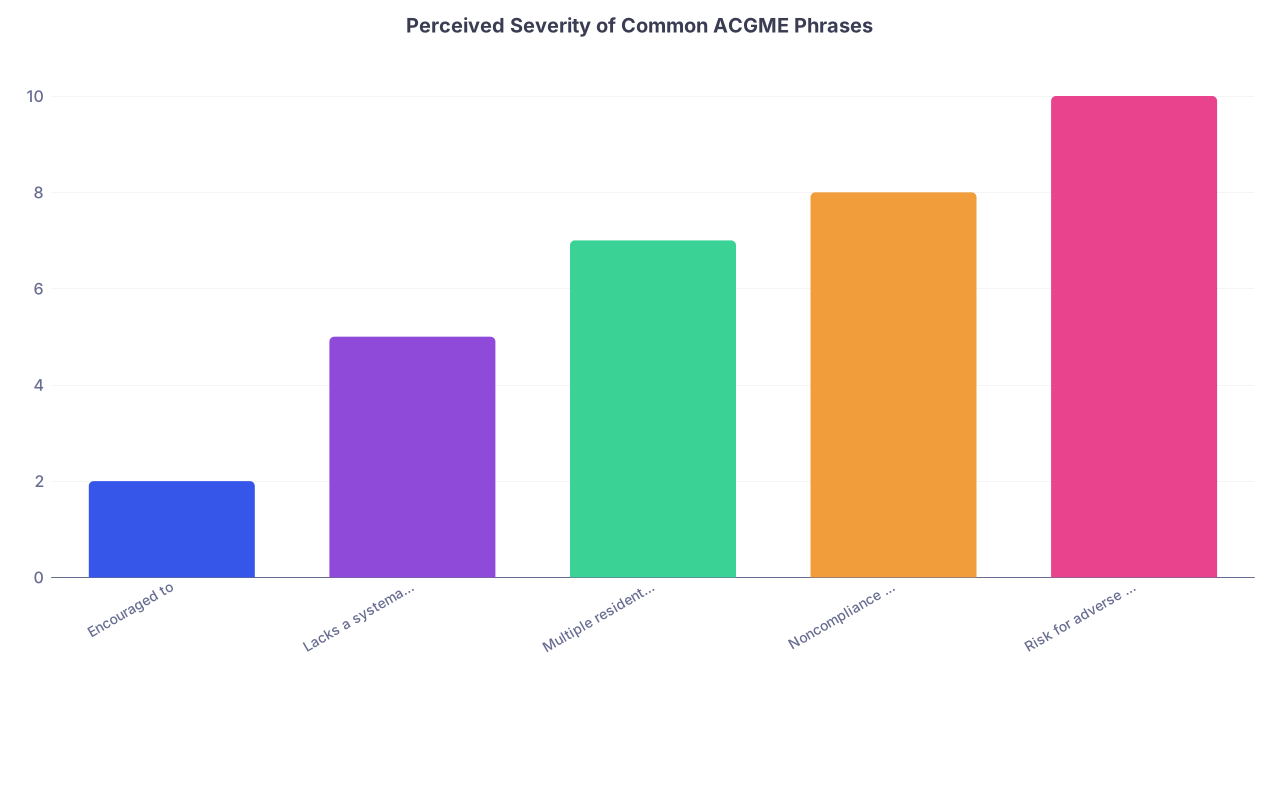
| Category | Value |
|---|---|
| Encouraged to | 2 |
| Lacks a systematic approach | 5 |
| Multiple residents reported | 7 |
| Noncompliance with | 8 |
| Risk for adverse action | 10 |
Severity scale 1–10:
- “The program is encouraged to…” → 2/10 (annoying, low risk)
- “The program lacks a systematic approach to…” → 5/10 (systemic, fixable but real)
- “Multiple residents reported…” + negative issue → 7/10 (breakdown in environment)
- “The program is in noncompliance with…” → 8/10 (serious, already beyond warning)
- “Persistent noncompliance places the program at risk for adverse accreditation action.” → 10/10 (your program is on the brink)
13. The Future: Why This Matters More Every Year
ACGME has been leaning harder into:
- The Clinical Learning Environment Review (CLER) framework
- Psychological safety, burnout, and mistreatment
- Data-driven oversight (Milestones, surveys, board pass rates)
That means two things for you:
- The language will get more standardized and easier to compare across programs over time.
- Programs that have been “getting away with it” for years—overworking residents, silencing complaints, ignoring duty hours—are increasingly on borrowed time.
You are not powerless in this. You can:
- Learn to read ACGME language like an attending reads a CT report.
- Ask smarter questions on interview day.
- Push internally for real fixes when you see these words appear.
- Decide early when a situation is not salvageable and protect your own training.
Residents who understand accreditation language are much harder to gaslight. PD’s cannot hand-wave “a couple small citations” when the letter literally says “noncompliance” and “risk of adverse action.”
You now know the difference.
With this vocabulary in your pocket, you are better equipped to judge which residency red flags are tolerable and which are structural hazards. The next step is translating that judgment into action—choosing programs, advocating inside them, and sometimes walking away. That is the next part of the journey, and it deserves its own playbook.