
Resident Clinic Structures That Quietly Undermine Your Training Quality
It is Thursday afternoon continuity clinic. You sprint in from wards 20 minutes late because your intern called about a crashing patient. The waiting room is already overflowing. Your schedule shows 18 “return, 20 minutes” visits and 4 double-booked “add-ons” wedged into the same half-day. Your preceptor is covering 4 residents and also has their own panel booked. The MA hands you a stack of “quick forms” to sign before you have even opened the EHR.
You are technically “learning outpatient medicine.” In reality, you are triaging chaos.
Let me be direct: clinic structure will make or break the quality of your residency training, especially in IM, FM, peds, psych, and OB. And many programs quietly design clinics for billing efficiency first, education somewhere around fourth or fifth.
You already know to ask about “clinic experience” on interview day. That is not enough. You need to know the specific structural choices that sabotage learning while pretending to be “high-volume, real-world training.”
I will walk you through those structures, how they show up in daily life, and exactly what to ask or look for before you sign yourself up for three years of chronic frustration.
1. Overbooking As A Default: When Volume Replaces Thought
Overbooking is not just “a busy clinic.” It is a philosophy: see more, think less, bill everything.
A healthy resident panel has complexity, continuity, and enough time per visit to think. A toxic one treats you like a warm body attached to an NPI.
Here is what overbooking looks like from the inside:
- A “standard” template of 16–20 patients in a half day for a PGY-2/3 (yes, some places actually do this).
- Double-booked slots marked as “urgent” or “same-day access” but function as overflow because the front desk never says no.
- Residents routinely staying 1.5–3 hours after clinic “end” time finishing notes and refills.
- Preceptors explicitly saying, “We are behind, keep it under 10 minutes per patient.”
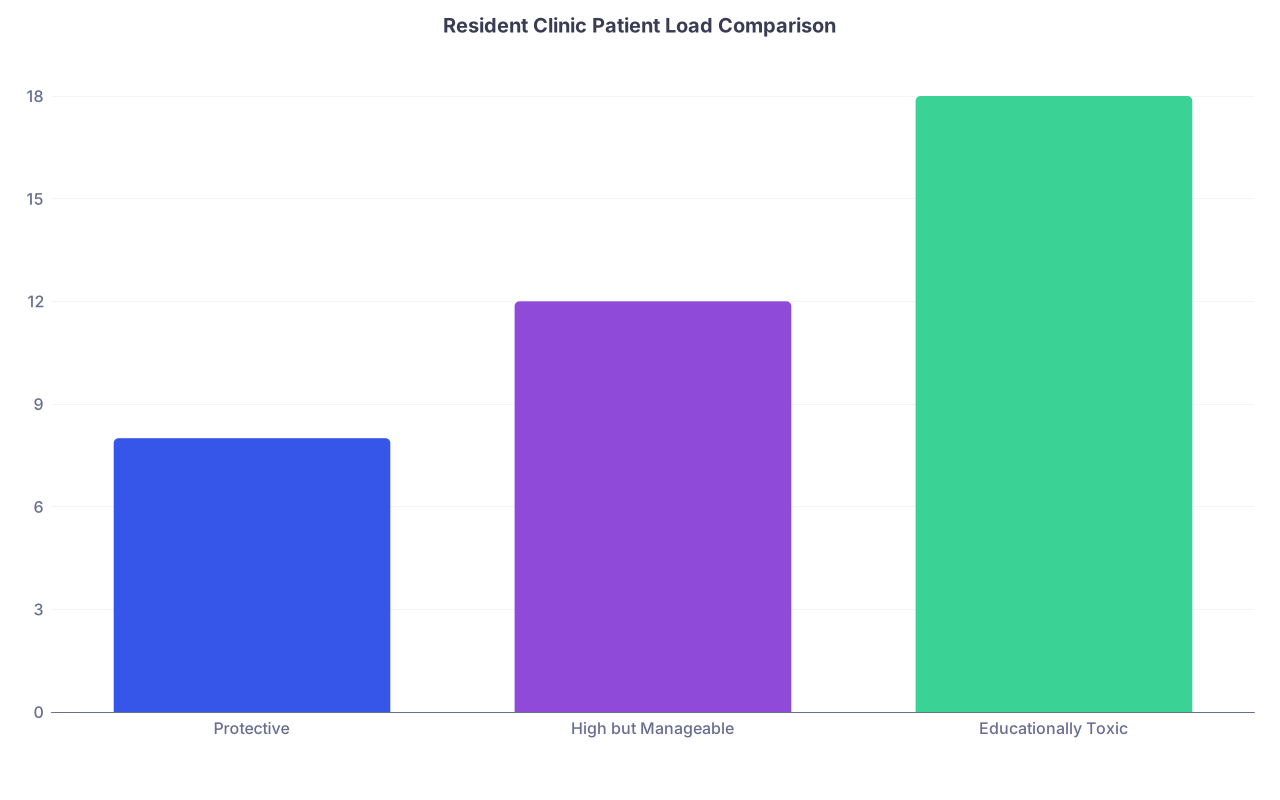
| Category | Value |
|---|---|
| Protective | 8 |
| High but Manageable | 12 |
| Educationally Toxic | 18 |
Educational impact is obvious:
- You do not have time to build differential diagnoses.
- You autopilot guideline-based care without understanding nuance.
- You never circle back to discuss cases in depth; you are just trying to survive.
What this does long-term is worse: it conditions you to practice defensive, superficial medicine. I have seen third-year residents who can click through a diabetes visit in 7 minutes but cannot explain when to switch from basal-bolus insulin to GLP-1 + basal, or why.
Red flags in how programs talk about this:
- “Our residents see a lot of volume; they’re ready for anything when they graduate.”
- “We run a real-world pace—our grads have no problem joining private practice.”
- “Clinic flows quickly; we average 15–20 patients per half-day by PGY-3.”
Interpretation: they have decided you are cheap labor first, trainee second.
Questions you should actually ask:
- “What is the average number of patients scheduled per resident per half-day by PGY level?” (You want numbers, not vibes.)
- “Are there routine double-booked slots? How often are they used?”
- “How often do residents stay more than one hour after clinic just finishing notes?”
If they dance around those, or residents laugh nervously and say “depends on the day” for everything, assume overbooking is standard.
2. One Preceptor, Too Many Residents: Invisible Supervision Failure
Good clinic supervision is not a hallway signature. It is:
- Pre-visit case discussion and strategy.
- In-room observation and feedback.
- Post-visit debrief of key decisions.
You cannot do that when one attending is “supervising” 4–6 residents while running their own full clinic.
Common structure that destroys supervision:
- One attending, 4 residents, 4 MAs, and 50–60 patients in a half-day across the team.
- Attending sees their own panel in parallel while “staffing” resident cases in 60–90 second bursts between rooms.
- Cases staffed at the very end of clinic after all patients are gone—no real-time teaching, just rubber-stamping.
Resident experience in this setup:
- You discuss only the “sickest” or most confusing cases; everything else gets autopilot “sounds good.”
- You rarely get corrected on subtle judgment calls because no one is watching you practice in real time.
- Your documentation and coding habits go essentially unchecked until you get a random compliance email.
This is how bad habits get baked in. Forever.
Classic phrases that should set off alarms:
- “Our attendings are always available if you need them.” (Translation: you will interrupt them between their own visits.)
- “We use a team-based approach; your preceptor supervises several learners at once.”
- “Residents are expected to manage routine issues independently by PGY-2.”
Independence is not the problem. Unobserved independence is.
Concrete things to ask:
- “How many residents are typically assigned to one preceptor in a half-day of clinic?”
- “Does the attending have their own patients scheduled during resident clinic?”
- “Do attendings ever come into the room with the resident? About how often per half-day?”
You want an answer that sounds like: 1–2 residents per attending, minimal or no attending own-panel in that block, and at least some planned direct observation.
If they say, “We trust our seniors; they do not need us in the room,” what they mean is: we cannot afford the time to supervise properly.
3. “Ownership” Without Control: The Illusion of a Continuity Panel
Continuity clinic is where you are supposed to learn longitudinal care. Patterns over years. How your decisions age.
The common structural sin: residents get “assigned” patients on paper but have no actual control over access, scheduling, or communication. So they never see the downstream effects of their own choices.
How this shows up:
- Patients randomly shuffled to “any resident with availability” rather than truly assigned panels.
- Every time you are on inpatient or elective, your patients are seen by whomever is there, with no closed-loop communication.
- No system to ensure you see “your” patient after a hospitalization, ER visit, or new diagnosis.
This kills continuity. Hard.
And without continuity, these core learning experiences vanish:
- Seeing whether your antidepressant plan worked at 3 and 6 months.
- Watching uncontrolled diabetic A1c fall, plateau, or bounce back after lifestyle changes fail.
- Understanding how communication failures lead to readmissions and lawsuits.
I have seen programs proudly list “resident panel size: 120–150 patients,” and then residents quietly say, “I only recognize about 30 names; the rest are randoms I saw once.”
Big warning signs in language:
- “We use a pooled resident panel model for access.”
- “We prioritize same-day coverage; patients may see different residents depending on availability.”
- “Panel sizes are shared across a resident team.”
Panel-based care with team backup is fine. Panel dilution is not.
Specific questions:
- “How is patient-provider continuity measured? What percent of resident visits are with their own paneled patients?”
- “If your patient is seen by another resident while you are inpatient, how do you find out what happened?”
- “After one of your patients is hospitalized, are post-discharge visits routinely booked with you specifically?”
If they cannot produce continuity percentages—many cannot—they are not actually watching it. And what they do not track, they will not protect.
| Feature | Healthy Structure | Harmful Structure |
|---|---|---|
| Panel assignment | Named PCP for most patients | Pooled “resident clinic” |
| Visit continuity | 60–70% with own PCP | <30% with same resident |
| Post-discharge follow-up | Default to own PCP | Whoever has open slot |
| Coverage when away | Partner with clear handoff | Random coverage with no feedback loop |
4. The Hidden EHR Burden: When Clicks Replace Cognitive Work
Every program will tell you, “We use Epic/Cerner/etc.” That is not useful. The structure around EHR work is what matters.
Here is the quiet sabotage:
- No dedicated time for inbox management, result review, and refills. So you do them in 3-minute bursts while rooming your next patient.
- Residents expected to personally process every refill, portal message, and result, without RN or MA triage.
- No charting support: no scribes, no standardized note templates, no pre-visit planning.
What you end up doing is spending your “clinic education” time:
- Figuring out which dot phrase will not trigger a documentation compliance alert.
- Manually reconciling meds that pharmacy already corrected.
- Replying to portal novels at 10 pm because otherwise they will pile up.
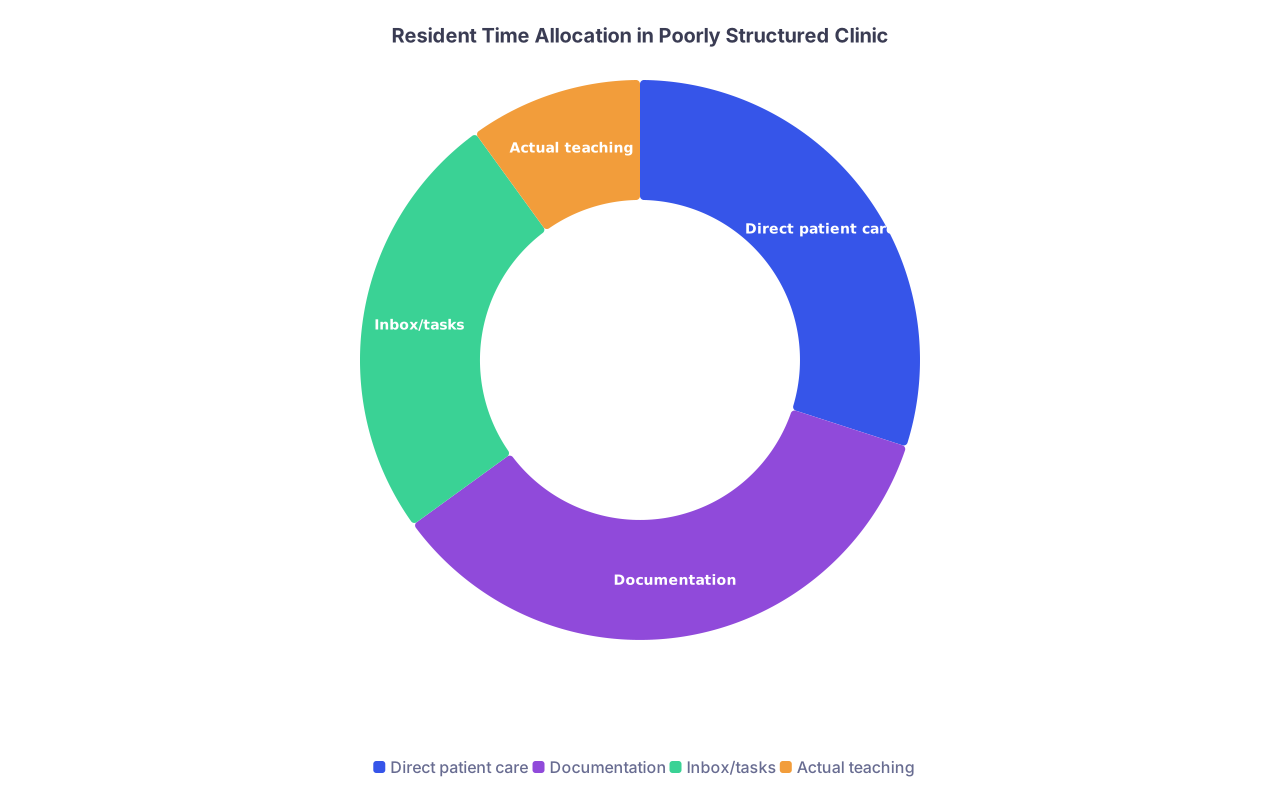
| Category | Value |
|---|---|
| Direct patient care | 30 |
| Documentation | 35 |
| Inbox/tasks | 25 |
| Actual teaching | 10 |
If you are spending 60–70% of your clinic time doing clerical tasks and fighting the EHR, you are not learning outpatient medicine. You are learning how to be a slightly faster cog.
Red flags in how they describe their system:
- “Residents manage their own inboxes—this teaches ownership.”
- “We do not have scribes, but residents are very efficient with templates.”
- “Portal messages are routed directly to the PCP to maintain continuity.”
Ownership without infrastructure is abuse, not education.
Questions that actually reveal the setup:
- “Who is the first line for phone calls, portal messages, and lab result notifications—RN, MA, or resident?”
- “Is there blocked time for inbox and documentation separate from face-to-face visits?”
- “How often do residents respond to patient messages or finish notes from home?”
You want to hear some version of:
- RN/MA triages first.
- Residents have protected non-visit time for inbox.
- Finishing notes from home is the exception, not the norm.
If they brag about residents “learning efficiency” by typing 200 words per minute, they have missed the point.
5. No Protected Teaching Inside Clinic: Pure RVU Factory
There is a simple test: In a typical 3–4 hour clinic session, how many minutes are explicitly dedicated to teaching, not just check-box staffing?
Many programs will answer: “It depends.” That is code for “basically zero.”
Sabotaging structures here:
- No pre-clinic huddle to review complex cases and learning goals.
- Staffing only takes place in the hallway or via chat, each case in under 90 seconds.
- Didactic teaching is scheduled only on “academic half-days” that constantly get eaten by service needs; clinic itself has no embedded teaching.
Result: residents become throughput machines.
You learn pattern recognition from repetition, which is not nothing, but you never correctly label or deepen that pattern. You just know that “people with headaches get CT if X, MRI if Y, neurology referral if Z.”
I have seen attendings trying to teach properly in this environment and just failing because the system does not give them 5 uninterrupted minutes.
Things they say that should raise suspicion:
- “Teaching is continuous through the day as you staff.” (In practice, it almost never is.)
- “We do not stop clinic for teaching; patients come first.” (Translation: bills come first.)
- “Residents learn a ton just from seeing so many cases.”
You should ask:
- “Is there scheduled pre-clinic huddle or post-clinic wrap-up? How long, and how often does it actually happen?”
- “Are there protected ‘no-patient’ slots for teaching in each clinic session?”
- “Can you give an example of a typical teaching interaction during clinic?”
You are listening for structure, not vague enthusiasm. For example: “We start every clinic with 10 minutes to review one complex case, and no patients are booked then” is structure. “Our attendings love to teach” is wishful thinking.
6. Too Many Sites, No Single Home: Fragmented Outpatient Identity
This one is subtle. Programs love to advertise “diverse clinic sites.” Community health center, VA, academic clinic, maybe a rural satellite. Sounds great on paper.
In practice, if you are rotating through 3–4 different clinic locations over your training, you end up with:
- Different workflows at each site: different MAs, different triage rules, different ancillary resources.
- Different attendings each time you show up, so no one really knows your growth curve.
- Fragmented panels split across sites, so your continuity is hopeless.
Educationally, you never get to feel what it is like to truly own a clinic space and team. You are always the visitor, never the anchor. You become expert at adapting to chaos instead of shaping a system.
Patterns that worry me:
- Residents do PGY-1 clinic at one site, PGY-2 at another, PGY-3 at a third.
- Clinic site changes every 3–6 months.
- VA Monday afternoons, community FQHC every third Thursday, academic internal medicine clinic on other weeks. Constantly shifting.
This kills relationships—with nurses, MAs, front desk, and most importantly, patients.
Questions to ask:
- “How many physical clinic sites will I be assigned to over my three years?”
- “Will my main continuity panel be at a single site for all three years?”
- “Do I have the same MA or nurse care manager consistently, or does that rotate too?”
You want a primary home site, especially for your continuity panel. Rotations at other sites are fine as electives or block experiences, but your core “I am the doctor here” identity needs one stable place.
7. Service Disguised As Education: Specialty “Clinics” That Are Really Consult Mills
Subspecialty clinics can be fantastic: nuanced cases, exposure to higher-level thinking, and procedural skills.
They become training-trash when:
- Residents are placed in high-volume specialty consult clinics just to move bodies because fellows/attendings are overbooked.
- Resident role is narrowed to “do the H&P and present,” with little autonomy in diagnostic or management decisions.
- No continuity—just one-off visits where you never see what happens after the CT, biopsy, or med change.
Examples you will recognize:
- “Resident cardiology clinic” where you see 20 follow-up patients who actually think they are seeing the cardiologist, not you.
- “Orthopedic access clinic” where residents churn through MSK complaints to generate consults.
- “Endocrine diabetes access clinic” where you adjust insulin regimens according to protocol but never decide on big-picture management.
There is educational value at the beginning. But if a significant chunk of your ambulatory “education” is this kind of slot-filling, you are trading breadth and depth of generalist outpatient care for a glorified scribe role.
Things to listen for:
- “Our residents staff many of the specialty clinics; it is a great way to increase access.”
- “We rely on residents in clinic to help manage demand.”
- “Residents are the front line in our subspecialty triage clinics.”
Access improvement is not a bad thing. But you are not an FTE extender. Your time in any specialty clinic needs explicit educational goals and some say in the plan.
Ask:
- “In subspecialty clinics, what percentage of patients are seen primarily by residents versus fellows/attendings?”
- “Do residents have their own slots, or do they just ‘help out’ with overflow?”
- “Are there explicit learning objectives or curricula for each specialty clinic, or is it purely service?”
You should be wary if they brag more about “access” than about how these clinics change resident competence.
8. No Feedback Loop: You Never See Your Own Outcomes
One of the quietest but worst structural flaws: no mechanism to show you your outcomes as an outpatient physician.
You cannot improve what you never see.
Bad structures here:
- No resident-level performance data on core chronic disease metrics (BP control, A1c, screening rates).
- No chart review or panel review sessions where you look at your own practice patterns.
- No system to let you know when one of your patients is admitted elsewhere, has an ER visit, or dies.
The result is that residents practice in a vacuum. You are making hundreds of decisions with no feedback beyond “clinic ended on time” or “attending signed my note.”
A strong clinic tells you, regularly:
- Here is what proportion of your hypertensive patients are at goal.
- Here are your screening gaps.
- Here is how often your notes document smoking cessation counseling, but your panel smoking rate is unchanged.
- Here are your 30-day readmits.
Most programs do none of this. Or if they do it, they report aggregated “clinic” metrics, not individual resident data.
Questions you must ask:
- “Do residents receive their own panel quality metrics? How often?”
- “Is there a regular panel review process where we sit down and look at our data with a preceptor?”
- “Do you have a system that notifies resident PCPs when their patients have ED visits or admissions?”
If the answer is “We have not gotten that set up yet,” or “Not really at the individual level,” understand that you will finish residency with very little idea how good or bad your outpatient care actually is beyond your own intuition.
9. Call, Wards, and Clinic Colliding: When Continuity Becomes a Joke
You can design the most elegant clinic template in the world. If your inpatient schedule constantly collides with clinic, continuity dies.
Destructive structures here:
- Weekly continuity clinic that is routinely canceled for ICU, nights, or floor rotations without make-up time.
- No coverage plan other than “patients are rescheduled” or “seen by whoever is free.”
- Residents switching call days every month, so their clinic day is perpetually clashing with something.
This is how you end up with residents who “technically” have a panel but lose 30–40% of their clinic sessions over a year due to schedule conflicts.
Patients get annoyed. They leave. Or they stop believing you are their doctor and treat you like a rotating student.
You want to know:
- “Over the last year, what percentage of scheduled continuity clinic sessions actually occurred for residents versus being canceled due to inpatient duties?”
- “When a resident is on ICU or nights, what happens to their clinic? Is it rescheduled, covered by a partner, or just canceled?”
- “Is the continuity clinic day protected from ward schedules, or can it be moved month to month?”
If the response is “We try our best, but medicine is busy,” you already know the answer. They have chosen hospital service over outpatient training when push comes to shove.
A mature program has solved this:
- Fixed clinic half-day that follows you regardless of rotation.
- Wards and ICU schedules built around clinic, not the other way around.
- Clear partner system so your patients are seen by a small group, with feedback to you.
Anything less is lip service to continuity.
10. The Future-Facing Problem: Clinics Ignoring Where Medicine Is Going
You are not training for 1998. Yet many resident clinics are structurally frozen there.
Structures that tell me a clinic is stuck in the past:
- No integration of telemedicine for resident continuity. All “virtual” visits routed to attendings or separate access pools.
- No structured involvement in population health tools: registries, risk stratification, outreach.
- No interdisciplinary clinics with pharmacists, social work, behavioral health embedded.
So you graduate having never:
- Run a panel management meeting.
- Handled a full session of video visits as the PCP.
- Worked in a genuinely integrated behavioral health model.
That is a problem, because large systems (Kaiser, Mayo, big multispecialty groups) expect you to do exactly those things, starting day one.
Ask very specific questions:
- “Do residents have their own telemedicine or video visit slots for continuity patients?”
- “How are behavioral health, social work, and pharmacy integrated into resident clinic? Are they physically present? Virtual? On-demand?”
- “Do residents participate in population health projects based on their own panels—e.g., outreach to uncontrolled diabetics?”
Look for structure, again. Not just “we sometimes do video visits” or “we have social work in the building.” If they are not building your skills around team-based, tech-enabled primary care now, you will have to scramble to learn it later.
How To Quickly Assess A Program’s Clinic Culture
You cannot do an ethnography at every interview, but you can use a fast pattern-recognition approach.
Here is a simple mental flowchart you should be running:

| Step | Description |
|---|---|
| Step 1 | Ask about patient volume |
| Step 2 | Probable overbooking |
| Step 3 | Better sign |
| Step 4 | Ask about preceptor -resident ratio |
| Step 5 | Weak supervision |
| Step 6 | Potentially strong supervision |
| Step 7 | Ask about continuity % and panel metrics |
| Step 8 | Educationally weak clinic |
| Step 9 | Clinic likely supports learning |
| Step 10 | >12 per half day by PGY3? |
| Step 11 | One attending covers >3 residents or own panel? |
| Step 12 | No data on continuity or outcomes? |
When you talk to current residents, do not ask “How is clinic?” Ask them:
- “What is the worst part about your clinic structure?” (Then shut up and listen.)
- “How many hours after clinic do you usually stay just doing notes or inbox?”
- “How often does your attending actually come into the room with you?”
- “Do you feel like you have a real panel that knows you, or are you just seeing randoms?”
Their faces will tell you more than the program director’s slide deck.
Key Takeaways
Clinic structure is not cosmetic; it dictates what kind of physician you become. Overbooked, under-supervised, continuity-poor clinics train you to be fast, not thoughtful.
Vague reassurances are useless. You need concrete numbers: patients per session, preceptor-to-resident ratios, continuity percentages, after-hours work, and whether you ever see your own panel outcomes.
A truly educational clinic gives you: reasonable volume, real continuity at a single home site, strong supervision with observation, protected teaching and EHR time, and exposure to modern team-based, data-driven outpatient care. Anything else is quietly undermining your training, whether they admit it or not.