Fellow Presence vs Resident Autonomy: Detecting Training Imbalance
You are standing at the PACS workstation on interview day. A PGY‑3 is scrolling through CT scans, a fellow leans over their shoulder, and the attending is… somewhere. You ask, casually, “Who usually staffs these cases?”
The resident hesitates. Glances at the fellow. “We usually run things by the fellow first.”
That one sentence should set off a mild internal alarm. Not full code blue. But at least “monitor closely.”
Let me break this down specifically: fellow presence can massively enrich resident training. It can also quietly suffocate resident autonomy if the structure is wrong. Most applicants are terrible at telling these scenarios apart during a single interview day.
You can do better than that.
First Principles: What “Balanced” Training Actually Looks Like
Forget the brochure language for a minute. A healthy relationship between fellows and residents has a few non‑negotiable features.
Core reality: residents are the backbone of most programs
In a well‑run academic program:
- Residents own the primary day‑to‑day care of most inpatients.
- Fellows exist to deepen subspecialty care and model the “next level up.”
- Attendings set standards, ensure safety, and sign off.
That triangle works when each level is clear on scope.
Balanced fellow presence looks like this:
Residents still:
- Present on rounds as the first voice.
- Call most consults and take initial histories.
- Write initial assessment/plan on complex patients.
- Scrub key portions of procedures appropriate for their level.
Fellows:
- Focus on complex decision‑making residents have not seen yet.
- Teach technique, nuance, and subspecialty judgment.
- Serve as intermediate supervisors, not final bosses.
- Step back intentionally when the resident can handle it.
Attendings:
- Evaluate residents directly at least part of the time.
- Do not outsource all resident teaching to fellows.
- Know individual resident strengths and weaknesses.
When that balance breaks, you feel it. The day becomes fellow‑centric. Residents start to sound like scribes, scut‑collectors, or perpetual observers.
The Three Common Failure Modes When Fellows Dominate
I will be blunt. I have seen the same failure patterns repeated across multiple institutions.
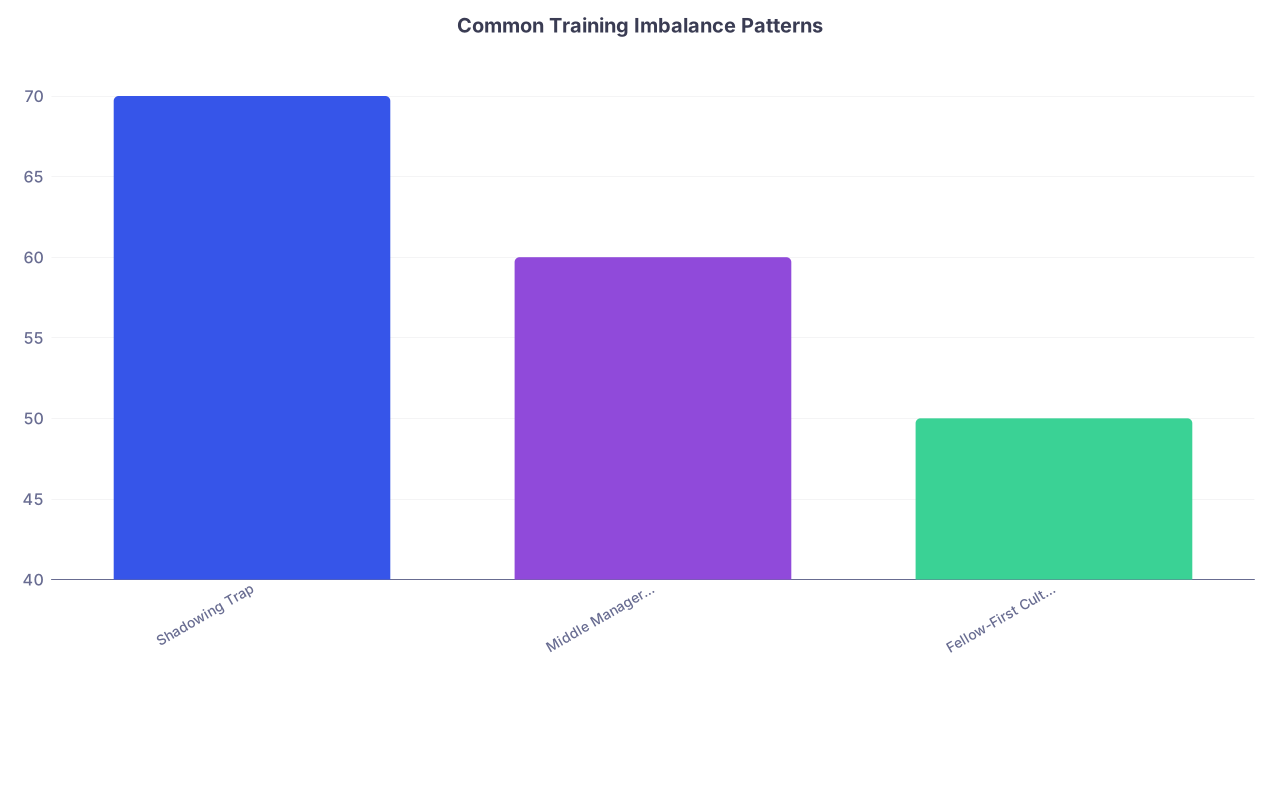
| Category | Value |
|---|---|
| Shadowing Trap | 70 |
| Middle Manager Medicine | 60 |
| Fellow-First Culture | 50 |
Numbers here are illustrative, but the patterns are real.
1. The “Shadowing Trap” – Fellows Take the Wheel
You will hear residents say:
- “Yeah, for the really sick patients, the fellow just takes over.”
- “Procedures go a lot faster when the fellow drives, so we usually just watch.”
- “Codes are run by the fellow; we manage the orders and notes.”
At first glance, that sounds reasonable. Sick patients. Need experience. Efficiency.
The problem: this becomes the default, not the exception.
Concrete signs you are in a shadowing culture:
On ICU or subspecialty rotations, residents are:
- Standing at the edge of the bed during procedures, not gloved.
- Rarely the one actually running the code or leading the huddle.
- Rarely the one calling families about major decisions; the fellow does it.
Fellows:
- Write (or dictate) most major notes and plans for the highest‑acuity patients.
- Speak first and longest during rounds on complex cases.
- Are the ones the nurses page first for any real problem at night.
This produces residents who are excellent observers and terrible decision‑makers under pressure. By PGY‑3 they “know” a lot, but they have not had to own those decisions.
2. “Middle Manager Medicine” – Residents Reduced to Workflow Staff
This is common in large, high‑volume academic centers with many services and “service fellows.”
You will see:
Residents:
- Managing throughput, admission logistics, discharges and paperwork.
- Acting as couriers for tasks: “Run this by the fellow, then by the attending.”
- Getting pulled from the bedside to “just help with the list.”
Fellows:
- Doing high‑level consult discussions.
- Negotiating with other services.
- Owning procedural lists and complex consults.
On paper, the residents “saw everything.” In reality, they were traffic controllers, not clinicians.
A PGY‑2 tells you:
“We usually pre‑round, then present briefly, then the fellow and attending go back and re‑discuss everything in more detail.”
Decoded: residents are preparing data; fellow/attending are doing the actual critical thinking. That is a structural red flag.
3. “Fellow‑First Culture” – Teaching Bypasses Residents
This one is more subtle, but more toxic.
Classic pattern:
- Attendings address complex questions to fellows, not residents.
- Teaching is framed as:
- “As a fellow, you’ll need to know…”
- “When you are in subspecialty practice, you’ll do it this way…”
- Residents get reheated teaching second‑hand, when the fellow remembers.
You will hear:
“The formal education is really geared toward the fellows, but we can sit in on some of the conferences if we are free.”
Translation: this department thinks of itself as a fellowship shop. Residency is an afterthought.
Where Fellow Presence Is Legitimately Powerful (And How To Tell)
I am not anti‑fellow. Strong fellows can be the best teachers you ever have. The trick is discrimination: when is heavy fellow presence a feature, not a bug?
Element 1: Deliberate graduated autonomy
Look for structures where fellow involvement clearly decreases as residents progress.
Example of a healthy model in a cardiology‑heavy IM program:
PGY‑1 on CCU:
- Runs overnight cross‑cover with fellow backup.
- Fellow directly supervises first central lines, first transvenous pacer.
PGY‑2:
- Runs most daytime CCU notes and presentations.
- Fellow steps in mainly for complex device patients and unstable arrhythmias.
PGY‑3:
- Runs codes independently while fellow stands back unless needed.
- Leads family meetings, with fellow present but not leading.
On interview day, concrete indicator:
You ask a PGY‑3, “Who runs the codes?” and they answer, “We do. Fellow is usually there, but we run them unless things go off the rails.”
Very different from, “The fellow runs all the codes.”
Element 2: Fellows explicitly tasked as teachers, not gatekeepers
You want fellows who say:
- “I staff with the resident first, then we go to the attending together.”
- “I try to let the resident do as much of the procedure as safely possible.”
- “My job is to help them think more like a subspecialist, not just to fix their plan.”
Ask a fellow directly:
“How do you see your teaching role with residents? Where do you step back?”
If they cannot answer clearly—or worse, they look confused—this program has not thought about resident‑fellow dynamics at all. Training drift is almost guaranteed.
Element 3: Attendings maintain direct contact with residents
Balanced programs do not hide behind their fellows.
Good signs:
- Dedicated resident teaching attending on key rotations (e.g., MICU, CCU, surgical services) whose primary job is resident education.
- Residents report regular one‑on‑one feedback from attendings, not just from fellows.
- Morning reports, M&Ms, and didactics are resident‑centered, with fellows welcome but not the main audience.
Ask:
“How often do attendings observe you directly on procedures, family meetings, or critical events?”
If the answer is, “Mostly the fellow sees those and passes feedback along,” that is a problem.
Concrete Red Flags: What You Should Actively Look and Listen For
Let us get very specific. On interview day, you have maybe 6–8 hours of data. You need to extract as much signal as possible.
Watch behavior, not just brochures
Pay attention to interactions when you walk onto a floor or into a conference.
Red flags in 30 seconds:
- On rounds:
- Fellow stands directly next to attending, speaks first.
- Resident hangs a step back, fills in details when asked.
- In conference:
- Case is presented by fellow, residents silent, mostly checking phones.
- Attendings direct questions only to fellows.
You are allowed to trust your eyes. If residents are socially and physically peripheral during key clinical discussions, they are likely educationally peripheral too.
Specific questions to ask residents (and what answers should raise your eyebrows)
Do not ask, “How is resident autonomy?” That invites a canned answer.
Ask these instead:
“On your sickest patient right now, who is actually writing the plan and making the overnight calls—resident, fellow, or attending?”
- Good answer: “Me, with input from the fellow / attending.”
- Bad answer: “The fellow usually writes the key stuff; I just help with orders and notes.”
“Can you describe the last time you led a code or rapid without a fellow taking over?”
- Good: specific, recent example, with fellow as backup.
- Bad: long pause, vague “usually the fellow handles the critical ones.”
“How do procedures work here? Who gets first shot at lines / scopes / OR cases—the residents or the fellows?”
- Good: “Residents get first dibs; fellows step in for complex cases or if we are backed up.”
- Bad: “Fellows own most of the procedures; we can do some if they are not available.”
“Do you feel like attendings know you personally and can assess your growth, or does most evaluation flow through the fellows?”
- Good: “Attendings definitely know us and give direct feedback.”
- Bad: “It mostly goes through fellows; we get attending evals but they are pretty generic.”
“Have there been conflicts about residents wanting more autonomy and fellows stepping in? How did that get handled?”
- Good: “Yes, occasionally, but our PD was clear about resident ownership, and it improved.”
- Bad: uncomfortable laugh, “Yeah, but that is just how it is here.”
Questions to ask fellows (they will accidentally reveal the culture)
You want to hear how they think of their role.
“How do you balance service demands, your own learning, and teaching residents?”
- Healthy: they describe a conscious balance; they mention stepping back deliberately.
- Unhealthy: they primarily talk about “protecting residents from too much work” or “just getting things done efficiently.”
“On a typical day, what are residents better at by the end of the year because you were involved?”
- Healthy: they talk about residents gaining confidence in procedures, critical care decisions, advanced imaging interpretation, etc.
- Unhealthy: they struggle to name specific skills, or focus on “they get used to the workflow.”
Specialty‑Specific Nuances: When High Fellow Density Is Expected vs Concerning
Fellow impact is not the same in psychiatry versus CT surgery. You need to calibrate expectations.
| Specialty Type | Typical Fellow Density | Autonomy Risk if Poorly Structured |
|---|---|---|
| Internal Medicine (large academic) | Moderate-High | Moderate-High |
| General Surgery | High | Very High |
| Anesthesia / Critical Care | High | High |
| Pediatrics (general) | Low-Moderate | Moderate |
| Neurology / EM | Variable | Moderate |
Internal Medicine and its subspecialties
Big IM departments love fellowships. Cards, GI, Heme/Onc, Pulm/CC, ID, Nephrology, the list goes on.
Stanford, Hopkins, Penn, wherever—patterns repeat:
- Cards/CCU: risk that residents become note‑writers for advanced heart failure, LVAD, transplant patients while fellows run the real medicine.
- MICU with critical care fellows: risk that residents never own ventilator management; they just “check vent settings” someone else decided.
Healthy IM programs:
- Have resident‑run wards and nights that are not dominated by fellows.
- Use fellows mainly on consult‑heavy or high‑acuity subspecialty services, with explicit resident roles carved out (resident primary, fellow consultant).
General Surgery and surgical subspecialties
This is where fellow vs resident competition can get ugly, fast.
What you must clarify:
Who gets the primary operative experience?
- On trauma/acute care: residents should own the bread‑and‑butter cases.
- On electives with fellows (HPB, CT, vascular): residents should still get meaningful portions of cases, not just skin to skin.
Who runs cases from the table perspective?
- If fellows are first assistant on everything big, residents watch or retract—this is an educational failure.
Direct questions to ask a senior surgical resident:
- “On your last big case with a fellow—who was at the console / primary operator for the key steps?”
- “By chief year, are there complex cases you still have never done because fellows always have priority?”
If they say, “There are certain cases we just do not touch as residents,” think very carefully if you are comfortable with that.
Anesthesia and Critical Care
Risk here: residents become “induction and emergence techs” while fellows manage complex intra‑operative or ICU decision‑making.
You want:
- Resident‑run OR rooms with attending supervision, where fellows are present mainly for very complex cases.
- ICU environments where residents are running rounds on at least a subset of patients, not just scribing for the fellow.
Again, ask: “Who is driving the vent and pressor changes at 3 a.m.?”
Structural and Data‑Level Clues of Training Imbalance
Not everything is vibes. Some metrics and structures are objective tells.
, Attendings rarely evaluate residents directly](https://cdn.residencyadvisor.com/images/articles_svg/chart-warning-signs-of-fellow-driven-culture-6011.svg "Warning Signs of Fellow-Driven Culture")
| Category | Value |
|---|---|
| Fellow-dominated didactics | 80 |
| Residents rarely lead codes | 70 |
| [Procedures mostly done by fellows](https://residencyadvisor.com/resources/residency-program-red-flags/subspecialty-exposure-patterns-that-limit-your-future-fellowship-options) | 75 |
| Attendings rarely evaluate residents directly | 65 |
1. Conference structure
Look at the schedule if you can:
- Are there:
- Separate fellow conferences that look richer / more advanced than resident conferences?
- Multiple weekly fellow‑only teaching sessions, but only a token “morning report” for residents?
- Who presents:
- Case conferences run mostly by fellows?
- M&M focused on fellow decision‑making, residents peripheral?
Occasional fellow‑focused teaching is fine. A full parallel educational universe where residents are spectators is not.
2. Procedure logs and milestones
If programs share case numbers, look closely:
- Do residents barely meet minimums despite massive hospital volume and many fellows? That suggests fellows are absorbing procedures.
- Do chiefs report “having to chase cases” that should be routine at their level?
You can ask on interview day:
“How do you monitor that residents are getting enough procedural exposure given the number of fellows?”
Strong programs will have a specific system and can describe adjustments they made when residents were falling behind.
3. Who is on the off‑hours schedule?
Night float and weekends reveal hierarchy.
Warning patterns:
- Nights always have in‑house fellows on key services, residents just cross‑cover floor issues.
- Complex admissions at night (e.g., STEMI, GI bleeds, sick ICU transfers) bypass resident leadership and go straight to fellows / attendings.
Ask the night float resident bluntly:
“When something major happens at 2 a.m.—who is actually the first clinician on scene, you or the fellow?”
If the fellow is usually first and in charge, you will not magically have autonomy during the day.
How To Interpret Mixed Signals Without Overreacting
You are not trying to find a program with zero red flags. That does not exist. You are trying to avoid structural flaws that will cap your growth.
Some nuance:
One heavy fellow service is not a program‑wide indictment
For instance:
- A transplant hepatology service where the fellow leads advanced immunosuppression discussions. Fine—if residents still run notes and basic management.
- A Level I trauma center where fellows run the most complex trauma activations, but residents still get tons of OR and ED procedural time.
You worry when:
- Every high‑acuity or high‑value rotation has fellows “on top of” residents.
- Residents consistently describe their role as “supporting the fellow” rather than owning a patient panel or OR room.
A strong fellowship culture is not inherently bad
Some of the best residencies sit inside departments that care deeply about fellowship training. This can benefit you:
- More subspecialty teaching.
- Stronger research opportunities.
- Better mentorship into competitive fields.
But your litmus test:
- Do residents still graduate as independent, confident generalists in their specialty?
- Or do they all feel compelled to do a fellowship because they are not comfortable practicing at a general level?
If almost every graduate from a big IM program goes into fellowship, do not just say, “Wow, they are all so academic.” Ask: “Would they feel safe as hospitalists right now?”
Using This Lens Strategically on the Interview Trail
You will not remember everything. Use a simple mental framework.

| Step | Description |
|---|---|
| Step 1 | See Fellows On Service |
| Step 2 | Good balance |
| Step 3 | Potential red flag |
| Step 4 | Balanced |
| Step 5 | Imbalance likely |
| Step 6 | Healthy structure |
| Step 7 | Training risk |
| Step 8 | Who runs sick cases? |
| Step 9 | Who does procedures? |
| Step 10 | Attendings know residents? |
On your notes after each interview, literally jot three bullets:
- Who runs the sickest 10% of patients?
- Who gets first shot at high‑value cases / procedures?
- Who do attendings teach and evaluate directly?
If “fellows” is the honest answer to all three, you are looking at a residency designed around fellowship training, not resident growth.
Two Subtle But Crucial Questions To Ask Yourself
When you replay your impressions on the flight home, ignore the catered lunch and the glossy atrium. Ask yourself:
- “Did I see residents in charge of anything that actually mattered?”
Not just vitals, not just notes, not just calling consults. Actual decisions.
- Adjusting vasopressors based on their own assessment.
- Running a family meeting about withdrawal of care.
- Leading a debrief after a bad outcome.
- Driving an OR case or a complex procedure.
If your gut answer is “not really,” listen to that.
- “Could I see myself leaving this program as the person everyone turns to at 2 a.m.—without needing another 3 years of fellowship to feel ready?”
If the honest answer is no, that program may be over‑fellowed and under‑residented from a training standpoint.
Key Takeaways
- Fellow presence is not the problem; misaligned hierarchy is. You want fellows as amplifiers of resident growth, not replacements for resident responsibility.
- Watch who runs the sickest patients, who gets first shot at procedures and decisions, and who attendings know and teach directly. Those three data points will tell you more than any brochure.
- Trust what you see and hear from residents. If their daily reality is “supporting the fellow” rather than owning care, you are looking at a structural training imbalance that will not magically fix itself while you are there.