
The match list is not a brag sheet. It is a dataset. And the data often shows—very clearly—when a program is failing its fellows.
Most applicants glance at match lists for name recognition: MGH good, “local community hospital” bad. That is lazy reading. If you treat match lists like a statistician instead of a starstruck M4, you start seeing structural problems: inadequate mentorship, weak advocacy, lopsided training, even toxic culture.
Let’s pull this apart with numbers, not vibes.
1. What a Match List Actually Is (and Is Not)
A match list is a small, messy dataset: low sample size, survivor bias, and heavy confounding. But like any noisy dataset, patterns emerge if you stop asking “Is this prestigious?” and start asking “What is the distribution and what does it imply?”
At minimum, you can usually extract:
- Number of fellows per year
- Destinations: programs, cities, and sometimes tracks
- Rough specialty/subspecialty choices
- Occasional notes: “research track,” “chief,” “advanced fellowship”
From that, you can compute:
- Proportion to top-tier programs
- Spread vs clustering of destinations
- Year-to-year variance
- In-field vs out-of-field matches
- Geographic mobility vs local anchoring
And then the key question: does this pattern look like a healthy environment where fellows’ goals are supported, or an ecosystem where people quietly give up or get boxed in?
2. Core Metrics That Expose Whether Fellows Are Being Supported
You are not just evaluating “strength of program.” You are evaluating “alignment between trainee goals and outcomes.” That is different. The data shows cracks in that alignment if you know what to compute.
2.1 Destination Tier Mix: Too High or Too Low is a Problem
A simplistic lens: more “big-name” destinations = better. Reality is more nuanced.
Look at the distribution of match destinations by rough tier. You can use a crude step-function: for example, define Tier 1–3 based on NIH funding, reputation metrics, case volume, or publicly available rankings.
| Program Year | Tier 1 (%) | Tier 2 (%) | Tier 3+ (%) |
|---|---|---|---|
| A – 2021 | 20 | 50 | 30 |
| A – 2022 | 25 | 45 | 30 |
| A – 2023 | 22 | 48 | 30 |
| B – 2021 | 0 | 10 | 90 |
| B – 2022 | 0 | 0 | 100 |
Program A: stable, reasonable spread. Program B: 0–10% to Tier 1–2 over multiple years. Could be geography. Could be self-selection. But if you ask the PD, “How many fellows in the last 5 years targeted academic T1/T2 jobs?” and the answer is “Quite a few,” the numbers indicate failure of support.
The red flag is not “no one matched Harvard.” It is “our fellows routinely aim high but the empirical hit rate is nearly zero, year after year.” That is a support problem, not a randomness problem.
2.2 In-Field vs Out-of-Field Match Rates
You see this especially in subspecialty fellowships and advanced training (e.g., interventional, advanced heart failure, complex EP).
Look for:
- How many fellows matched in their intended subspecialty vs pivoted to something else?
- How often do people “default” to general positions after apparently planning a subspecialty?
If 6 out of 8 cardiology fellows openly say they want interventional, and the match list shows:
- 1 interventional
- 1 EP
- 4 general cardiology jobs (hospital-employed, non-academic)
- 0 advanced HF
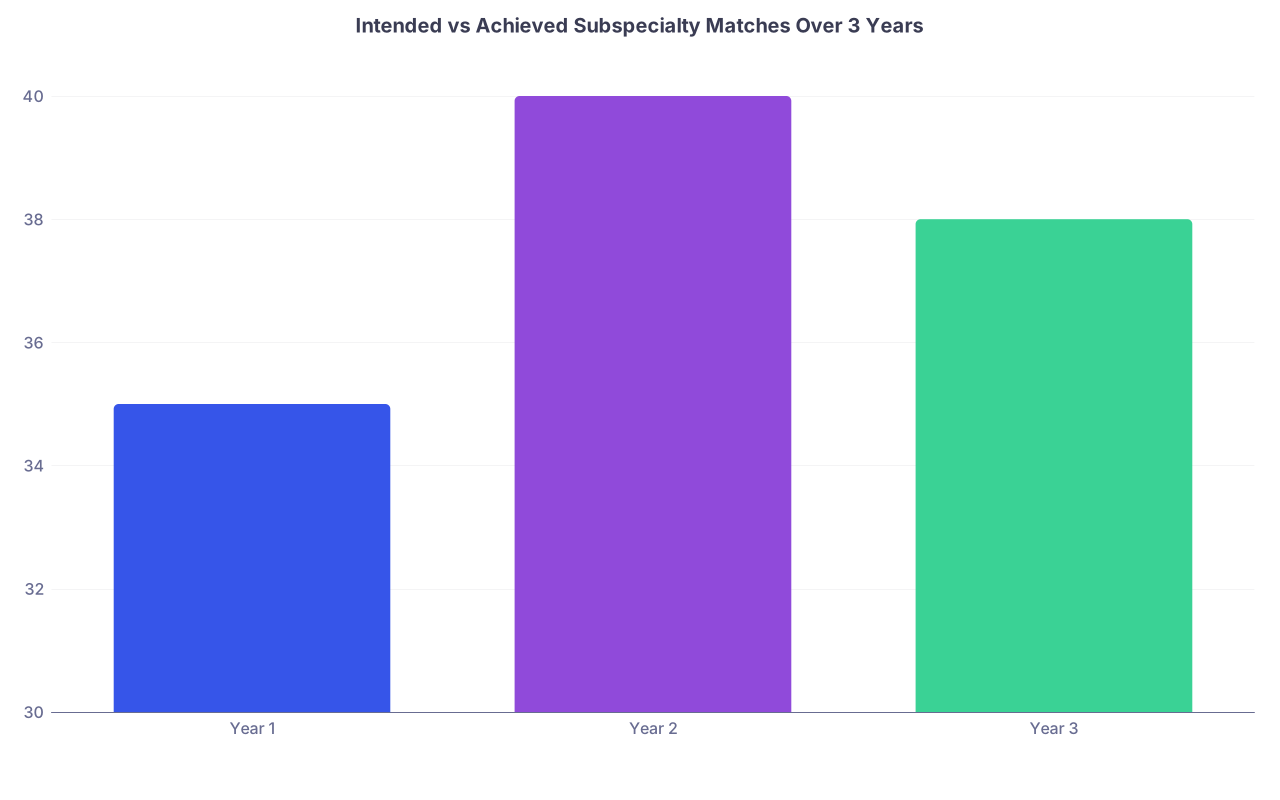
That is a 33% realization rate for the primary expressed goal. That is poor. Over 3–4 years, if that 30–40% conversion persists, it stops looking like random chance and starts looking like structural under-preparation: weak case logs, poor letters, no research push, weak advocacy.
| Category | Value |
|---|---|
| Year 1 | 35 |
| Year 2 | 40 |
| Year 3 | 38 |
Values here represent the percentage of fellows achieving their initially stated subspecialty target. Anything consistently below ~60–70% in a program that markets itself as “strong in subspecialty placement” is concerning.
2.3 Geographic Mobility: Are Fellows Effectively Trapped?
Some fellows want to stay local. That is fine. But you should detect whether fellows can leave when they want to.
You can treat “local vs external” as a binary outcome per fellow per year:
- Local (same institution or same system)
- External (new institution, especially out of region)
If for three consecutive years, 80–100% of fellows remain in the same institution or local system, you need to ask: is that preference or a ceiling?
Signs that it is a ceiling, not a choice:
- Fellows say they tried to go elsewhere and failed.
- No one matches to competitive programs outside the region despite decent CVs.
- The program leadership boasts about “great retention,” but current fellows sound more resigned than enthusiastic.
The data pattern: over, say, 5 years, out of 20 fellows, only 2–3 leave the regional network. That density is statistically unlikely if many had national aspirations. It implies weak external connections and lukewarm letters.
2.4 Year-to-Year Volatility: Healthy Variance vs Chaos
Healthy programs show some variance in match power—because cohorts differ—but the distribution shape stays recognizable. You might see:
- Year A: one star match, a few mid-tier.
- Year B: no star, but mostly solid placements.
- Year C: two strong, some mid-tier, one lesser-known.
Red flag version:
- Year 1: 80% to weak destinations, one non-match.
- Year 2: 100% to strong destinations.
- Year 3: 70% to weak, two scrambling into last-minute positions.
That kind of whiplash often signals inconsistent mentorship, unstable leadership, or chaotic internal politics. Stable systems do not produce wild oscillations like that without an underlying shock (new PD, loss of key faculty, accreditation issue). If volatility tracks leadership changes in time, your match list is basically a time series confirming the turbulence.
3. Hidden Signals: What the Match List is Quietly Telling You
Some of the loudest signals are where fellows end up not going.
3.1 “All Roads Lead Back Here”
If a program’s match list keeps showing:
- “Fellow – Attending, [Same Institution]”
- “Fellow – Junior Faculty, [Same Institution]”
- “Fellow – Hospitalist, [Affiliated Hospital]”
Year after year, with virtually no external placements, you are likely looking at one of two things:
- A very desirable institution that truly can absorb and develop its own; or
- A closed ecosystem where the only viable path is: do fellowship here, then stay here because no one else is calling.
Differentiate them by asking current fellows:
- “How many alumni in the last 5 years left the system for academic jobs elsewhere?”
- “How many had offers at other top institutions but chose to stay?”
If the match list shows 90% staying, and the answer to both questions is “Almost none,” the data suggests limited external endorsement. That is… not the market signal you want.
3.2 Overconcentration in Non-Academic or Low-Complexity Jobs
Again, not everyone wants R01s and RCTs. But if the program continually markets “strong academic outcomes” yet the 5-year match data shows:
- <10% to university-based academic roles
- Majority to small community sites with minimal teaching/research
- Rare or zero research-track positions
Then the outcome profile contradicts the marketing. The environment is likely not supporting scholarship to the point necessary for external academic placement.
A rough benchmark in many competitive fellowships:
- For a genuinely academic-leaning program, you should see at least 30–40% of fellows over several years land at academic centers or hybrid roles with explicit teaching/research expectations.
- If that number sits at 5–10% for 5+ years, scholarship support is not doing its job.
3.3 “We Don’t Talk About the Non-Match”
The most glaring red flag: missing data. A PGY-6 just vanishes from the list. Or the count of residents/fellows in the program does not match the count of people listed as having matched.
Watch for:
- Cohort size vs listed outcomes mismatch.
- Vague outcomes: “Pursuing opportunities” with no specifics.
- “Took time off” patterns that only appear in the most recent class.
One missing fellow = could be personal reasons. Three omissions across two years = pattern. That is a retention and support signal, not just a match outcome. High non-match or attrition rates are rarely advertised, but you can infer them.
4. Red Flag Patterns That Recur Across Programs
Let me group some key patterns that show a program is failing its trainees, using match list data only.
4.1 The “Always Undershooting” Pattern
You see this all the time:
- Fellows with otherwise competitive profiles (multiple first-author papers, strong board scores, good letters from visiting rotations) consistently matching to lower-tier destinations than peers from other programs with similar CVs.
When you talk to them later, they say things like:
- “My PD was supportive but not very connected.”
- “Letters were fine, but not the kind that open doors.”
- “We got almost no structured help with applications.”
The match list shows 0–1 high-end outcomes per year, despite 3–4 fellows obviously aiming that high. Over a 5-year sample, this is not “random.” This is poor mentorship, bad branding, or weak advocacy.
4.2 The “Random Scatter” Pattern (No Coherent Trajectory)
Contrast two distributions:
Program X (healthy):
- 2019: 1 Top-10, 3 mid-tier, 1 local academic.
- 2020: 2 Top-20, 2 mid-tier, 1 community.
- 2021: 1 Top-10, 2 Top-50, 2 community.
There is a center of gravity: mostly solid places, occasional stars, some community by choice.
Program Y (red flag):
- 2019: 1 unfilled, 2 low-volume sites, 1 mid-tier.
- 2020: 1 Top-10, 1 non-match, 2 small private groups no one has heard of.
- 2021: 1 outside the specialty, 1 mid-tier, 1 unknown clinic, 1 industry role.
That is a noise-dominated pattern. Lack of coherent outcomes over multiple years usually means the program does not have a clear, supported path for fellows. People just scatter where they can.
4.3 Consistent Non-Alignment with Stated Program Strengths
If a program claims “We are a powerhouse in transplant, global health, and outcomes research,” you should see that in the destinations:
- Transplant-heavy centers.
- Global health fellowships / academic global units.
- Outcomes research groups, at least for a subset.
If the actual match list is:
- 80% generic clinical positions with no mention of these niches.
- Rare or zero transplant / global positions.
- No clear research-track outcomes.
Then the data contradicts the brochure. Programs that truly support niche career goals have visible pipelines in the match list. When those pipelines are absent, fellows are probably being sold a brand the system cannot actually deliver on.
5. How to Analyze a Match List Like a Data Person
You do not need R or Python. You just need discipline.
5.1 Standardize the Data You Collect
For any program you care about, extract:
- Last 5 years of match lists (3 at absolute minimum).
- For each fellow:
- Year
- Name (for cross-checking, not necessarily sharing)
- Destination institution
- Destination city/region
- Nature of role (academic vs community vs private)
- Subspecialty / track, if relevant
- Whether destination is same system, same city, or external
If the program only posts one or two years, ask for more. If they refuse or “don’t have it compiled,” that is its own data point about transparency.
5.2 Create Simple Proportions
Compute:
- % same-institution / same-system.
- % academic vs non-academic roles.
- % achieving specific subspecialty tracks.
- % at what you would consider top-tier / high-volume centers.
- % apparent non-matches or “unclear” outcomes.
Then compare across programs you are considering.
| Category | Value |
|---|---|
| Program A | 55 |
| Program B | 25 |
| Program C | 40 |
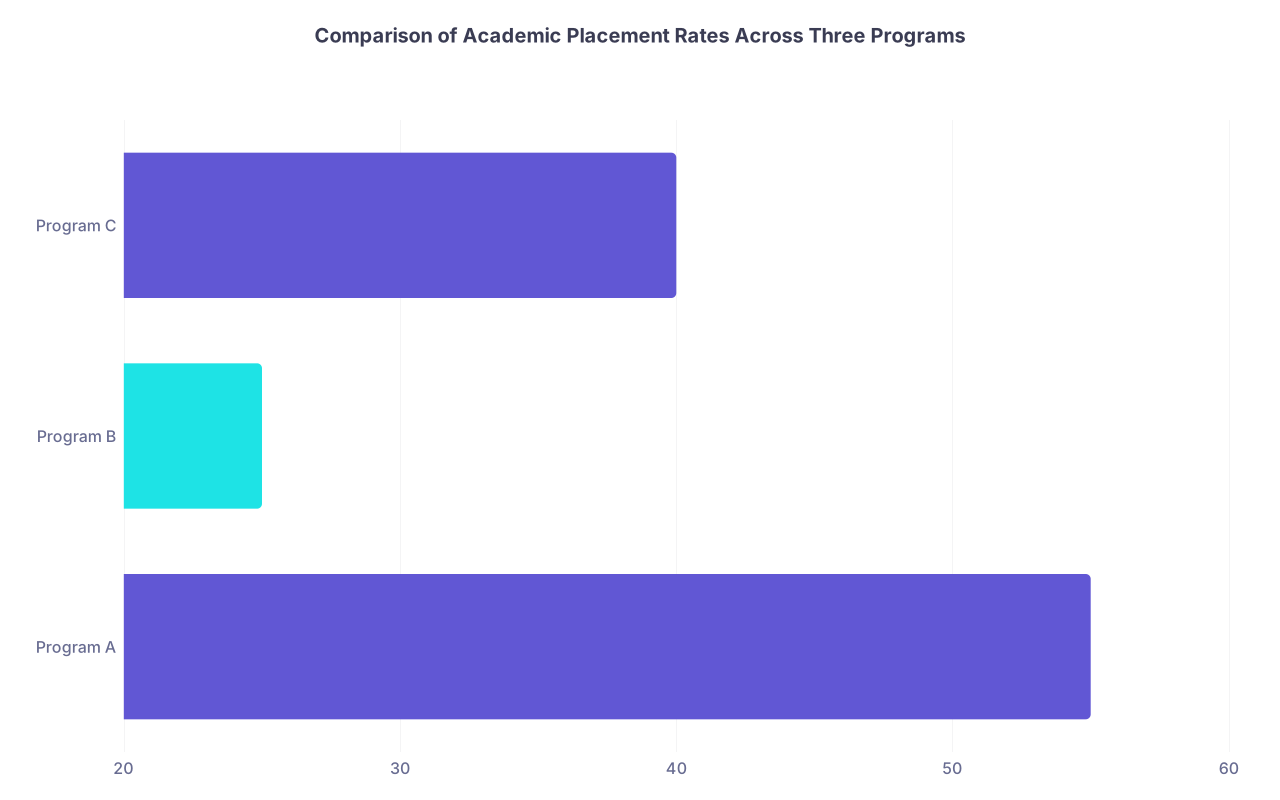
If Program B is placing 25% into academic roles vs 55% for Program A over the same 5-year window, with similar cohort sizes, that gap is not trivial. That is your likelihood ratio for getting the outcome you claim to want.
5.3 Look for Trajectories, Not Just Snapshots
Plot outcomes mentally (or literally) per year.
- Are academic placements trending up or down?
- Did things crater after a leadership change?
- Are certain subspecialty outcomes increasing as new faculty arrived?
Short example: a program publishes:
- 2018: 1 academic, 4 community.
- 2019: 1 academic, 4 community.
- 2020: 2 academic, 3 community.
- 2021: 3 academic, 2 community.
- 2022: 3 academic, 3 community.
That upward trend suggests that the support structure for academic careers improved. Maybe they hired a research director or started a formal mentorship program. Match list data often captures the effect of those internal shifts before you see them in glossy marketing.
5.4 Cross-check with What Fellows Actually Say
Match lists are outcomes. Fellow interviews provide ground truth about process.
A classic pattern: match list looks “OK” at first glance, but every fellow you talk to says:
- “Honestly, those who did well did it in spite of the program.”
- “If you want research, you have to build everything yourself.”
- “Our PD writes generic letters, and we rely on external mentors.”
When that narrative combines with mediocre outcomes compared to similar programs, you are looking at a systemic support deficit. The stories match the stats.
6. Safely Interpreting Small Sample Sizes
Yes, cohorts are small. A 3-fellow class has enormous year-to-year variance. You cannot treat it like a 10,000-patient RCT. But you can still infer.
Here is how I handle small n:
- Use 3–5 years of data to smooth out noise.
- Focus on directional differences between programs, not exact percentages.
- Pay attention to repeated failures in specific areas (e.g., no one matching EP for 7 years despite people trying).
- Give more weight to systemic patterns, less to single superstar outcomes.
One star fellow who came in with 10 publications and Ivy League letters does not mean the program made them. You look at what happened to the median fellow, not the outlier.
| Category | Value |
|---|---|
| Year 1 | 20 |
| Year 2 | 25 |
| Year 3 | 30 |
| Year 4 | 40 |
| Year 5 | 45 |
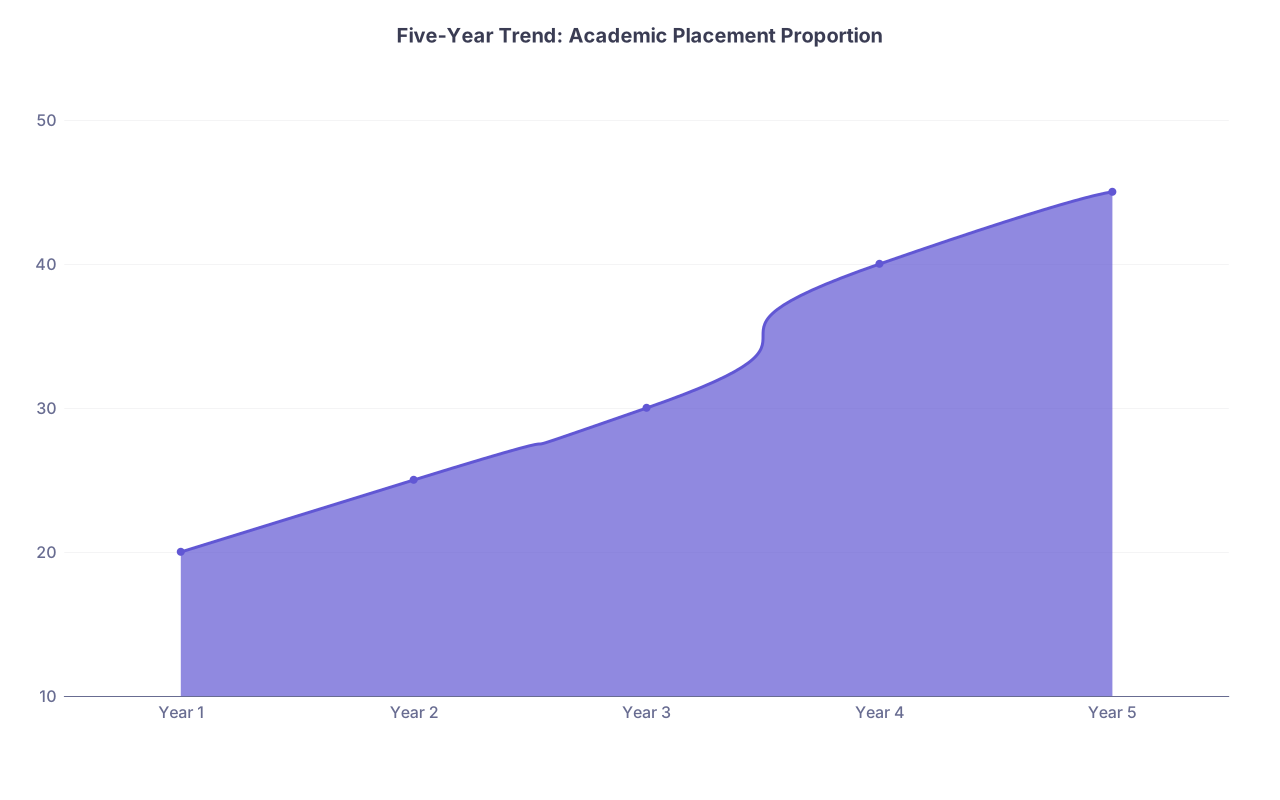
When the 5-year line climbs like that, it is not random. Something structural changed. The reverse is true when that line is decaying.
7. Practical Red Flags You Should Not Hand-Wave Away
Let me condense the quantitative tells that a program is not truly supporting fellows:
- Over 5+ years, a near-absence of matches at institutions comparable to or stronger than the home program, despite fellows clearly trying.
- Consistent overreliance on same-institution or same-system jobs, with very few external offers materializing.
- Discrepancy between advertised strengths and actual outcomes (e.g., “big research program” with almost no research-track or academic placements).
- Visible non-matches, unexplained disappearances from match lists, or multiple fellows listed with vague “pending” outcomes.
- Highly volatile annual outcomes that track leadership chaos or internal dysfunction.
- Subspecialty outcomes that repeatedly fall short of fellows’ expressed goals, producing a low realization rate for competitive tracks.
You will never see those spelled out in brochures. But they are all sitting there in the match list data.
8. How to Use This as an Applicant Without Going Insane
You do not need to conduct a meta-analysis in Excel for every place you interview. But you should:
- Pick your top 3–5 target programs.
- Pull 3–5 years of match data per program.
- Compute a few basic proportions: academic rate, top-tier rate, local retention, subspecialty realization.
- Ask current fellows pointed questions anchored on those numbers.
Example question: “I noticed in the last 4 years, maybe 1–2 fellows per year went to large academic centers, and most stayed local. For someone who wants a national-level academic job, what has differentiated those who got there from those who did not?”
You are not accusing. You are stress-testing whether they own their data.
If the answers are hand-wavy, dismissive, or blame fellows (“Some people just are not competitive”), that tells you everything about their mindset. Strong programs can usually explain their numbers, their pipelines, and what they are doing to improve weak spots.
Three takeaways.
- Match lists are datasets, not marketing gloss. Read distributions, trajectories, and gaps, not just logos.
- Repeated underachievement relative to fellows’ goals—especially in subspecialty and academic outcomes—is a structural support failure, not bad luck.
- When the story a program tells about itself clashes with the objective pattern in its match lists, believe the data.