
Most residency applicants are more afraid of the ZIP code than the actual program quality. That’s backwards.
You are being conditioned—by classmates, anonymous Reddit threads, and glossy program websites—to obsess over “how fun the city is” and “will I be happy there?” while glossing over the stuff that will actually affect your career for decades: training quality, case volume, supervision, culture, and outcomes.
Let’s blow this up properly.
The Location Obsession Problem
I’ve watched MS4s rank lists with this exact sentence: “I mean, Program B seems weaker, but I just can’t see myself living in [insert midwestern/southern/rural city] for three years.”
Then five years later they’re scrambling to fix gaps in training, or doing an extra fellowship they never really wanted just to compensate.
Here’s the uncomfortable truth: for most specialties, the data show program quality and training environment affect your career trajectory far more than the social appeal of the city.
Outcomes that actually matter to you:
- Board pass rates
- Fellowship placement (if relevant)
- Procedural volume / case exposure
- Alumni job placement and scope of practice
- Burnout and attrition rates
Outcomes that feel huge now but shrink fast in hindsight:
- Nightlife
- How “cool” the city sounds on Instagram
- Whether your college friends have heard of the city
- The perceived “vibe” based on one interview day and some catered sandwiches
There’s pretty good indirect evidence that training environment matters. Board pass rates, for example, are not random noise. Programs consistently underperforming their peers over years usually have real educational problems. Same with fellowship placement patterns, especially in competitive subspecialties.
By contrast, there is almost no evidence that training in New York vs Detroit vs Omaha vs Birmingham, by itself, meaningfully changes your long‑term career opportunities—once you control for program strength, case mix, and your own performance.
Yet medical students routinely treat location like the main variable and program quality like a tiebreaker. That’s how you end up in an actually bad program in a very popular city.
What “Unpopular Location” Really Means
Let’s define terms before the myths spiral.
When students call a location “unpopular,” they usually mean some combination of:
- Not a major coastal city
- Limited nightlife / restaurant scene
- Perceived as “boring,” “conservative,” or “in the middle of nowhere”
- Far from family or partner
- Cold. Or too hot. (Depends who’s talking.)
None of that automatically predicts training quality.
Some of the strongest programs in multiple specialties are in places most MS4s trash-talk quietly in group chats. I’ve heard verbatim:
- “I don’t want to spend three years in Rochester.” (Mayo)
- “Cleveland is depressing.” (Cleveland Clinic, Case)
- “Who even lives in Iowa?” (University of Iowa Ophthalmology is elite.)
- “Birmingham? Hard pass.” (UAB has very strong programs in multiple specialties.)
And at the same time, I’ve seen residents get burned at “dream city” programs where the main selling points were skyline shots and proximity to brunch.
To be clear: location isn’t irrelevant. If your partner’s job, your kids’ school, or immigration constraints hinge on geography, that’s real. But that’s a different conversation from “this city doesn’t sound exciting enough.”
For most people, the training question should come first. Because three to seven years of weak training in a fun city is a bad trade.
What a Bad Program Actually Looks Like
Here’s where people really get confused. A “bad program” is not:
- One that isn’t well-known on SDN
- One that’s community-based instead of university-affiliated
- One that sits in a small or “uncool” town
- One without fancy branding or research infrastructure
You can get excellent training at lower‑prestige, community-heavy, or smaller-city programs. And you can get terrible training at big-name places that skate by on reputation and NIH funding while residents drown.
A truly concerning program has concrete, repeatable red flags. A few examples I’ve actually seen or residents have told me directly:
- Multiple recent residents failing boards, and leadership brushing it off as “they just didn’t study enough,” without changing teaching, support, or structure
- Chronic under-staffing leading to 80–100 hour workweeks on the regular, scrubbed from official schedules but widely acknowledged at the hospital
- Residents graduating in procedure-heavy fields with shockingly low case numbers or skill discomfort (“I’ve only done a handful of central lines by myself,” from a third-year in a high-acuity hospital)
- A culture of fear—PDs or attendings retaliating against feedback, residents told not to report duty hour violations or safety issues
- High attrition that nobody wants to talk about or that gets hand-waved as “bad fit” every time
And the location? Often completely irrelevant. I’ve seen this in major metros and in tiny towns.
To separate myth from real risk, you have to stop using prestige and city name as proxies for quality. They’re weak proxies at best.
Data: City Glamour vs Training Quality
Let’s line up the illusions.
| Factor | Big Coastal City Program A | Smaller City Program B |
|---|---|---|
| City desirability (students) | Very high | Low to moderate |
| Board pass rate (5-year) | 85–88% (below avg) | 96–100% (strong) |
| Case volume | Moderate, heavy scut | High, resident-driven |
| Fellowship match strength | Average | Strong, consistent |
| Resident burnout complaints | Frequent | Present, but lower |
Is this table an exact snapshot of specific programs? No. But this pattern is real and surprisingly common.
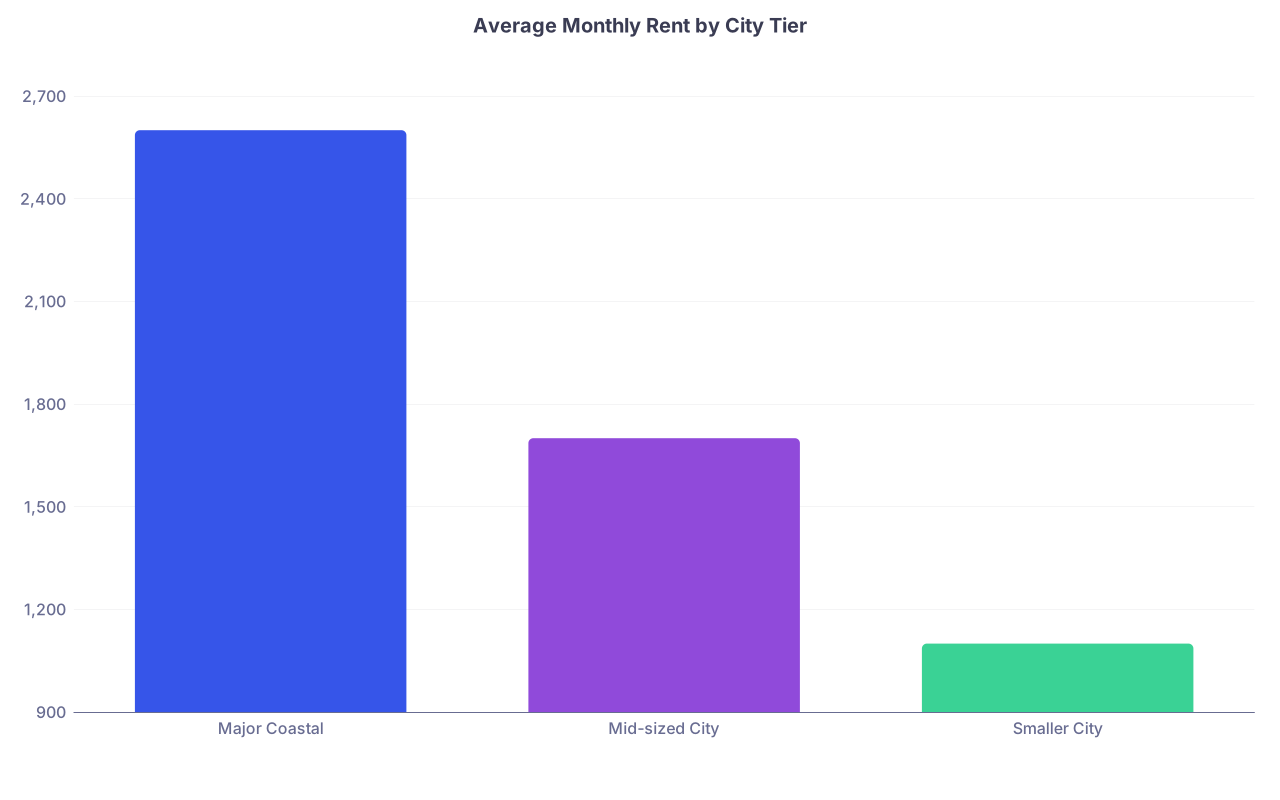
There’s another angle here: cost of living. Many “unpopular” cities give you:
- Cheaper rent
- Shorter commute
- More realistic chance of owning a car / having decent space
- Less time in traffic, more time sleeping or studying
| Category | Value |
|---|---|
| Major Coastal | 2600 |
| Mid-sized City | 1700 |
| Smaller City | 1100 |
That extra $800–$1500 per month matters when you’re paid a PGY‑1 salary and trying to stay sane. Chronic financial stress feeds burnout. So does a 70‑minute commute each way from the only apartment you can afford.
Almost no one puts “time lost in traffic” on their rank list spreadsheet. They should.
How to Tell: Unpopular Location vs Dangerous Program
You’re not choosing between good vs bad geography. You’re choosing between training environments.
So the real question becomes: “Is this an unsexy city with strong training, or a program with actual red flags hiding behind pretty marketing?”
Here’s how to separate the two.
1. Track Record: Boards, Fellowship, Jobs
You want objective history, not vibes.
- Ask directly: “What is your 5-year rolling board pass rate?”
- Ask where graduates work. Community? Academic? Procedural? Are they getting the jobs or fellowships they want?
- For competitive fellowships, ask for the last few years of match outcomes. Not just cherry-picked big names.
If they dodge or stay vague—“oh, around national average, I think”—and cannot give you approximate numbers, that’s not great.
If they’re in a smaller or “unpopular” city but proudly rattle off a strong, consistent track record, that’s a green flag. The city just happens to not be cool on TikTok.
2. Resident Autonomy and Case Volume
You are not going to residency to watch. You are going to do.
Ask about:
- Typical number of key procedures / cases by PGY‑year
- When residents start taking real responsibility (not just scut)
- Whether advanced cases are staff‑hogged or given to fellows while residents stand in the corner
I’ve heard residents at big, prestigious programs say things like: “We watch more than we do. The fellows get everything interesting.” They leave with strong CVs and weak hands-on skills.
Conversely, I’ve watched residents at “no‑name” Midwestern programs run codes confidently, do procedures independently, and graduate ready to function day one.
3. Culture and Transparency
This is harder to quantify, but very real. You listen for inconsistencies.
Examples of red-flag culture behavior:
- Official party line: “We strongly respect duty hours.” Off the record: “Well, we definitely work more, but we just don’t log it.”
- Faculty talk about residents as “labor” more than trainees.
- Residents on interview day look visibly exhausted, guarded, or oddly rehearsed. Every answer is “it’s great here” with no nuance.
If you have to drag information out of people about what’s hard, that’s suspicious.
Healthy programs—even in boring towns—usually have residents who can say, “The ICU months are brutal, but leadership really listens and adjusted X, Y, Z,” or “It’s busy, but the education is strong and I feel supported.”
4. Attrition and Remediation
Ask: “How many residents have left the program or required extended training in the last five years, and why?”
There will always be some attrition. Life happens. But patterns matter.
Bad sign: several residents leaving or being pushed out + leadership framing all of them as “bad fits” or “couldn’t handle it,” with no introspection.
Less concerning: one or two clear life‑event or genuinely mismatched‑specialty stories, with honest acknowledgment.
5. Resident Life Reality vs Marketing
This is where location shows its true impact.
In a fun city, you might assume wellness is built-in. “There’s so much to do!” But I’ve seen residents who never see daylight except from the call room window, regardless of how many jazz bars or beaches are within 10 miles.
In a quieter city, the fear is boredom and isolation. Sometimes that’s real—especially if you’re single with no built-in community and you hate the outdoors.
So you ask:
- “What do residents actually do on golden weekends?”
- “How many live within 15 minutes of the hospital?”
- “Do residents hang out together outside work?”
Pay attention to whether people talk about:
- Long commutes
- Unsafe neighborhoods being the only affordable option
- Or, conversely, “I live 5 minutes away, I actually see my kids” or “I save money and travel a lot on vacations.”
Location affects your non-work life. A bad program affects both your work and non-work life.
When forced to choose, the rational move is to protect the training.
When an Unpopular Location Is Actually a Problem
Let’s not pretend geography never matters. It does, but differently than students imagine.
There are scenarios where an “unpopular” location can create genuine risk:
- Severe isolation if you’re part of a marginalized group in a place with very limited social support or open hostility
- No realistic support system for your partner, kids, or dependents
- Repeated stories from residents about being unsafe off-campus, particularly at night, with no good housing alternatives
That’s real risk. But it’s about your life and safety, not just your social calendar.
The other category: programs in genuinely under-resourced hospitals that also happen to be in remote areas.
You might see:
- Chronic understaffing with no end in sight
- Key services missing (no on-site cath lab, no ICU subspecialty support) so you get skewed or partial training
- Facilities so outdated that basic patient care is unsafe
Remote + under-resourced + leadership in denial about it? That’s not “just an unpopular location.” That’s a program-level problem with a geographic component.
Again, the pattern is what matters, not the map.
How to Actually Use This When Ranking
Here’s a more rational ranking framework than “fun city first, program second”:
- Hard filter on true red flags: seriously poor board performance, chronic duty hour abuse, unsafe culture, bad case volume. Those go at the bottom or off the list completely, regardless of location.
- Among the rest, prioritize training: where will you come out competent, confident, and not completely destroyed? Strong clinical training in a boring city beats mediocre training in a cool one, every time.
- Then—and only then—use location as a tiebreaker between two good programs. Climate, proximity to family, city size, all fair game.
One way to visualize it:

| Step | Description |
|---|---|
| Step 1 | All Interviewed Programs |
| Step 2 | Move to bottom or remove |
| Step 3 | Evaluate training strength |
| Step 4 | Rank by training quality |
| Step 5 | Use location and lifestyle as tiebreakers |
| Step 6 | Finalize rank list |
| Step 7 | Any true red flags? |
| Step 8 | Ties between strong programs? |
That’s the opposite of what most MS4s actually do. They start at the bottom of this chart and work up. Which is how you end up sacrificing competency for skyline views.
The Future You Will Care About Different Things
Talk to attendings 10–15 years out and ask what they remember from residency.
They’ll talk about the cases, the mentors, the nights they felt in over their heads but had backup, the colleagues who kept them sane. Not the new restaurant openings. Not the city’s reputation on social media.
Years from now, you won’t remember how many people raised their eyebrows when you said you matched in “somewhere in Ohio.” You’ll remember whether you walked into your first attending job feeling ready—or secretly hoping nobody noticed the holes in your training.