
What goes through a program director’s mind when they see three fellowships on a CV instead of one?
Because I’ll tell you what I’ve actually heard in conference rooms:
“Impressive training.”
“Couldn’t commit.”
“Is this person going to be happy anywhere?”
“All-star niche expert—if we can keep them.”
Same CV. Four different reactions.
The myth is clean and simple:
Multiple fellowships = red flag.
Or, if you listen to some academic evangelists:
Multiple fellowships = elite, ultra-specialized, future department chair.
Both are wrong. Or at least, wildly incomplete.
The truth is messy, contextual, and depends heavily on why those fellowships happened, what sequence they followed, and how coherently the story reads.
Let’s tear apart the myths and look at what the data and real-world behavior of programs actually show.
What the Data (and Behavior) Actually Show
There is not a giant multicenter RCT of “one vs. two vs. three fellowships and lifetime happiness.” But we do have:
- Match and job trend data
- Specialty-specific workforce data
- Hiring and credentialing patterns
- The unfiltered opinions of PDs, division chiefs, and hiring committees
Here’s the pattern that quietly emerges:
One fellowship is the default in subspecialty-driven fields
In cardiology, GI, heme/onc, critical care, etc., a single fellowship after IM is the norm. Nobody flinches.Two fellowships is increasingly common in certain combinations
Think: pulmonary + critical care, heme + onc, cards + advanced imaging, anesthesia + critical care, EM + critical care. In some of these, “two” is basically baked into how the field evolved.Truly multiple, non-overlapping fellowships (2–3+), especially in different directions, raise more questions
IM → Cards → EP is coherent.
IM → Cards → Palliative → Sleep is… less obviously coherent. Not automatically bad. But you will get asked.Job market and reimbursement structure quietly drive this
People do second fellowships not because they’re “lost souls” but because certain niches pay, protect time, or secure visas better. Or because pure academic jobs in some subspecialties have essentially collapsed in certain markets.
Let’s pin this down a bit more concretely.
| Path Type | Typical Perception by Committees |
|---|---|
| One standard fellowship | Normal, expected, neutral-positive |
| Integrated dual fellowship (e.g., PCCM) | Standard, not “multiple” in the negative sense |
| Sequential but related (e.g., Cards → EP) | Focused, strategic, usually positive |
| Sequential but partially related (e.g., Heme/Onc → Palliative) | Acceptable, context-dependent |
| Multiple divergent fellowships (3+, changing directions) | Question-raising, needs strong narrative |
So no, “multiple fellowships” is not uniformly a red flag.
But it can absolutely become one if the story looks disorganized, reactionary, or driven by avoidance rather than purpose.
When Multiple Fellowships Are a Clear Strength
If you want the blunt version: multiple fellowships are a strength when they scream deliberate depth, not unresolved indecision.
Several scenarios do this very well.
1. Highly coherent subspecialty stacking
Classic example:
- IM → Cardiology → Electrophysiology
- IM → Pulmonary → Critical Care
- IM → GI → Advanced Endoscopy
- Radiology → Neuroradiology → Interventional Neuroradiology
Here, each additional fellowship tightens the focus.
Committees read this as:
- “This person is intentionally becoming the person for X niche.”
- “They’ll be our go-to for high-complexity referrals and program-building.”
- “They’re likely to bring in procedures, referrals, and sometimes research funding.”
No one sane calls IM → Cards → EP a “red flag”. It’s practically the standard route for EP.
The same goes for combinations that define a specific clinical or academic identity:
Heme/Onc → Cellular therapy; GI → Motility; Anesthesia → Critical Care → ECMO.
2. Strategic academic or research alignment
Another strong pattern: clinically related fellowships aligned with a research or program-building goal.
Example I’ve seen:
- IM → Heme/Onc
- Additional fellowship in Palliative or Geriatrics
- Research in end-of-life quality metrics in advanced malignancy
This is not “couldn’t decide.” This is “I’m constructing a toolkit to run a cancer + symptom-management program and publish on it.”
Program directors and division chiefs—especially at academic centers—like this. Why? Because it translates to:
- Better outcomes metrics
- Grants and publications
- Differentiated services they can market
If your CV shows training choices that obviously support a coherent research agenda or programmatic niche, you’re not a red flag. You’re an investment.
3. Market-aligned skill stacking
Sometimes it’s not high theory. It’s economics.
Second fellowship used as:
- A hedge against a saturated primary subspecialty job market
- A way to add billable procedures
- A way to access ICU, transplant, or niche care that locks in employability
Example: Pulm-only fellowships in some regions are over-saturated. Pulm + Critical Care? Much more employable. You become the “we can staff your ICU and your clinic” candidate.
From a job committee viewpoint, that’s strength. You can cover more service lines, justify more FTE, and plug more call gaps.
No one on the hiring side complains about flexibility in coverage when it aligns with their needs.
When Multiple Fellowships Start Looking Like a Red Flag
Let me be blunt: the red flag is not “multiple fellowships”.
The red flag is multiple pivots with no coherent story.
That usually falls into a few patterns.
1. Serial, directionless subspecialty hopping
This is the one that makes people raise eyebrows in promotion or hiring meetings:
- IM → Cards
- Then Palliative
- Then Sleep
- Now applying to hospitalist or general oncology jobs
Again, none of those fellowships are bad. But if they’re presented as a series of “I realized it wasn’t for me” without a clear throughline, it starts to look like:
- Poor self-assessment
- Low tolerance for delayed gratification
- Risk of future dissatisfaction and job hopping
I’ve literally heard a chief say:
“If this person keeps pivoting every 2–3 years, why exactly would we believe they’ll stay in this job for 5–7?”
It’s not always fair, but it’s the calculation.
2. Perceived training as avoidance rather than progression
Multiple fellowships can look like a long, drawn-out avoidance of:
- Real-world responsibility
- Productivity expectations
- Independent decision-making
Especially if:
- There’s minimal scholarly work despite long training
- Repeated comments in letters or evaluations about decision paralysis, burnout, or “fit issues”
- The fellow keeps picking non-procedural, non-billable, niche fellowships with limited job markets and no clear endpoint
People absolutely talk about this in hiring meetings, usually in phrases like:
“Are they just avoiding the real world?”
“Why so much training with so little to show in terms of output?”
Is that always true? No. But if your training record is long and your CV is otherwise thin, you are inviting that interpretation.
3. Visa-driven fellowships with no narrative
This one is delicate but real.
Sometimes multiple fellowships are an artifact of:
- Needing to extend training time for visa reasons
- Limited job sponsorship options
- Accepting any available fellowship that will keep status valid
From your side, it’s survival. From the committee side, if the story isn’t explained, it can look random.
You can recover this. But you do need to own the narrative: “Because of visa constraints, I pursued additional training in X, which then allowed me to do Y. Here’s how it fits my current role in Z.”
If you pretend it was all one grand design and it obviously was not, people smell the disconnect.
Specialty Matters: Where Multiple Fellowships Are Normal vs. Suspect
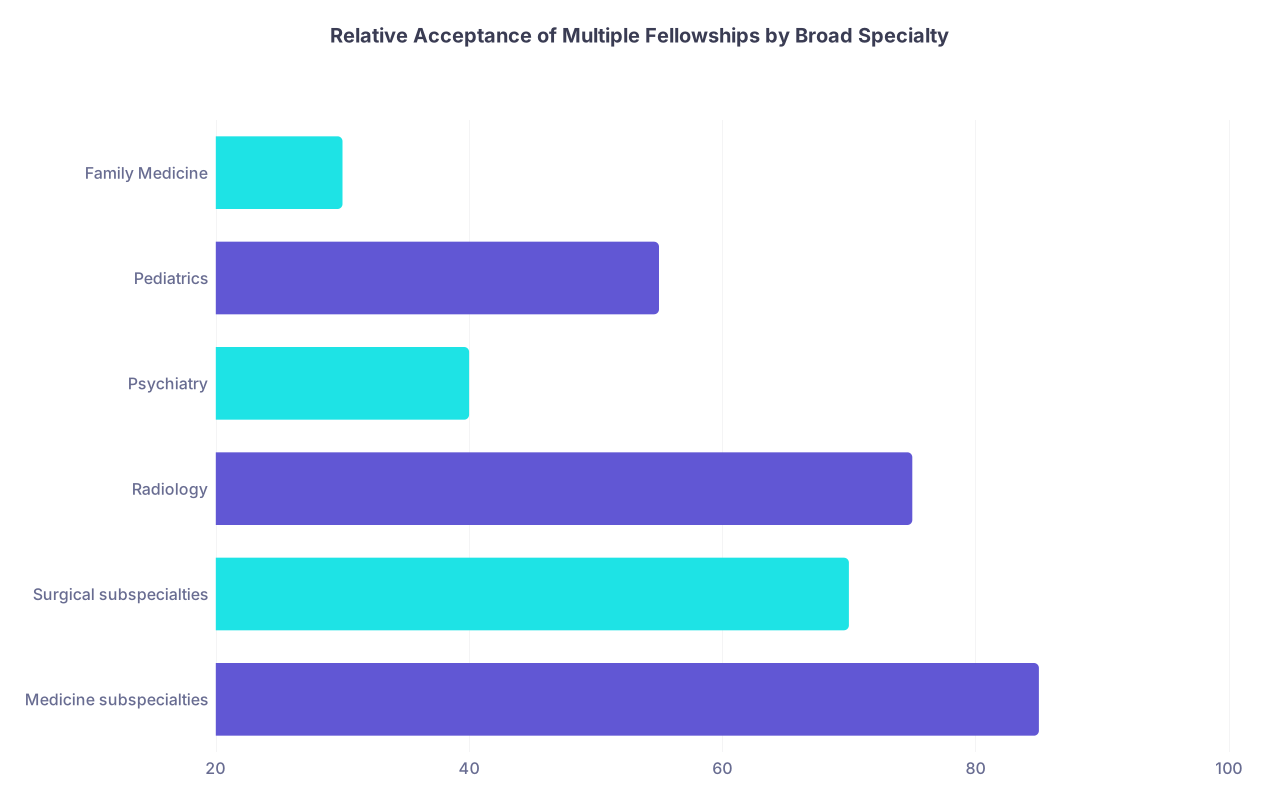
Some fields simply don’t interpret “multiple fellowships” the way others do.
| Category | Value |
|---|---|
| Medicine subspecialties | 85 |
| Surgical subspecialties | 70 |
| Radiology | 75 |
| Psychiatry | 40 |
| Pediatrics | 55 |
| Family Medicine | 30 |
This is not exact science, but this reflects rough cultural attitudes I’ve seen:
IM subspecialties: Very used to dual or sequential training. Cards, GI, Heme/Onc, Pulm/CC—seeing 2 fellowships is normal in many niches.
Surgical subspecialties: Second fellowships (e.g., trauma/critical care, transplant, advanced MIS, plastics after general, etc.) are common and often seen as value-add, especially if they bring rare procedures.
Radiology: Single fellowship standard, but a second (e.g., body → IR, neuro → IR) can make sense. Three starts to look strange unless very clearly related.
Psych, FM, general peds: Multiple fellowships look more unusual and invite more “why?” questions. They can be strong when coherent (e.g., Child psych → Forensics), but random stacking is more suspect.
Culture matters. If you’re in a fellowship-heavy field, people are less alarmed. In fields where most people go straight to practice or do a single focused fellowship, your multiple fellowships will stand out harder—and need a tighter explanation.
How Program Directors and Hiring Committees Actually Read This
Strip away the politeness, and here’s what they’re really asking when they see multiple fellowships:
Is this a focused expert or a chronic seeker?
Does the path converge or endlessly diverge?Will this person stay and be satisfied in the role we’re offering?
Or will they be bored in a year because it doesn’t match their hyper-special niche?Does their training make them more useful or harder to deploy?
Example:- Hyper-subspecialized EP doc in a community hospital that mostly does general cards? Potential mismatch.
- PCCM + ECMO + lung transplant experience in a tertiary ICU? Jackpot.
Is the time spent in training proportional to output?
Long training with strong publications, teaching, and leadership? Good.
Long training with minimal differentiation from a standard fellowship grad? Harder sell.Does their narrative suggest resilience or fragility?
Did they handle transitions and challenges constructively, or is there a pattern of conflict, burnout, or “it just wasn’t the right fit” repeated three times?
No one phrases it exactly like that on the record. But that’s the subtext.
If You Already Have Multiple Fellowships: Fix the Story
You cannot go back and un-do a fellowship. But you can absolutely reframe what they mean.
Three things matter:
1. Build a coherent throughline
You need a single, clean answer to: “So tell me about your path—what led you to pursue multiple fellowships?”
That answer cannot be chaotic. It should sound something like:
- “My interest has always centered around X (e.g., advanced heart failure, complex airway, end-of-life quality). I first trained in A to build foundation, then pursued B to deepen skills in Y, and C to round out Z. Now I’m specifically looking for roles where I can do [concrete blend of those skills].”
You’re not listing training. You’re telling a trajectory.
2. Translate extra training into concrete value
Hospitals and departments think in terms of:
- Clinical services you can provide
- Revenue or referrals you can attract
- Programs you can build
- Teaching and mentorship you can offer
- Research or quality projects you can lead
If your answer to “What do you bring because of this extra fellowship?” is vague enthusiasm, that’s a problem.
If your answer is: “I can staff ICU, run the ECMO program, and mentor residents in X while helping build a sepsis QI pipeline,” now those extra years look like a bargain.
3. Close the loop on instability concerns
If your path has obvious pivots, you have to address them head-on in a grounded way:
- Acknowledge the pivot
- Show what you learned
- Show why the current direction is stable and long-term
For example:
“Initially, I thought I wanted a purely procedural career in X, but through that training I realized my real interest was in longitudinal care and symptom management, which led me to Y. Since then I’ve focused entirely on [current niche] and see my future in [clear practice setting].”
No drama. No oversharing. Just a mature explanation and a clear endpoint.
For Residents Considering a Second Fellowship: Ask the Right Questions
If you’re still at the decision point, here’s the uncomfortable litmus test I’d actually use:
- Is this second fellowship tightening my focus or escaping my current dissatisfaction?
- Can I articulate, in two sentences, why this combination makes me more valuable and where I’ll work because of it?
- Am I doing this because of job market realities with a clear plan, or because I don’t want to graduate and face real-world productivity expectations yet?
If you cannot answer those cleanly, you’re at risk of walking into the “chronic trainee” stereotype.
A useful exercise: map your path visually.

| Step | Description |
|---|---|
| Step 1 | Residency complete or near complete |
| Step 2 | Consider 1 focused fellowship |
| Step 3 | Clarify interests with mentors |
| Step 4 | Second coherent fellowship may help |
| Step 5 | One fellowship likely sufficient |
| Step 6 | Avoid serial fellowships as exploration |
| Step 7 | Do you have 1 clear target niche? |
| Step 8 | Second fellowship needed to practice that niche? |
If your path looks more like a spiderweb than a line, slow down.
The Bottom Line: Multiple Fellowships Are a Multiplier, Not a Label
Multiple fellowships are neither automatically a red flag nor some badge of elite status. They’re a multiplier.
If your underlying direction is clear and aligned with real clinical, academic, or market needs? Multiple fellowships multiply your value.
If your underlying direction is scattered and driven by avoidance, fear, or fantasy? Multiple fellowships multiply the perception of instability.
Years from now, you will not be judged by how many fellowships you did, but by whether the career you built makes sense given all that time. The anxiety is now; the narrative is long. Make sure the extra years of training are building a story you actually want to keep telling.