
High attrition does not automatically mean a toxic residency program. That’s a lazy shortcut—and it will make you misread some of the best and worst places to train.
The myth: “High attrition = bad program”
You’ve heard this on the interview trail or on Reddit:
- “More than one resident left in the last few years? Must be malignant.”
- “Low attrition proves they support their residents.”
- “Nobody ever leaves = great culture.”
This is comfortable, simple, and often wrong.
Reality: Attrition is a blunt instrument. It measures one thing—how many people left—not why, not who, not from what baseline, and not what happened next. Programs with excellent cultures can have eye‑popping attrition during certain years. Some quietly soul‑sucking programs have almost none.
Let me break down what the data and real-world patterns actually show.
What the literature actually shows about residency attrition
First, some grounding in data. We’re not going to hand-wave this.
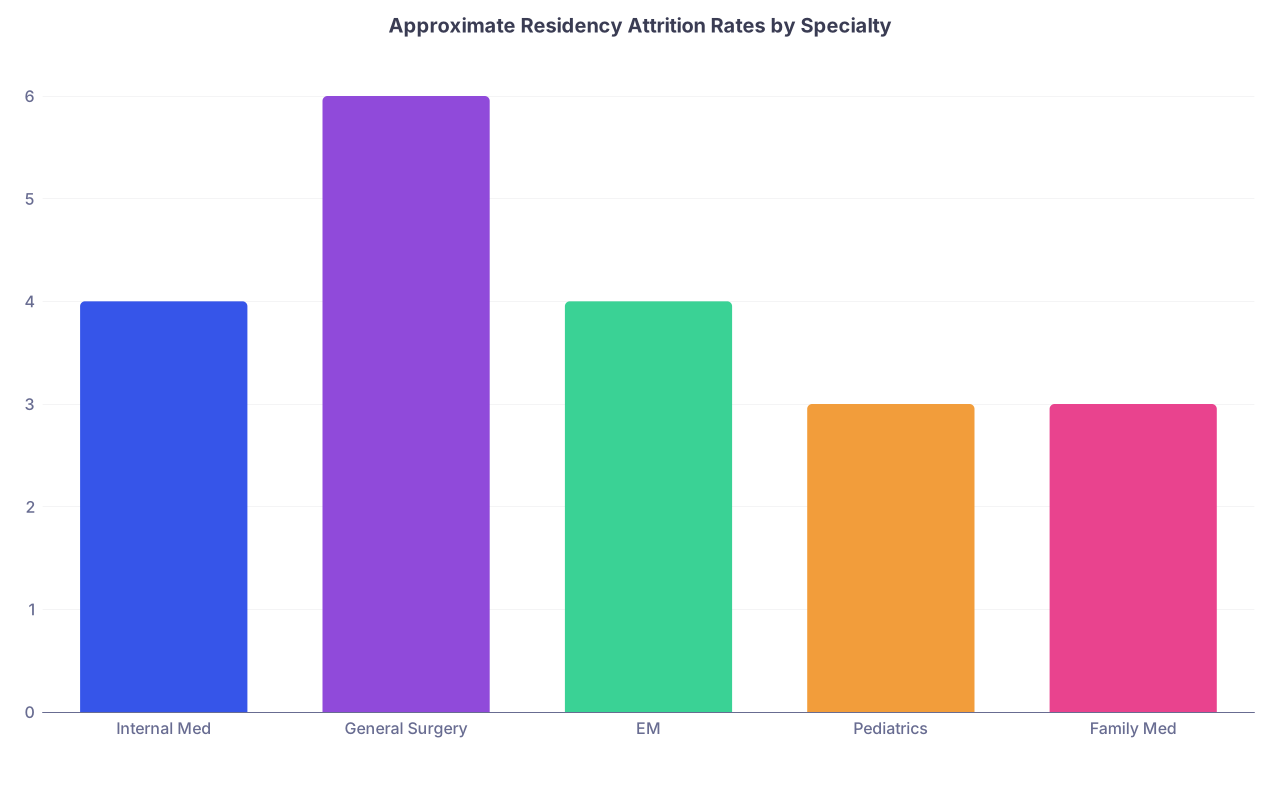
Across specialties, overall U.S. residency attrition rates tend to be in the low single digits per year, but they vary enormously by specialty and context.
| Category | Value |
|---|---|
| Internal Med | 4 |
| General Surgery | 6 |
| EM | 4 |
| Pediatrics | 3 |
| Family Med | 3 |
These are ballpark multi-year averages from published studies and ACGME reports; individual programs will be far higher or lower.
What the research consistently finds:
- Surgery and some procedurally intense fields have higher attrition than cognitive fields.
- A lot of attrition is voluntary and sometimes positive: switching to a better-fit specialty, leaving for research/PhD, family moves.
- Risk factors for attrition include: mismatch between expectations and reality, lack of mentorship, poor well-being, and sometimes demographic disparities (women, IMGs, or underrepresented groups having higher leave rates in some specialties).
- But the same numeric attrition rate can arise from very different underlying reasons.
So when you see “Program X lost 4 residents in 3 years,” that raw number is like hearing a patient’s heart rate is 110. Could be sepsis. Could be walking up the stairs. Could be anxiety. Context is everything.
Five situations where high attrition is NOT a red flag
Let’s hit the contrarian part, because this is where most applicants get it wrong.
1. New or rapidly expanding programs
New programs and aggressively expanding programs almost always have bumpy early years. Why?
- Faculty are still figuring out workload and call structure.
- The program’s reputation is unformed, so early classes are a mixed bag—some who truly want to be there, some who just needed a spot.
- The schedule and curriculum get rewritten mid-stream.
Those first 3–5 cohorts? You’ll often see higher attrition.
I’ve seen new programs where 2–3 residents left in the first few years, and the knee‑jerk interpretation was “toxic.” In reality, it was:
- One PGY‑1 realized surgery wasn’t for them and transferred to anesthesia.
- One PGY‑2 followed a spouse across the country.
- One PGY‑3 left for an unexpected family crisis and never returned.
The culture was actually very supportive—part of why people felt safe being honest and changing paths.
Clue you’re misreading it: newish program, candor from leadership about growing pains, and specific, traceable stories about where those residents went that make sense.
2. Programs that protect residents from unsafe remediation
This one’s rarely discussed, because it’s politically awkward: sometimes attrition is the right outcome.
If a resident has:
- Repeated serious professionalism issues
- Unsafe clinical judgment despite remediation
- Refusal to engage in supervision requirements
A program has two options: pass them along because “low attrition looks good,” or make the hard call and support an exit.
I’ve sat in meetings where PDs said, “If we push them through, they’ll be someone’s attending in a year. I can’t justify that.” Those decisions show integrity, not toxicity.
What does a program like this look like?
- Documentation-heavy remediation processes
- Clear policies, transparent to applicants, about expectations
- Few surprises—residents know who is on remediation and roughly why (within reason)
If a PD tells you, “We have lost people because we would not lower our bar for safety,” that’s not a red flag. That’s honesty. Be more worried about the place that claims nobody has ever been asked to leave in 20 years. That either means:
- They’re extraordinarily selective and perfect at selecting. Or
- Problems get swept under the rug and pushed forward.
Wanna guess which is more common?
3. High-achieving programs that residents “trade up” from
Some mid-tier or community programs have weirdly high attrition because their residents are ambitious and marketable. They:
- Match there as a “safety” or geographic compromise.
- Crush Step 3, build research, get strong letters.
- Then jump to another program in the same specialty (or a more competitive one) when a PGY‑2 slot opens at a big‑name academic center.
Is this great for stability? No.
Is it a sign of toxicity? Usually not.
The giveaway: when you ask, “Where did those residents go?” and the answer sounds like a brag list, not a disaster report.
“One left to join a more research-heavy program at [Big Flagship]. One switched into dermatology after falling in love with it. One moved for dual-physician couple matching to [Major University].”
You might still not want that program if you crave stability. But don’t confuse “people used us as a stepping stone” with “we chew people up.”
4. Programs that actually let people admit they’re miserable
In some places, nobody leaves because everyone’s terrified to say they’re struggling. That’s not healthy; that’s fear.
Supportive programs sometimes have more attrition because they:
- Normalize career changes (“Better to switch now than hate your life for 30 years.”)
- Help residents explore other specialties or non-clinical tracks
- Create an environment where saying “I’m not okay in this field” doesn’t get you labeled as weak
You’ll occasionally hear PDs say something like: “We helped two residents transition to psychiatry and radiology after realizing surgery wasn’t the right long-term fit.” That’s good mentoring, not malignancy.
5. Structural upheaval years (mergers, leadership turnover, hospital crises)
If a hospital merges, a department chair is fired, or a health system implodes financially, you often see a burst of exits over 1–2 years. Residents are not stupid. They read the writing on the wall.
High attrition in those windows may reflect:
- Residents jumping to more stable institutions
- Anxiety around accreditation changes
- Geographic disruptions (new main site, new commute, call changes)
Is that stressful? Yes.
Is it the same as a chronically abusive or gaslighting culture? No.
Here’s the key distinction: acute disruption vs chronic rot. Acute disruption might spike attrition once. Chronic rot bleeds people over years and nobody gives a straight answer why.
When high attrition does smell like toxicity
Now let’s flip the lens. There are patterns where “high attrition = big, flashing red light.”
Pattern #1: Nobody gives a coherent, concrete explanation
You ask three people what happened and get three vague, evasive answers:
- “It just wasn’t a good fit.”
- “They had personal things.”
- “They chose to pursue other opportunities.”
One or two vague cases? Fine. But if every story is mush, that’s intentional. People are afraid to talk.
Contrast that with a healthy program where you hear specifics:
- “He switched to radiology at [X program].”
- “She transferred to be closer to family after a parent got sick.”
- “Two left during a very rough leadership transition; we’ve since replaced the PD and changed call.”
You’re not entitled to private details, but you are entitled to a pattern that makes sense.
Pattern #2: The attrition is one-sided
If you find out almost everyone who leaves is:
- From a specific demographic group (e.g., women, IMGs, URiM)
- From the same PGY class that clashed with a particular attending
- On the same off-site rotation or service
That’s not just “people changing their minds.” That’s a structural or cultural problem targeting certain residents more than others.
Pattern #3: Rumors of retaliation or blacklisting
Online forums are full of noise, but multiple independent reports like:
- “Everyone is terrified of going to the PD with concerns.”
- “They threatened people’s careers when they brought up duty hour violations.”
- “No one who has left has gotten a neutral letter; it’s scorched earth.”
That combination—high attrition plus a culture of fear—is about as “toxic” as it gets.
Pattern #4: No evidence of learning or course correction
Some programs have a rough year, lose several residents, and then:
- Hire new leadership
- Change call structure
- Increase staffing or NP/PA support
- Add wellness or mentorship structures
You should see the institution react.
If instead, they blame “weak residents” every time, never change anything, and keep hemorrhaging people? Believe the pattern.
How to actually evaluate attrition on the interview trail
You’re not an investigator with subpoena power. You’re a stressed applicant getting a 6-hour curated tour and a fake-smiles social. But you can still extract useful signal.
Here are specific questions and tactics that work better than “So, what’s your attrition like?”

1. Ask about patterns, not numbers
Good questions:
- “Have residents transferred out or switched specialties in the last 5 years? What usually drives those decisions?”
- “How does the program support someone who realizes this specialty might not be right for them?”
- “Have there been years that were particularly hard on morale? What changed afterward?”
You’re fishing for stories and change over time, not a sanitized statistic.
2. Compare stories between leadership and residents
Talk to:
- PD or APD
- Chief residents
- Random PGY‑2/3 on wards or at social
- If possible, someone off-cycle or non-traditional
Red flag: leadership says, “We had a couple people leave for personal reasons,” and residents say, “Yeah, three people left because they were burned out of their minds and felt dumped on.”
The mismatch is the signal.
3. Ask residents what would happen if they needed help
Try:
- “If you were really struggling and thinking of leaving, who would you go to first?”
- “Have you actually seen anyone supported through remediation or a transition? How did that go?”
If they all glance at each other and jokes start about “you just disappear”… not great.
4. Look for evidence of longitudinal improvement
If a program admits, “We had a rough patch in 2019–2021, lost several people, but here’s what we did…” and then tells you concrete changes—duty hour enforcement, night float, new fellowship options, expanded staffing—that’s what a learning culture looks like.
The dead giveaway of toxicity isn’t that they had a bad year. It’s that they learned nothing from it.
Attrition vs culture: a quick comparison
Here’s a simple matrix most people never build in their head:
| Scenario | Likely Interpretation |
|---|---|
| High attrition + clear, specific stories | Mixed; context-dependent |
| High attrition + fear, vague answers | Culture red flag |
| Low attrition + residents afraid to speak | Hidden toxicity possible |
| Low attrition + candid, consistent stories | Likely healthy culture |
And to make it painfully clear: low attrition is not a halo. I’ve seen “no one has ever left” programs where PGY‑3s whisper in stairwells about counting the days until graduation. People stay because the politics of leaving are worse than surviving.
A more honest mental model for applicants
Instead of “high attrition = bad, low attrition = good,” try this:
- Attrition is a symptom, not a diagnosis.
- Ask: “Is this voluntary growth or forced escape?”
- Look for how the program responds when someone struggles or leaves.
- Trust patterns and consistency, not a single number or anecdote.

| Step | Description |
|---|---|
| Step 1 | Hear about attrition |
| Step 2 | Context dependent - examine reasons |
| Step 3 | Likely culture red flag |
| Step 4 | Likely healthy culture |
| Step 5 | Possible hidden toxicity |
| Step 6 | High or low? |
| Step 7 | Get clear stories? |
| Step 8 | Residents candid? |
You’re choosing a system that will shape your habits, your coping mechanisms, and your view of medicine. Do not reduce that decision to a single metric pulled off Doximity or a gossip thread.
FAQs
1. Is there a “bad” attrition number I should use as a cutoff?
No hard cutoff. A small program that loses 2 residents in 3 years looks numerically worse than a huge program that quietly sheds 1 per year. Instead of fixating on a percentage, focus on:
- Whether the departures have coherent explanations.
- Whether the program shows evidence of learning and change.
- Whether current residents seem blindsided or unsurprised by the history.
If the stories make sense and residents seem genuinely okay, a “scary” number on paper may be irrelevant.
2. How can I tell if a program is hiding toxic culture behind low attrition?
Low attrition can hide toxicity when:
- Residents speak in rehearsed, PR-sounding phrases.
- Nobody will describe downsides with any specificity.
- There are persistent rumors of retaliation for complaints, but “no one has ever left.”
Ask about how conflict is handled, how feedback goes up the chain, and what’s actually changed based on resident input. If all you hear is “we have an open-door policy” with zero examples, stay suspicious.
3. Are online reports of high attrition reliable?
They’re a starting point, not a verdict. Some are accurate whistleblowing. Others are outdated or driven by a single messy situation. Use them to:
- Form specific questions to ask on interview day.
- Watch residents’ body language and consistency when you bring up history.
- Cross‑check whether the program acknowledges or denies known issues.
If online chatter, resident stories, and leadership narratives all align—then you can start trusting the pattern.
4. What’s a smart way to ask about attrition directly without sounding confrontational?
Try neutral, curiosity‑framed questions:
- “I’ve heard nationally there’s been more movement between programs in recent years. Has your program seen much of that, and what tends to drive it?”
- “How has the resident cohort size changed over the past 5–10 years?”
- “Can you share an example of a resident whose path here didn’t go as planned and how the program handled it?”
You’ll learn more from how they answer—and whether residents and faculty tell matching stories—than from the numeric answer itself.
Key points:
- High attrition by itself does not prove a toxic residency culture; it’s a crude signal that needs context.
- The real red flags are vague, inconsistent explanations, fear, and lack of learning—not just how many people left.
- Your job isn’t to avoid any program with attrition. It’s to find the places where people can tell the truth, change course safely, and where the system learns when something goes wrong.