71% of residents in a national survey said their workload was “too high to safely learn,” yet programs with the heaviest service burden often brag about “unmatched clinical exposure” as if that alone proves they’re elite training sites.
Both cannot be right.
Let me be blunt: “High volume equals great training” is one of the most stubborn half‑truths in residency. It’s partly right, but weaponized constantly to justify cheap labor, unsafe conditions, and terrible education.
You are told this myth early: “You want to be busy. Busy residents learn the most.” Then you rotate at a place where “busy” means 28 patients on a ward list, 4 new admits, 2 cross‑covers, and nobody has read an actual guideline in weeks. And somehow you’re supposed to believe this is “top‑tier training.”
Let’s pull this apart using actual data, not program director folklore.
What the Data Actually Says About Volume and Learning
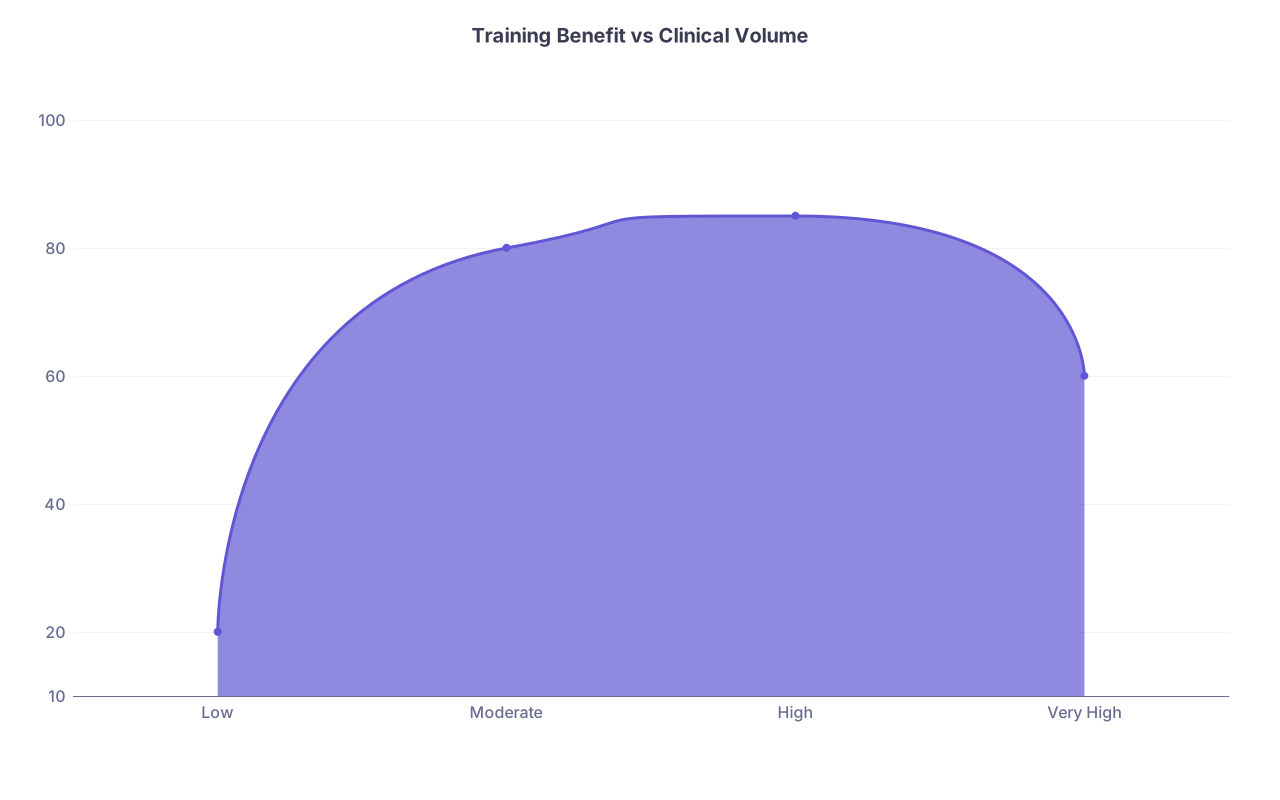
The relationship between clinical volume and competence is not linear. It’s a curve. And it flattens fast.
There’s decent evidence from surgery, internal medicine, and anesthesia that some increased volume improves skills. But after a threshold, more patients or more hours stop improving outcomes and start degrading them.
The key pattern across studies: benefit early, harm late.
| Category | Value |
|---|---|
| Low | 20 |
| Moderate | 80 |
| High | 85 |
| Very High | 60 |
That’s the gist of what multiple domains show: big gains going from low to moderate volume, tiny gains going from moderate to high, then deterioration at the extreme.
Here’s where we have actual numbers:
Duty hours vs outcomes: After the 80‑hour workweek rule, patient mortality basically did not worsen, and in some specialties slightly improved. That alone tells you that the “more hours = better doctor” argument is weak. If cutting hours by 10–20% doesn’t hurt patients, those hours weren’t critical to learning.
Resident workload: In one internal medicine study, residents seeing more than ~10–12 patients per day had lower teaching interaction, worse documentation quality, and more errors. You don’t need a PhD in cognition to understand why. There’s only so much bandwidth.
Surgical volume: Yes, procedural volume matters. But multiple analyses show a learning curve that plateaus. Going from 50 to 150 laparoscopic cholecystectomies helps. Going from 300 to 600 mostly doesn’t. You refine, you don’t transform.
Here’s the uncomfortable truth: a lot of “high‑volume” bragging is hiding the fact that the hospital relies on residents for cheap service. If that volume were that educational, patient outcomes and board scores would be off the charts at those places. They’re not.
When High Volume Is Actually Good Training
I’m not going to pretend low volume is better. Residents stuck in half‑empty community programs with 3 admissions a night and no complex cases don’t suddenly become master clinicians because they had time to read UpToDate.
High volume is beneficial under specific conditions:
You’re doing, not just documenting.
If you’re placing central lines, calling consults, leading codes, making real decisions—with supervision—that’s high‑value volume. If you’re copy‑pasting notes, fixing med rec, and doing discharge summaries on patients you barely know, that’s clerical service.You see repetition of key pathologies, not just chaos.
Seeing 30 admissions of chest pain, COPD, DKA, and sepsis where you actually manage them—great. Seeing 30 scattered follow‑ups where you just tweak insulin and refill meds without stepping back to think—less great.There’s time for feedback and reflection.
High‑quality training requires debriefing: “Why did we choose this antibiotic?” “What were we missing?” In truly toxic high‑volume programs, that never happens because everyone is drowning.The system is efficient enough that you touch the medicine, not just the EMR.
Programs with well‑trained ancillary staff, solid workflows, and decent EMR support can handle more clinical volume safely than ones where the resident is the nurse, case manager, and social worker.
I’ve watched residents on a busy MICU month see death daily, run real codes, handle advanced ventilator strategies—and grow massively. That’s high volume used correctly. I’ve also seen residents on “crushing” ward services learn almost nothing because they’re stuck fixing printer issues and chasing transport.
The volume wasn’t the problem. The ratio of medicine to nonsense was.
Where Volume Crosses the Line into Exploitation
Exploitation is not about “feeling tired.” Residency is hard, and you’ll be tired.
Exploitation is when the system uses your labor in ways that add little to your development but are essential for the hospital’s bottom line, while pretending it’s all “for your education.”
Here are the red‑flag patterns I’ve seen repeatedly:
- Chronic unsafe patient loads
I don’t care what specialty you’re in. When intern caps are constantly stretched or “flexed” because of “operational need” and nobody bats an eye, that is not rigorous training. That’s a staffing problem being dumped onto trainees.
A medicine intern consistently carrying 18–20 primary patients and cross‑covering another 40 is not “getting great exposure.” They’re triaging, firefighting, and missing the chance to actually learn the medicine behind the chaos.
Everyone lies on duty hours a bit. That’s the worst‑kept secret in residency. But there’s a difference between a bad night here and there and a culture where people say, “You’ll never log all your hours or we’ll be cited, so just ‘fix’ it.”
That’s straight exploitation. You’re providing free labor beyond the agreed standard, and the program is hiding it.
- You’re mostly fixing system failures
If most of your “busy” is chasing consults that never call back, getting labs recollected because of labeling errors, or dealing with missing transport, your program isn’t “high acuity”—it’s dysfunctional. And you’re the patch.
- No time for teaching, but constant pressure for RVUs
The ugliest version: attendings telling residents, “We’re behind on RVUs, we need to move these patients,” but somehow never protected teaching time, no case conferences that actually run, and “self‑study” as the default excuse.
Here’s where the contrast gets real:
| Feature | High-Value Volume | Exploitative Volume |
|---|---|---|
| Patient cap culture | Respected, rarely exceeded | Frequently “flexed” or ignored |
| Teaching time | Protected and used | Regularly canceled or “too busy” |
| Main resident activities | Decisions, procedures, analysis | Scut, chasing systems, documentation |
| Duty hour reporting | Honest with occasional overage | Systematic underreporting expected |
| Supervision | Readily available, engaged | Thin, distracted, or absent |
If you’re seeing the right column more days than not, you’re not just “working hard.” You’re being used.
The Hidden Cost: Cognitive Load and Burnout
Let’s talk neurocognitive reality.
Your brain is not a bottomless pit for clinical load. The “just grind harder” culture ignores how learning and decision‑making actually work.
Research from multiple fields—medicine, aviation, cognitive psychology—shows a consistent pattern: after a certain point, added tasks worsen performance, increase errors, and reduce retention of what you supposedly learned.
Residents under chronic overload:
- Make more diagnostic errors
- Miss subtle but important data
- Default to pattern recognition even when the case doesn’t fit the pattern
- Retain less of what they see, because it all blurs together
You’ll hear a senior say, “But you want to see as much as possible.” Sure. But you need encoding time. Time to process, consolidate, and link cases to frameworks in your head.
When volume is so high that every day is a blur of survival, you don’t become a badass. You become someone who’s seen 200 cases of sepsis and can’t clearly articulate why you chose one broad‑spectrum antibiotic over another beyond “that’s what we always do.”
Burnout is not just a wellness buzzword here. It directly affects learning. Multiple studies link higher burnout to worse objective test performance and self‑reported clinical errors.
High volume without recovery is not training. It’s cognitive sandblasting.
How to Evaluate Volume When Ranking or Rotating at Programs
You’re not powerless. You just need to stop asking the wrong question: “Is this a busy program?” Ask better ones.
Here’s how to interrogate “high volume” like a grown adult, not a brochure victim.
1. Ask about a typical day, not vague “acuity”
On interview day, corner the residents, not the PD.
Ask an intern or junior:
- “How many patients do you usually carry on wards?”
- “How often do people stay more than an hour late?”
- “How often are you still precharting from home?”
And then you do the quiet math. If they say “caps are 10, but we usually have 14–16 and we ‘help each other out’ so it doesn’t violate caps,” you know what that means.
2. Probe for actual teaching
Words to listen for: “informal,” “on the fly,” “we’re so busy that…”
Ask:
- “On a typical week, how many hours of dedicated teaching or conference do you actually get, and how often is it canceled for the service being too busy?”
- “Do attendings sit down and review cases, or is it mostly hallway checkouts?”
If teaching is always sacrificed to volume, that volume isn’t for you. It’s for the hospital.
3. Ask how they handle being over census
A serious test question for residents:
- “What happens when the census is out of control? Do they open another team? Bring in a float? Or do you just grind?”
If the answer is essentially “we grind,” that tells you their first instinct is to use residents as an elastic workforce.

| Step | Description |
|---|---|
| Step 1 | High Census Detected |
| Step 2 | Float/Extra Team |
| Step 3 | Lower Caps or Divert |
| Step 4 | Residents Absorb Load |
| Step 5 | Program Response |
Where that arrow usually lands tells you everything.
4. Compare how programs talk about volume vs outcomes
If a program endlessly boasts:
- “We’re the busiest trauma center in the region.”
- “You’ll see more pathology here than anywhere else.”
Ask the follow‑ups:
- “How do your board pass rates compare to national averages?”
- “What are your fellowship match outcomes like?”
- “How often do residents need remediation?”
If they love boasting about volume but go vague on outcomes, you have your answer.
High Volume and the Future of Medicine: This Model Is Cracking
The “grind them until they’re good” model comes from an era of paper charts, fewer diagnostics, and much less complexity. Medicine has outgrown that fantasy.
Today:
- EMRs add massive clerical load
- Patients are older and more complex
- Guidelines are more intricate
- Documentation demands are insane
But the old myth—“if we’re not breaking you, we’re not training you”—lingers because it’s convenient. Residents are the cheapest physicians the system will ever have.
Over the next decade, a few forces are going to make the old high‑volume exploitation model harder to justify:
- Workforce shortages and shifting expectations
Younger physicians are far less willing to tolerate abuse disguised as rigor. That is not softness. That’s sanity. Hospitals that run residents into the ground will have more trouble recruiting.
- Outcome‑based accreditation
Accreditors are slowly waking up that “we’re busy” isn’t a competency. As more concrete outcomes (board pass rates, patient outcomes, milestone data) get emphasized, programs that run on brute force volume are going to look exposed.
- Growing data on burnout and safety
We already have evidence linking exhaustion to errors and attrition. As that data piles up, it will be harder for programs to hide behind “this is how we’ve always done it.”
| Category | Value |
|---|---|
| Normal Load | 85 |
| Very High Load | 60 |
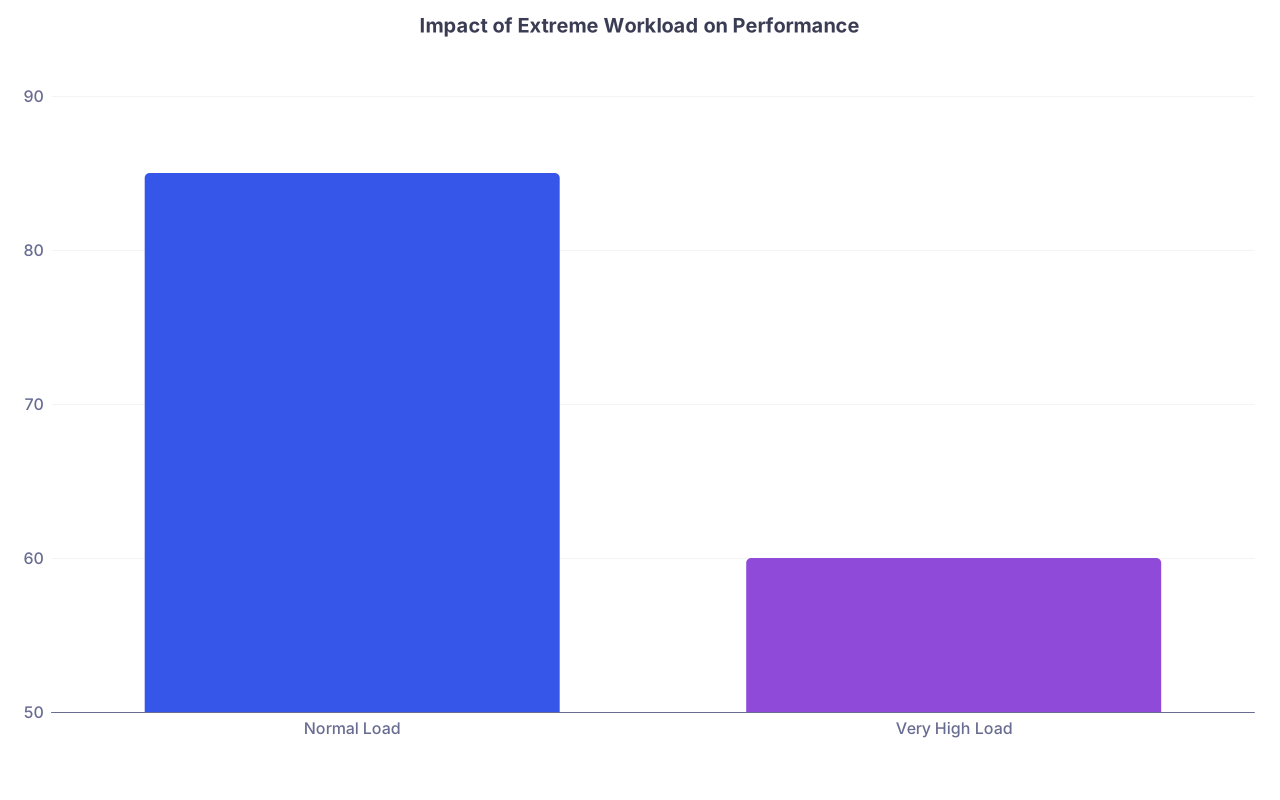
(Think of that as: probability of correct decision‑making or retained learning, not your ego.)
Residency of the future that actually makes sense will not be cushy. It should still be hard, intense, and demanding. But it will treat your time as a limited educational resource, not a bottomless service line.
How to Protect Yourself Without Sabotaging Your Training
You don’t beat the system by avoiding all busy programs. You’ll end up undercooked.
The smart move is to aim for high, structured volume with guardrails rather than chaos. Some practical heuristics:
- You should feel stretched, not constantly unsafe.
- You should have days that are brutal, but not months where brutal is the baseline.
- You should leave residency tired, not hollowed out and resentful.
One more litmus test: ask a senior resident or alum,
“If you could go back, would you choose this program again knowing what you know now?”
If you see the long pause, the half‑smile, the “it made me strong but…”—listen carefully to the second half of that sentence. People will rationalize their suffering. But they’ll usually tell you, indirectly, whether it was growth or exploitation.

FAQ: High Volume, Training, and Exploitation
1. Do I need a super “busy” program to become a good doctor?
No. You need enough volume of relevant cases with real responsibility and supervision. Most of the learning curve happens going from low to moderate–high volume, not from high to insane. A well‑run medium‑busy program will train you better than a chaotic war zone that calls itself “hardcore.”
2. Is it a red flag if residents say, “We work really hard, but we’re like family”?
Not by itself. That phrase is common. The question is: what comes after? If they also say they feel supported, caps are respected, and they still have time to study and have a life sometimes, it’s probably fine. If they laugh nervously and talk about “earning your stripes,” that’s a warning.
3. How many patients is “too many” on wards?
It depends on the system, support staff, and acuity, but patterns are clear: consistent intern loads >14–16 on medicine wards in a typical U.S. setting usually mean you’re in service land, not training land. Occasional spikes happen. Chronic overload is the problem.
4. Isn’t low volume just as bad?
It can be. If you never see sick patients or procedures, you will graduate underprepared. That’s not better; it’s just a different failure mode. The sweet spot is a program where you routinely see sick, complex patients, but the workload is structured enough that you’re not constantly drowning.
5. How can I tell if a high‑volume ICU or trauma program is “worth it” versus exploitative?
Listen for: strong teaching structure, clear protocols, accessible attendings, and residents who can talk concretely about what they learned rather than just how much they suffered. If all the selling points are “you’ll see everything” and “you’ll be so tough after,” with nothing about structured education or outcomes, assume they’re selling you on being cheap labor.
Key takeaways: High volume is only good training when it’s structured, supervised, and leaves room to think. Past a point, more patients and more hours are not rigor—they’re just exploitation in a white coat. Choose programs that challenge you, not ones that break you and call it education.