
Small residency classes are neither the magical “family vibe” you’re sold on nor automatically a dumpster fire. But they are high variance. When a program only takes 2–4 residents per year, everything—good and bad—is amplified.
Let me be blunt: the smaller the class, the smaller the margin for error. For you and for them.
Most applicants treat “small program” like a personality fit question:
“Do I want a close-knit class or a big cohort?”
Wrong frame. You should be asking:
“Is this small by design and well-resourced, or small because nobody wants to be here and they can barely staff the call schedule?”
Let’s sort out the myths from what actually shows up in outcomes, workload, and day-to-day life.
The Core Truth About Small Classes
The main truth: small classes magnify whatever the program already is.
A well-run, well-resourced program with 3 residents per year can be fantastic:
- Tons of one-on-one attending time
- Clear role on the team
- Less competition for procedures, cases, and research
A disorganized, understaffed program with 3 residents per year is brutal:
- No buffer for illness, pregnancy, or someone leaving
- Constant schedule reshuffling
- Chronic burnout and resentment
Size itself isn’t the red flag.
Unstable systems in a small program are the red flag.
What the Data and Patterns Actually Suggest
There isn’t a giant RCT that randomizes people into 4-person vs 20-person classes. But we do have:
- ACGME citations and probation patterns
- Board pass rates
- Case logs and procedure volumes (especially in surgical fields)
- Retention and fill rates (NRMP data)
- Resident-reported burnout and satisfaction trends from surveys and specialty societies
Patterns you see over and over if you look closely:
Stable, small programs (especially university-affiliated or long-standing community programs) often match residents who:
- Pass boards at high rates
- Graduate on time
- Log strong procedure/volume numbers
Small, struggling programs more often show:
- Marginal or at-risk board pass rates
- Residents leaving, transferring, or taking extra time to graduate
- ACGME citations related to supervision, duty hours, or education quality
- Persistent open spots or SOAP fills
Resident well-being in small programs is very bimodal. Surveys and anecdotal data show:
- Either “This is amazing, faculty know me and I get tons of support”
- Or “If one person gets sick, we all get destroyed.”
No nuance in the brochure. Tons of nuance in the outcomes.
When “Small Class Size” Is a Genuine Advantage
Let’s start with the upside—because there is real upside when the structure is solid.
1. Faculty Attention and Direct Teaching
In a small program with stable staffing, this is the biggest win. You’re not resident #17 of 18, fighting for the attending’s time.
I’ve seen places where:
- The PD can literally name what each PGY-2 needs to work on clinically
- Residents get direct attending feedback almost every shift
- Faculty know your fellowship goals and actively feed you cases and connections
That’s not marketing fluff. With 3–4 residents per year, it’s operationally realistic.
Programs that do this well usually:
- Have long-tenured core faculty
- Have clear teaching structures (dedicated teaching rounds, protected didactics)
- Aren’t scrambling every month to fill service holes
If you see that combination, small is a genuine advantage.
2. Procedure and Case Volume Per Resident
In procedural or high-volume specialties, fewer residents can mean:
- More central lines, intubations, deliveries, scopes, or OR time per resident
- Less intra-resident competition for “good cases”
- Quicker path to independence
But only if the baseline volume is high enough.
Here’s the real question: Volume per resident, not volume in the abstract.
| Program Type | Annual Cases (Service) | Residents on Service | Cases per Resident per Year |
|---|---|---|---|
| Small, busy community | 4,000 | 6 | ~667 |
| Large, academic | 6,000 | 18 | ~333 |
| Small, low-volume | 1,500 | 6 | ~250 |
Too many applicants get impressed by “We see 4,000 ED visits per month” or “7,000 deliveries a year” and forget to ask: how many residents are sharing that pie?
Smart questions:
- “How many residents are typically on this service at a time?”
- “What are average procedure numbers for graduating residents?”
- “Do fellows take first dibs on the high-yield cases?”
If they dodge, that is itself data.
3. Identity and Autonomy
In many large programs, interns feel like anonymous cogs for the first year (or two). In small programs:
- You’re known by name from week one
- Nurses / attendings actually notice your growth
- You often assume supervisory responsibility earlier
That can build confidence—if you’re actually supervised appropriately.
Borderline or unsafe autonomy is not a flex; it’s a liability.
Look for:
- “We trust our residents with real responsibility, but you always have a reachable attending who actually answers.”
- Not: “You’re basically the hospitalist at night by PGY-2. You’ll be fine.”
A subtle but critical difference.
When Small Size Is a Structural Red Flag
Now the part no one likes to say out loud on interview day.
1. No Buffer for Normal Life Events
With 3 residents per year, losing one person (leave, transfer, illness, pregnancy, remediation) is a 33% hit to your class. That’s catastrophic if the program doesn’t have actual contingency plans.
Residents feel it immediately:
- “We’re now Q3 call because one co-resident left and they didn’t backfill.”
- “Our vacation got reshuffled three times this year to cover holes.”
- “We have ‘golden weekends’ on paper, not in reality.”
Ask specifically:
- “In the last 5 years, has anyone taken parental leave or a medical leave? How was coverage handled?”
- “Has anyone transferred out or extended residency? What happened to the schedule?”
If the answer is vague, or the residents give each other that sideways “don’t say it” glance—pay attention.
2. Chronic Over-Reliance on Residents as Labor
Small community programs in particular can fall into this: residents are treated as cheap labor that keeps the hospital functioning, not as learners.
Symptoms:
- Constant service coverage talk, little mention of education
- Attending presence thin or mostly “available by phone” at night
- You hear “you’ll be running the whole hospital by second year” presented like a selling point
In a stable, high-quality small program, you’ll hear:
- Clear discussion of duty hour monitoring
- Mention of midlevels, hospitalists, or nocturnists who share the workload
- Some redundancy (moonlighters, per diem coverage) when residents are out
If everything hinges on “the residents will pick up the slack,” that’s not resilience. That’s fragility.
3. Weak Academic or Structural Support
Small size often correlates with:
- Limited research infrastructure
- Few or no subspecialty clinics
- Minimal exposure to certain pathologies
- Sparse ancillary services (social work, PT/OT, case management) that slow down your workflow and crush your days
It’s not that small programs can’t be academically strong. Some are surprisingly good. But a lot are small because they don’t have the patient mix or faculty depth to justify more residents.
Red flags to watch for:
- Hand-wavy answers to “How do you support residents applying to competitive fellowships?”
- No real track record of recent graduates matching into the fellowships you’re interested in
- Very few faculty with ongoing scholarly output, especially in academic specialties
If your goal is general practice in a community setting, this might matter less. If you think you might want cardiology, GI, heme/onc, or any competitive fellowship, it matters a lot.
The Hidden Emotional and Social Risks
This part rarely shows on websites but hits hard once you’re there.
1. Interpersonal Dynamics Are Magnified
In a class of 3:
- If you clash with 1 person, that’s 33% of your class.
- If 2 people pair off as friends, you’re the third wheel by default.
- If one person is consistently underperforming, you and your co-residents absorb their workload.
I’ve seen small classes where:
- One toxic co-resident made the entire residency miserable
- A single domineering attending essentially controlled the culture
- Faculty–resident conflict felt inescapable because there was no “other team” to rotate with and reset
Large programs have more social redundancy. You can find your people. Small programs don’t offer that luxury if things go sideways.
Ask residents privately:
- “If there’s major conflict between co-residents, how is it managed?”
- “Have there been any serious issues in recent years?”
You’re not being nosy. You’re assessing actual risk.
2. Limited Mentorship Diversity
In a large program, if you clash with one attending, you probably have 10–20 others. In a small one, your options might be 3–5 true mentors. If none of them match your style, goals, or values, you’re stuck.
Subtle sign of trouble:
- Every resident names the same one or two attendings as “the ones who really teach.”
That suggests excellence is not distributed. If those people leave, what’s left?
How to Distinguish “Intentionally Small” from “Barely Surviving”
This is the core diagnostic question.
Here’s how I’d sort them if I were applying again.
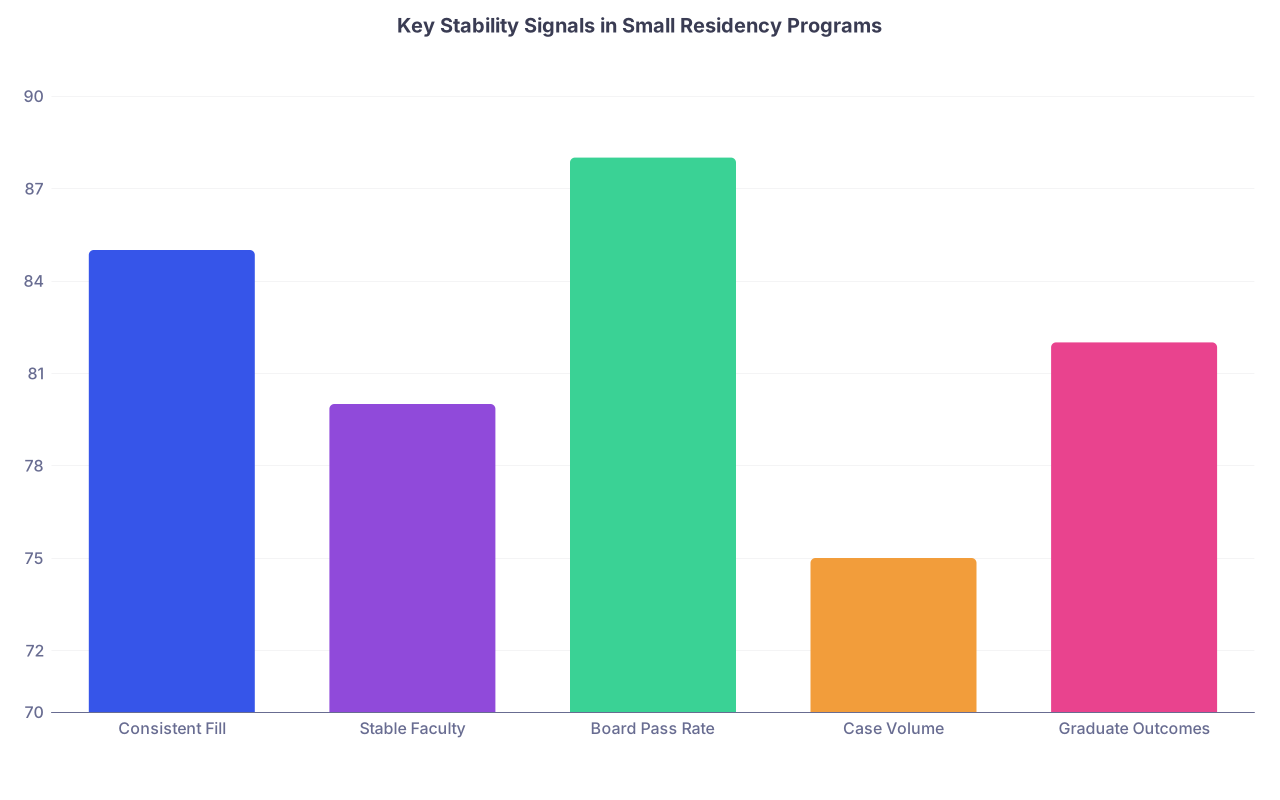
| Category | Value |
|---|---|
| Consistent Fill | 85 |
| Stable Faculty | 80 |
| Board Pass Rate | 88 |
| Case Volume | 75 |
| Graduate Outcomes | 82 |
Those bars aren’t from a specific dataset; they reflect the relative importance of what actually matters most.
Concrete signs of an “intentionally small, stable” program
You’ll see things like:
- Consistent full match over many years (no chronic unfilled spots, minimal SOAP reliance)
- Stable leadership (PD and core faculty around for several years, not constant turnover)
- Transparent numbers:
- Board pass rates discussed openly
- Case logs or typical procedure numbers readily shared
- Clear duty hour compliance
- Thought-out coverage systems for leave/illness: moonlighters, hospitalists, extra prelims, etc.
- Graduates doing what you want to do (fellowships, jobs, locations)
Concrete signs of “small because it’s struggling”
Things I’d treat as structural red flags:
- Program has repeatedly been on probation or cited for major issues
- Multiple unfilled spots over multiple years
- Recent wave of faculty departures or a brand-new PD trying to “rebuild” everything
- Very few graduates heading to the kind of practice or fellowship you want
- Resistance or vagueness when you ask for objective metrics (boards, volume, ACGME citations)
If you want a mental shortcut:
Small is fine. Small and unstable is not.
How to Interrogate a Small Program Without Being Annoying
You do not need to ask 47 neurotic questions on interview day. Ask a few targeted ones that cut straight through the sales pitch.
To faculty or leadership:
- “What has resident attrition looked like over the past 5–10 years?”
- “Have there been any recent ACGME citations, and how have they been addressed?”
- “How do you handle schedules when someone takes parental leave or extended sick leave?”
- “What are your 5-year board pass rates for first-time takers?”
To residents (away from faculty):
- “Realistically, how often do you feel like you’re covering for being short-staffed?”
- “Has anyone left the program or transferred out in the past few years? Why?”
- “Do you feel like you’re learning first, or staffing the hospital first?”
- “If one resident went out suddenly for 3 months, what would actually happen to your call schedule?”
You’re not trying to attack them. You’re testing whether the system is robust at its current size.
Small vs Large: The Trade-Offs You’re Actually Making
To put some structure on this, here’s the real trade space—not the marketing nonsense.
| Factor | Small Class (2–4/yr) | Large Class (12–25/yr) |
|---|---|---|
| Faculty attention | Higher ceiling, more variable | More average, less individualized |
| Social dynamics | Intense, high-impact conflicts | More diversity, more redundancy |
| Coverage resilience | Low unless well-designed | Generally higher, easier redistribution |
| Procedure opportunities | Can be excellent if volume adequate | Can be diluted, especially with fellows |
| Academic breadth | Often limited | Wider subspecialty and research options |
| Culture change | Faster, but more sensitive to 1–2 people | Slower, more inertia |
There is no “right” size for everyone. But there are wrong environments for you, given your risk tolerance and goals.
Visualizing the Risk Curve
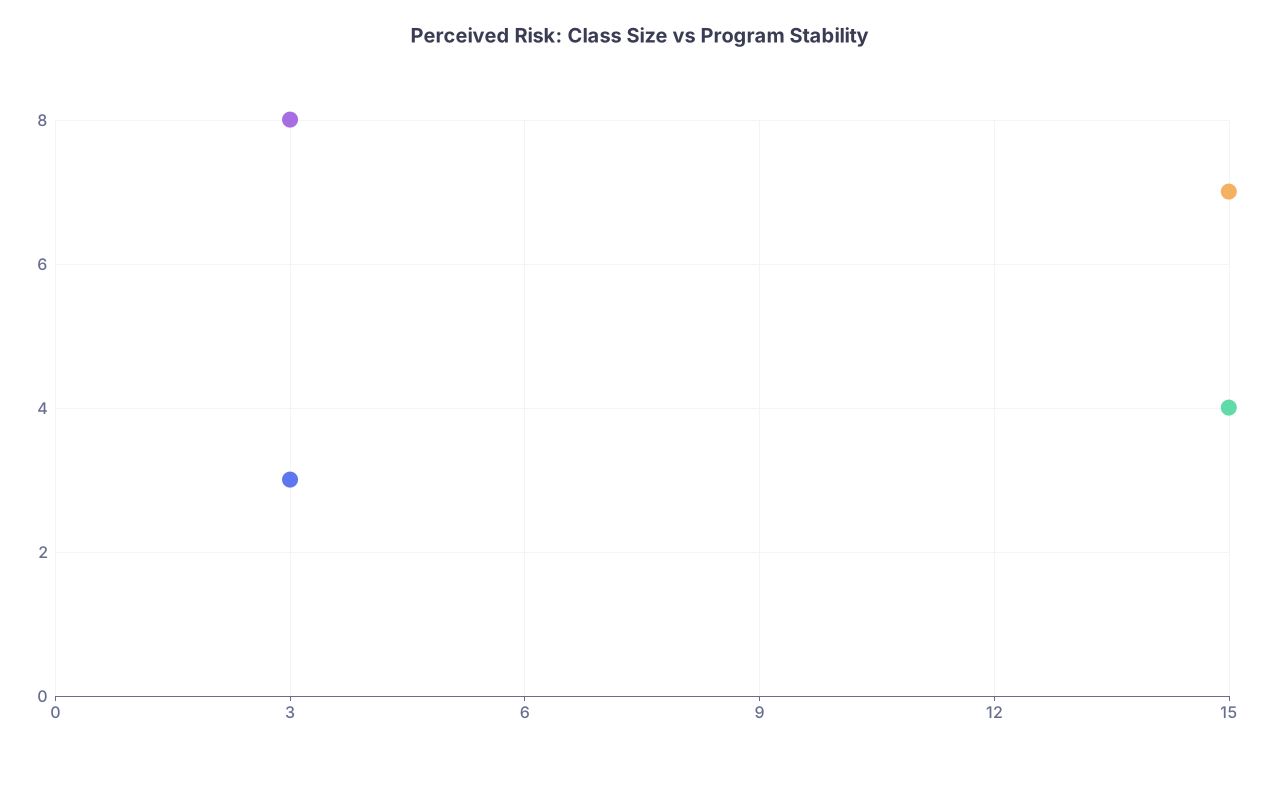
One last picture to drive home how small size and instability interact.
| Category | Value |
|---|---|
| Stable Small | 3,3 |
| Unstable Small | 3,8 |
| Stable Large | 15,4 |
| Unstable Large | 15,7 |
Think of x-axis as class size, y-axis as risk (higher is worse).
- Stable small: manageable risk, high upside
- Unstable small: bad combination—steep risk
- Stable large: safe, sometimes a bit generic
- Unstable large: chaotic, but buffered by numbers
Your job is to figure out whether a given small program lives in “stable small” or “unstable small.” That’s the entire game.
Final Take: Hidden Advantage or Structural Red Flag?
Three points to walk away with:
Small class size is a multiplier, not an inherent virtue or flaw. It amplifies whatever the program already is—good or bad.
The red flag isn’t “small.” It’s “small and structurally fragile.” Look for patterns: persistent unfilled spots, attrition, lack of backup for leave, vague answers about boards and volume.
Treat small programs like high-volatility investments. Potential for great returns if they’re stable and well-run. But if you see instability stacked on a tiny resident pool, the downside hits you directly—no buffer, no anonymity, and no easy escape hatch.