62% of academic medical centers report annual faculty turnover above 8%—and most of those programs function just fine.
You would not guess that from the way residents and applicants talk about it. “Everyone’s leaving.” “The PD is new, that’s a disaster.” “They lost three cardiologists; the program must be toxic.” I hear those exact lines every cycle. Usually from someone who has half the story and all the anxiety.
Let me be blunt: “high turnover = bad program” is lazy thinking. Sometimes it’s true. Often it is absolutely wrong.
The real question is not how many people left. It is who left, why they left, and what happened next.
What the Data Actually Shows About Faculty Turnover
Most people throwing around “turnover” have never looked at actual numbers.
Nationally, across academic medicine, annual faculty turnover typically lands in the 6–10% range. Primary care is higher, surgical subspecialties are lower. Community programs may fluctuate more because losing two people out of a department of eight looks dramatic on paper.
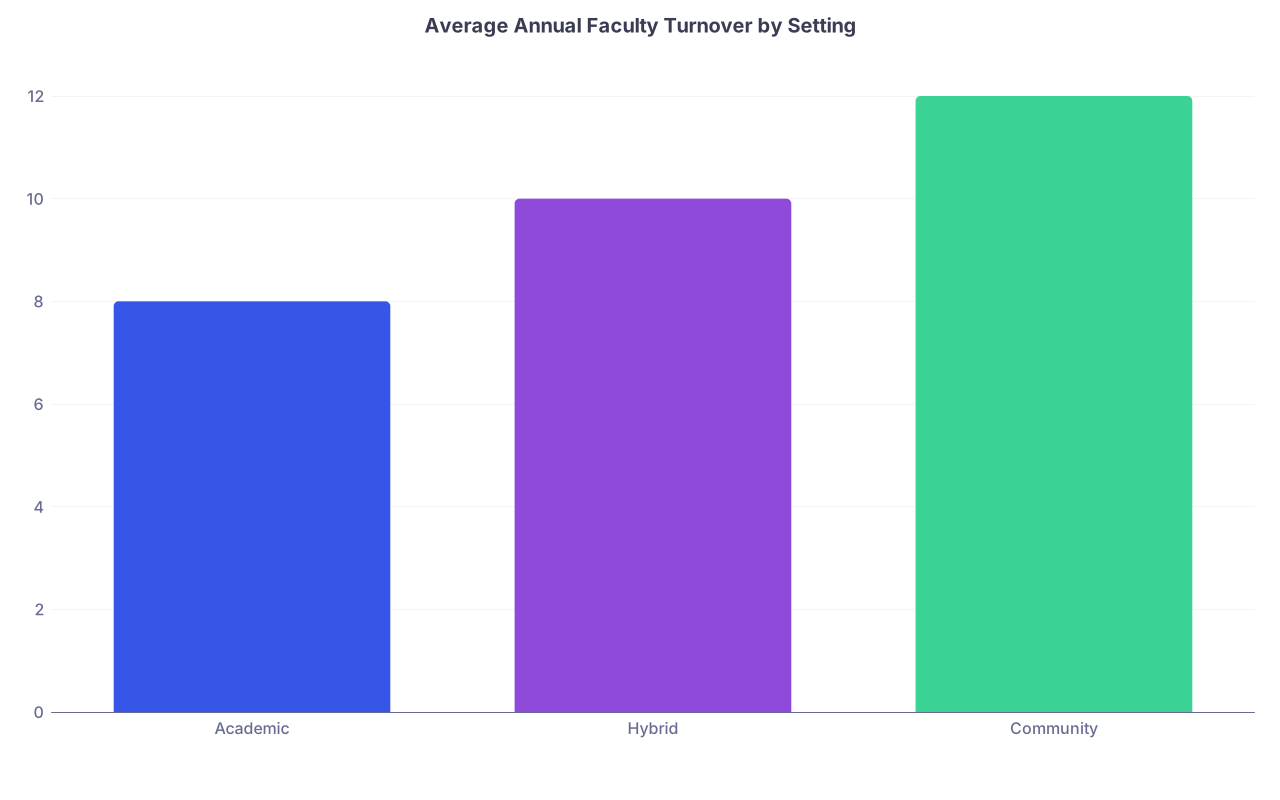
| Category | Value |
|---|---|
| Academic | 8 |
| Hybrid | 10 |
| Community | 12 |
Those numbers are not “everyone is fleeing.” That’s just what a dynamic labor market looks like in 2024. People relocate for spouses, kids, money, leadership roles, or because they’re done with 14-hour days and relative value units.
Here’s what the evidence and large HR datasets consistently show in academic medical centers:
- A big chunk of movement is normal churn: early-career faculty testing fit, mid-career faculty being poached by higher-paying systems.
- Burnout and moral distress do push people out—but they often push individuals, not entire departments at once.
- Stability at the program-director and core-educator level matters way more for resident experience than raw faculty headcount fluctuations.
But that is not the story applicants tell each other on Reddit and in group chats. They fixate on N of Departures without context. “Five faculty left in two years” sounds terrifying if the program only had five to start with. If it has 40? That might barely nudge the needle.
So you need a better filter: not “Is there turnover?” but “What kind is it?”
Normal vs Toxic Turnover: The Pattern Matters
Turnover is like a lab value. One reading means nothing. You need trend, context, and clinical correlation.
Here’s the basic framework I use when I look at a program’s faculty changes.
1. Who is leaving?
This is the single most important question, and almost nobody asks it correctly.
Red flag is not “people left.” Real red flag is exactly the people who matter to your training leaving, in clusters, with no clear replacement.
Think in tiers:
Tier 1: Core educational leadership
- Program Director (PD)
- Associate/Assistant PDs
- Clerkship director (for med students, but often overlaps)
- Chief of service that runs your main inpatient experience
Tier 2: Heavy-hitter clinician-educators
- The two or three attendings everyone says “you will learn the most from”
- The ones running bootcamps, simulation, didactics, key rotations
Tier 3: Peripheral or niche people
- A researcher who rarely staffs residents
- A subspecialist in a field you will barely touch
- Late-career faculty phasing into retirement
Now look at patterns.
If a program loses two senior researchers and one semi-retired attending, that is noise for your day-to-day training.
If a program loses its PD, two APDs, and the main night float attending in a 12–18 month window, that’s not background noise. That is structural instability.
I’ve watched programs survive waves of subspecialty departures and barely blink from the resident standpoint. I’ve also watched one mid-sized IM program lose its long-time PD, two APDs, and its ICU director within nine months—and they spent the next three years patching holes while residents found workarounds for everything from scheduling to research mentorship.
2. How fast and how clustered?
Rate and clustering matter more than raw totals.
A program losing 1–2 faculty a year across departments? Completely normal.
A program where half of its hospitalist educators bail within 6 months? That is not normal.

Rapid, clustered departures usually mean one of three things:
- New leadership came in and cleaned house (which can be good or bad, more on that later).
- Administration made major comp changes or workload changes that pissed people off.
- There was an internal conflict or scandal that triggered a mass exit.
When turnover is slow and spread out, people are usually moving for personal or career reasons. When it’s sharp and clustered in one division, something changed at the system level.
3. Are there credible replacements and a plan?
Turnover is not the problem. Lack of replacement—and lack of transparency about replacement—is.
I get suspicious when programs say, “We lost a few people but we’re recruiting hard” and then you look at their website a year later and it is still the same skeleton crew. Or residents tell you, “We keep hearing about new hires; they never arrive.”
Contrast that with programs that say, “We lost two interventionalists and one generalist in cardiology. Here’s the new hire starting in July, here’s the locums coverage plan, and here’s how we’re adjusting rotation structure for the next 6 months so you’re not stuck taking all the overflow.”
One is chaos. The other is just transition.
When Faculty Turnover Is a True Red Flag
Let’s be specific. There are patterns that, in my view, should make you seriously reconsider ranking a program high.
1. Leadership churn without stabilization
Losing a PD is not automatically bad. PDs are human. They get promoted, burned out, or pushed aside.
The red flag is repeated, short-tenure PDs with vague explanations.
| Pattern | Risk Level |
|---|---|
| PD 8–10+ years, 1 recent change | Low |
| PD turnover every 4–5 years | Moderate |
| 2+ PDs gone within 5 years | High |
| Multiple APDs resigning in same year | High |
If in the last five years, the PD turned over twice, two APDs “stepped down” without clear next roles, and the current PD is “interim”… that’s dysfunction. It signals misalignment with GME leadership, conflict with hospital admin, or deep morale issues.
Residents live inside the downstream chaos: shifting policies, changing evaluation structures, rotations being rebranded every year with no real improvement.
2. Disappearing core rotations or attendings
Watch what happens to rotations that anchor your skill set.
If the main MICU attending group that staffs your critical care months loses half its people and residents are now supervised by a rotating cast of locums who do not know the EMR, hospital workflow, or teaching culture—that will absolutely hit your training.
Same for key specialty areas: trauma surgery service emptied and replaced with night float hospitalists covering trauma by phone? That is not a small detail. That changes the spine of a surgical residency.
Bad sign: residents quietly saying, “That rotation used to be incredible; now it’s a mess since Dr. X left.”
Worse sign: those comments repeated across multiple rotations.
3. Turnover + culture of silence
Here’s the dead giveaway something is rotten:
You ask about recent departures, and you get forced smiles, vague euphemisms, and quick subject changes.
- “People move on all the time.”
- “We’re focusing on the future.”
- “That’s not really something we get into.”
If faculty left for neutral reasons, programs usually don’t mind being transparent:
- “She moved to be closer to family.”
- “He took a Chair position at another institution.”
- “They consolidated that service at a different campus.”
If nobody will touch the topic, and residents give you that “I wish I could talk freely” look, you’re being shown a red flag in real time.
4. Overreliance on NPs/PA/locums to replace teaching attendings
No shade to NPs and PAs—they keep hospitals functioning—but they do not replace what a seasoned clinician-educator does for a residency.
Red flag: “We lost three hospitalists, but coverage is fine; we hired three nocturnist NPs and some locums.”
What that usually means for you:
- Less continuity of teaching and feedback
- More service work with less supervision
- Locums whose goal is to get through the night, not build your skills
If the solution to faculty exits is “just add advanced practice providers and travelers” with no educational strategy, that’s a problem.
When Turnover Is Just Change (or Even Good)
Now the part people do not want to hear: sometimes that scary-sounding “everyone is leaving” rumor is…growth.
1. New leadership with a track record
You will routinely see this sequence:
- Long-time PD retires or is gently pushed aside.
- Several senior faculty who were coasting on reputation decide they do not like the new expectations and leave.
- Applicants panic. “Mass exodus!”
Then 2–3 years later, the program is actually stronger: better didactics, modern evaluation tools, sane duty hours, more wellness support, a real QI curriculum.
Change is noisy. If faculty leave because someone raised standards—for teaching quality, professionalism, or productivity—that’s not a red flag. That’s overdue housecleaning.
To tell the difference, look for this: Does the incoming PD have a real track record somewhere else?
If they came from a respected program with solid resident outcomes and they’re recruiting new faculty with known educational chops, short-term turnover may be the price of long-term improvement.
2. Career progression, not escape
Another non-red-flag pattern: people leaving for bigger, clearly better roles.
If faculty are going on to be division chiefs, chairs, or program directors elsewhere, your program isn’t toxic. It’s a talent factory.
You might hear:
- “Our APD just became PD at [well-known program].”
- “Our ICU attending left to build a new critical care fellowship in another state.”
- “Dr. Smith is now vice chair at [major institution].”
That’s not “run away from this dumpster fire.” That’s a normal career ladder.
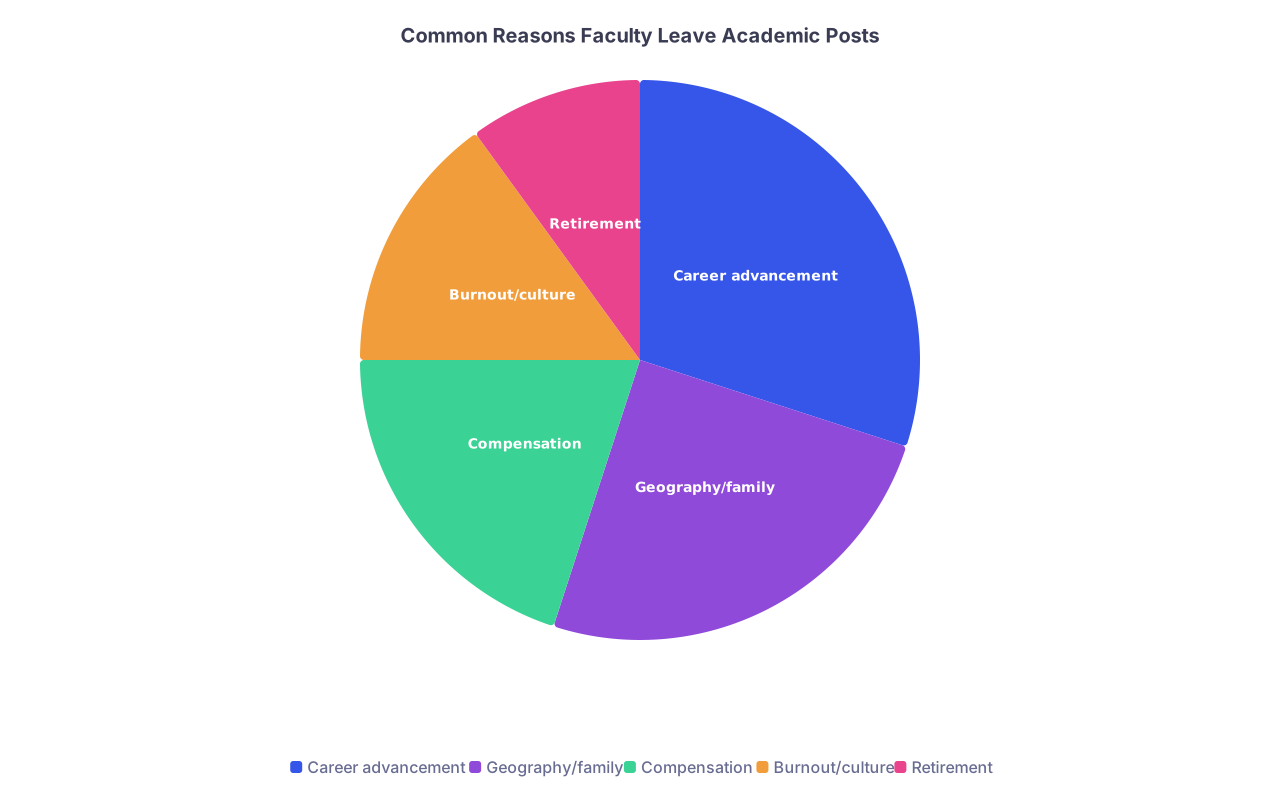
| Category | Value |
|---|---|
| Career advancement | 30 |
| Geography/family | 25 |
| Compensation | 20 |
| Burnout/culture | 15 |
| Retirement | 10 |
Burnout and bad culture are real reasons people leave, but they are not the only reasons. Do not treat every departure as a silent indictment.
3. Strategic restructuring
Sometimes you see a big shift in a single department because the hospital changes its model:
- Merging two campuses, consolidating services.
- Moving certain specialties to a new building or affiliate site.
- Pivoting toward or away from a quaternary-care focus.
Short term, it looks like “all the X attendings left.” But your lived reality as a resident might not degrade at all if rotations are redesigned intelligently and teaching responsibility is clearly reassigned.
You want to hear specifics:
- “We moved our stroke service downtown; now all residents do that rotation at the main campus with a dedicated neurohospitalist group.”
- “We stopped doing LVADs here; those patients go to [partner hospital], and we shifted our focus to bread-and-butter heart failure. Residents now spend that time in a high-volume general cardiology clinic.”
That is strategic change, not collapse.
How to Actually Investigate Turnover as an Applicant or Resident
Rumor is cheap. You need data.
Here’s a simple way to pressure-test faculty turnover without being obnoxious.
1. Compare faculty lists over time
Use the internet like an adult, not a doomscroller.
- Pull up the program’s faculty page from this year and from 2–3 years ago using the Wayback Machine.
- Count: who left? Are they clustered in one division? Are they mostly senior or junior?
You’ll quickly see if this is 10–20% movement over a few years (normal) or half of a department gone (not normal).
2. Ask residents how change has affected them
Do not ask, “Is turnover a problem?” That’s useless.
Ask:
- “How have faculty changes affected your day-to-day teaching in the ICU/wards/OR?”
- “Have any rotations gotten noticeably better or worse as people have left?”
- “Are there services where you feel under-supervised because of departures?”
Specific questions force specific answers. If turnover is just background noise, they’ll say so. If it’s wrecking their education, it will come out.
3. Observe who actually shows up for teaching
On interview day, second look, or as a current resident:
- Who is running morning report?
- Who is leading didactics and sim?
- Is it the same two exhausted people doing everything?
If you see a thin, overextended teaching core, and you know multiple others recently left, that’s risk. It means they have not rebuilt after turnover. You’ll feel that in call rooms at 2 a.m.

| Step | Description |
|---|---|
| Step 1 | Faculty Turnover |
| Step 2 | Minimal impact on residents |
| Step 3 | Short term disruption |
| Step 4 | Real red flag |
| Step 5 | Less supervision |
| Step 6 | Worse education |
| Step 7 | Resident burnout |
| Step 8 | Core educators affected |
| Step 9 | Replacements in place |
Stop Treating All Turnover as a Crisis
Faculty turnover is not automatically a residency program red flag. Sometimes it is a symptom of real toxicity. Sometimes it is just what change looks like in a system under constant financial and regulatory pressure.
Here’s the distilled version, without the drama:
- Pattern beats number. Clustered losses of PDs/APDs and core educators, with no clear replacements, are red flags. A slow drip of departures across years is usually just life.
- Transparency is the tell. Programs that can explain who left, why, and what they did about it are usually fine. Evasion and vague answers usually mean there’s something you would care about.
- Impact on training is all that matters. If residents still get strong supervision, stable rotations, and accessible mentors, the turnover is just background noise. If they are scrambling to find attendings and watching rotations decay, believe them—not the glossy brochure.