Not Every Busy Program Is Malignant: Differentiating Workload from Abuse
Is a brutal call month automatically a red flag, or are you confusing being tired with being exploited?
This distinction matters, because I’ve watched smart applicants run toward “chill” programs that quietly eat their trainees alive… and avoid high-volume programs that were actually safer, more supportive, and produced stronger graduates.
The myth is simple and seductive:
“Busy program = malignant. Light program = supportive.”
Reality is much uglier — and more useful.
Let’s pull this apart.
What the Data Actually Shows About “Malignancy”
People talk about malignancy like it’s a vibe. “I just felt it.” That’s not useless — but it’s not enough.
There are three big buckets we can actually anchor to: measurable workload, objective outcomes, and trainee-reported culture.
1. Workload ≠ Harm by Default
Residents should be busy. The ACGME didn’t design residency so you could be in bed by 9 pm every night. The key question is not, “Am I tired?” It is:
“Is the system designed to protect me while I do hard work?”
The research is pretty consistent:
- Duty hour violations correlate with burnout and depression
- Chronic sleep deprivation impairs performance, obviously
- But within the allowed ranges, program-level culture predicts burnout more strongly than raw hours
You see this in survey data: two programs with similar call schedules can have wildly different burnout rates depending on whether residents feel supported, heard, and not punished for asking for help.
In other words, 70 hours per week in a functional system can be healthier than 55 hours in a toxic one.
2. Objective Outcomes Don’t Lie
You can ignore the vibes; you cannot ignore:
- Board pass rates
- Disciplinary rates
- Attrition (people leaving or switching programs)
- Fellowship match outcomes
- Unplanned medical leaves for “stress” or “personal reasons”
| Metric | Program A (Busy, Supportive) | Program B (Light, Toxic) |
|---|---|---|
| Avg hours/week PGY-2 | 68 | 55 |
| Board pass rate (5-yr) | 98% | 85% |
| Resident attrition (5-yr) | 2% | 15% |
| Unplanned leaves / year | 1 | 6 |
| Fellowship match rate | 75% | 40% |
Everyone complains at Program A. “We’re slammed.” But people pass boards, stay, and match well.
Program B looks “chill” on interview day. Then you look under the hood and find a trail of burned-out PGY-3s who quietly disappear.
You tell me which is malignant.
The Core Distinction: Hard vs Harmful
Here’s the simple mental model:
Hard is high workload with support, fairness, and learning.
Harmful is high (or even moderate) workload with chaos, disrespect, and no off-ramps.
What “Hard but Healthy” Actually Looks Like
Busy programs that are not malignant tend to share specific features:
- High volume, but predictable patterns
- Clear escalation pathways (“Call the fellow/attending if ___”)
- Leadership that knows residents’ names and real situations
- Responsiveness when residents raise safety concerns
- Psychological safety: people admit mistakes without public humiliation
- Real coverage when someone is sick or in crisis, not just guilt-tripped
You leave those rotations exhausted but sharper. You’re challenged, sometimes pushed, but not discarded.
I’ve seen surgical programs like this: brutal case volume, real overnight work, but attendings who show up at 3 am when you call, apologize if they snap, and mean it. Chief residents who quietly move a case off your list when they see you falling apart. No one calls that “nice,” but it’s not malignant.
What Malignancy Actually Is
Malignancy is not defined by “I was busy” or “I cried on call.”
Malignancy is systemic disregard for resident well-being plus structural power used carelessly or abusively. You see patterns like:
- Public shaming or humiliation as routine teaching
- Retaliation (formal or informal) against residents who speak up
- Gaslighting around workload: “Everyone before you did it, why are you weak?”
- Unsafe staffing or patient loads that leadership accepts as normal
- Duty hour falsification pressure
- Chronic bullying that is known and tolerated
It’s abuse dressed up as “tradition” and “toughening you up.”
That’s very different from a 26-patient cap on wards where you’re actually staffed, supervised, and protected.
Things That Look Like Red Flags But Often Aren’t
Some of what gets labeled as “malignant” is just the job being the job. A lot of applicants don’t want to hear that.
Let me be blunt: if any of the following alone make you label a program malignant, you’re not distinguishing between workload and abuse.
1. High Patient Volume with Real Supervision
Internal medicine residents seeing 12–16 patients on a day team at a busy county hospital? Not automatically a red flag. That’s normal, even desirable, for many training environments.
If attendings round, fellows are available, and notes/orders are sane, that’s exposure, not exploitation. Learning how to manage a big list safely is part of becoming an independent physician.
2. Rotations That Everyone Dreads
Every decent program has “that” month. The MICU that wrecks your sleep. The trauma service that eats your social life.
A hard month is not malignancy. What matters:
- Do seniors and attendings normalize asking for help?
- Does leadership adjust if a rotation is dangerous, not just annoying?
- Is the suffering finite and followed by a lighter block, or is it the entire residency?
The programs I trust most are the ones where residents say, “Yeah, X rotation sucks… but it’s fair and I learned a ton.” Not the ones pretending every month is magical.
3. Direct, Blunt Feedback
Too many people equate “not nice” with abusive. They’re not the same.
A senior saying, “You need to tighten your presentations; they’re too long and you kept the whole team here late” — that’s blunt. It can hurt. But it’s about your behavior, not your worth, and it’s framed around patient care and team function.
Abuse is, “What’s wrong with you? Are you stupid? Maybe this career isn’t for you.”
Both feel bad. Only one is malignant.
Things That Really Are Red Flags (Even in “Chill” Programs)
Now the other side. There are programs that look light — few admissions, early sign-out, short notes — that quietly show you their true colors if you know where to look.
These are often worse, because residents feel crazy for feeling miserable when they’re “not even that busy.”
1. Normalized Disrespect and Humiliation
Listen for throwaway lines:
- “Our PD says if you can’t handle it, there’s the door.”
- “Yeah, Dr X screams sometimes, but that’s just how she teaches.”
- “We don’t ‘do’ mental health time off here.”
That’s not rigor. That’s contempt.
2. Unsafe Behavior Hand-Waved Away
Busy is not having enough time to pee during a code-heavy night. Malignant is:
- Chronic understaffing that’s been happening for years
- Single-resident cross-covering absurd numbers of patients as a norm
- Leadership dismissing safety reports or near-misses as “part of training”
When the system is dangerous and leadership shrugs, that’s malignancy whether or not you’re logging 40 or 80 hours.
3. Silence and Fear Among Residents
The biggest yellow-to-red flag: residents constantly checking who’s listening before they talk.
If you see:
- Residents hesitating before answering your questions honestly
- “Off the record…” prefacing every real comment
- PGY-3s warning you quietly about attendings or leadership they’ll never mention on surveys
You’re probably looking at a culture where speaking up has consequences. That’s malignant, regardless of census numbers.
How to Evaluate a Busy Program Without Panicking
You’re not going to get perfect transparency. But you can do a lot better than “They said they were a family.”
Watch the Congruence
Compare three things:
- What leadership says on interview day
- What residents say in front of leadership
- What residents say when leadership is not in the room
If the PD talks constantly about wellness and every resident looks dead behind the eyes, believe the faces, not the words.
If the PD openly acknowledges, “We’re busy, this rotation is rough, here’s what we changed after last year’s feedback,” and residents independently confirm that story — that’s a green flag in a high-workload environment.
Ask About Mistakes, Not Just Schedules
You’ll get more truth with questions like:
- “Tell me about a time a resident made a big mistake. How was it handled?”
- “What happens if you hit a wall on a call night and just can’t keep going safely?”
- “Has anyone ever raised concerns about a rotation being unsafe? What changed?”
Healthy, busy programs have real, specific answers. Toxic ones either dodge the question or make it about “resilience.”

| Step | Description |
|---|---|
| Step 1 | High Workload |
| Step 2 | Hard but Protective |
| Step 3 | High Risk of Harm |
| Step 4 | Moderate Workload |
| Step 5 | Generally Healthy |
| Step 6 | Quietly Malignant |
| Step 7 | Supportive Culture |
| Step 8 | Supportive Culture |
Where Workload Actually Bites: Burnout, Errors, Attrition
Let’s not pretend constant overwork is fine if the culture is “supportive.” Massive workload still has consequences.
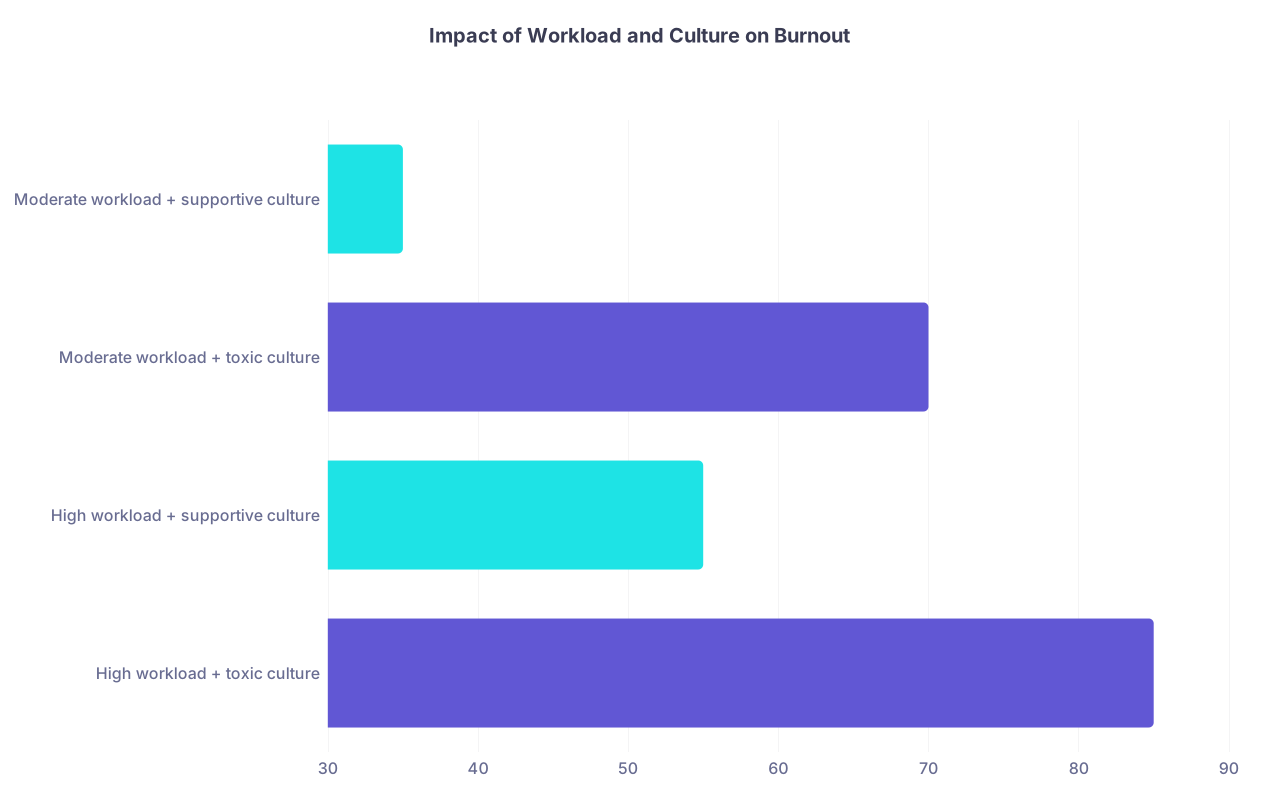
| Category | Value |
|---|---|
| High workload + toxic culture | 85 |
| High workload + supportive culture | 55 |
| Moderate workload + toxic culture | 70 |
| Moderate workload + supportive culture | 35 |
Interpretation:
- High workload + toxic culture is the worst of all worlds
- Moderate workload + supportive culture is ideal (and rare)
- High workload + supportive culture and moderate workload + toxic culture are surprisingly comparable in burnout risk
Which means: yes, you should pay attention to hours. But if you’re ignoring culture, you’re missing the main driver.
The Future: Why This Distinction Will Matter Even More
Residency isn’t getting softer. If anything, you’re heading into:
- Sicker patients
- More documentation and metric pressure
- Shrinking inpatient lengths of stay (aka more turnover, more work per day)
If you equate “protective” with “low volume,” you’re setting yourself up to be underprepared and still burned out.
The programs that will survive — and produce physicians who do not quit medicine by 40 — will not be the quietest. They’ll be the ones that:
- Accept that residency is hard
- Build real systems to buffer that hardness from becoming harm
- Treat residents as professionals in training, not disposable labor
You want to be where the work is real and the guardrails are, too.


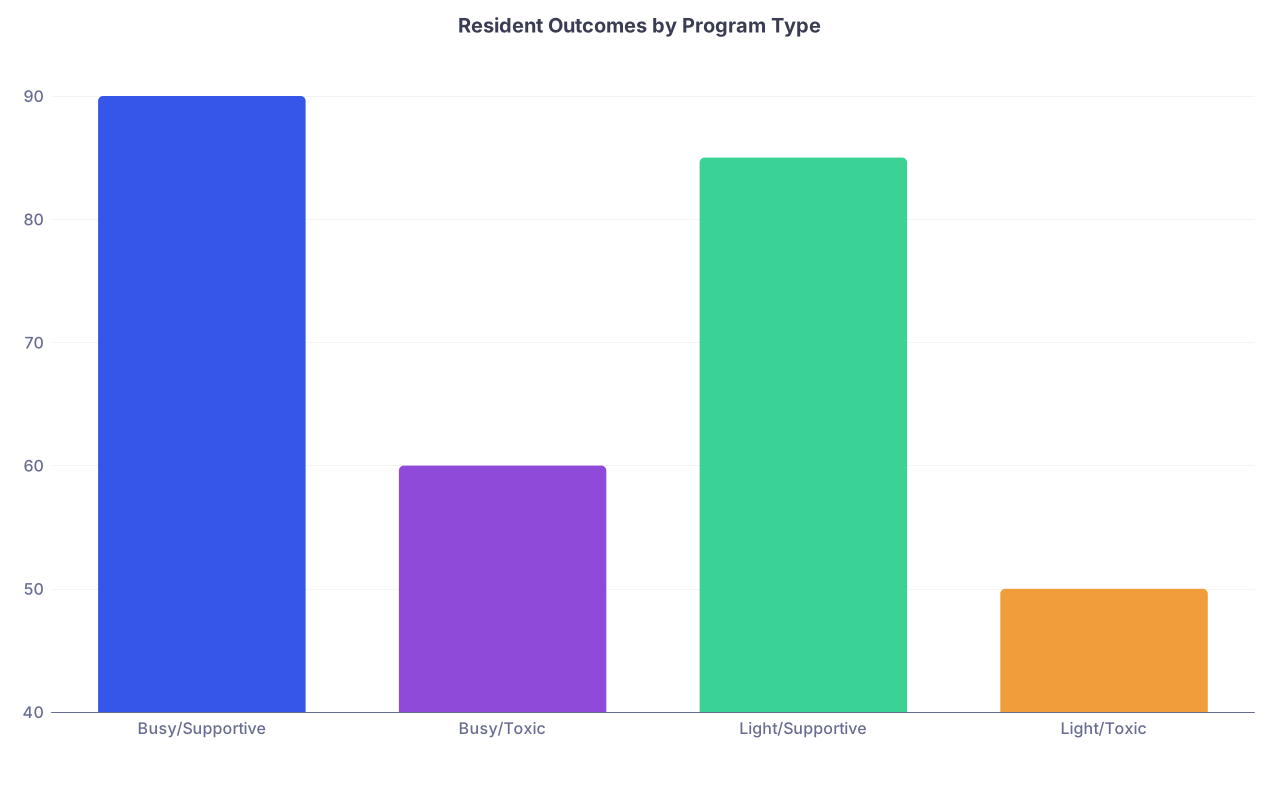
| Category | Value |
|---|---|
| Busy/Supportive | 90 |
| Busy/Toxic | 60 |
| Light/Supportive | 85 |
| Light/Toxic | 50 |
How to Use This When Ranking Programs
When you’re finalizing your list, stop asking, “Where will I be least tired?” Ask:
- “Where will I be worked hard but protected?”
- “Where is the suffering meaningful — tied to growth, not ego?”
- “Where do residents complain about being busy, but not about being belittled, unsafe, or ignored?”
If a program is busy, with honest leadership, cohesive residents, and clear systems for feedback and correction, it’s not a red flag. It’s just residency.
If a program is light, but residents are afraid, dismissed, or quietly disappearing, that’s not a hidden gem. That’s malignancy with a smaller census.
The bottom line
- Workload and abuse are not the same thing. Stop conflating “I’m tired” with “this place is malignant.”
- A hard, high-volume program with real support is safer than a “chill” program that tolerates disrespect, fear, and unsafe practices.
- When evaluating programs, prioritize culture, safety, and integrity over raw hours; you’re training to be a physician, not to win an easy lifestyle contest for three years.