The way most applicants talk about ACGME citations is wrong. A citation list is not an automatic death sentence for a residency program. But it is not a trivial footnote either. The truth is a lot messier—and more useful—than the folklore you hear on Reddit.
Let me be blunt: every serious residency program that’s been around long enough has had citations. The question isn’t “Are there citations?” The question is:
- What are they about?
- How many?
- How long have they persisted?
- What has the program actually done about them?
If you’re just filtering programs based on “ACGME cited = red flag,” you’re using a toy metric for a grown‑up decision.
What ACGME Citations Actually Mean (Not the Twitter Version)
An ACGME citation is not a scarlet letter. It’s a documented deficiency identified during accreditation review that needs correction. It’s closer to a “you must fix this” than “you’re unsafe and doomed.”
Under the Next Accreditation System (NAS), the ACGME shifted from rare, high‑stakes site visits to continuous oversight using data (surveys, case logs, outcomes) plus periodic self‑studies and visits. Citations are one of the levers they use to force improvement.
There are roughly three tiers of “bad news” in ACGME land:
| Level | What It Means |
|---|---|
| Citations | Specific deficiencies to fix |
| Areas for Improvement (AFIs) | Concerns to monitor, not mandatory fix |
| Probation / Warning status | Serious, program at risk |
Programs survive citations all the time. Probation or withdrawal of accreditation is where you start worrying about your ability to graduate from an accredited program.
The nuance nobody tells applicants: the presence of citations is less meaningful than their pattern and content.
- A single focused citation about documentation of evaluation? Annoying but trivial.
- A repeat citation over several cycles about duty hour violations and inadequate supervision? That’s a systemic, cultural problem.
The Data: Almost Nobody Looks at This Correctly
Applicants talk like “no citations = good; citations = bad.” That’s not how the system works.
Let’s walk through what actually drives ACGME scrutiny:
- Resident survey results (duty hours, teaching quality, bullying/harassment, evaluation fairness, etc.)
- Case logs and procedural minimums
- Board pass rates
- Faculty numbers and qualifications
- Program leadership stability
- Compliance with common and specialty‑specific program requirements
Citations show up when one or more of these domains fail to meet standards or when the program can’t demonstrate compliance.
Now here’s the key point: a program with zero citations could still:
- Have mediocre teaching
- Give you weak letters
- Be socially toxic but just barely above the threshold on survey metrics
- Be stagnant and risk‑averse, never pushing for innovation (which ironically can reduce risk of citations)
Meanwhile, a program with a handful of citations might be going through needed growth, leadership transitions, or major restructuring that ultimately benefits residents.
Is that always good? No. But it’s not as cartoonish as “citations = run.”
Not All Citations Are Created Equal
Treating all citations as the same is like treating all “abnormal labs” as the same. A mild isolated AST bump is not septic shock. Context matters.
Here’s how I’d mentally triage citation content as an applicant:
1. Mostly Harmless (Annoying but Fixable)
These are often process or paperwork issues.
Common examples I’ve seen:
- Poor documentation of resident evaluations or CCC processes
- Incomplete or inconsistent milestones reporting
- Lack of formal written goals and objectives for all rotations (they exist in practice, just not documented correctly)
- Faculty development not tracked or documented
These can still irritate your life (disorganized evals, inconsistent feedback) but they’re rarely existential.
2. Yellow Flag: Quality of Education / Supervision
Now we’re in “pay attention” territory.
Examples:
- Inadequate supervision of residents at night or on certain services
- Inconsistent didactics, poor attendance, or lack of protected time
- Inadequate feedback or no semi‑annual evaluation meetings
- Faculty-to-resident ratio concerns
These affect your actual training. But again, the trend matters:
- If the citation is recent and the program can show a credible action plan (e.g., new nocturnist coverage, revised didactic schedule), that can be a sign of a program honestly confronting its weaknesses.
- If it’s a repeat citation over multiple years? That’s a culture issue, not a paperwork issue.
3. True Red Flags: Safety, Culture, or Chronic Noncompliance
This is where a citation list really can be a dealbreaker.
Examples that should make you lean hard away:
- Persistent duty hour violations tied to service overeducation, not just short‑term crises
- Repeated issues with harassment, discrimination, or unprofessional behavior not being addressed
- Residents not meeting case minimums over several years
- Board pass rates consistently below ACGME thresholds with citations referencing it
- Unstable leadership: repeated program director turnover tied to cited problems
If the ACGME is essentially saying, “we’ve told you to fix this several times and you still haven’t,” you should take that more seriously than a long list of one‑off citations that were addressed.
What the Trend Line Tells You (More Than the Number)
The pattern over time is more important than the snapshot.
Think of it like this:
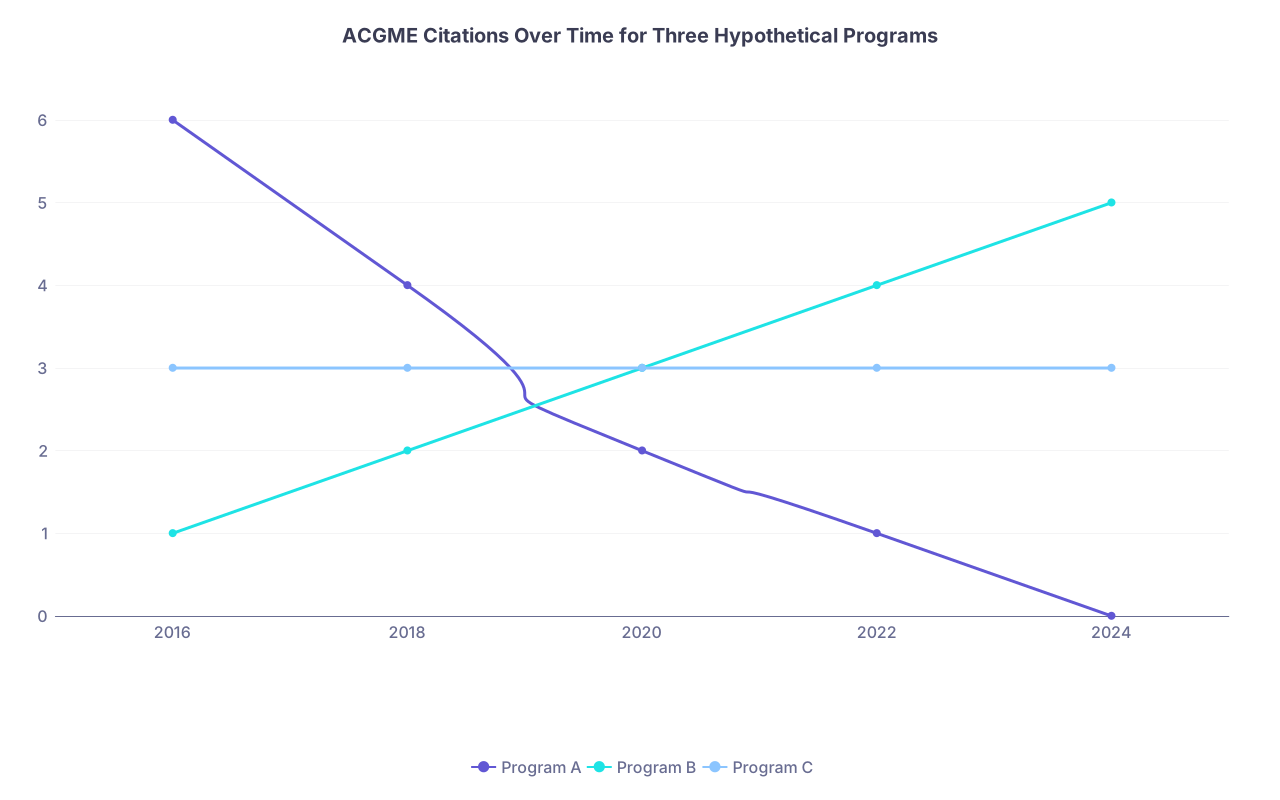
| Category | Program A | Program B | Program C |
|---|---|---|---|
| 2016 | 6 | 1 | 3 |
| 2018 | 4 | 2 | 3 |
| 2020 | 2 | 3 | 3 |
| 2022 | 1 | 4 | 3 |
| 2024 | 0 | 5 | 3 |
- Program A: History of problems but improving steadily. This can be a perfectly reasonable choice, especially if you’re seeing evidence of real change (new PD, revamped curriculum, better survey results).
- Program B: Accumulating new issues each cycle. That’s a trajectory problem.
- Program C: Chronic low‑grade dysfunction that never really improves. Might feel “fine” day‑to‑day but you’re probably signing up for constant low‑level frustration.
When you talk to programs, you’re trying to figure out which trajectory you’re walking into.
How to Actually Use ACGME Info as an Applicant
The ACGME does not post a public “citation list” for each program with juicy detail. You usually only see:
- Accreditation status (Continued, Initial, Probationary, etc.)
- Cycle length / site visit timing
- Major public actions (probation, withdrawal)
So how do you get meaningful intel without access to the full internal letter?
You use three levers: questions, pattern‑matching, and current residents.
1. Ask About Changes, Not “Do You Have Citations?”
Asking a program on interview day, “Do you have ACGME citations?” is a rookie move. They’ll default to a canned response.
A better approach:
- “What were the main areas ACGME asked you to work on in your last review?”
- “What changes have you made in the last 2–3 years based on resident feedback or ACGME input?”
- “Are there any areas right now that you consider ongoing work in progress?”
Then shut up and listen. A defensively vague answer is telling. A specific, concrete, “we were cited for X, so we did Y and Z” is a good sign.
Good programs are weirdly transparent about this. They’ll say things like:
- “We were hammered on inadequate ambulatory exposure five years ago. We added a second clinic site, hired two more faculty, and restructured PGY‑2 clinic time.”
- “Our survey scores on feedback were bad. Now we require formal mid‑rotation feedback and audit it.”
That’s not a red flag. That’s how improvement actually happens.
2. Cross‑Check With Resident Survey Signals
You can’t see full survey results, but residents live them.
Ask current residents (especially juniors):
- “What were the biggest concerns residents had in the last ACGME survey?”
- “Have those improved since you started?”
- “Anything people complain about every year that never changes?”
If they describe the same issue year after year with no progress—especially around duty hours, safety, or case volume—that’s likely reflected in ACGME concerns too.
3. Watch for Structural Vulnerabilities
You can often infer where citations might be:
- New program director in the last 1–2 years?
- Ask what prompted the change. Sometimes it’s exactly because the prior PD failed to fix cited issues.
- Rapid program expansion?
- Ask how they’ve adjusted supervision and faculty numbers. Growth with no infrastructure is a magnet for citations.
- Merge, hospital buyout, or system change?
- Transitions often generate “paperwork” citations. The question is whether residents are actually suffering or if it’s mostly admin chaos in the background.
When Citations Are a Dealbreaker
Let me draw a harder line, since nobody else will.
You should strongly consider avoiding or ranking low a program if:
The program is on probation or just came off probation with continued talk of “ongoing challenges,” especially around:
- Case volume
- Board pass rates
- Supervision/safety
Residents independently (not in front of faculty) say some version of:
- “We’ve complained about this to ACGME for years, nothing ever changes.”
- “We keep getting in trouble for duty hours but they just tell us to ‘document better.’”
- “We had ACGME here last year and leadership told us not to ‘overdramatize’ on the survey.”
There’s clear leadership denial:
- Minimizing survey feedback
- Blaming residents for “not being resilient enough”
- Hand‑waving about citations as “just politics” without any specific action plan
Those are not “fixable flaws.” That’s a program that treats ACGME oversight as an enemy rather than a quality lever. You will not win that fight as a PGY‑1.
When Citations Are Just Growing Pains (And Maybe a Good Sign)
Here’s the contrarian piece: a program actively wrestling with citations can be a better training environment than a sleepy, “no noted issues” shop that coasts.
Signs that citations are more of a fixable flaw than a fatal flaw:
- Program leadership talks openly about what ACGME flagged.
- There’s concrete evidence of change: new rotations, better call structure, added faculty, new wellness policies.
- Residents—even if they’re still annoyed—say something like, “It’s better than when I started; they actually listen to us now.”
I’ve seen programs that were borderline disasters ten years ago become excellent because ACGME and resident pressure forced a rebuild. Would I send someone there in the middle of the storm? Maybe not. But catching a program two or three years into an honest rebuild can give you strong training and a voice in shaping how things evolve.
That’s not for everyone. But pretending those programs are automatically “worse” than legacy big‑name programs with hidden dysfunction is naïve.
Future Direction: ACGME Scrutiny Is Increasing, Not Decreasing
The other reality: this is not going away. Expect more data‑driven oversight, not less.

| Step | Description |
|---|---|
| Step 1 | Resident Experience |
| Step 2 | Resident Survey |
| Step 3 | ACGME Review |
| Step 4 | Area for Improvement |
| Step 5 | Citation |
| Step 6 | Warning or Probation |
| Step 7 | Program Action Plan |
| Step 8 | Changes in Training |
| Step 9 | Concern Found |
Programs that take this loop seriously will show periodic citations. It’s how you know the system is actually doing something. Programs that treat surveys as a nuisance, silence residents, or manipulate responses might look “cleaner” on paper—for a while—but that’s not where you want to be.
If anything, I expect:
- More transparency around key metrics (board pass rates, case volume, survey domains) pressured by applicants and national bodies.
- Increasing use of longitudinal data flags that trigger citations earlier.
- Growing tension between service demands and education, especially in community and safety‑net hospitals. That’s where you’ll see duty hour and supervision citations cluster.
You can either understand this landscape or pretend it’s simple. Only one of those strategies protects you.
How to Sanity‑Check a Program in Under 10 Minutes
If you do not have time for a deep dive, here’s a ruthless, fast approach to using the “citations” concept correctly without seeing the actual ACGME letter.
Look at:
Accreditation status and history
- Any recent probation? Warning? Rapid PD turnover?
Board pass rates and case volume (often discussed on interview day or on program websites)
- Consistently above thresholds? Or hiding the numbers?
Resident responses during interviews
- One‑off complaints are normal. Repeated, consistent themes about unaddressed problems are not.
How leadership talks about change
- Defensive and vague vs. specific and data‑driven.
That tells you more about how a program handles citations than the raw count ever will.
The Short Answer You Actually Wanted
Citations are neither automatic dealbreakers nor meaningless noise. They’re a tool—and a clue. Here’s the bottom line:
- ACGME citations are only a red flag when they’re chronic, tied to safety/education fundamentals, and met with denial or inaction.
- A thoughtful pattern of “we had problems, we were cited, we fixed them” is not a weakness; it’s evidence of a program that’s actually responsive.
- You should care far more about the trajectory of a program and how leaders and residents talk about past issues than about whether some ACGME bureaucrat once wrote them up for something.
If you stop treating “citations” as a binary yes/no and start treating them as a window into culture and accountability, you’ll make much smarter ranking decisions than 90% of your peers.