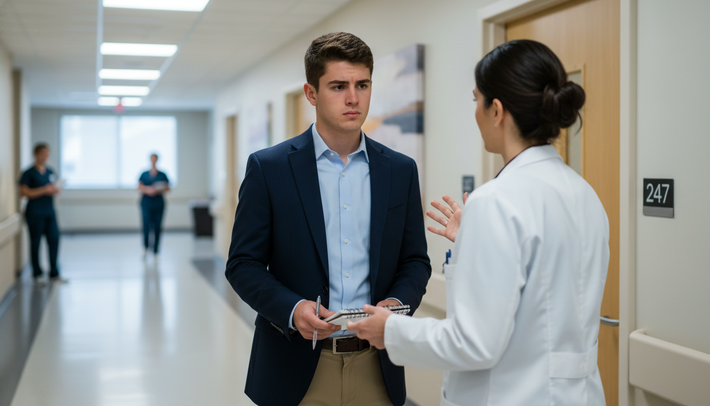
It’s 7:45 AM and you’re standing outside the clinic or OR in your too-stiff business casual, badge flipped backward, wondering if they can see your heart pounding through your shirt.
You’re praying today’s shadowing is “just clinic,” and not procedures. No laceration repairs. No bone marrow biopsies. Definitely no surgeries. You told yourself it would be fine, but now you’re replaying that one time in high school you almost fainted during a blood draw. Or that YouTube surgery video you had to pause after 10 seconds because your vision started to tunnel.
(See also: What If I Felt Uncomfortable During Shadowing? Will Schools Judge Me? for more details.)
And the thought keeps pounding in your head:
“I’m scared of blood. I get woozy during procedures. Does that mean I can’t be a doctor?”
Let’s just say it out loud: you’re terrified this one thing disqualifies you from the career you’ve wrapped your entire identity around.
First: You’re Not The Only One (Even If It Feels Like It)
You look around at other premeds and they all seem… weirdly fine. They brag about sitting through 8-hour surgeries. They gush about watching a chest tube placement “up close.” Meanwhile, you’re just trying not to black out when someone mentions “incision” in too much detail.
It feels like some secret test you’re failing before you even get into med school.
But here’s the thing no one advertises on their premed Instagram:
- A lot of future doctors feel faint around blood or needles at first.
- Some medical students actually pass out in the OR. Like, fully hit-the-floor pass out.
- Many attending physicians will openly admit they used to be squeamish.
They usually just don’t lead with that on their “How I matched derm” posts.
There’s a huge difference between:
- “Blood and procedures make me anxious, I feel lightheaded, and I’m scared this means I can’t do it”
vs. - “I have a deep, permanent aversion to medicine and I never want to be around any of this.”
Most people in the first group. Very, very few in the second.
You’re probably in the first group and catastrophizing it into the second.
What’s Actually Happening When You Feel Faint
Let me normalize this in a very un-glamorous, un-Instagram way.
A lot of people who get lightheaded around blood or procedures have something called vasovagal syncope or near-syncope. That’s just a fancy way of saying your body:
- Sees something stressful
- Your nervous system goes “NOPE”
- Heart rate and blood pressure drop
- You feel dizzy, nauseous, sweaty, tunnel vision, or you actually faint
This doesn’t mean you’re “too weak” for medicine. It means your autonomic nervous system is overreacting to a trigger.
And honestly? Medicine is full of people whose bodies overreact at first.
Plenty of students:
- Almost pass out the first time they see a lumbar puncture
- Get queasy watching an intubation
- Feel weak watching an open fracture reduction
The part you don’t see is that by the tenth time, the same students are holding the retractor or drawing the blood. The anxiety response calms down as their brain goes, “Oh, I guess we don’t die every time we see blood.”
Your reaction right now isn’t a permanent character trait. It’s your nervous system getting hit with something new.
“But What If I Never Get Over It?”
This is the nightmare loop, right?
You imagine: you get into med school (after all of the agony), you step into your first anatomy lab or your first surgery rotation, you faint, everyone judges you, rumors spread, and eventually someone pulls you aside and says, “You don’t belong here.”
Let’s reality-check this.
Common scenario that actually happens:
- MS1 walks into anatomy lab. Smell + visuals hit. They get pale. They sit down. Faculty or TAs give them juice and crackers. It’s treated as completely normal.
- MS3 goes into first OR. Watching the draping is fine. First incision is made, they feel sweaty and lightheaded. They tell the scrub nurse, step out, sit down, breathe. Surgeon later says, “Happens all the time. Let’s try again tomorrow.”
I wish you could hear how casually attendings talk about students or residents who’ve fainted. It’s not some career-ending event; it’s more “Well, we’ve all been there.”
The question that matters isn’t “What if I never get over it?” It’s closer to, “Am I willing to keep exposing myself slowly and safely until it gets better?”
For most people, it does get better with:
- Repeated exposure
- Thoughtful preparation
- Basic strategies to manage the physical response
Not overnight. Not magically. But steadily.
Shadowing When You’re Scared of Blood: How To Survive Without Humiliating Yourself
This is what you’re really worried about, right? Not some theoretical MS3 year. You’re worried about tomorrow when you’re expected to stand there and “observe” and your body might completely betray you.
A few concrete strategies you can actually use:
1. Tell the physician or resident before things start
I know you want to hide it. But quietly falling over in the corner of the OR is 100x more dramatic than saying one simple sentence at the start.
You can say something like:
“Just so you know, I’m still getting used to procedures and blood. Sometimes I get a little lightheaded, but I’m working on it. If I step out for a minute, that’s why – I don’t want to be a distraction.”
Most physicians will:
- Respect your self-awareness
- Keep an eye on you
- Offer you a seat if it’s a longer procedure
- Check in with you after
No one is thinking, “Wow, this premed clearly shouldn’t be a doctor.” They’re thinking, “Ah, normal human nervous system. Seen it a hundred times.”
2. Don’t lock your knees and don’t starve yourself
Very un-sexy, but very real.
You’re much more likely to faint if:
- You’re standing still for long periods with your knees locked
- You skipped breakfast because you were anxious
- You’re dehydrated
Eat something with actual carbs and a bit of protein before you go. Drink some water. If you have a tendency to get faint with blood draws or shots, consider salty snacks beforehand.
When you’re standing:
- Shift your weight
- Move your legs a bit
- Flex your calves (this keeps blood moving back up)
No one cares if you’re doing tiny leg movements in the corner of the room.
3. Look away before you feel bad
You don’t get extra “premed points” for staring directly into a gaping wound when your vision is already dimming.
Safe, sane approach:
- If a part of the procedure is too intense, let your eyes drift to something less graphic (monitor, hands, drapes)
- If you start to feel off – hot, nauseous, lightheaded – step back and quietly say, “I’m feeling a little lightheaded, I’m going to sit down for a second.”
That’s not weakness. That’s protecting the sterile field and not becoming a second patient.
4. De-sensitize gradually
You don’t have to go from queasy-with-needles to loving open-heart surgery in one step.
You can build up:
- Start with clinic visits: listening to heart and lungs, physical exams
- Then minor procedures: suturing a small cut, joint injections (from a bit of distance at first)
- Then more intense things: OR shadowing for short cases, sitting at the back to start
Each time you survive one, your brain files it under “scary but safe.” Little by little, your threshold changes.
Can You Be a Doctor If You Never Love Procedures?
This is the other fear hiding underneath: not just “Can I tolerate blood?” but “Do I have to love procedures and surgery to belong in medicine?”
No. You absolutely don’t.
Medicine is huge. Not every path is trauma surgery at 2 AM.
Real things doctors do with minimal procedural/bloody exposure:
- Psychiatry (yes, you’ll see some medical stuff, but procedures are minimal)
- Pathways in preventive medicine, public health, health policy
- Some non-procedural internal medicine roles (hospitalist/clinic heavy, procedures done by others)
- Non-procedural pediatrics roles
- Radiology (you’ll deal with patients and sometimes procedures, but the “blood and guts” aspect is different)
- Pathology (you’re with specimens, not live surgery—some people find this easier, some harder)
You will still go through anatomy, clinical skills, maybe some core procedures in training. You may watch surgeries. You’ll definitely see blood as a doctor, even in the least procedural fields.
But you don’t have to seek out the most graphic, invasive specialties. You don’t have to match into trauma surgery to “prove” you’re a real physician.
What matters more is:
- Are you willing to learn to manage your reaction enough to function safely?
- Do you care about patients enough to tolerate some discomfort as you grow?
When Is It Actually a Red Flag?
You’re probably assuming your situation is a huge red flag. Honestly, in most cases it’s not.
But there are moments where it’s worth pausing and really reflecting:
- If you feel intense dread every single time you’re in any clinical setting, not just during procedures
- If even thinking about touching patients, hearing about illness, or entering a hospital makes you panic
- If your reaction isn’t improving at all with repeated exposure, preparation, or coping strategies
- If the idea of doing any physical exam, ever, makes you sick to your stomach
That may mean a couple things:
- Maybe medicine isn’t the right fit, and that is painful but valid
- Or maybe there’s underlying anxiety, trauma, or phobia that can be helped with therapy and structured exposure
Talking to a mental health professional about this doesn’t automatically mean “you’re out.” It can actually be what helps you stay in and function.
The red flag isn’t “I get woozy at blood.” The red flag is “I’m in persistent, paralyzing distress around the entire idea of clinical care and I’m forcing myself anyway because I don’t know who I am without medicine.”
How This Looks in Real Life: Not-Perfect People Who Made It
You rarely hear these stories out loud, so here are some that are more common than you’d think:
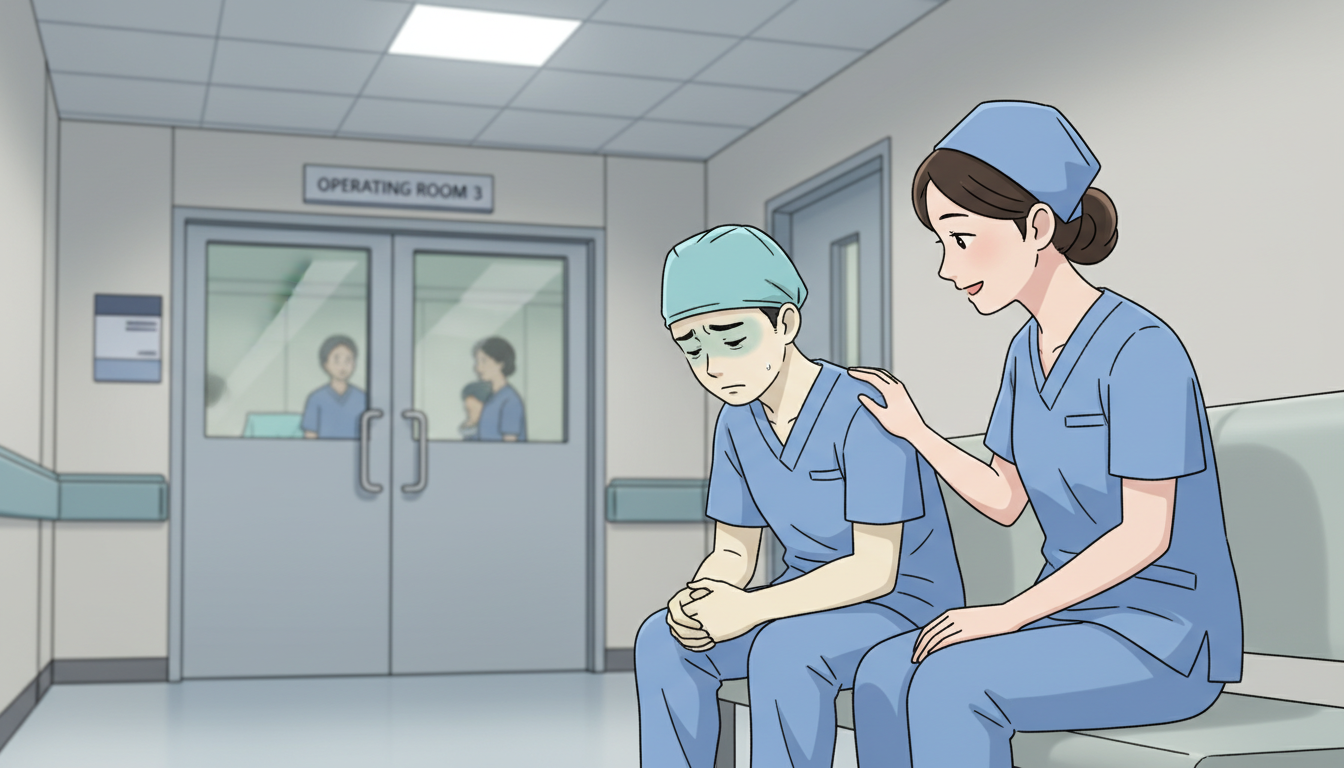
- A med student faints second week of anatomy next to the cadaver table. Everyone pauses, they help them up, move them to a chair with some juice. The following week, that same student comes back, stands a little farther away at first, and gradually moves closer. By the end of the semester, they’re dissecting like everyone else.
- A premed shadows in the OR, sees the first incision of a C-section, nearly goes down. They step out, embarrassed. The attending later says, “Happens all the time. Try again next month. Stand at the back for 10 minutes and then step out.” Eventually that student is closing incisions on their own patient as a resident.
- An internal medicine resident is open about never loving procedures. They do what they have to do to train safely, but choose a hospitalist job later where most procedures are covered by a dedicated procedure team. They still absolutely count as a real doctor.
You’re holding yourself to this impossible standard: no squeamishness, ever, day one.
That’s just not how human beings work.
So… Can You Still Be a Doctor?
If your situation is something like:
- “I get nervous, lightheaded, sweaty around blood or procedures, especially when I’m not used to it”
- “I’m scared to go shadow because I don’t want to faint or look weak”
- “I worry this reaction means I’m fundamentally unfit for medicine, even though I want to help patients”
Then yes. You can still be a doctor.
You will probably:
- Need to be honest with yourself and with supervisors about how you’re feeling
- Need to slowly expose yourself to more clinical/procedural settings over time
- Need to learn tangible tricks to manage vasovagal responses (food, hydration, movement, breathing, looking away briefly)
- Need to accept that the first few times might be uncomfortable, and that this doesn’t equal failure
The people who worry about this the most are often the ones who care deeply and hold themselves to a crushing standard. You fear that any sign of weakness means you’re an imposter.
Medicine isn’t made of superheroes who were born immune to human reactions. It’s made of regular people who learn, adapt, and grow.
You don’t have to be fearless. You just have to be willing.
FAQ (Exactly 5 Questions)
1. Should I even mention my squeamishness in a personal statement or interview?
Usually, no. There’s no real benefit to leading with, “I’m scared of blood,” in an application context. Admissions committees want to know that you understand medicine realistically and can handle its demands, not that you have an unresolved worry that might distract from your strengths. If it comes up organically (for example, you once fainted in anatomy but used that to grow, seek help, and now function well), it could be framed as a growth story. But don’t center your whole narrative around it.
2. What if I actually faint during shadowing – is my career over?
No. It’s embarrassing in the moment, but clinically it’s… very normal. Tell the staff if you start to feel off, sit or lie down, and let your body recover. If you’re worried, email the physician afterward thanking them for the opportunity and briefly acknowledging what happened (“I really appreciate your understanding; I’m still getting used to the environment and I’m working on it.”). That shows maturity and insight, not weakness. No one is calling med schools to blacklist you.
3. Should I avoid all OR or ER shadowing because I’m scared?
Avoiding it completely often strengthens the fear long term. Instead, you can plan controlled exposure. Let the physician know you’re nervous, stand at the back, and tell yourself you can step out whenever you need. Maybe start with shorter cases or less invasive procedures. Your goal isn’t to turn into someone who loves guts overnight; it’s to prove to your brain that you can be present without falling apart.
4. Could this mean I’m not actually “meant” to be a doctor?
Not automatically. Being a doctor is about a lot more than tolerating blood: thinking through complex problems, communicating with patients and families, handling uncertainty, working in teams. Many incredible physicians started off squeamish. What would be more concerning is if you consistently dread everything about patient care, not just procedures, and that dread doesn’t get better with support or exposure. That’s when deeper reflection (ideally with a counselor or advisor) makes sense.
5. What can I do right now to test whether this is something I can work through?
You don’t need a full OR day to start. You can: watch a very mild medical video (like a simple physical exam) and notice your reaction, then gradually move up to a basic procedure video; schedule a standard blood draw for yourself and pay attention to what helps (looking away, deep breathing, having a snack after); or ask to shadow in a low-intensity clinic setting first. Each small, safe exposure gives you data: do you recover? Does it get a little easier next time? That pattern is often a better predictor of your future in medicine than one dramatic fainting episode.
Open your calendar right now and pick one low-stakes clinical exposure you can schedule in the next 2–3 weeks—a short clinic shadowing session, a lab tour, even just a visit to a hospital volunteer office. Put it on the calendar, and decide one concrete coping strategy you’ll practice during it. That’s how you start proving to yourself that this fear doesn’t get to decide your entire future.