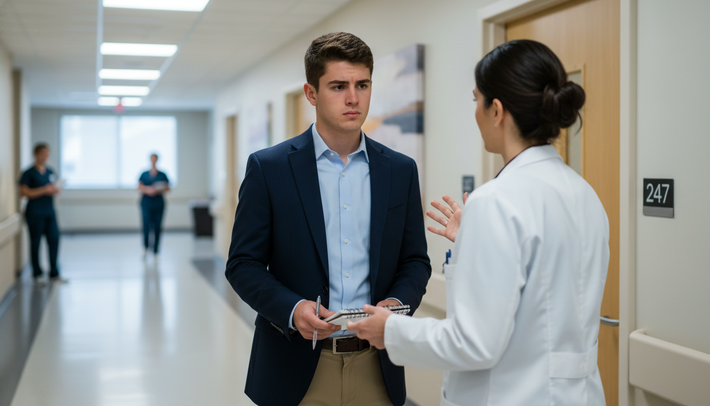
Your lack of shadowing hours is not the death sentence it feels like right now.
I know that voice in your head is screaming: “Everyone else has 200+ shadowing hours and hospital volunteering and I have…nothing. AMCAS opens in a few weeks. I’m done. I ruined this.”
(See also: What If I Say Something Wrong in Front of a Patient While Shadowing? for more insights.)
You didn’t ruin anything.
But you do need a plan.
Let’s walk through what this actually means, what’s salvageable, and what’s just your anxiety trying to convince you your dream is over when it’s really…not.
First: Are You Actually “Behind” or Just Panicking?
Let’s be brutally honest for a second.
Medical schools don’t secretly meet on Zoom and say, “Reject anyone who doesn’t have exactly 100+ shadowing hours in three specialties and a handwritten letter from a neurosurgeon.”
That’s the fantasy we create in our heads. The reality is a lot messier and much more flexible.
But I get it. Your brain is probably going:
- “Everyone on Reddit has 300+ clinical + 100 shadowing.”
- “I’m the only idiot who waited this long.”
- “No shadowing = they’ll assume I don’t know what being a doctor is actually like.”
The last one is the only semi-legit concern.
Schools do want evidence that you understand the realities of medicine beyond Grey’s Anatomy. Shadowing is one of the easiest, simplest ways to show that.
But it’s not the only way.
Here’s the uncomfortable truth though: if your application opens in, say, 2–3 weeks and you have genuinely zero:
- shadowing
- clinical experience (scribing, EMT, MA, CNA, hospice, etc.)
- or sustained patient-facing volunteering
then yes, you are at a disadvantage.
Not doomed.
Not “dream is over.”
But you’re signing up for a harder road.
The question becomes: do you submit this cycle anyway, or pivot fast and start damage control?
What Med Schools Actually Care About (Beyond the Panic)
Schools aren’t counting hours like it’s an attendance sheet. They’re asking:
Do you understand what doctors actually do?
Not just saving lives, but charting at 10pm, dealing with insurance, having difficult conversations, watching patients decline.Have you seen this up close?
Not necessarily for 500 hours, but enough that your decision to pursue medicine feels grounded in reality.Can you reflect on those experiences?
“I loved helping people” is weak.
“Watching a family struggle with end-of-life decisions showed me…” — that’s reflection.
Shadowing is the easiest shorthand signal for “yes” to those questions.
But clinical work, hospice, scribing, MA, EMT, patient transport, crisis line volunteering — all of that can speak even louder.
So if you have no shadowing but solid clinical? You’re anxious, but probably okay.
If you have neither? That’s where this starts to get serious.
Different Scenarios: Where Do You Actually Fit?
Let’s break this into buckets. Be ruthless with yourself about which one you’re in.
1. No Shadowing, But You Do Have Clinical Experience
Example:
- 600 hours as an ER scribe
- 300 hours as a CNA
- 1 year of MA in primary care
- Long-term hospice volunteer
If this is you: your anxiety is louder than the problem.
Most admissions committees would rather see real, hands-on clinical work than 30 hours of trailing a doctor silently through hallways.
You still should try to add some shadowing if possible (even 15–30 hours across a couple of specialties), but your application is not sinking just because you don’t have a classic “shadowing” line.
What you must do:
Talk in your personal statement and secondaries about:
- specific patient interactions
- what you observed about physicians’ roles
- the emotional and ethical complexity of healthcare
Don’t just say you learned “teamwork and communication.” That’s every applicant.
Talk like someone who’s actually been in real clinical spaces, even without formal shadowing.
2. No Shadowing, No Clinical, But Apps Don’t Open For a Few Months
This is stressful but fixable.
If you’re, say, 3–6 months from submitting:
- You can realistically get 30–50 hours of shadowing if you start this week
- You can start a sustained clinical role — maybe not hundreds of hours before you submit, but enough to show active commitment
Most adcoms care less about “How many hours on day 1 of submission?” and more about “Is there a clear trajectory that’s still ongoing?”
You might still feel behind compared to the imaginary “perfect” applicant in your head. But if you start now, your story becomes:
“I realized I was headed toward medicine on a more traditional academic route, but I actively sought out clinical exposure in the months before applying. Since then, I’ve been consistently working with patients, learning…”
That’s not a red flag. That’s growth.
3. No Shadowing, No Clinical, and You’re Submitting in Weeks
This is the nightmare scenario your brain keeps looping.
Applications about to open. MCAT probably done. GPA decent. But your clinical and shadowing section is…basically empty.
You’re probably thinking:
“If I don’t apply this cycle, I’ll be ‘behind.’ But if I do apply, they’ll reject me for sure.”
This is where it becomes a really personal, strategic decision.
Let’s be painfully real:
Submitting with no meaningful clinical or shadowing is a huge risk. Some schools will more or less auto-screen you out, no matter how great your stats are. Not out of cruelty, but because they’re afraid you’ll get 2 years into med school and realize you hate clinical practice.
What you can do in this scenario:
Scramble for any legitimate clinical or shadowing experience starting now.
Even a few honest hours shadowing across a couple of specialties is better than zero.If possible, delay submission a bit (not 6 months, but a few weeks) to at least start something. You can update schools later with ongoing experiences.
Decide whether this needs to be a growth year instead of a panic submission year.
The Hard Question: Should You Even Apply This Cycle?
This is the part no one wants to talk about, because everyone’s terrified of “wasting a year.”
But what’s actually worse?
- Applying this cycle with no shadowing, no clinical, getting mostly rejections, burning time, money, and emotional energy
or - Taking 1 year, getting 500+ hours of meaningful clinical work, 40–60 hours of shadowing, stronger letters, more maturity, and applying once with a story that actually makes sense?
Admissions committees very much can see growth between cycles. They don’t secretly blacklist reapplicants. In many cases, they prefer someone who clearly grew, gained clinical exposure, and came back with a stronger, well-grounded purpose.
Your anxiety says: “If I delay, everyone will be ahead of me. I’ll be 25, 26, 27 before I’m a doctor, and that’s too old.”
You will see 30-year-olds starting med school. 40-year-olds, even.
No one at that point is thinking about “falling behind.” They’re thinking, “Thank God I’m where I actually want to be.”
How to Get Shadowing Fast (Without Being Sketchy)

If you’re in emergency mode, your brain is probably going, “No doctor will answer me. Hospitals won’t let me in. It’s impossible.”
It’s not impossible. It’s just deeply uncomfortable and rejection-heavy.
Some concrete approaches:
Start with anyone you have even a 1% connection to.
Friend’s parent, your own PCP, a specialist you’ve seen, a professor who used to practice, the urgent care doc you met last month. You’re not asking for a 6-month internship. You’re asking:
“Would it be possible to shadow you for a day or two to better understand what your work is actually like?”Cold email clinics, not just big hospitals.
Private practices, community clinics, FQHCs, primary care offices — they often have more flexibility than giant academic centers drowning in policies.Be specific and small in your ask.
Instead of “Can I shadow you long-term?”
Try: “Would you ever allow a premed student to shadow you for a single morning or afternoon?”
Once you’re in once, it’s much easier to be invited back.Leverage student organizations.
Premed clubs, AMSA chapters, minority premed groups — a lot of them have established pipelines for shadowing or physician talks.
You don’t need 100 hours next week. You need to show that you’re starting, that you care enough to push through some awkwardness and uncertainty.
And be honest in your applications:
If you started shadowing in May and submitted in June, that’s okay. You’re allowed to be someone who realized late and then genuinely committed.
If You Truly Can’t Shadow (At Least Right Now)
Some people are in locations or situations where shadowing is extremely hard:
- Rural areas with few physicians
- Post-COVID policy-heavy hospitals
- Family obligations, financial constraints, limited transportation
If that’s you, focus on clinical and patient-facing roles that you can access:
- Medical assistant
- CNA
- ER tech
- Scribe
- Hospice volunteer
- Crisis hotline volunteer
- Patient transport in a hospital
- Community health worker roles
Then in your applications, be transparent:
“Shadowing opportunities in my area were limited due to X and Y, so I sought out patient-facing work where I could directly participate in care and observe physicians as part of a broader team.”
Adcoms aren’t heartless. They don’t live in a fantasy world where everyone has a Level 1 trauma center next door and a physician parent on speed dial. Context matters.
But they won’t know your context unless you tell them.
How to Talk About Late or Limited Shadowing in Your Application
This is where your anxiety will try to sabotage you into sounding apologetic and weak.
Don’t write:
“I know I should have gotten more shadowing, but I was busy and then time passed and I didn’t realize.”
Instead, frame it as:
- Awareness: You realized you needed real-world exposure.
- Action: Once you realized that, you acted.
- Reflection: You learned specific, concrete things about medicine.
For example:
“During my senior year, I recognized that understanding medicine required more than coursework. I began shadowing a family physician, Dr. X, and watched her balance 15-minute appointments with complex psychosocial realities. In one visit, she spent most of the time helping a patient navigate housing insecurity rather than adjusting medications. Experiences like this challenged my assumption that medicine was primarily about diagnosis, and showed me how physicians advocate for patients in non-clinical ways.”
That’s deeper than “I saw cool surgeries and I liked how the doctor explained things.”
Even limited shadowing can be powerful if the reflection is thoughtful.
Your Dream Isn’t Over. But It Might Need a Different Timeline.
This is the part your anxious brain won’t like:
You might have to let go of the timeline you’d built in your head.
The one where you go straight from college → med school → residency without a gap. The one where you never have to tell people, “I’m working as a scribe this year” instead of “I’m starting med school this fall.”
But your dream of becoming a doctor? That’s not over. Not because you’re missing shadowing hours in April of your application year.
We’ve turned “gap years” into some weird symbol of failure when for a lot of people, they’re the difference between a lukewarm, rushed application and a powerful, grounded one.
You’re allowed to say:
“I’m not ready to apply yet. I want to actually understand what this career looks like before I commit the next decade of my life to it.”
That doesn’t make you weaker. It makes you safer — for yourself and, honestly, for your future patients.
Years from now, you won’t be thinking about whether you applied in 2025 or 2027. You’ll be thinking about what kind of physician you became and whether you built that on a solid, honest foundation.
FAQ (Exactly 6 Questions)
1. Will med schools automatically reject me if I have zero shadowing hours?
Not automatically, but you’re taking a big risk. Some schools have explicit or implicit expectations of shadowing or at least clear physician exposure. If you also lack clinical experience, your chances drop significantly because they can’t tell if you understand medicine in practice. If you have strong, hands-on clinical work, the absence of formal “shadowing” is less damaging, but you should still try to add some if you can.
2. Is it worth applying this cycle if I can only get like 10–20 hours of shadowing before I submit?
It can be, if you already have solid clinical experience and the rest of your app is strong. Those 10–20 hours at least show you’ve started and are currently engaged. If you have neither clinical nor shadowing and are banking on 10 hours next month to fix it, you’re probably better off waiting a cycle and building a much stronger foundation rather than submitting a weak, rushed application.
3. Can virtual shadowing or webinars count for anything?
Virtual shadowing is generally seen as supplemental, not a substitute. It can help you articulate some understanding of the field, but it doesn’t replace being physically in a clinical space, seeing workflow, and observing real patient-physician interaction. You can list it under experiences if it’s structured and legitimate, but don’t rely on it as your only form of exposure unless you truly have no other option — and then explain your circumstances.
4. What if I’ve done non-clinical volunteering for years (tutoring, shelters, etc.) but no clinical or shadowing?
That shows you’re compassionate and service-oriented, which is good, but it doesn’t show you understand medicine. Adcoms won’t see that as interchangeable. You still need clinical or at least strong healthcare-adjacent exposure. The upside: your non-clinical service will pair nicely with new clinical work once you start; it shows consistency in caring about people, which you can build on in your narrative.
5. How late is “too late” to start shadowing before applying?
There’s no official cutoff. Starting in the months before you apply is actually pretty common. What matters is: did you start, are you continuing, and can you reflect meaningfully on what you’ve seen? If your experiences start right before you submit, you may need to use update letters or secondaries to show that your involvement is ongoing. But “late” is better than “never” — and thoughtful reflection can partially compensate for lower hours.
6. Will taking a gap year just to get shadowing and clinical experience make me look weak?
No. When done intentionally, it makes you look more mature. If you spend that year getting substantial clinical experience, real shadowing, and maybe some extra growth (research, community work, or just working to support yourself), you’ll often look stronger than the rushed straight-through applicant. Med schools see applicants all the time who needed another year to be ready. They’re much more concerned about people who apply without understanding what they’re signing up for than those who took time to figure it out.
Years from now, the thing that will matter isn’t whether you shadowed “on time” — it’s whether you had the courage to face this uncomfortable moment honestly and choose the path that actually serves your future self, not just your current fear.