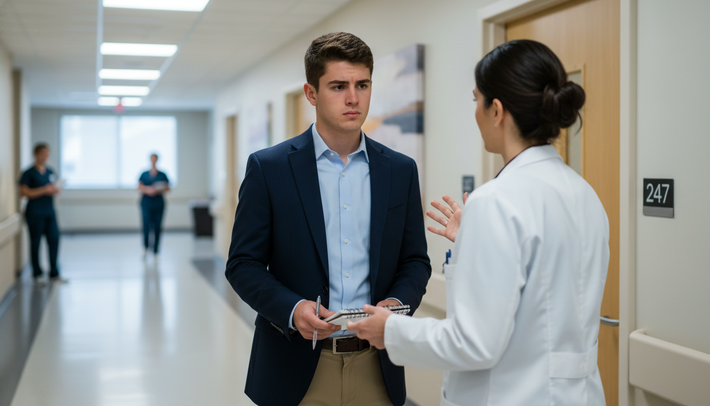
You are standing just inside the doorway of a clinic exam room. The attending has just finished explaining a new diabetes diagnosis to a patient. The visit flows smoothly, the patient nods with relief, and everyone stands to leave. You want to say “It was nice meeting you, good luck with everything,” but you hesitate. That does not sound like what the physician just said.
This is the gap you are starting to notice while shadowing: you know how to talk to people, but you do not yet have the professional language of medicine. The phrases, the structure, the tone. The things that make a premed sound like a future colleague instead of “the college student who’s here to observe.”
Let me break this down specifically: you can start building that language now, by deliberately mirroring the right phrases while you shadow.
The Core Principle: “Mirroring” Without Pretending To Be The Doctor
Before the phrases, you need the rule that will keep you out of trouble.
You are not there to speak as the physician. You are there to speak in the orbit of the physician’s language, while staying firmly in your role: observer, learner, aspiring professional.
“Mirroring” in this context means:
- Matching the formality level of the physician’s language
- Adopting structure and wording that signal professionalism
- Using safe, role-appropriate phrases you can say as a student
- Avoiding medical advice, management decisions, or documentation that implies responsibility
You want staff and patients to think, “This person is clearly early in training, but they already sound like they belong here.”
So for every situation, we will build:
- What not to say (common informal or risky phrases)
- A “baseline professional” version (safe, neutral)
- A “more advanced” version you can grow into (especially in later premed or early medical school stages)
We will walk through key phases of a shadowing day and plug in phrases you can literally rehearse before you go.
Introducing Yourself: Hallways, Nurses’ Stations, and Exam Rooms
You will introduce yourself dozens of times in one shadowing block. Most students improvise each time and end up sounding inconsistent. Better to have 2–3 stock phrases ready.
Introducing yourself to staff
What many students say:
- “Hi, I’m [Name], I’m shadowing today.”
- “Hey, I’m with Dr. Smith.”
- “I’m a premed, I’m just kind of here following people around.”
That language undersells you and sounds casual or unsure.
Baseline professional:
- “Hi, I am [First Last]. I am a premed student shadowing Dr. Smith today.”
- “Good morning, I am [First Last], a visiting student observer with Dr. Lee.”
- “Hello, I am [First Last]. I am here as a premedical observer with Dr. Patel’s team.”
More advanced (especially once you have some experience):
- “Good morning. I’m [First Last], a premedical student from [University], shadowing on the internal medicine service today.”
- “Hi, I am [First Last]. I am exploring primary care and will be observing with Dr. Chen this week.”
Notice the structure: greeting → full name → role → connection to the physician/team. No apologies for being there. No self-deprecating “just a premed.”
Introducing yourself to patients
This is where wording matters even more. You must not imply that you are a medical student or part of the treating team if you are not.
What you should avoid:
- “Hi, I’m [Name], I’m a med student.” (if you are not)
- “I’m working with Dr. Smith today.” (sounds like clinical responsibility)
- “I’ll be helping out.” (overstates your role)
Baseline professional for premeds:
- “Good morning, I am [First Last]. I am a premedical student shadowing Dr. Smith today. Is it alright with you if I stay and observe?”
- “Hello, my name is [First Last]. I am a college student interested in medicine who is observing with Dr. Rodriguez. Would you be comfortable with me being here during your visit?”
Two critical elements:
- State clearly that you are a student and observer
- Explicitly ask permission for your presence
More advanced variants:
- “Hi, I’m [First Last]. I am a premedical student spending some time with Dr. Ahmad to learn more about cardiology. If you prefer, I can step out during the visit.”
- “Good afternoon, my name is [First Last]. I am a visiting observer interested in pediatrics. I am here to watch and learn from Dr. Chen, if you are comfortable with that.”
You are already mirroring professional structure: full introduction, role disclosure, patient autonomy built into your phrasing.
Small Talk That Sounds Professional, Not Awkward
You will often be alone with a patient while the physician steps out briefly. This is where many premeds either say nothing or slip into casual chatter.
You want to occupy a narrow lane:
- Friendly, human
- No clinical advice
- No promises or speculation about outcomes
Phrases to avoid:
- “I’m sure everything will be fine.”
- “Wow, that sounds really scary.”
- “Honestly, if it were me, I’d…”
- “Yeah, that doesn’t sound too serious.”
These may feel empathetic, but they step into reassurance or interpretation you cannot provide.
Baseline professional small talk:
- “How has your day been going so far?”
- “Were you able to find the clinic easily today?”
- “How long have you been coming to this clinic?”
- “Do you live close by, or did you have to travel a bit to get here?”
Safe, relationship-building, but not clinical.
More advanced, lightly acknowledging their experience:
- “I know these visits can feel long. Has it been a busy morning for you?”
- “This can be a lot of information to take in. How are you feeling about everything so far?” (if the physician has already had a discussion)
- “I really appreciate you letting me be here while you talk with the doctor.”
If someone shares something difficult:
- “Thank you for sharing that with me.”
- “That sounds like it has been a lot to handle.”
- “I am glad you are here today to talk with the doctor about it.”
Then stop there. Do not diagnose, do not compare to your own health, do not promise anything.
Inside the Visit: What You Can Say, What You Should Mirror
Many premeds assume they must stay totally silent in the exam room. Some attendings actually prefer short, appropriate contributions that show engagement, as long as you stay clearly in the learner role.
Safe questions to ask in front of the patient (when the physician pauses and invites questions)
Professional, concise:
- “Would you mind clarifying what you meant by [term]?”
- “Could you explain how [test] helps in this situation?”
- “For my understanding as a student, how did you decide between [option A] and [option B]?”
Note the explicit learner frame: “for my understanding as a student.” That signals you are not questioning the plan; you are learning from it.
Avoid:
- “Why did you pick that medicine?” (feels confrontational)
- “Is that the best treatment?”
- “Could they also try…?” (sounds like you are suggesting an alternative plan)
Mirroring the physician’s phrasing with patients
Watch how good clinicians phrase things. Then adopt the structure of their language, not the content.
For example, suppose you hear:
- Physician: “One of our goals today is to get a better sense of why you have been feeling short of breath and figure out what might be contributing to that.”
You can later mirror that structure in safe contexts:
- “My goal in shadowing today is to get a better sense of what a typical clinic day looks like and what goes into making decisions with patients.”
Notice the pattern: “One of our/my goals today is to get a better sense of [X] and figure out [Y].”
You can also mirror the way physicians normalize and validate:
- Physician (to patient): “A lot of people in your situation feel overwhelmed at first. You are not alone in that.”
You (to another patient or to a family, in a non-clinical context):
- “Many patients have told me that coming to the hospital can feel overwhelming at first.”
You are not giving advice. You are reflecting experience.
Talking With the Physician: Before, Between, and After Patients
Your language with the attending or resident can either sound like “interested college student” or “future colleague in early training.” Vocabulary and structure matter.
Before clinic or rounds start
Instead of:
- “So, what kind of doctor are you?”
- “Is today going to be busy?”
- “Why did you decide to be a doctor?”
Those are not terrible, but they are generic. You can do better.
More professional phrasing:
- “Could you give me a quick overview of how your clinic is structured today?”
- “What would be most helpful from me as an observer? Where should I stand or sit during visits?”
- “Are there particular things you recommend I focus on observing today?”
You are signaling respect for workflow and structure, not just curiosity.
Between patients
This is where you can ask content questions. The trick: keep questions focused, framed as learner-focused, and timed so you are not delaying care.
High-yield formulations:
- “For my learning, could you walk me through your thought process in that last case?”
- “When you see someone with [symptom], what are the first 2–3 things you want to rule out?”
- “What were the key findings that pushed you toward [diagnosis] rather than [alternative]?”
- “If you had a student on your team, what would you expect them to pick up on in that visit?”
Notice how precise those are. You are mirroring the diagnostic reasoning language residents and attendings use with one another.
What to avoid:
- “So what do you think they have?” (too superficial)
- “Was that a hard case?”
- “Do you see a lot of people like that?” (vague)
After the day is over
Students often waste this moment with “Thanks so much, this was great,” and nothing else.
You can instead use phrases that:
- Reflect specific learning
- Signal ongoing interest
- Open the door for feedback or future opportunities
Examples:
- “Thank you again for letting me shadow today. One thing that stood out to me was how you [specific communication behavior]. I would like to work on that as I go forward.”
- “I really appreciated how you explained [condition] to the patient with simple language but did not oversimplify. Are there any resources you would recommend for learning how to do that well?”
- “If you ever host medical students, I would be very interested in learning from you again once I am further along.”
If you want feedback (and the relationship feels appropriate):
- “As someone early in this process, I would value any brief feedback you have about how I carried myself today or things I could improve when I shadow in the future.”
That is exactly how medical students ask for feedback on rotations. You are already practicing the language of clinical training.
Email and Written Communication: Sounding Like a Future Colleague
Your “professional language” does not start in the clinic. It starts with the first email you send to request shadowing.
Email to request shadowing
Common weak version:
Hi Dr. Smith,
My name is Alex and I’m a sophomore premed at State. I was wondering if I could shadow you sometime? I’m really interested in cardiology. Let me know. Thanks!
Now, a more professional approach.
Stronger template:
Subject: Premedical student shadowing request – [Your Full Name]
Dear Dr. Smith,
My name is [First Last], and I am a [year] undergraduate student at [Institution], majoring in [major] and pursuing premedical studies. I am writing to ask whether you might be willing to allow me to observe you in clinic for a limited period, to gain a better understanding of [specialty] in practice.
I am particularly interested in [brief, specific interest – e.g., how you manage chronic cardiovascular disease in an outpatient setting] and would be grateful for any opportunity to watch how you work with patients and the healthcare team. I would, of course, comply with all institutional requirements for observers, including confidentiality and vaccination documentation.
My schedule is flexible during [time frame], and I would be happy to adapt to whatever time and setting would be most convenient for you, even if it is just for a single morning or afternoon.
Thank you for considering this request.
Sincerely,
[First Last]
[Year, Major], [University]
[Phone]
[Email]
Look at the structure:
- Formal greeting and subject line
- Clear self-identification and purpose
- Specific, not generic, interest
- Respect for constraints and institutional policies
- Polite close with full contact info
This is exactly how you will write to clerkship directors, residency programs, and future colleagues.
Post-shadowing thank-you email
Instead of “Thank you again, I had a great time,” you can mirror the reflective tone of professional correspondence.
Dear Dr. Smith,
Thank you for allowing me to observe your cardiology clinic on [date(s)]. I learned a great deal from watching how you [one or two specific behaviors – for example, “explain complex diagnostic decisions in accessible language” or “structure follow-up plans for patients with multiple comorbidities”].
The experience reinforced my interest in [specialty or aspect of medicine], particularly [brief detail]. I appreciate the time you took to answer my questions between patients.
Please let me know if there are any institutional forms I should complete to document the shadowing experience.
Sincerely,
[First Last]
Short, respectful, specific.
High-Risk Phrases To Avoid Entirely While Shadowing
There are certain categories of phrases you should remove from your vocabulary in clinical spaces, even if they seem benign outside.
1. Anything that sounds like medical advice
- “You should…”
- “If I were you, I would…”
- “You probably don’t need to worry about that.”
- “That medication is really strong.”
- “That doesn’t sound too serious.”
Instead, defer:
- “That is a really good question for Dr. [Name].”
- “I am actually just an observer, so I am not able to give medical advice, but I can let the doctor know about your concern.”
2. Anything that questions the physician’s plan in front of the patient
Even if you are confused, avoid:
- “Why aren’t you ordering an MRI?”
- “But they said online that…”
- “So, you are not going to give them antibiotics?”
You can process those thoughts later, in private, with appropriate phrasing: “For my learning, how did you decide not to order imaging in that case?”
3. Anything that discloses your own or others’ health in detail
Oversharing personal medical stories with patients or staff can blur boundaries:
- “I had the same surgery, and here is what happened to me…”
- “My relative had your condition and it went really badly.”
- “I take that medication too.”
If someone asks you directly:
- “I prefer to keep my own health private, but I really appreciate you sharing your experience.”
or
- “I am here mainly to observe and learn from your visit today.”
You can be human without making yourself part of the clinical narrative.
Specialty-Specific Phrases You Can Safely Mirror
Different settings have their own micro-language. You can start tuning your ear and adopting safe versions of what you hear.

In outpatient primary care
Common structures you can mirror (in describing your own goals, not giving advice):
- “One of the main things we are focusing on today is…”
- “The next step from here will be…”
- “We will keep an eye on…”
- “We are going to work together on…”
Safe mirroring in your learner context:
- “One of the main things I am trying to focus on today is how you manage time in these visits.”
- “My next step from here will be applying what I have seen when I return to campus and work with our student clinic.”
In inpatient/rounding settings
You will hear structured, concise language. You can mirror that structure when speaking to the team (not to patients):
- “Key points I noticed in that case were…”
- “From my perspective as a student, it seemed that the turning point in the case was…”
- “If it is alright, I would be interested in following that patient’s course over the next day.”
Notice: you are not summarizing clinical content like a resident would, but you are using parallel structure to organize your observations.
In surgical or procedural settings
You might not talk much in the OR, but you can ask targeted questions at appropriate times (before or after, not during critical moments):
- “For my learning, what are the major steps of this procedure?”
- “What are the main risks you focus on preventing in this kind of case?”
- “How do you talk to patients beforehand about what to expect?”
Again, you frame everything as “for my learning” or “for my understanding as a student.”
How To Practice: Turning Phrases Into Habits
You will not suddenly become fluent in professional language the moment you step into a hospital. This is a skill you can practice deliberately.
Concrete strategies:
Script 5–10 phrases in advance.
Write them down, say them out loud. For example:- Your self-introduction to staff
- Your self-introduction to patients
- Two small-talk phrases
- Two question-stems for physicians
- One polite exit line: “Thank you again for allowing me to observe today.”
Shadow with a notepad (if permitted).
When you hear a particularly effective phrase from the physician, jot down a fragment after the visit:- “How he explained risk: ‘small but real risk’ phrase”
- “How she transitioned: ‘before we wrap up today…’”
Convert what you hear into your learner version.
If the attending says, “One of my goals today is to help you feel more in control of your symptoms,” your version becomes:- “One of my goals during this shadowing experience is to better understand how you help patients feel more in control of their health.”
Review and refine after each shift.
Ask yourself:- Which phrases felt natural?
- Which sounded forced or overly formal?
- What did the best communicators consistently do with their language?
You are building a small personal “phrase bank” that will carry straight into medical school OSCEs and clinical rotations.
Three Anchors To Keep You Grounded
To close, hold onto a short, practical checklist for your language while shadowing:
Always label your role clearly.
Use explicit phrases like “premedical student,” “observer,” “student learning about medicine.” Do not let patients or staff assume you have clinical responsibility.Frame your words as learning, not deciding.
Phrases that start with “For my understanding as a student…” or “From my perspective as an observer…” keep you on the safe side of the line.Aim for concise, respectful, and specific.
Whether it is an introduction, a question, or an email, structure your language clearly and avoid vague, filler phrases.
If you build these habits now, you will enter medical school already sounding like someone who belongs in clinical spaces. The content knowledge will come. The professional language can start today.