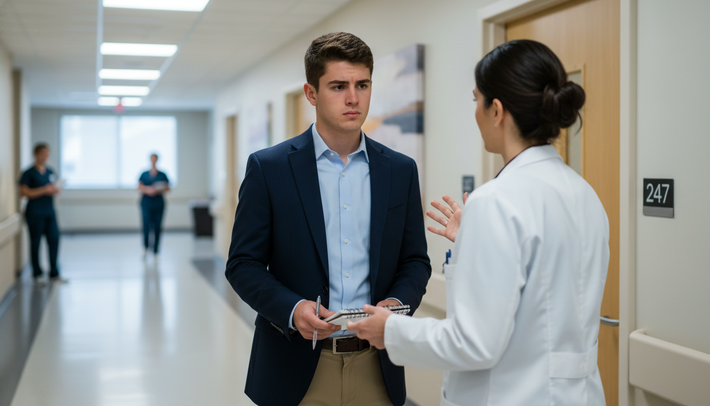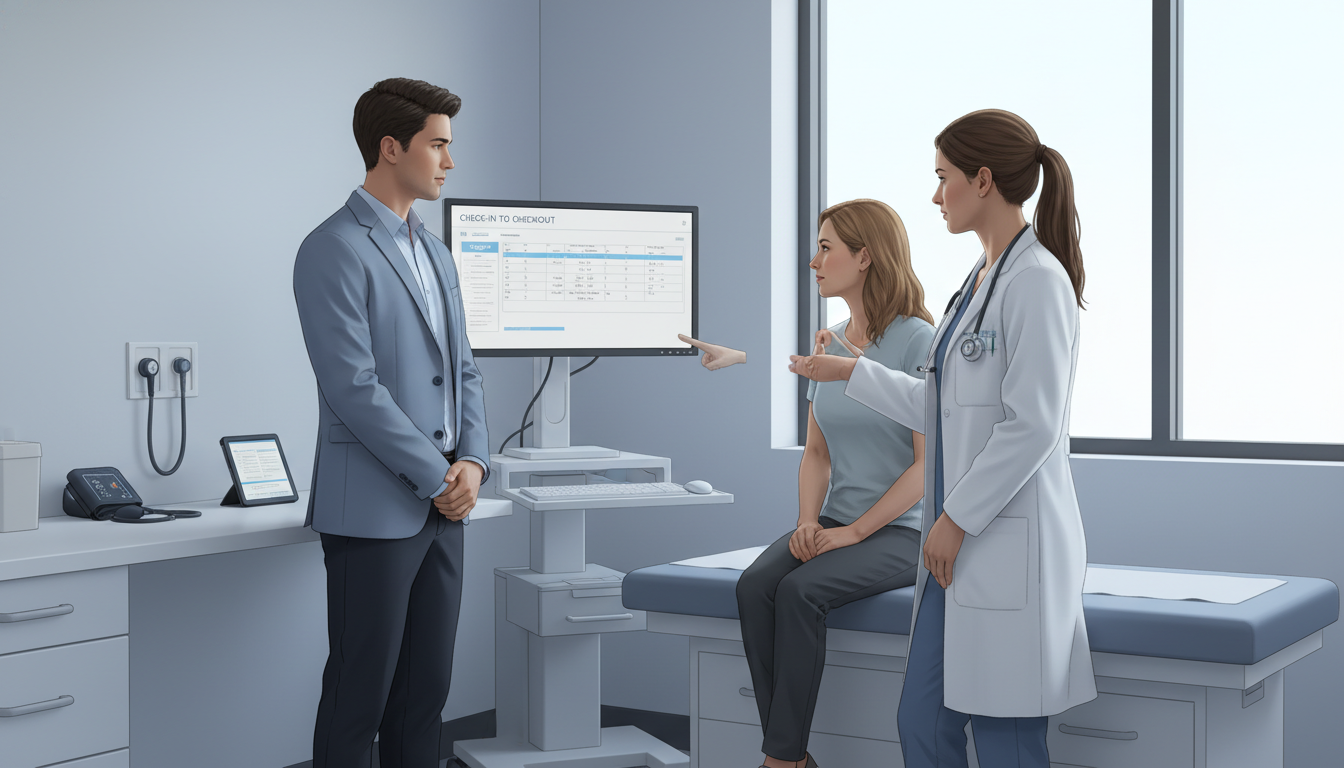
It is 8:10 AM on a Tuesday. You are standing just inside the doorway of a busy internal medicine clinic. The waiting room is half full. Phones are ringing. A medical assistant just called a patient’s name. Your white coat is new, your badge says “Observer,” and you have exactly one thought:
(See also: Shadowing on Rounds: Decoding Orders, Notes, and Hand‑Offs in Real Time for more details.)
“I have no idea what is actually happening behind all these doors.”
You are there to “shadow,” but the clinic feels like a machine with 20 moving parts. Front desk, MAs, nurses, residents, attendings, computers, printers, forms, consent, refills, prior authorizations. You get ushered into room 3 with your preceptor, smile politely at the patient, and then…everything is a blur.
This is where a lot of premeds and early medical students get stuck. You see fragments of the day. A single room. A single interaction. But you never really understand the workflow—the full arc of what happens from the moment a patient walks through the door to the moment they leave with a plan.
Let us walk through that complete arc, step by step, from check‑in to checkout, with you specifically in mind as the shadower. I will not just describe what the clinic staff and physicians are doing. I will tell you precisely where you fit, what you can watch for, and how to make sense of what looks like chaos.
1. Before the Patient Arrives: The Invisible Prep Work
Most students think the clinic day starts with the first patient in the room. In reality, the work starts before that.
The pre‑clinic huddle
In many primary care and subspecialty clinics (family medicine, internal medicine, endocrinology, GI), the team huddles briefly before the first patient.
Who is there?
- Front desk staff
- Medical assistants (MAs)
- Nurses (RNs/LPNs, depending on clinic)
- Physicians (attendings, sometimes residents)
- Occasionally a pharmacist, care manager, or social worker
What do they cover?
- Patients with complex needs (e.g., interpreter required, wheelchair transfer, dementia)
- Labs or imaging that came back since the last visit (abnormal A1C, positive H. pylori, CT results)
- Vaccines to be given that day
- Forms that need completion (FMLA, disability, school physicals)
- Same‑day add‑ons or urgent visits
Your role while shadowing:
Stand slightly back, listen, and pay attention to patterns:
- Which patients trigger more discussion?
- How do they prioritize time for a 20‑minute slot when the patient has 8 active issues?
- Who is responsible for what? Watch how the MA, nurse, and physician divide tasks.
If your preceptor is solo (common in private practice), the “huddle” may be just them glancing at the schedule and labs for 10 minutes before seeing the first patient. Still, that is your first learning opportunity.
Ask quietly:
“Can you walk me through your schedule today and what you focus on before you start seeing patients?”
You will learn more in that two‑minute answer than in 30 minutes of passive observation.
2. Front Desk Check‑In: Where the Visit Officially Starts
The patient’s visit begins at the front desk. For you, this looks like a lot of clicking and printing. For the clinic, it is where logistics and legalities are locked in.
What actually happens at check‑in?
Usually:
Identity verification
- Confirm name, date of birth, address
- Sometimes verify a photo ID
Insurance and financials
- Scan or photograph insurance card
- Collect copay
- Verify coverage eligibility electronically
Consents and forms
- General consent to treat (often signed yearly)
- HIPAA acknowledgment
- Financial responsibility forms
- Sometimes specific consent for procedures (e.g., minor surgery, injections) done at that clinic
Demographic and contact updates
- Emergency contacts
- Preferred pharmacy
- Changes in phone/email
Reason for visit / chief complaint (at a basic level)
- Front desk may enter a quick reason: “cough”, “diabetes follow‑up”, “medication refill”
- This is not the full history; it just anchors the visit.
Administrative flags
- New patient paperwork
- Language needs (interpreter scheduled or called)
- Mobility needs (room with stretcher, accessible bathroom)
From your perspective:
You are not usually involved at the front desk, but you should understand:
- By the time the physician sees the patient, the reason for visit, insurance status, and basic consents are already in place.
- When a physician says, “The front desk said you are here for back pain,” that summary likely came from this check‑in step.
Front desk work might seem non‑clinical, but it is the infrastructure that keeps the clinical work possible. Without accurate registration and consents, the visit cannot proceed safely or be billed correctly.

3. The MA / Nurse Intake: Where the Clinical Story Begins
Once called from the waiting room, the patient moves from the public space into the clinical zone. For you, this is usually the first point where you are allowed to follow along.
Step‑by‑step intake flow
Typical MA or nurse workflow:
Room assignment and basic orientation
- “Follow me, you will be in room 4 today.”
- Patient is seated on the exam chair/table.
Vital signs
- Blood pressure
- Heart rate
- Respiratory rate
- Temperature
- Oxygen saturation
- Weight (and sometimes height, BMI calculated automatically by EHR)
Chief complaint and brief symptom screen
- Very short: “What brings you in today?”
- MA may enter 1–2 lines: “cough x 1 week, no fever” or “3‑month diabetes follow‑up”
Standardized screening instruments (depending on clinic)
- Depression: PHQ‑2 / PHQ‑9
- Anxiety: GAD‑7
- Substance use: AUDIT‑C
- Fall risk questions (for geriatric patients)
- Pain scores (0–10, location)
Medication and allergy verification
- “Are you still taking these medications?” (and reads list)
- “Any new allergies to medications?”
- Reconcile differences between what EHR shows and what the patient actually takes
Standing orders or protocol‑driven actions
- Vaccines due: flu shot, COVID booster, pneumococcal, etc.
- Point‑of‑care tests: A1C fingerstick, glucose readings
- EKG or spirometry if protocol allows and time permits
Room set‑up for the physician
- EHR note opened on the right patient
- Gown offered if needed (pelvic exam, skin exam)
- Required forms placed in the room
Your specific shadowing behavior here:
- Position yourself out of the way—usually behind the physician desk corner or near the door.
- Do not jump in to ask your own questions during intake. The MA is trying to be efficient.
- Observe exactly which data the MA collects and which they leave for the physician. That division of labor is intentional.
Key questions to ask your preceptor later:
- “Why does the MA ask only a very brief chief complaint instead of a full history?”
- “How do you use the screening tools like PHQ‑9 in your decision‑making?”
- “If the medication list is wrong, who fixes it and when?”
For many specialties, this intake step is where the real work of chronic disease management is quietly happening—blood pressure trends, A1C values, screening for depression, etc.—long before you enter the room with the physician.
4. Physician Enters: The Encounter Proper Begins
This is the part you are used to thinking about when you imagine “shadowing.” But it does not stand alone. It sits on top of all the previous steps.
The opening 60–90 seconds
Pay attention to how your preceptor starts each visit. There is often a highly consistent pattern:
- Knock, enter, immediate identification
- “Hello, I am Dr. Chen.”
- “This is [Your Name], a premedical student observing today. Is it alright if they stay in the room while we talk?”
Crucial point: You must have explicit patient consent to be in the room. If a patient seems uncomfortable, your preceptor should offer you the option to step out, and you need to accept that gracefully.
Small talk or re‑establishing connection
- “How have you been since I last saw you?”
- “Did the physical therapy help your back at all?”
Agenda setting
- “I see you are here for diabetes follow‑up and knee pain. Are there other things you wanted to talk about today?”
- Then: “We probably can focus deeply on 2 main things today so we do not rush. Which are most important to you?”
As a shadower, listen for this “agenda setting” moment. It is one of the most clinically powerful but subtle skills.
History taking (HPI and beyond)
No need to re‑teach you SOAP note structure, but watch for:
- How the physician transitions from open‑ended (“Tell me more about the pain”) to targeted questions (“Does it wake you from sleep? Any numbness or tingling?”)
- How they use the computer—typing as they talk vs. focusing completely on the patient and documenting later
- How they handle sensitive topics (substance use, sexual history, mental health, domestic violence)
You will see differences by specialty:
- Primary care/internal medicine: Longer, broad review of systems, multi‑morbid patients, behavioral counseling.
- Surgical subspecialties (orthopedics, ENT, urology): More focused HPI, heavy emphasis on timing, mechanism of injury, functional limitations.
- Psychiatry in clinic setting: Almost entirely conversational, with long, detailed mental status assessments.
Keep a running tally in your mind:
- How many minutes on average are spent on talking?
- How often do they circle back: “Let me make sure I understood this correctly”?
Physical examination
The exam is not just “head‑to‑toe.” In outpatient clinic, it is almost always problem-focused plus key screening elements.
Watch:
- Which parts of the exam are repeated almost every visit (e.g., heart, lungs in primary care).
- Which are tailored to the complaint (Lachman test for knee, monofilament for diabetic neuropathy).
- Infection control pieces: hand hygiene before and after, glove use.
Your behavior:
- Position yourself where you can see but not block access to the patient.
- Do not handle instruments or touch patients unless explicitly taught and given permission (and typically not as a premed).
- If your preceptor says, “Come feel this,” step forward, do exactly as instructed, and step back.
Notice time management. A complete “visit” in many clinics is 15–20 minutes. History + exam may consume 10–14 of those.
5. Assessment, Plan, and Patient Education: The Decision‑Heavy Core
The last third of the encounter is where reasoning is made explicit. This is the part you should listen to like a hawk.
Framing the assessment
You may hear something like:
- “Based on your symptoms and what I found on your exam, I think this is most consistent with osteoarthritis of the knee.”
- “There are a few possibilities here for your abdominal pain. The one I am most concerned about is gallbladder disease.”
What is happening cognitively:
- The physician is turning a narrative into a problem list:
- #1 Right knee pain – likely OA
- #2 Hypertension – uncontrolled
- #3 Diabetes – A1C stable
- Then matching each problem with:
- Diagnostics (labs, imaging)
- Therapeutics (medication, PT, referrals)
- Monitoring/follow‑up timing
This is also where coding and billing complexity start to solidify (number and complexity of problems addressed, amount of data reviewed, risk of complications). You will not see CPT codes at this stage, but the content that will later justify that code is being created right here.
Shared decision‑making and education
Listen for:
How the physician explains:
- Why they are or are not ordering an MRI
- Why antibiotics are or are not appropriate
- Risks and benefits of starting a new medication
How they explore patient preferences:
- “Would you be more comfortable starting with physical therapy and weight loss, or do you feel you want to try an injection first?”
- “Some patients prefer to monitor their sugars at home; others focus more on diet and lab follow‑up. What sounds more realistic for you?”
As a shadower, you can learn a lot from watching how physicians handle disagreement:
- Patient wants a test that is not indicated.
- Patient declines medication the physician believes is strongly indicated.
- Patient has barriers: cost, transportation, health literacy, fear of procedures.
That tension between ideal medical plan and real human life is the heart of outpatient medicine.
Documentation during or after the visit
Some physicians type the Assessment and Plan in real time. Others jot notes and complete documentation between patients or at the end of the half‑day.
You might see:
- Smart phrases or templates inserted into the EHR.
- Checkboxes for quality measures (e.g., foot exam for diabetics, cancer screening updated).
- Medication reconciliation completed in the medication list.
Ask later:
“How do you balance charting during the visit versus after? What are the trade‑offs?”
You will be living this question for most of your career.

6. Orders, Referrals, and Tasks: The Hidden Spine of the Visit
Before the patient even leaves the room, the physician is typically queuing multiple actions in the EHR.
Clinical orders
These may include:
- Labs: CBC, CMP, A1C, lipid panel, TSH, etc.
- Imaging: X‑ray, ultrasound, CT, MRI.
- Procedures: joint injection, skin biopsy, EKG.
- Medications: new prescriptions, refills with changed doses, discontinuations.
- Vaccines: flu, pneumococcal, HPV.
Often the MA or nurse will complete certain orders under protocol once the physician signs.
Referrals and consults
Outpatient medicine runs on referral networks.
You may see:
- Referral to cardiology for chest pain or abnormal stress test.
- Referral to PT for back pain or post‑op rehabilitation.
- Referral to behavioral health for anxiety/depression.
What you are not seeing, but which is happening behind the scenes:
- Referral coordinators checking insurance requirements.
- Prior authorization staff working on approvals for MRIs or high‑cost medications.
Ask your preceptor:
- “When you refer to another specialist, how do you communicate what you are asking them to do versus what you will continue managing?”
Understanding that boundary helps you see how care is coordinated longitudinally.
7. The Exit: Checkout, Instructions, and Follow‑Through
The visit does not end when the physician says, “Do you have any other questions?” It ends when all downstream logistics are tied off.
In‑room wrap‑up
Right before leaving, the physician often:
- Summarizes:
- “So just to review, today we…”
- Confirms:
- “You will pick up the new blood pressure medication at your usual pharmacy.”
- Sets expectations:
- “If your symptoms get worse—fever, shortness of breath, cannot keep fluids down—go to the ED or call us.”
You should watch for those last 30 seconds. They reveal the physician’s mental checklist of what must be clear before the patient walks out.
Nurse/MA post‑visit tasks
Once the physician leaves:
- Vaccines given
- Blood drawn (if clinic has phlebotomy in‑house)
- Demonstrations:
- How to use inhalers, glucometers, blood pressure cuffs
- Paperwork completed that was discussed in visit
You may notice patients sometimes leave with multiple papers:
- After‑visit summary (AVS) printed from the EHR
- PT referral forms
- Pre‑op instructions
- Work or school notes
Front desk checkout
At checkout, front desk staff:
- Schedule follow‑up appointments:
- “The doctor would like to see you back in 3 months.”
- Provide information about referrals:
- “Cardiology will call you. If you do not hear from them in a week, call us.”
- Collect any outstanding balances.
- Sometimes hand the patient printed directions for imaging centers or specialists.
For you as a shadower, this is where you see whether the front‑end plan (what the physician said) actually becomes concrete reality:
- If the physician ordered follow‑up in 4 weeks but scheduling is backed up for 10 weeks, that matters clinically.
- If the patient says at checkout, “I actually cannot come in the mornings because of work,” then the theoretical plan may need adjustment later.

8. Your Workflow as a Shadower: Where You Fit at Each Stage
So far we have walked through their workflow. Now let us explicitly structure yours, from check‑in to checkout.
Before clinic starts
- Arrive 10–15 minutes early.
- Check in with your preceptor or clinic manager for:
- Where to store your bag/coat
- Which rooms you are allowed in
- Infection control requirements (mask? eye protection?)
Ask:
“Would you like me to follow you the entire session, or are there staff members you prefer I observe at times, like the MA or nurse?”
That question alone distinguishes you from the average passive shadower.
During patient flow
For each patient:
Outside the room
- Glance at the schedule or patient list if allowed.
- Ask: “What are the main issues for this patient?” even in one sentence.
- Think ahead: what you expect the encounter to involve (differential, likely plan).
Entering the room
- Stand slightly behind and to the side of your preceptor.
- Maintain a neutral facial expression; you are part of the professional team atmosphere.
- Make eye contact and say a simple, one‑time introduction if invited:
- “Nice to meet you, I am [Name], a premedical student observing today.”
During history and exam
- Do not interrupt.
- Mentally track:
- Chief complaint
- Three most important history details
- Key exam findings
- Final assessment and plan
Use those to structure questions later.
- After leaving the room
- Let your preceptor document or order first.
- When there is a natural pause, ask 1–2 specific questions:
- “You mentioned two possible causes for his chest pain. What made you favor musculoskeletal over cardiac in this situation?”
- “How did the PHQ‑9 score change what you did for her today?”
Your goal is to link each moment of the visit to the larger workflow and thought process—not to quiz them on random medical facts.
Between patients
Your preceptor is likely trying to catch up on charting. Respect that.
High‑yield questions are:
- “What do you look at in the chart before you enter a room?”
- “If you are running 20 minutes behind, how do you adjust your visits?”
- “Which parts of this visit affected how it will be billed or coded?”
Those questions show you are thinking like a future clinician, not just a student memorizing isolated encounters.
9. Seeing the System, Not Just the Doctor
When you walk out at the end of the session, you should not just remember “the man with COPD” or “the woman with knee pain.”
You should understand:
- How the front desk, MA, nurse, physician, and checkout each touch that patient’s trajectory.
- Where information is captured:
- Demographics → front desk
- Vitals → MA
- Clinical story → physician
- Orders and logistics → everyone
- Where errors or delays can enter:
- Incorrect medication list
- Missed abnormal lab in pre‑clinic review
- Referral not scheduled despite being ordered
Ask yourself:
- “If I were responsible for this patient’s outcome over 2 years, what in today’s visit would be most critical?”
Sometimes it is not the eloquent explanation of disease. It is whether the colonoscopy referral actually happened. Whether the A1C was checked. Whether the follow‑up was scheduled before they left.
That is the practical core of outpatient medicine that shadowing can reveal, if you know where to look.
With a clearer mental map of clinic workflow—from check‑in to checkout—you are no longer just an extra body in the room. You can watch the day unfold with structure: anticipating steps, recognizing patterns, linking decisions to downstream consequences.
As you move further into your journey—into more advanced shadowing, clinical volunteering, and eventually your own clerkships—you will start to inhabit that workflow rather than just observe it. You will go from silent observer to active participant: taking histories, presenting cases, placing orders under supervision.
That next phase, where you step from the corner of the room to the center, builds directly on this understanding of how a clinic actually runs. And that is the layer you are now ready to tackle.