The fastest way for a premed to get banned from a hospital—and quietly blacklisted from future opportunities—is not bad grades. It is a HIPAA violation while shadowing that you did not even realize was a violation.
You are not “just a student” in the eyes of the law when you’re in a clinic or hospital. You are an extra set of eyes and ears in a space full of Protected Health Information (PHI). If you mishandle that, no one will care that you “didn’t know.”
Let’s walk through the mistakes premeds commit all the time while shadowing, the ones attendings and coordinators complain about behind closed doors, and how you can avoid being the student everyone quietly refuses to host again.
The First Big Mistake: Thinking “HIPAA Doesn’t Really Apply To Me”
This is the root error that causes all the others.
Many premeds believe:
- “I’m not documenting anything, so it’s fine.”
- “I’m just here to observe, so HIPAA is the doctor’s problem.”
- “I’m a volunteer/student, not staff, so the rules don’t fully apply.”
All three are wrong.
The moment you’re allowed to see or hear anything related to a patient’s health, identity, or care, you’re in HIPAA territory. Even if:
- You never touch a computer.
- You never write in the chart.
- You never introduce yourself as part of the healthcare team.
You’re still present. You still hear names, diagnoses, lab results, family details, and sometimes extremely sensitive issues (STIs, mental health, substance use, pregnancy decisions). That’s PHI the law expects you to protect.
Do not make the mistake of assuming your “student” status is a shield. It is not. At best, people will stop inviting you back. At worst, a serious breach can trigger institutional reporting and formal discipline.
Talking About Cases: The Casual Conversations That Are Not Casual
For premeds, the single most common HIPAA violation is verbal. Not hacking EMRs. Not stealing records. Simply… talking.
Mistake #1: Telling Friends or Family “Interesting Cases”
You leave a shadowing shift buzzing with excitement. At dinner, you say:
- “We saw a 19-year-old with a suicide attempt.”
- “There was this undocumented patient in the ER with a gunshot wound.”
- “This 32-year-old pregnant woman came in with twins and no prenatal care.”
You may think, “I didn’t say a name, so it’s fine.”
No. HIPAA’s definition of PHI isn’t limited to names. It includes any combination of details that can reasonably identify a person. That means:
- Unusual conditions (“rare tumor,” “quadruple amputation”)
- Specific ages with rare events (“14-year-old with a stroke”)
- Highly publicized incidents (car crash everyone in town is talking about)
- Location + time + demographic details
If someone in that town, at that school, or in that community can reasonably figure out who you’re talking about, you’re walking right into HIPAA territory.
Mistake #2: Case Stories in Applications or Interviews
Another risky spot: using real, detailed patient stories in:
- Personal statements
- Secondaries
- Interview answers
- Social media posts about your “journey in medicine”
Common red flags:
- Mentioning rare diagnoses plus hospital name plus city.
- Describing a timeline or personal details so specific the patient (or their family) could recognize themselves.
- Using direct quotes from a patient or family member.
Even if you never write a name, you can still reveal identifiable information. Admissions committees have seen essays that basically report a case in narrative form. They recognize when you’re too specific.
You can absolutely talk about clinical experiences—but strip them down:
- Generalize age ranges.
- Change non-essential details (job, number of kids, exact timing).
- Avoid geographic markers if the situation was newsworthy or unusual.
If you wouldn’t feel comfortable reading that paragraph aloud in front of the patient, you’ve probably gone too far.
Mistake #3: Talking Too Loud in Public Spaces
This one gets overlooked constantly.
You’re in:
- The elevator.
- The cafeteria.
- The parking garage shuttle.
- The Starbucks across the street from the hospital.
You and the physician or another student are talking about:
- “That psych patient who keeps eloping.”
- “The teacher from [local high school] in room 14.”
- “The guy who came in after the crash on Highway 6.”
Strangers around you:
- Live in that community.
- Have kids at that school.
- Know about that crash.
You’ve just participated in a privacy breach, even if you never touched a chart. HIPAA expects you—and everyone in the system—to use reasonable safeguards. That absolutely includes lowering your voice and avoiding identifiable details in public or semi-public spaces.
Safer rule: No patient-specific discussions outside of clinical areas unless absolutely necessary, and even then, keep it vague, quiet, brief.
Phones, Photos, and “Just For Myself” Notes: The Digital Traps
Where premeds really get into trouble is with phones and tech. If you remember nothing else, remember this: your phone plus the hospital environment is a loaded weapon.
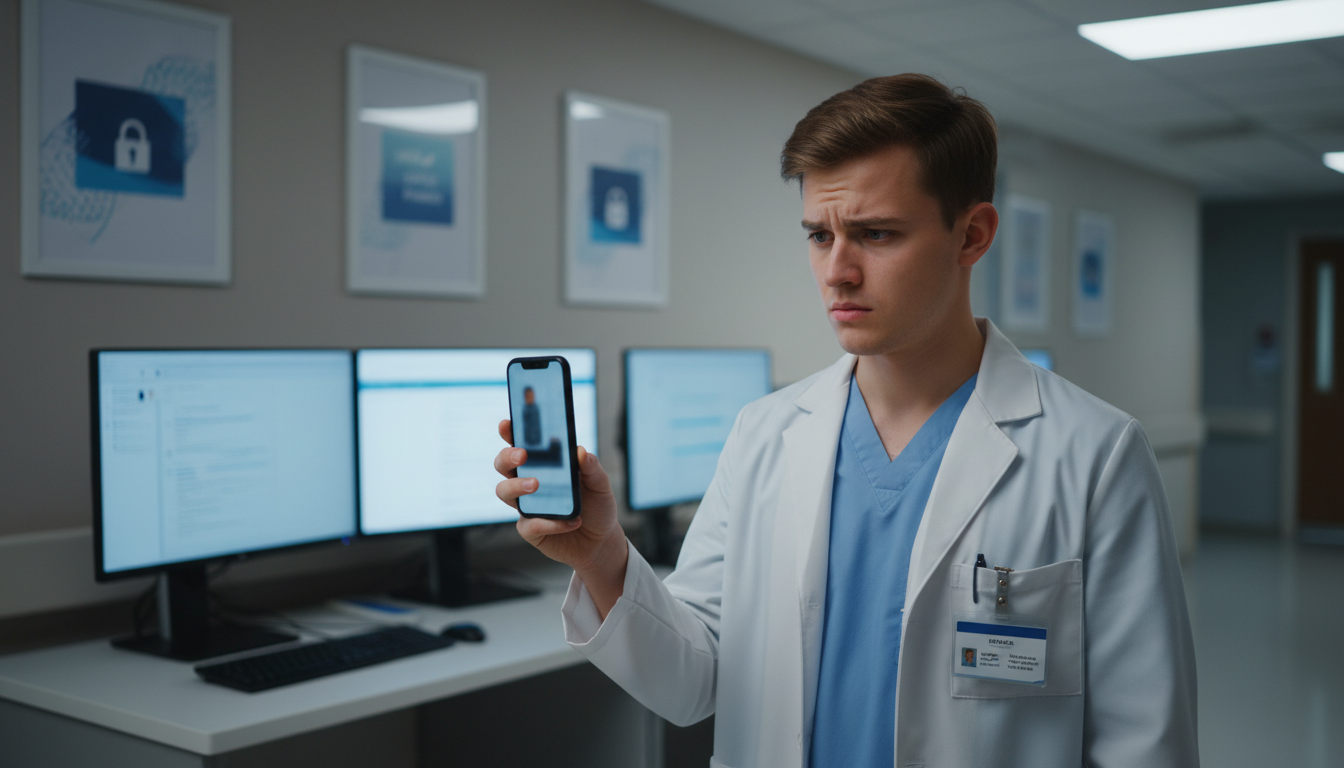
Mistake #4: Taking Any Photo in Clinical Areas
Bad assumption: “As long as I’m not photographing the patient directly, it’s fine.”
Wrong. Here is how premeds accidentally capture PHI in photos:
- A whiteboard in the background with room numbers and diagnoses.
- A computer screen with the EMR open.
- A bracelet, chart, wristband, or monitor with a patient name on it.
- A door sign with an unusual isolation precaution and room number.
Even selfies can be problematic if you are near identifiers.
Common dangerous scenarios:
- Selfie in the ED pod with monitors behind you.
- Group photo with the team in front of a patient’s room board.
- “First day shadowing!” hallway pic near census lists.
Unless you have explicit, written institutional permission (not just a verbal “yeah sure”), do not take photos anywhere that PHI might appear.
Mistake #5: Texting or Messaging About Patients
Another hidden violation: sharing details via:
- iMessage / SMS
- Group chats (premed friends, family, mentors)
- Instagram DMs / Snapchat
You might text:
- “We had a 45-year-old who coded after a car accident. It was insane.”
- “Just saw my first overdose case at [Hospital Name].”
Even if you believe it’s anonymous, you’re committing the same identify-risk problem as verbal conversation, now with a written record and often with the institution’s name attached.
Some hospitals use secure messaging apps (like TigerConnect, Epic Secure Chat) for staff. As a premed, you should not be sending or storing patient details on your personal device in any non-institutional, non-secure way.
Safe habit: assume any mention of a specific patient in a text that includes age, condition, event, or hospital is risky. Do not do it.
Mistake #6: Taking Notes “To Remember” Cases
Premeds sometimes create:
- A Notes app file with diagnoses they saw and patient details.
- A spreadsheet to “log interesting cases” with age, disease, outcome.
- A personal journal with very specific case descriptions.
If those notes contain enough detail to identify someone, and they’re stored on your personal device, you’ve just created an unprotected PHI dataset.
You can absolutely keep a shadowing log. But keep it generic:
- “Internal Medicine – 4 hours – observed management of chronic disease.”
- “Emergency Medicine – saw acute presentations of chest pain and trauma.”
- “OB/GYN – observed prenatal care and delivery process.”
That’s all admissions offices need. They do not want patient-level detail from you—and your phone is not a HIPAA-compliant storage system.
Social Media: The Silent Career Landmine
If there is one space where premeds casually destroy their reputations, it is social media.
Mistake #7: Posting “Vague” Stories or Tweets
Posts like:
- “Crazy night in the ER—multiple overdoses, one fatal. Medicine is wild.”
- “Just watched a teenager get devastating news about cancer. I’m not ok.”
- “My attending just did the most incredible emergency C-section at [Hospital].”
Does it feel anonymous to you? Maybe.
But if:
- The event was newsworthy.
- The hospital is named or obvious by location.
- The time-window is narrow (e.g., “tonight,” “this morning”).
You’ve made it easier to match your post to a real person’s awful day.
Admissions committees and program directors increasingly screen applicants’ online presence. HIPAA-adjacent insensitivity is a very fast way to get labeled “unprofessional” or “risky.”
Mistake #8: Posting Photos in Scrubs or With Badges Showing
Even “innocent” pictures can be problematic:
- Wearing hospital-branded scrubs and tagging location.
- Selfies with visible ID badges (yours or others).
- Group photos labeled “shadowing in the ICU today!” while at a specific hospital.
Problems:
- The institution may have strict rules about branding and patient privacy.
- Viewers can infer context: unit, timing, and possible events.
- If anything in the background is even borderline identifiable, you’ve now broadcast it.
You also risk annoying the very people writing your letters of recommendation. Many attendings absolutely do not want shadowing to become Instagram content.
Safe rule: no photos from clinical areas; no identifying hospital + clinical story combo; and if you’re unsure, don’t post.
Boundary Failures: When “Curiosity” Becomes a Violation
Another form of HIPAA risk isn’t about what you share—it’s about what you access or overhear and how you handle it.
Mistake #9: Asking About People You Know
Scenario:
- You see someone from your school wheeled into the ED.
- You hear a nurse mention a name you recognize.
- A family friend says, “You’re at that hospital, right? My uncle is in there—can you see how he’s doing?”
You:
- Ask the attending, “What happened to that guy from [school]?”
- Glance at the whiteboard looking for the name.
- Try to sneak a peek into the room door as you walk by.
That’s not “curiosity.” That’s an unauthorized attempt to access PHI.
You are only allowed to know about patients the attending explicitly includes you in, and only to the extent necessary for your observational role. Anything outside that is off-limits.
Proper response when asked about someone in the hospital: “I’m not allowed to access or talk about anyone’s medical information.” Full stop.
Mistake #10: Reading What You Should Not Read
You’re standing near:
- A workstation with open charts.
- A printer spitting out lab results.
- A clipboard at the bedside with vital signs and names.
Looking briefly at what’s on a screen as you walk past is unavoidable. But deliberately reading, scanning names or diagnoses, or trying to interpret charts for patients you’re not actively following is inappropriate.
As a premed, you should not:
- Use a computer to “click around” charts.
- Ask for login access.
- Try to explore the EMR for fun.
If someone offers to show you something, it should be:
- A specific patient you’re observing.
- Limited to what’s needed to understand what you’re seeing clinically.
- Done on their logged-in session—not with a shared password.
Physical Space and Privacy: The “I’m Just Standing Here” Problem
HIPAA isn’t only about data. It’s also about how you physically move and exist in patient spaces.
Mistake #11: Staying in the Room When You Should Step Out
Some premeds think: “If the doctor’s staying, I can stay.”
Not always.
Common times you should consider stepping out unless explicitly invited:
- Sensitive pelvic, breast, or genital exams.
- Psych or trauma discussions involving assault, domestic violence, or abuse.
- Family meetings about end-of-life decisions.
- Delivery room moments where the patient seems overwhelmed and exposed.
Even if the attending doesn’t automatically dismiss you, you can quietly ask, “Would you prefer I step out for this part?” or look to the patient and say, “I’m a premed student shadowing today—would you like me to step out?”
Patients have a right to say no to observers without feeling guilty. Don’t be the extra body that makes them feel more like objects than people.
Mistake #12: Reading or Touching Physical Charts
Old-school but still relevant in some clinics and hospitals.
You see:
- A paper chart at the door.
- A folder open at the nurse’s station.
- A consult note on the counter.
Temptation: flip through to “learn.”
As a premed shadowing, you are not part of the care team. Unless the attending explicitly uses the chart as a teaching tool and physically shows you a page, you shouldn’t be handling charts.
Even when they do:
- Don’t photograph.
- Don’t copy details.
- Don’t write down identifying information.
Learn to observe without harvesting data.
Protecting Yourself: Simple Rules That Keep You Out of Trouble
You don’t need to memorize every line of HIPAA law. You do need a set of instincts and habits that default toward caution.
Here are protective principles:
- Assume everything about a patient is private. Age, story, diagnosis, family situation. All of it.
- If you’re about to tell someone a patient story, stop. Ask yourself: could they or their community realistically identify who I mean?
- Your phone is not HIPAA-safe. No photos in clinical areas, no detailed case notes, no case-related texts.
- Silence is better than “anonymous” details. If you’re unsure, vague and nonspecific is the safest route—or say nothing.
- Ask when uncertain. Before staying in a room or being present for a sensitive situation, ask the attending: “Is it okay for me to be here for this part?”
- Respect “need to know.” If you’re not directly involved in observing that patient’s care with your supervising physician, you don’t need to know about them.
- Keep your shadowing log generic. Document hours and settings, not identifiable stories.
Remember: programs are not looking for premeds who can recite regulations; they’re looking for people who instinctively protect patients’ dignity and privacy.
One Step To Take Today
Open your phone, laptop, and social media right now and search for anything you’ve written, texted, or posted about shadowing or clinical experiences. If there’s even a chance a real patient—or their family—could recognize themselves, delete it. Then adjust your habits going forward so you never have to scrub your tracks again.