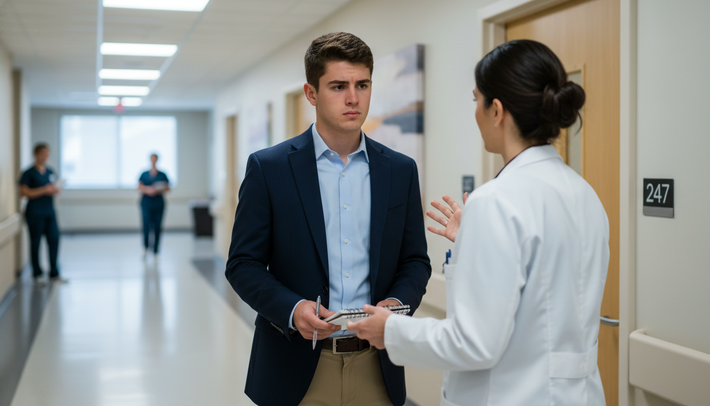
What if the best shadowing you’ve ever done—the experience that actually made you want medicine—is from years ago… and now you’re terrified every school will look at it and think, “This doesn’t count anymore”?
The “I Shadowed Too Early” Panic
You did everything “right” early on.
Maybe you shadowed a pediatrician in high school. Or followed a trauma surgeon between freshman and sophomore year. You remember the smell of the ED, the rhythm of clinic visits, the way your heart pounded the first time someone crashed. It changed you.
And now you’re sitting in front of an AMCAS draft or secondaries, realizing:
“That shadowing was… 4, 5, 6+ years ago. Is this going to look outdated? Are they going to think I’m applying based on some childish fantasy from forever ago?”
The worries pile up fast:
(See also: What If I Say Something Wrong in Front of a Patient While Shadowing? for more details.)
- “Will admissions think I haven’t verified my interest in medicine recently?”
- “Does old shadowing look worse than no shadowing?”
- “What if they ask in an interview, ‘What clinical exposure have you had recently?’ and I just freeze?”
- “Everyone on Reddit seems to have ‘ongoing’ shadowing. I have… a great experience from 2019.”
You start rewriting the story in your head: that what felt like real, meaningful experience is now just a stale line on a CV.
Let’s untangle that before you convince yourself you’re doomed.
Do Schools Officially Care How Old Shadowing Is?
Here’s the annoying and honest answer: it depends, but it’s not as black-and-white as your anxiety is telling you.
Most med schools don’t have a strict, written rule like “no shadowing older than 3 years.” You’re not going to see a line on a website saying, “Experiences from before 2022 are invalid.” That’s not how they think.
What they do care about is:
- Do you understand what a physician’s life is like now, not just at age 16 when everything felt magical?
- Have you demonstrated a sustained, realistic interest in medicine over time?
- Can you speak like someone who’s seen healthcare up close recently, not just romanticized it from an old memory?
So no, that shadowing you did years ago is not automatically worthless. It can still absolutely count and be meaningful.
But they’ll look for signs that you’re not basing a lifelong decision solely on something you did when you barely knew what “rounding” meant.
Think of your old shadowing as a strong foundation. It’s not the problem. The problem is if nothing has been built on top of it since.
When Older Shadowing Still Looks Solid (And When It Starts to Look Shaky)
Let’s say you shadowed 60 hours with a family medicine doctor in 2019 as a sophomore.
Scenario A:
Since then, you’ve been a medical assistant at an urgent care in 2022–2024, volunteered in a free clinic, and maybe even did scribing for a year.
In this case? Your old shadowing is totally fine. It shows when the spark started. Your more recent stuff shows you’ve kept your eyes open and stayed grounded. Schools aren’t going to care that the shadowing itself is a bit older because your clinical exposure hasn’t stopped.
Scenario B:
You shadowed that same doc in 2019… and then nothing clinical happened afterward. Maybe you focused on research, or a different career path for a while, or life just hit you hard. Now it’s 2025, and that 2019 shadowing is still your only real look at what doctors do.
Here’s where it gets shaky.
Not because 2019 is “too old” on paper, but because it raises questions:
Is this applicant making a decision based on a single snapshot from years ago? Has their view of medicine been reality-tested in adulthood?
This is what admissions readers will wonder, especially when so many applicants have something more recent to point to.
So the age of the experience isn’t judged in isolation. It’s judged in the context of everything else you’ve done.
“What If My Best Story Is Old?”
This is the part that really messes with you.
You might have one unforgettable shadowing day from years back:
The patient who burst into tears when the doctor explained their diagnosis kindly.
The first code you watched.
The surgeon who let you stand close enough to see every detail and then debriefed with you afterward.
And now you’re afraid to talk about it because of the date.
Here’s the thing: admissions committees don’t hate old stories. They hate stories that sound like nothing’s happened to you since.
If you say in your personal statement:
“I first shadowed Dr. Lee, a cardiologist, during my junior year of high school. Watching him manage a patient with acute heart failure pulled medicine out of the abstract and into reality for me…”
That’s fine. Totally allowed.
But if the narrative ends there, or if every meaningful experience seems to stop around 2019, that’s an issue.
You want to do this instead:
- Use older shadowing to explain when and how the spark ignited.
- Use newer experiences (even if they’re not shadowing—clinical work, volunteering, scribing) to prove that the spark survived contact with reality.
Old shadowing = origin story.
Recent clinical experiences = proof you’ve grown and haven’t idealized the job.
As long as you anchor the old story to a more current “And here’s how I’ve continued to engage with patients/healthcare since then,” the age doesn’t sink you.
The “Do I Need to Shadow Again?” Question You’re Afraid to Answer
You probably already know the answer, and you’re hoping I’ll say, “Nah, it’s fine, old shadowing is enough by itself.”
But if your only shadowing or clinical exposure is several years old, and you’re applying soon or reapplying?
Yes. You should try to get something more recent.
Not because schools have a magical cutoff date. But because right now, your anxiety is telling you something true:
- Interviewers might ask, “What’s something you’ve seen recently in healthcare that shaped how you think about being a physician?”
- Secondaries might say, “Describe one of your most meaningful recent clinical experiences.”
- You might be sitting in front of an MMI interviewer being asked about burnout, healthcare systems, or physician life today.
If the last time you were in a clinic or hospital in any meaningful way was pre-pandemic or pre-your current adult life, it’s harder to answer those questions convincingly.
Even 10–20 hours of recent shadowing or clinical volunteering can help you breathe easier.
You don’t need another 100 hours. You need enough to show:
“I haven’t just leaned on a high school/early college memory. I’ve gone back, as a more mature version of myself, and confirmed this is still what I want.”
So if you’re stuck in the worst-case thinking of:
“What if every school rejects me just because my shadowing says 2018–2019?”
Give yourself one concrete goal: find at least one more recent clinical exposure you can point to, even if it’s modest.
An urgent care. A primary care office. A day in the OR. A safety-net clinic.
Something.
How To Talk About Outdated-Looking Shadowing Without Sounding Outdated
Let’s say you can’t magically time-travel and redo your timeline. You shadowed years ago. Life was chaotic. You’re only now able to refocus on medicine.
How do you not sound like someone who’s clinging to ancient experiences?
A few ways to frame it:
Acknowledge the timing honestly if it comes up.
In an interview, you might say:
“My first real exposure to medicine was shadowing Dr. Patel in 2019. Since then, my path hasn’t been linear—I worked in [X], took time for [Y], and during that time I kept coming back to that experience. To reconnect with healthcare more recently, I’ve been [volunteering/scribing/etc.], which gave me a more current perspective on patient care.”You’re not pretending the gap didn’t happen. You’re explaining it and showing you’ve re-grounded yourself.
Use reflection that sounds mature and current.
Don’t just say, “I shadowed and it was inspiring.” That sounds like it could’ve come from a 16-year-old.Say what you noticed that only someone paying attention would notice:
- How much time the doctor actually spends charting
- How health literacy, language, or insurance issues complicated care
- How emotionally draining certain days seemed for the team
Showing depth makes it feel less like a naive, old experience and more like a meaningful piece of your longer journey.
Connect old shadowing to present-day understanding.
Even if the experience is old, you can still tie it to what you know now:“When I first shadowed in 2020, I didn’t fully appreciate how much of the physician’s work happens outside the exam room. Now, having [worked/volunteered] in [setting] and seen how documentation, prior authorizations, and team communication shape patient care, I better understand what I observed back then.”
Suddenly, that “outdated” moment becomes part of a story of growth, not a frozen-in-time moment.
What If You Literally Can’t Get New Shadowing?
This is a nightmare scenario in your head: you’re working two jobs, or caregiving, or in a rural area, or every email to a physician goes unanswered, and the months are ticking down to your application cycle.
If you truly can’t get updated shadowing, your job becomes:
- Make sure you at least have some more recent clinical exposure of any kind, even if it’s not formal shadowing: health-related volunteering, EMT, CNA, MA, scribe, hospital volunteer, crisis hotline, community health projects, mobile clinics, telehealth support.
- If even that’s impossible, then explain context in a school’s “additional information” section or secondaries. Not as an excuse, but as a factual constraint.
Example:
“Most of my physician shadowing occurred in 2019, prior to the COVID-19 pandemic. Since then, my attempts to arrange additional shadowing have been limited by [X: institutional restrictions, work schedule, caregiving]. To stay engaged with patient care, I have [done Y more recently], which has provided regular contact with patients and healthcare teams even without formal shadowing.”
That’s not perfect. But it’s a lot better than silence. Silence lets them invent their own story. Context lets them see you as a human being constrained by real life, not laziness.
How Much Is “Recent Enough”?
Your brain wants a number: “Shadowing older than 3 years is dead, 2 years is fine,” something like that.
But admissions doesn’t live in neat cutoffs.
Roughly though, here’s how it tends to feel:
- Shadowing within the last year or two plus older experiences? Comfortably fine.
- Shadowing 3–4 years ago, with consistent clinical exposure since? Also fine.
- Shadowing 3–4+ years ago, with little to nothing clinical since? That’s where flags go up.
So if you’re within a year of applying and your most recent clinical exposure is drifting toward that 3–4 year mark, it’s worth pushing hard to add something newer, even if small.
Not because you’re “disqualified” otherwise, but because you’re already anxious, and having one 2024–2025 thing on your app can dramatically change how confident you feel talking about medicine in interviews.
You’re Not Starting From Zero
Your anxiety wants to rewrite your story as: “I messed up. My shadowing is too old. I wasted it. I have nothing.”
That’s not true.
You have:
- Real moments with real patients and physicians that shaped how you think.
- Time to add even a little more recent experience.
- The ability to connect your old experiences to your current, more mature understanding of medicine.
Schools aren’t sitting there with a stopwatch timing how fresh every activity is. They’re asking: Does this person understand what they’re getting into, and have they demonstrated that steadily over time?
If your shadowing is years old, it doesn’t mean you’re out. It just means you may need to:
- Layer on something more recent if you can.
- Be intentional about how you frame and reflect on what you did back then.
- Own your timeline instead of trying to hide it.
Key points to hold onto:
- Old shadowing isn’t automatically invalid; it’s just incomplete if nothing has come after it.
- Even small, recent clinical experiences can “update” your story and give you credibility.
- How you talk about your old experiences—depth, reflection, and growth—matters as much as the date stamped on them.