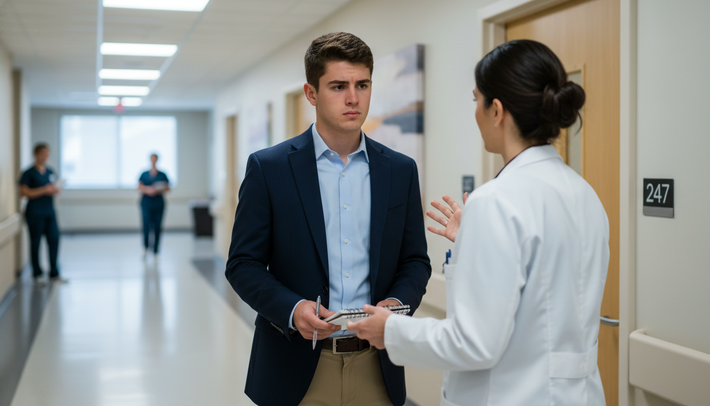
The week after shadowing will quietly determine whether that experience opens doors for you or disappears into your memory.
Most students think the shadowing is over once they walk out of clinic. They are wrong.
Your post‑shadowing week is when you:
- Secure strong future letters of recommendation
- Capture details you will need for AMCAS/AACOMAS/TMDSAS
- Turn vague impressions into concrete insights about medicine
(See also: Final 6 Months Before AMCAS: Shadowing Tasks to Complete and Record for guidance on documentation.)
Here is your day‑by‑day, then week‑by‑week plan for the 7–14 days after you finish a shadowing block.
Day 0: Final Shadowing Day – Set Up Your Follow‑Through
Before you leave on your last day:
Confirm contact details
- Ask the physician or main contact:
- “What is the best email for me to send a brief thank‑you and any follow‑up questions?”
- Verify spelling and professional title (MD, DO, MBBS, etc.)
- If appropriate, confirm their clinic coordinator’s email as well.
- Ask the physician or main contact:
Clarify future communication
- One line is enough:
- “Would it be all right if I reached out in the future with questions about pursuing [specialty/medicine]?”
- This sets the expectation that you may contact them again.
- One line is enough:
Note the exact end date
- Write down:
- Final shadowing date
- Number of hours that day
- You will need this for total hour calculations.
- Write down:
Immediately after leaving
- In your notes app, quickly jot down:
- 3 specific cases or encounters you observed
- 1 moment that changed or challenged your view of medicine
- Any phrases or teaching points the physician repeated
- In your notes app, quickly jot down:
At this point, you have closed the in‑person portion. The rest is professional follow‑through.
Day 1: Send the Primary Thank‑You Email
Your first 24 hours set the tone. By the end of Day 1 you should have:
1. Prepared your information
Before writing, list:
- Physician’s full name and credentials
- Practice type and location
- Exact dates of shadowing
- Approximate total hours
You will reuse these details in multiple places.
2. Drafted your main thank‑you email
Aim to send this email within 24 hours of your final shadowing session.
Structure (5–7 sentences):
- Subject line:
- “Thank you for allowing me to shadow – [Your Name]”
- Opening:
- “Dear Dr. [Last Name],
Thank you very much for allowing me to shadow you from [start date] to [end date] at [clinic/hospital name].”
- “Dear Dr. [Last Name],
- Specific appreciation:
- Mention 1–2 concrete things:
- A particular patient interaction (de‑identified)
- A teaching moment
- A process you observed (pre‑op, rounds, family discussion)
- Mention 1–2 concrete things:
- Reflection line:
- “Shadowing you confirmed my interest in [primary care/surgery/EM/etc.] by showing me [specific insight].”
- Future contact:
- “I would be grateful to stay in touch as I continue on my path to medical school.”
- Close:
- “Sincerely,
[Full Name]
[School], Class of [year]
[Phone] | [Email]”
- “Sincerely,
Example middle paragraph:
“I especially appreciated your explanation of how you balance efficiency with making each patient feel heard, such as when you paused to summarize the plan and check for questions before leaving each room. Observing those conversations made me more aware of how much communication, not just clinical knowledge, shapes patient care.”
3. Decide whether to mention letters now
If:
- You shadowed for ≥20–30 hours, and
- You had multiple meaningful interactions, and
- The physician knows your goals
Then you can add a light, future‑oriented line (do not request a letter yet if applications are >6–9 months away):
“As I move closer to applying to medical school, I hope I might be able to reach out to you regarding advice and potential future support in my application process.”
If your time was brief (≤10 hours), skip any letter hint for now. Focus on gratitude and reflection.
By the end of Day 1 your thank‑you email should be sent, not sitting in drafts.
Day 2: Capture Structured Reflection Notes
On Day 2, your main task is to transform fuzzy memories into structured notes you can reuse later.
1. Block 30–45 minutes for reflection
Use a notebook, Word/Google Doc, or note app. Create a dedicated document titled:
“Shadowing – [Dr. Name] – [Specialty] – [Month Year]”
Include:
A. Basic logistics
- Physician name, credentials
- Specialty and setting (e.g., outpatient cardiology, academic ED)
- Hospital/clinic name and location
- Dates shadowed
- Total hours (approximate breakdown per day)
B. Bullet point observations
Create 4 headings and free‑write bullets:
“What I actually saw”
- Types of visits (follow‑ups, new consults, procedures)
- Common diagnoses (e.g., CHF, diabetes, depression)
- Team members involved (RN, MA, PA, social worker)
“What surprised me”
- Time spent on EMR vs patient interaction
- Phone calls or family meetings
- Non‑clinical tasks (prior authorizations, paperwork)
“What I admired”
- Specific communication strategies
- How the physician handled a difficult patient or bad news
- Professionalism under time pressure
“What I am unsure about”
- Aspects of the specialty that concerned you
- Work‑life balance observations
- Any ethical or emotional questions that arose
C. One or two story seeds
For future personal statements or secondaries, you want story “seeds,” not full essays.
Write:
- 2–3 sentences about one memorable patient encounter
- De‑identify completely (no name, age, or unique diagnosis that could identify them)
Example:
“I observed a middle‑aged patient with a chronic condition who felt dismissed by prior providers. Dr. A invited her to share what she felt had been overlooked and paused after each response to summarize what he heard. The patient’s visible relief reminded me that feeling heard can be just as therapeutic as a new medication.”
You are not writing polished prose. You are capturing raw material while it is fresh.
Day 3: Formal Documentation for Applications
On Day 3, you shift from reflection to structured documentation that fits AMCAS/AACOMAS style entries.
1. Create an experience log
If you are premed:
- Open a spreadsheet or table with columns:
- Activity name
- Organization
- Supervisor name and title
- Start date
- End date
- Total hours
- Type (shadowing, clinical, non‑clinical)
- Brief description (2–3 bullets)
- Notes (potential letter writer? yes/no)
Log this shadowing experience immediately.
Example entry:
- Activity: Shadowing – Internal Medicine
- Organization: University Hospital Primary Care Clinic
- Supervisor: Priya Singh, MD
- Dates: 06/03/2025 – 06/07/2025
- Hours: 24
- Type: Clinical – Shadowing
- Description bullets:
- Observed outpatient management of chronic diseases including diabetes, hypertension, heart failure
- Witnessed patient counseling on lifestyle changes and medication adherence
- Gained exposure to EMR workflow, interprofessional communication, and clinic operations
2. Draft application‑style descriptions
Write a 600–700 character version that you will later adapt directly into application entries. Example:
“Shadowed an internal medicine physician in an academic primary care clinic (24 hours over 1 week). Observed longitudinal management of chronic conditions such as diabetes, hypertension, and heart failure. Watched patient–physician communication during complex medication discussions and shared decision‑making. Gained insight into clinic workflow, multidisciplinary collaboration, and documentation demands of outpatient practice.”
Store this text in your master experiences document.
3. Update your CV
Under “Clinical Experience” or “Shadowing Experience,” add:
- Shadowing Student, Internal Medicine
- University Hospital Primary Care Clinic, City, State
- Month Year – Month Year
- ~24 total hours
- One concise bullet describing scope
This habit now will prevent last‑minute scrambling when you assemble your CV for research positions, premed committees, or gap‑year jobs.
Day 4: Deeper Personal Reflection – Fit, Values, and Direction
By Day 4, initial excitement fades. This is the right moment to ask harder questions.
1. Write a short reflection (300–500 words)
Use prompts such as:
- “What did this week show me about the daily reality of being a physician?”
- “Which aspects of the work energized me? Which drained me?”
- “Did this experience strengthen or weaken my interest in medicine?”
- “What surprised me about patients’ lives or barriers to care?”
Keep this separate from your official application‑style notes. This is for your own clarity.
2. Compare with previous or future shadowing
If you have other shadowing experiences:
- List 3–4 contrasts:
- Pace of work
- Patient population
- Level of emotion or acuity
- Time spent on documentation
If this was your first shadowing:
- Note 2 specialties you now want to explore next and why.
This is how shadowing experiences become a coherent narrative rather than isolated checkboxes.
Day 5: Professional Follow‑Up and Networking
On Day 5, you extend the relationship beyond a one‑time interaction.
1. Optional short follow‑up email
If there was a topic you wanted to learn more about, or you discussed research, careers, or specialties:
Send a brief email:
- Thank them again with one line.
- Ask one focused question, for example:
- “Are there 1–2 resources you recommend for learning more about primary care for underserved populations?”
- “If I hoped to explore research in [their specialty], how might a premed student get involved at [hospital/system]?”
Keep total length under 8–9 sentences.
2. Connect in a professional way where appropriate
If the physician is involved in:
- A university faculty role
- Public speaking
- Research groups
You can:
- Follow their professional profile on LinkedIn or institutional page.
- Do not send casual social media requests (Instagram, Facebook) unless they explicitly offered.
3. Log potential letter writer status
In your experiences spreadsheet “Notes” column, mark:
- “Potential letter writer – shadowing only”
- Or “Potential mentor – had meaningful conversations”
If you are still >1 year away from applying:
- Set a reminder 6–9 months before your planned application date:
- “Email Dr. [Name] with update, ask about letter if appropriate.”
Day 6: Organize Physical and Digital Materials
The sixth day is for cleanup so you do not lose anything.
1. Consolidate all notes
- Merge:
- Handwritten notes
- Phone notes
- Word/Google docs
Into one organized digital folder:
- Folder name: “Shadowing – [Year]”
- Subfolder for each physician or specialty
2. Separate confidential from non‑confidential details
Review your notes:
- Remove any patient identifiers (names, dates of birth, room numbers)
- Generalize rare diagnoses or combinations that could be identifying
Your notes should reflect experiences and themes, not traceable patient data.
3. Scan any paper verification
If you received:
- A signed letter confirming hours
- A hospital badge with date stamp
- A site completion form
Scan or photograph:
- Save as: “Shadowing_verification_[PhysicianName]_[MonthYear].pdf”
Most medical schools do not require formal proof of shadowing, but premed committees, honors tracks, or special programs sometimes ask. Keep it anyway.
Day 7: Decide on Next Steps and Integration
By the end of the first post‑shadowing week, you should transform experience into trajectory.
1. Identify action items from reflection
Review your Day 2 and Day 4 notes. List 3–5 concrete next steps:
- “Shadow a different primary care physician in a community clinic to compare academic vs community settings.”
- “Seek a clinical volunteering role with more direct patient contact.”
- “Read about [condition or topic] that came up frequently.”
- “Ask premed advisor about more exposure to [specialty] at affiliated hospitals.”
Assign each item:
- Target month
- Any person you must contact
2. Update your premed/medical preparation timeline
If you keep a long‑term prep plan (recommended):
- Insert this shadowing experience into your chronology:
- “Summer 2025 – Internal medicine shadowing (24 hours) – confirmed interest in longitudinal patient care.”
Over time, you want your activities to tell a story:
- From early observation → to active involvement → to leadership or deeper commitment.
Week 2 and Beyond: Longer‑Term Follow‑Up
Once the first week is complete, your remaining tasks are low‑frequency but high‑impact.
1. 1–3 month check‑in (optional but valuable)
If your shadowing was:
- Extended (>20–30 hours)
- Impactful personally
- Or in a specialty you are seriously considering
Then 1–3 months later:
- Send a brief update email:
- Remind them who you are and when you shadowed
- Share 2–3 concrete updates:
- New clinical role
- MCAT planning or completion
- A decision or insight influenced by shadowing them
- Optionally ask a focused career question
Example excerpt:
“Since shadowing you in June, I have started volunteering in the hospital’s discharge clinic and have been able to see how some of the chronic disease management principles you described play out during care transitions.”
2. Planning for future letters of recommendation
When you are 3–9 months from applying:
Review your shadowing experiences
- Which physicians:
- Spent meaningful time teaching you?
- Saw your reliability or professionalism?
- Commented positively on your questions or engagement?
- Which physicians:
Decide if a shadowing‑only letter is worth requesting
- Shadowing letters are generally weaker than letters from:
- Research PIs
- Course instructors
- Clinical supervisors in paid or volunteer roles
- Shadowing letters are generally weaker than letters from:
If you still want to request a letter:
- Email 1–2 physicians (not more) who know you best from shadowing.
- Provide:
- Updated CV
- Brief personal statement draft or “Why medicine” summary
- Reminder of when and how long you shadowed
- Any specific interactions you recall
You might phrase the request:
“If you feel you know me well enough to write a supportive letter, I would be very grateful…”
This gives them an easy way to decline if they are uncertain, which protects you from lukewarm letters.
3. Reuse your reflections in essays and interviews
When application season arrives:
For personal statements:
- Use your “story seeds” as starting points for anecdotes.
- Emphasize what you learned and how you acted differently afterward.
For secondaries:
- “Tell us about a clinical experience”
- “Describe an interaction that confirmed your desire to pursue medicine”
- Your Day 2 and Day 4 notes give you ready‑made material.
For interviews:
- Practice 1–2 concise stories from this shadowing experience:
- Situation
- What you observed
- What you learned
- How it affected your decisions or behavior
- Practice 1–2 concise stories from this shadowing experience:
Your early documentation work makes these later steps far easier and more authentic.
Quick Checklist: Post‑Shadowing Week Essentials
By the end of your Post‑Shadowing Week, you should have:
Within 24 hours (Day 1):
- Sent a professional thank‑you email
- Noted exact dates and hours
By Day 3:
- Detailed reflection notes (observations + surprises + story seeds)
- Experience logged in spreadsheet
- Application‑style description drafted
- CV updated
By Day 7:
- Longer personal reflection written
- Digital folder organized with all notes and scans
- Potential letter writer flagged in your records
- Next steps and target dates identified
Core Takeaways
- The shadowing week is only half the experience; the post‑shadowing week converts hours into insight, documentation, and relationships.
- A timely, specific thank‑you, structured notes, and a permanent activity log will save you time and stress when you apply.
- Reflection and follow‑up transform shadowing from a checkbox into real professional growth and narrative strength in your path to medical school.