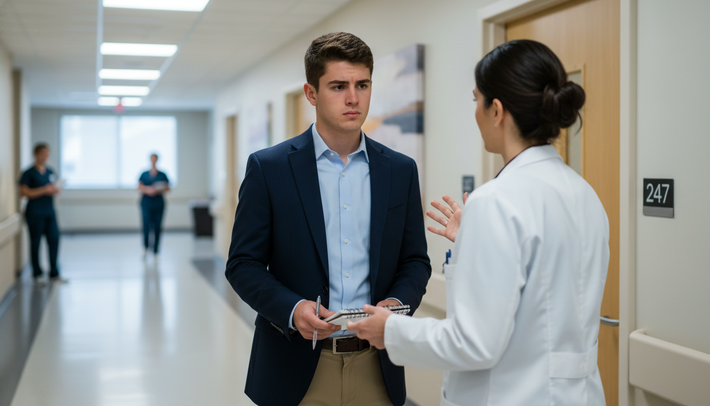
Last week a student messaged me after leaving the OR mid-surgery because she thought she was going to pass out. She’d been so excited to shadow; then suddenly she was in a bathroom stall, shaking, convinced she’d just ruined her entire future. The thing she kept saying over and over was, “How is this going to look in interviews? Are they going to think I’m weak?”
If you’re reading this, I’m guessing some version of that panic feels way too familiar.
When Shadowing Makes You Question Everything
Shadowing is supposed to confirm you’re meant for medicine, right? That’s what everyone tells us. You’ll shadow a doctor, feel inspired, see lives changed, and walk away thinking, “Yes. This is it.”
But what if that’s not what happens?
What if:
- You felt dizzy in the OR
- You almost cried after a tough patient encounter
- You went home completely drained and thought, “I’m not sure I can do this every day”
- You caught yourself thinking, “Maybe I’m not as resilient as I thought”
And then the next wave of panic hits:
“If I admit this, will schools think I can’t handle medicine?”
“Will this be a red flag in my interviews?”
“Do I just never mention this shadowing experience?”
(See also: What If I Felt Uncomfortable During Shadowing? Will Schools Judge Me? for more details.)
That’s the part that keeps people up at night. Not just the reaction itself—but how it looks.
What Programs Actually See vs. What You Think They See
Here’s the nightmare story we tell ourselves:
- You mention struggling during shadowing
- Interviewer thinks: “Red flag. Weak. Can’t handle stress.”
- You get quietly screened out
- Everyone else seems fine, so clearly you’re the problem
Realistically? That’s not how this usually plays out.
Most physicians and interviewers:
- Have either almost fainted, cried, or panicked in training themselves
- Have watched plenty of students struggle early on
- Know that shadowing is often someone’s first exposure to real suffering, blood, death, or chaos
What they’re actually noticing isn’t:
“Did this person have a hard moment?”
They’re asking:
“What did this person do with that hard moment?”
There’s a huge difference between:
- “I fainted in the OR, so I avoid hospitals now and don’t really want to talk about it.”
vs.
- “I got lightheaded during a surgery, which honestly scared me. But I talked with the surgeon about it, reflected on what triggered it, and gradually worked my way back into clinical settings with better preparation.”
The event itself isn’t the red flag.
The lack of reflection, growth, or follow-through is.
Common Shadowing “Fails” and How They Actually Look
Let’s be brutally honest about the stuff people are too embarrassed to admit.
1. “I Got Lightheaded / Had to Leave the Room”
This is the classic one. OR, blood draw, wound care, childbirth—suddenly your ears are ringing and your vision’s going gray.
How it feels inside your head:
- “I’m going to be the only med student who faints every day.”
- “Surgeon probably thinks I’m pathetic.”
- “Interviewers will laugh if I say I almost passed out.”
How an interviewer is more likely to see it if you handle it well:
- Normal physiologic response, especially early on
- Evidence you’ve actually seen real stuff and aren’t romanticizing medicine
- Potential insight into your self-awareness and coping strategies
What matters is what you did next:
- Did you speak to the doctor afterward and ask how to handle it in the future?
- Did you go back to clinical settings or totally avoid them after that?
- Did you learn to eat beforehand, hydrate, and stand in certain ways to prevent it?
If you can say something like:
“I got lightheaded during my first surgery observation. It was embarrassing, but it pushed me to learn more about managing my physical response. I talked with the surgeon, adjusted how I prepared, and by my third OR shadowing experience I was able to stay fully present.”
…that doesn’t sound like weakness. That sounds like resilience developing.
2. “I Went Home Completely Emotionally Wrecked”
Maybe it wasn’t the blood. Maybe it was watching a family being told their loved one died. Or sitting in on a breaking-bad-news conversation. Or seeing a patient your same age with a terminal illness.
Inside your head:
- “If I can’t emotionally detach, I’ll burn out.”
- “Everyone else seems fine—why am I the only one struggling?”
- “I cried in my car afterward; that means I’m not cut out for this.”
From an interviewer’s perspective (assuming you’re honest and reflective):
- Emotional impact is expected when you’re new
- Being moved by human suffering is often a good sign
- The key question becomes: How did you process it? Did you shut down or grow?
If you can say:
“After shadowing in oncology, I went home and cried. I felt overwhelmed by how unfair it all was. That reaction scared me, so I brought it up with my mentor. She shared how she copes with those emotions while still being present for patients. That conversation helped me see that feeling deeply isn’t a liability as long as I develop tools to manage it.”
That doesn’t sound like someone who won’t survive residency.
It sounds like someone who’s actually taking the emotional side of medicine seriously.
3. “Shadowing Made Me Question if I Want to Be a Doctor at All”
This one feels the scariest.
You went in expecting confirmation.
You left thinking, “Wow, this is… not what I imagined.”
Internal panic voice:
- “Schools will grill me if they sense any doubt.”
- “What if they ask, ‘Tell me about your clinical experiences,’ and I secretly don’t even know if I want this anymore?”
- “Does having doubts mean I shouldn’t be a doctor?”
Here’s the uncomfortable truth:
People who never question their path worry me more than people who do.
Medicine is:
- Long
- Messy
- Emotionally and physically draining
- Constantly full of gray zones and trade-offs
If your shadowing experience made you sit back and go,
“Am I willing to do this? Not the idea of this, but the actual reality?”
…that’s not a red flag. That’s insight.
The red flag would be:
- Lying to yourself
- Ignoring your hesitation
- Never exploring or addressing the doubts
Programs don’t expect you to have zero doubts. What they care about is whether:
- You explored them honestly
- You sought more experiences, not fewer
- You made a thoughtful, not impulsive, decision to continue toward medicine

How to Talk About “Resilience Doubts” in an Interview Without Sinking Yourself
Let’s say they ask any of the usual suspects:
- “Tell me about a challenging clinical experience.”
- “What have you learned about yourself from shadowing?”
- “How do you handle stress or emotionally difficult situations?”
You can absolutely talk about shadowing that rocked you—if you frame it the right way.
Think in three parts:
What actually happened?
Be specific, but not graphic. One short scene is enough.How did you react?
This is where your vulnerability comes in—what you felt, what scared you.What did you do with that reaction?
Actions, reflection, change, growth, follow-up experiences.
Here’s a sample structure:
“During one of my early shadowing experiences in the emergency department, I watched a team work on a patient who ultimately didn’t survive. I remember going home that night feeling emotionally overwhelmed and honestly questioning whether I was built for this kind of work.
I didn’t like that I felt unsure, so I talked with the physician I was shadowing about it. She shared her own early experiences and how she developed ways to process those emotions without shutting down. I also sought more clinical exposure in less acute settings, like primary care, to see how I responded there.
What I learned is that I can feel deeply and still function effectively—as long as I’m intentional about how I process those experiences. That’s something I’m still growing in, but shadowing helped me see that resilience isn’t about never being affected. It’s about what you do after those moments.”
Notice what you’re not saying:
- “I’m totally fine now, nothing fazes me.”
- “I realized I’m actually super tough and nothing bothers me anymore.”
You’re acknowledging:
- Initial struggle
- Ongoing growth
- Specific steps you’ve taken
That sounds like someone who’s actually thought about resilience—not someone who’s memorized a cliché answer.
When Should You Not Bring This Up?
Just because you can talk about it doesn’t mean you always should.
It might be wise to avoid this topic if:
- You’re still actively avoiding clinical settings because of the experience
- You haven’t done any processing, reflection, or follow-up
- You’re not ready to talk about it without breaking down in the interview
In those cases, it’s okay to:
- Choose a different example of a challenge or learning moment
- Keep this as something you’re still working through privately or with mentors
- Focus on experiences where you can clearly show what you did to move forward
You don’t owe an interviewer your deepest unresolved trauma.
You do owe them honesty about where you are and the path you’re on.
What If I Truly Don’t Know If I’m “Resilient Enough”?
This is the terrifying core, isn’t it?
You’re thinking:
- “What if I get into med school and then fall apart?”
- “What if my shadowing reaction was a preview of future failure?”
- “What if my classmates all handle it and I’m the weak link?”
Here’s the inconvenient good news:
You don’t have to be fully formed and perfectly resilient before med school.
What matters is:
- Willingness to learn coping skills
- Openness to feedback and mentorship
- Ability to recognize when you’re struggling, not deny it
- Engagement in actual experiences rather than hiding from them
If shadowing shook you but also:
- Pushed you to talk to someone about it
- Motivated you to seek more varied clinical experiences
- Made you more realistic and thoughtful about medicine
…that’s not disqualifying. That is your resilience starting to take shape.
Resilience doesn’t always look like “I was totally fine.”
Sometimes it looks like: “I wasn’t fine, but I didn’t run away from that forever.”
Exactly What You Can Do Next (So This Feels Less Like a Secret Shame)
Concrete steps, because vague reassurance isn’t enough when your brain is spiraling:
Write down what happened during shadowing
- The situation
- Your physical and emotional reaction
- What specifically scared you about it
Write what you did after
- Did you talk to anyone? Mentor, physician, advisor, friend?
- Did you go back to shadow? In the same or different setting?
Identify what you learned about yourself
Examples:- “I need better pre-OR routines (food, hydration, positioning).”
- “I’m deeply affected by certain patient stories; I need tools to process that.”
- “I might fit better in outpatient settings than trauma surgery long-term.”
Turn that into a 2–3 minute story you could explain calmly
Not scripted, just clear. Think: beginning (event), middle (reaction), end (growth).Get an outside perspective
- Run it by a premed advisor, trusted physician, or mentor
- Ask: “If I shared this in an interview, how would it land?”
You don’t have to use this in an interview.
But knowing you can talk about it without falling apart gives you back some control.
FAQ: Six Big Fears About Shadowing and “Resilience” in Interviews
1. Will fainting or almost fainting during shadowing automatically hurt me in interviews?
No. It’s extremely common, especially early on. What matters is how you responded afterward. If you avoided all clinical experiences after that and never addressed it, that might raise concerns. If you learned from it, talked to mentors, and gradually re-exposed yourself, it shows growth, not weakness.
2. Do I have to tell schools if shadowing made me doubt becoming a doctor?
You’re not required to volunteer every doubt you’ve ever had. If they ask about challenges or doubts, you can choose which experiences to share. If you do talk about shadowing-related doubts, make sure you can clearly explain how you explored them and why you still chose medicine.
3. What if I cried after shadowing—should I admit that?
You don’t need to describe crying in detail unless it’s central to your story. You can say you were “emotionally overwhelmed” or “deeply affected.” If mentioning tears helps show your humanity and leads into a story of reflection and growth, it can be okay. If it still feels raw and unresolved, you can choose another experience.
4. Interviewers always ask about resilience. Is it bad if my example is from shadowing?
Not at all. Shadowing is a valid source of challenges, especially premed. The key is to show that the experience pushed you beyond your comfort zone and led to concrete changes—new coping strategies, seeking mentorship, or pursuing additional clinical experiences to better understand your fit for medicine.
5. What if I’m still not sure I’m “cut out” for the hardest parts of medicine?
Uncertainty doesn’t disqualify you, but it does mean you should keep exploring. Seek different kinds of clinical exposure (outpatient vs. inpatient, high-acuity vs. low-acuity). Talk with physicians honestly about their day-to-day reality. If, after serious reflection and exposure, you still feel deeply misaligned with the core demands of medicine, it’s okay to reconsider. That’s not failure; it’s self-knowledge.
6. Could being too honest about my struggles in shadowing ruin my chances?
It could hurt you if:
- You present ongoing, unaddressed issues with no sign of growth
- You seem avoidant of clinical settings
- Your story ends on “I’m still not sure I can handle this” without any sense of forward movement
But honest, well-reflected stories where you struggled, learned, sought help, and grew? Those are often strengths in interviews, not liabilities.
Key things to hold onto:
- Shadowing that made you doubt your resilience doesn’t automatically mark you as unfit; it marks you as human.
- Interviewers care far more about what you did after that moment than the moment itself.
- You don’t need to be perfectly resilient yet—you just need to be actively growing, reflective, and honest with yourself about what this path really demands.