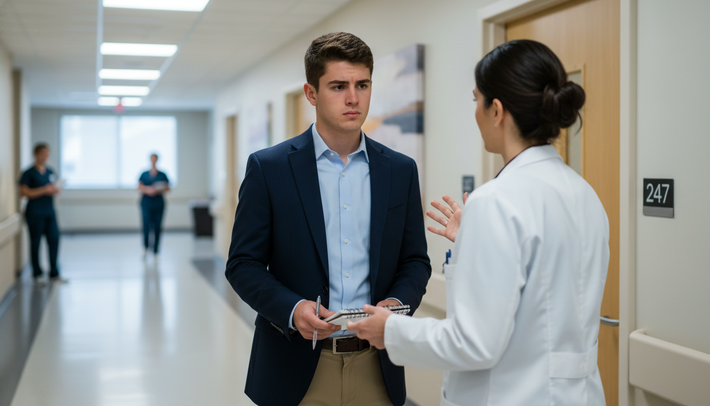
You just walked out of clinic after a full day of shadowing.
Your brain’s buzzing with new terminology, complex cases, and that one awkward silence in the exam room you keep replaying.
You get home, throw your bag down, open your laptop… and then you hesitate.
“Should I email them now? Wait a day? Ask for a letter? Ask to come back? Do I say ‘thanks’ or write a full essay?”
This is exactly where students quietly sabotage themselves.
You can do the shadowing perfectly, show up on time, dress appropriately, ask good questions — and then lose 90% of the value by mishandling the follow‑up.
Let’s walk through the biggest follow‑up mistakes after shadowing a physician, so you don’t blow it after you’ve already done the hard part.
(See also: Shadowing in the OR: Safety and Sterility Errors You Must Avoid for more details.)
1. The Silent Treatment: Not Following Up at All
The most common mistake is also the simplest.
You finish shadowing, you’re “pretty sure they know you’re grateful,” and you move on with your life.
From your side, it feels neutral.
From the physician’s side, it can look careless, entitled, or simply forgettable.
Why this is a serious mistake
- You signal that their time did not matter enough to acknowledge.
- You blend into the crowd of students they barely remember.
- You close the door on:
- Future shadowing opportunities
- Research or volunteer recommendations
- A potential letter of recommendation later
Physicians are used to busy, appreciative students.
They are not used to students who disappear completely.
How to avoid it
Don’t overthink. Do not delay.
Rule: Send a follow‑up thank you email within 24–48 hours of your last shadowing session.
Include:
- A clear subject line:
- “Thank you for the opportunity to shadow – [Your Name]”
- Specific details:
- One or two cases you found particularly meaningful (de‑identified)
- One thing you learned about patient care, decision making, or the specialty
- A brief sentence about:
- How this experience shaped or confirmed your interest in medicine
Skipping this step is like seeing the attending extend their hand and you just walk past them.
2. The Overly Casual or Sloppy Email
On the other extreme: you do follow up — but your email reads like a text to your roommate.
“Hey Dr. B! Thx for letting me shadow, it was cool!!!”
Or worse, “Hi Dr. John” when their name is Dr. Johnson and it’s right there in their email signature.
Red flags physicians notice immediately
- Typos in their name or title (Dr. Smith vs. Dr. Smyth)
- No greeting or sign‑off
- Text-speak or emojis
- Writing like a DM:
- “lol that one guy was wild”
- “you seemed kinda annoyed with that nurse haha”
- Walls of text with no structure
You’re not just “being yourself.”
You’re signaling how you’ll communicate with patients, staff, and colleagues.
How to avoid it
Treat this like professional correspondence, because it is.
Checklist before you hit send:
- Subject line is clear and specific.
- Start with:
- “Dear Dr. [Last Name],” or
- “Hello Dr. [Last Name],”
- Spell their name correctly. Triple-check.
- Use full sentences.
- No slang, no emojis, no “u” instead of “you.”
- End with:
- “Sincerely,” / “Best regards,”
- Your full name, school, contact info
Example (tight, respectful, and safe):
Dear Dr. Patel,
Thank you again for allowing me to shadow you in clinic yesterday. I really appreciated observing how you explained complex imaging results to patients in a way they could understand. Watching you walk a patient through their new diagnosis without overwhelming them was especially impactful.
This experience gave me a much clearer picture of what internal medicine looks like day to day, and it reinforced my desire to pursue a career focused on longitudinal patient care.
Thank you for taking the time to answer my questions between visits. I’m very grateful for the opportunity.
Best regards,
[Your Full Name]
[Premed Student, University X]
[Email] | [Phone]
Do not make them work to figure out who you are, where you’re from, or why you’re writing.
3. Asking for a Letter of Recommendation Way Too Early
One of the fastest ways to turn a mentor possibility into an awkward “no” is asking for a letter of recommendation after a single afternoon of shadowing.
You spent 4–8 hours with them.
They don’t know:
- How you work
- How you handle responsibility
- How you perform academically
But you’re ready to ask for a letter that’s supposed to describe your character and potential as a future physician?
Why this is a dangerous move
- It puts them in a corner:
- Say yes → write a generic, weak letter
- Say no → feel uncomfortable and maybe less willing to keep working with you
- It can feel transactional:
- “Thanks for your time, now please produce a deliverable for my application.”
- It shows poor judgment about what a strong letter requires
A shadowing-only relationship usually does not justify a letter for:
- Medical school
- Residency
- Competitive programs
The safer approach
Do not ask for a letter after limited contact.
Instead:
- Focus on building a relationship over time.
- See if they:
- Invite you back to shadow again
- Offer to answer future questions
- Take an interest in your path
If, months later, you’ve:
- Shadowed multiple times
- Maybe worked with them on a project, clinic role, or research
- Had several meaningful conversations
Then you can ask more tactfully:
“Do you feel you know me well enough to write a strong letter of recommendation for my medical school applications?”
That wording gives them space to decline honestly.
Asking hard and early is a mistake you do not want to make.
4. Turning the Thank‑You Into a Networking Grab Bag
Another common misstep: cramming every possible favor into one follow‑up email.
Some students write:
- “Can you proofread my personal statement?”
- “Do you know anyone at [Specific Med School] to introduce me to?”
- “Could I get a letter from you?”
- “What do you think of my school list?”
- “Can I shadow your colleagues too?”
All in the first or second email. Right after shadowing. No relationship yet.
Why this backfires
You come across as:
- Transactional
- Self-focused
- More interested in what they can do for you than what you learned from them
Busy physicians will often:
- Ignore the email
- Respond with a very generic “best of luck” answer
- Mentally move you into the “I don’t need to invest more in this student” box
A better way to handle future asks
Step 1: Start with gratitude only.
Your first follow‑up email should be primarily a thank‑you, with maybe one brief line such as:
“If you ever feel it would be appropriate to have a student back in clinic, I’d be grateful for the opportunity to learn more.”
Step 2: Let time and rapport build.
If they respond kindly or invite you back, that’s your signal this relationship might have room to grow.
Step 3: Ask for one thing at a time.
- After a few shadowing sessions:
- “Would it be alright if I emailed you in a few months with a question about choosing between two programs?”
- Later, once you know each other better:
- “I’m working on my personal statement. Would you be open to giving brief feedback from a physician’s perspective?”
Do not stack requests.
You’re not writing a grant proposal; you’re building trust.
5. Oversharing or Breaking Professional Boundaries
Students sometimes feel so comfortable after shadowing that their follow‑up crosses a line — clinically, personally, or both.
Common boundary mistakes:
- Mentioning identifiable patient details in an email
- Sending photos from clinic or hospital areas where photos weren’t explicitly allowed
- Venting about staff, nurses, or specific patients
- Sharing your own deeply personal medical or mental health history in great detail
Shadowing is your entry into a professional world with strict privacy and conduct rules. Your follow‑up must reflect that you understood those boundaries.
HIPAA and confidentiality landmines
You might write:
“I was really moved by the 45-year-old man with metastatic colon cancer we saw at 3 pm…”
Combine age, diagnosis, time of visit, and setting, and you’ve potentially described an identifiable patient in writing.
Better:
“I was really moved by the patient we saw in the afternoon who was facing a new serious diagnosis…”
Be general. De‑identify.
If you’re not sure it’s de‑identified enough, make it more vague.
Emotional oversharing
It is fine to say:
- “This experience made me reflect a lot on my grandfather’s illness.”
- “Shadowing you helped me process why my own hospital experiences inspired me to pursue medicine.”
It is not fine at this stage to send a three-page trauma narrative expecting the physician to act as counselor or therapist.
You want them to see you as:
- Self‑aware
- Reflective
- Professional
Not as someone whose boundaries are blurry.
6. Ghosting Future Communication
Another quiet mistake: you do write a nice thank‑you email, and the physician responds warmly:
“Glad to have had you in clinic, feel free to reach out if you have more questions.”
Then you never reply.
No “thank you for your reply,” no future questions, nothing.
Later, when you suddenly email them seven months down the line saying:
“Can you write me a letter for my AMCAS application?”
They have to dig back in their memory to even match your name to a face.
What this looks like to them
- You only reappeared when you needed something.
- Their initial openness wasn’t reciprocated.
- You view them more as a vending machine for letters than a mentor.
The low-effort way to avoid this
You don’t need to email weekly. That would be weird.
But you can:
- Reply to their initial response with a one-line “thank you again”
- Reach out once every few months with:
- A concise update (“I took the MCAT, I’m applying next cycle”)
- A genuine question (“How did you decide between your top two residency programs?”)
You’re making it easy for them to remember you when – and if – the time comes to advocate for you.
7. Ignoring Their Time Constraints
Physicians often answer emails late at night, between cases, or during short breaks. Their inbox is already overflowing.
Mistakes students make:
- Sending huge blocks of dense text with no paragraph breaks
- Asking five complex career questions in one email
- Expecting same‑day replies, then following up again with, “Just bumping this up!”
- Sending attachments without explanation or request (“Here’s my 3-page draft, what do you think?”)
Why this hurts you
They might:
- Skim and forget to reply
- Feel irritated and less eager to help further
- Only give you a superficial response
How to respect their time
If you’re going to ask a question:
- Keep the email under a few short paragraphs.
- Ask one main question at a time.
- Phrase it so it can be answered in 2–5 minutes.
For example:
“You mentioned in clinic that you initially considered emergency medicine but chose internal medicine instead. If you have time, could you briefly share the biggest factor that shaped that decision for you?”
That’s answerable.
“What’s your life advice for premeds?” is not.
Do not chase them with multiple “just wanted to check if you saw this” emails. If they don’t respond after a week or two, you can send one polite follow‑up. Then stop.
Relentless nudging crosses from “persistent” to “disrespectful” very quickly.
8. Failing to Capture and Reflect on What You Learned
This mistake is quieter and more internal, but it matters for your future applications.
Some students:
- Shadow
- Send a basic thank‑you
- Move on
- Then months later, cannot remember specific details, insights, or moments to write or talk about
When interviewers ask:
- “What did you learn from shadowing physicians?”
your answer becomes vague and generic.
That makes it sound like your shadowing was checkbox‑driven, not growth‑driven.
How to avoid this (and still keep it professional)
In your follow‑up, explicitly name what you learned:
- Communication skill you admired
- Clinical reasoning moment that stood out
- How they handled uncertainty or difficult news
Then, privately (not in the email), write down:
- 2–3 specific patient encounters (de‑identified) that impacted you
- What you noticed about the physician’s approach
- What you learned about yourself as a future clinician
Your future self — writing secondaries or answering “tell me about a clinical experience” on interview day — will be very grateful you did this.
9. Acting Like a Peer Rather Than a Trainee
Shadowing can be relaxed. Some physicians are incredibly friendly. They crack jokes, ask about your hobbies, share their frustrations with the system.
The trap: you mistake warmth for equality and then your follow‑up email shifts tone too far.
Examples:
- “Haha you were savage with that resident, that was hilarious”
- “You seemed pretty annoyed with the nurse today – I don’t blame you lol, she was slow”
- “Man, those patients were a lot…”
Remember, you’re not debriefing with a classmate. You’re corresponding with someone who:
- Supervises trainees
- Evaluates professionalism
- Protects their own reputation and team dynamics
Even if they vent around you in clinic, your follow‑up must stay on the high road.
Focus on:
- What you admired
- What you learned
- How they modeled professionalism, even in tough moments
If your email can be screenshotted and shared with their colleagues without embarrassment, you’re safe. If not — don’t send it.
FAQ (Exactly 5 Questions)
1. Should I send a handwritten thank‑you note or is email enough?
Email is usually sufficient and more practical because physicians often communicate primarily online. A handwritten note can be a nice touch if you already have their office address and won’t be creating work for staff to figure out who you are. Do not delay your appreciation waiting to buy a card; if you’re going to be late with a handwritten note, send an email first, then the card if you want.
2. What if I forgot to follow up and it’s already been a few weeks?
Do not assume the opportunity is lost, but do not pretend it hasn’t been awhile. Send a brief, honest email acknowledging the delay (“I apologize for the late note; the start of the semester got away from me, but I didn’t want to miss the chance to thank you…”). Keep it focused on gratitude, not excuses. You may not get a deep relationship out of it, but it’s still better than silence.
3. Is it okay to connect with the physician on LinkedIn or social media after shadowing?
LinkedIn is generally acceptable if your profile is professional and your connection request includes a short note (“Thank you again for letting me shadow…”). Be cautious with personal social media like Instagram or TikTok; many physicians won’t want to mix their professional and personal spheres with students. Never message them on casual platforms about clinical experiences or patient details.
4. How do I know if it’s appropriate to ask to shadow again?
Look for cues in their behavior and emails. If they said things like “Feel free to come back anytime” or “We often have students return,” a polite request is reasonable. If they seemed rushed, disengaged, or emphasized how busy the clinic was, consider that a sign to wait or not ask. When you do ask, phrase it in a way that makes it easy to say no: “If your schedule allows and you feel it would be appropriate, I’d be very grateful for the chance to shadow again.”
5. Can I mention specific shadowing experiences in my personal statement if I only shadowed a few times?
Yes, as long as the experience was meaningful and you protect patient confidentiality. The mistake isn’t using brief shadowing experiences; the mistake is exaggerating your role or making it sound like you had direct responsibility. Describe what you observed, what you learned, and how it influenced your understanding of medicine — not what you “did” for patients as a mere observer.
Key points to remember:
- A prompt, specific, and professional thank‑you email within 24–48 hours protects the value of your shadowing experience.
- Do not rush into asking for favors — especially letters of recommendation — before a real relationship and track record exist.
- Every follow‑up message should reflect professionalism, respect for boundaries, and awareness of how busy physicians truly are.