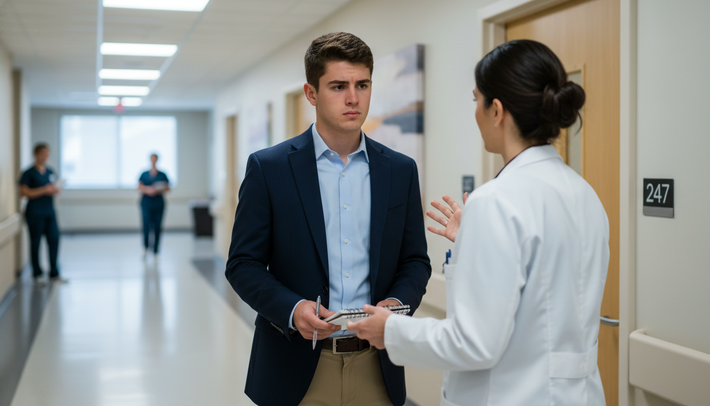
Shadowing emails fail more from preventable mistakes than from a lack of opportunities.
Most physicians are not hostile to students. They are busy, skeptical, and trained to filter out noise. Your email can either signal “serious future colleague” or “extra work / ignore.” The difference is rarely your GPA; it is almost always your approach.
You are not competing with “perfect” students. You are competing with students who send lazy, vague, or demanding messages and then wonder why no one replies.
Let us walk through the 10 most common shadowing outreach mistakes that quietly sabotage strong applicants—so you do not repeat them.
1. Sending One Generic Email to Everyone
The fastest way to be ignored is to send a copy‑paste email that could have gone to any physician in any specialty at any institution.
Premeds routinely do this:
“Dear Doctor, I am very interested in medicine and would love to shadow you to learn more.”
(See also: Shadowing in the OR: Safety and Sterility Errors You Must Avoid for more details.)
No mention of:
- The physician’s specialty
- Their practice setting
- Their institution
- Anything about why this specific person was chosen
This reads like spam. Busy clinicians have learned to ignore it.
Red flags of a generic email:
- “To whom it may concern” or “Dear Sir/Madam”
- No reference to their specialty: “as a cardiologist,” “as an emergency physician,” etc.
- Vague interest: “I am very interested in medicine”
- Sent in bulk with everyone BCC’d (or worse, CC’d)
Physicians want to see that you:
- Know who they are
- Know what they do
- Have a reason for choosing them
If you want an easy test: remove their name and specialty from your draft. If the email still “works” for any random doctor, it is too generic.
Avoid the mistake:
- Read their faculty page or practice bio.
- Reference one concrete detail: “I noticed you work both inpatient and outpatient in endocrinology,” or “I see that you practice at the county hospital and the VA.”
- Modify 2–3 sentences per physician so the email is clearly tailored.
Generic emails do not read as “efficient.” They read as “low effort,” which translates to “probably low effort in person too.”
2. Writing Walls of Text (or One‑Line Emails)
Overly long emails and ultra‑short emails both send the wrong message.
Some students write five-paragraph essays about their life story, every extracurricular, and why they have “always dreamed” of medicine. Physicians do not have time to read a personal statement in their inbox.
Others go to the opposite extreme:
“Hi, can I shadow you? Let me know. Thanks.”
Both are self‑sabotage.
Too long suggests:
- You may be needy or high‑maintenance
- You will overtalk in clinic and slow them down
- You do not respect time constraints
Too short suggests:
- You have not thought carefully about this
- You do not understand professional communication norms
- You expect them to do the work of figuring out what you want
Aim for 150–250 words. Clear, structured, and easy to skim.
A solid structure:
- Brief introduction (who you are, where you study, stage: premed / M1, etc.)
- One or two specific reasons you are reaching out to them
- Clear, modest ask with flexibility on dates
- One line on your reliability / professionalism
- Thank you and sign‑off
If your email would require them to scroll twice on a phone, it is probably too long. If they could read it out loud in under 15 seconds and still not know who you are or what you want, it is too short.
3. Making the Email About What They Can Do for Your Application
This mistake is deadly and surprisingly common.
Lines like:
- “I need shadowing hours for my medical school application.”
- “I am short on clinical hours for my AMCAS.”
- “I need 20 shadowing hours before June.”
You might think you are being honest and transparent. What they hear is:
“You are a checkbox for my CV. I care about the hours, not the learning or the patients.”
Physicians do not want to feel like a transactional requirement.
They will be much more receptive if you frame shadowing as:
- Curiosity about their specialty or practice
- Desire to understand patient care better
- Interest in seeing how physicians think and make decisions
The benefit to your application can be true without being front‑and‑center in the email.
Better framing:
- “I am exploring internal medicine and would be grateful for the opportunity to observe how you manage complex chronic conditions in an outpatient setting.”
- “As someone considering psychiatry, I would value the chance to see how you build rapport and navigate challenging conversations with patients.”
You are still building your application, but you are not announcing, “You are my hours machine.”
Center the learning. Let the admissions benefits stay in the background.
4. Being Vague or Sloppy About Logistics
Many shadowing request emails fail because the physician cannot easily imagine what saying “yes” would entail.
Vague ask:
“Could I shadow you sometime?”
Clear ask:
“Would it be possible to shadow you for 1–2 half‑days sometime between March 10 and April 5? I am available Monday, Wednesday, and Friday mornings but can be flexible based on your schedule.”
The first puts all the work on them. The second shows:
- You have thought about your schedule
- You understand they will need to fit you in
- You are flexible and respectful of their time
Students also make avoidable logistical mistakes:
- Not stating where they are located or willing to travel
- Not indicating if they have a car / can get to multiple sites
- Not acknowledging that different hospitals have different clearance rules
You do not need a detailed logistics plan, but you must show you understand that shadowing is not as simple as “just show up.”
Better logistics language:
- “I currently live in Chicago and can commute to any of the Northwestern or affiliated hospitals.”
- “I recognize that some hospitals require paperwork or clearance for observers, and I am happy to complete any necessary steps.”
This reassures them you are practical, not naive.
5. Ignoring Institutional Policies and HIPAA Concerns
Nothing turns off a risk‑aware clinician faster than an email that suggests you have never considered privacy, liability, or institutional rules.
Problem phrases:
- “Can I just come in one day and follow you around the hospital?”
- “I would love to sit in on surgeries and maybe take some photos for my premed club.”
- “I can just stand quietly in the corner, no need for paperwork.”
This is a major red flag. Hospitals and clinics have strict policies. Many require:
- Proof of vaccination
- Background checks
- Signed HIPAA/confidentiality forms
- ID badges
- Specific observer approval processes
If your email suggests you expect an informal, rule‑free arrangement, you look unsafe.
What to do instead:
- Explicitly acknowledge institutional policies:
- “I understand there may be institutional or HIPAA‑related requirements for observers, and I am prepared to complete any necessary forms or trainings.”
- Avoid asking to see “absolutely everything”
- Do not joke about confidentiality, photography, or recording
You want them thinking, “This student will not get me in trouble.” Your wording must reflect that.
6. Unprofessional Tone, Grammar, or Email Address
Many otherwise strong students lose credibility in the first line of their message.
Red‑flag elements:
- Casual openers: “Hey,” “Yo,” “Sup doc,” “Hi there doc!”
- Overly familiar language: “I’d love to hang out with you in clinic.”
- Emoji or texting shorthand: “I’m super interested in surgery lol”
- Typos, run‑on sentences, inconsistent capitalization
- An unprofessional email address:
sk8rboi99@...,partygirl420@...
You are asking a physician to sponsor your presence around vulnerable patients. Sloppy communication makes you look careless.
Baseline standards:
- Use a neutral, professional email: ideally your university address, or something like
firstname.lastname@... - Open with: “Dear Dr. [Last Name],” or “Dear Dr. [Last Name] and Team,”
- One exclamation mark at most, and not in every sentence
- Run spellcheck. Then read it aloud once.
Do not overcompensate with stiff, archaic language or flattery. Avoid things like “Most esteemed and honorable Dr.…” or paragraphs of praise about how “inspiring” they are.
Aim for clear, respectful, concise. That is what reads as professional in medicine.
7. Asking for Too Much, Too Soon
Another common failure: you ask for such a big commitment that “no reply” feels like the safest option for them.
Overreach examples:
- “Can I shadow you full‑time for the entire summer?”
- “Would you be willing to mentor me, write me a letter of recommendation, and let me shadow regularly for the next 2 years?”
- “Can I scrub into your surgeries this month and maybe assist?”
You have not met them. You have not earned that level of trust.
When the first interaction is a heavy ask, clinicians are more likely to ignore the email than negotiate you down to something reasonable.
Safer initial asks:
- “Would 1–2 half‑days of shadowing be possible, if your schedule allows?”
- “If it works with your clinic, even a single session observing would be valuable to me.”
Start small. Once you demonstrate you are:
- Punctual
- Discreet
- Engaged but not intrusive
Then you can sometimes extend:
- “If it is helpful, I would be grateful for any opportunity to return for additional sessions.”
But asking for letters, research positions, or long‑term mentoring in the first email screams “I see you as a resource to exploit,” not “I respect your time and boundaries.”
8. Poor Targeting and Not Using Existing Networks
A subtle but costly mistake: emailing random physicians with no connection to you and ignoring the easier, safer channels right in front of you.
Students often:
- Cold email physicians at distant academic hospitals they have no link to
- Ignore their own college’s premed advising office
- Skip department coordinators, alumni networks, and volunteer coordinators
- Go straight for “famous name” doctors because of a paper they saw on PubMed
Random cold emails can work, but your odds are worse if:
- You are unknown to the institution
- You do not reference any common ground
- You are clearly targeting prestige instead of access
Physicians are far more likely to respond if:
- You attend the same university
- You were referred by a mutual contact
- You connected briefly after a talk, grand rounds, or premed event
Better approach than blind blasting:
- Use your college’s career or pre‑health office list of alumni physicians.
- Ask current or former students which physicians at the local hospital are open to shadowing.
- Email department or clinic coordinators: “Is there a process for students interested in observing?”
- When you do cold email, mention concrete ties: “I am a junior at X College, and I see that you also completed residency at Y,” or “I volunteer at the same hospital where you practice in the ED.”
This matters because shadowing is a trust‑dependent activity. Physicians feel safer saying yes when there is some institutional or personal connection anchoring your request.

9. Failing to Follow Up Properly (or at All)
Many premeds send one email, never hear back, and immediately assume, “They hate me,” or “I am not competitive enough.”
In reality:
- They were on call and your email sank
- They meant to respond but got 40 other messages that afternoon
- They forwarded your email to an office coordinator who never followed up
Silence does not always mean “no.” Often it means “busy.”
The mistake is either:
- Never following up
- Or following up too frequently / aggressively
Healthy follow‑up pattern:
- Wait 7–10 days after the first email.
- Send one concise follow‑up, replying to your own thread:
- “Dear Dr. X, I wanted to follow up on the note below in case it was buried in your inbox. I remain very interested in any opportunity to observe your clinic if feasible. I understand your schedule is demanding and completely understand if this is not possible at this time. Best regards, …”
- If no reply after the second message, you can send one final follow‑up ~2–3 weeks later only if there is a specific reason (e.g., approaching time window).
- Then stop.
Do not:
- Send daily follow‑ups
- Call their office repeatedly asking, “Did you get my email?”
- Show up unannounced at their clinic
That shifts you from “persistent” to “boundary‑blind,” which is exactly the type of student they are trying to avoid.
10. Ignoring Basic Safety and Boundary Concerns
Shadowing is not just about you learning; it is about protecting patients and clinicians. Some outreach emails unintentionally signal risk.
Red‑flag content includes:
- Asking detailed clinical questions or for medical advice about a friend or family member
- Implying you want to use patient stories or images for your social media, blog, or YouTube channel
- Talking about “recording the day” or “capturing footage”
- Asking to sit in on extremely sensitive encounters (e.g., psychotherapy, oncology disclosure conversations) as if they are “cool experiences”
These things scare away cautious physicians, rightly so.
Your email should make clear that you:
- Respect patient privacy
- Understand shadowing is observational, not participatory
- Will defer to them on which encounters are appropriate
Simple language helps:
- “I understand that some patient encounters are too sensitive for observers, and I will always defer to your judgment and the team’s comfort.”
- “I do not intend to record, photograph, or post about any clinical experiences. My goal is strictly to learn by observing.”
You are trying to signal: “I will not create a legal, ethical, or reputational problem for you.” That reassurance matters as much as your GPA or MCAT.
Putting It All Together: A Safe, High‑Yield Approach
You do not need a perfect email. You need an email that avoids the major red flags above and makes it easy to say “yes.”
A quick mental checklist before sending:
- Is this clearly written to this specific physician or clinic?
- Can they understand who I am, where I am, and what I am asking in under 20 seconds?
- Does this respect their time, institutional rules, and patient privacy?
- Am I starting with a small, reasonable ask?
- Does my tone sound like an early professional, not a casual friend or desperate applicant?
If you can honestly say yes to those, you are already ahead of most students.
Final Takeaways
- Most shadowing emails fail because of preventable mistakes—generic content, unreasonable asks, unprofessional tone, and ignorance of institutional rules.
- Physicians respond best to concise, tailored, safety‑aware messages that show respect for their time, their patients, and their boundaries.
- Start small, be specific, and follow up once or twice professionally; your goal is not just to get hours, but to show you are the kind of future colleague they would actually trust in their clinic.