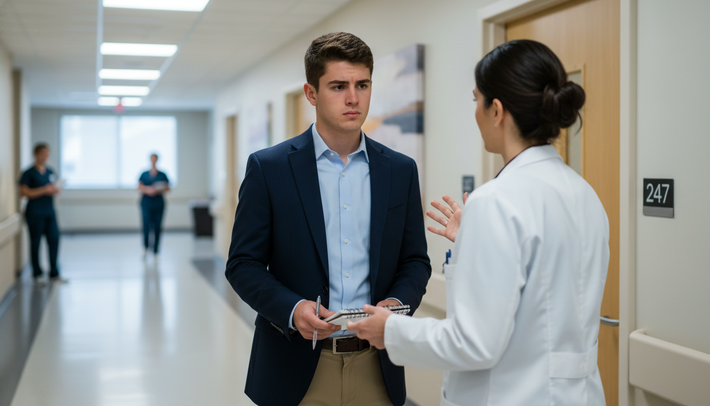
You swipe into the hospital at 6:58 a.m., palms sweaty, your brand‑new notebook in hand. You found the department… sort of. You are standing awkwardly near the nurses’ station, not sure who to talk to, refreshing an email that does not tell you exactly where to go. The physician you are supposed to shadow walks by, glances at you, and asks, “Are you with us?” You freeze.
That is how a lot of disastrous first‑day shadowing stories begin.
You only get one “first day” with a doctor. Blow it badly enough, and you will not just lose that shadowing spot. You can quietly get yourself blacklisted from that office, that department, sometimes that entire hospital system. Physicians remember the student who created extra work, broke rules, or made patients uncomfortable.
You are not trying to be that story.
This is the protective guide to the worst first‑day shadowing mistakes that get you uninvited—and how to stay far away from all of them.
1. Showing Up Unprepared (You Look Like a Liability)
The fastest way to make a physician nervous about you is to show up looking like someone they have to manage, not someone they can trust to stand quietly in the corner. The bar is not high, but too many students still trip over it.
(See also: The Biggest Follow‑Up Mistakes After Shadowing a Physician for more details.)
Not Knowing the Basics of Where/When/Who
Red flag behaviors:
- Arriving at the wrong building or floor because you never confirmed logistics
- Wandering around asking, “Is this where Dr. Patel works?”
- Showing up exactly at start time instead of early, so any delay makes you late
- Not knowing the physician’s full name or specialty
To avoid looking careless:
- Confirm 24–48 hours before: clinic address, building, floor, start time, and any check‑in instructions.
- Ask: “Is there a front desk or check‑in area I should report to first?”
- Plan to be there 20–30 minutes early on day one. If commuting in a new city, do a mental or physical dry run.
If you walk in flustered and lost, the team is already thinking: If they cannot manage getting here, can they follow infection control instructions? HIPAA? That is not the question you want in their minds.
Ignoring Required Paperwork and Training
Clinical spaces are regulated environments. One common “you are done here” mistake:
- Arriving without:
- Required immunization records or TB test documentation
- Completed HIPAA/confidentiality forms
- Hospital badge (if instructed to obtain one beforehand)
- Any required online orientation printouts or confirmations
What happens next? The physician discovers you cannot go near patients. You spend hours the staff does not have trying to fix your paperwork. Some clinics will simply send you home and never reschedule.
Protect yourself by:
- Before day one, explicitly asking:
- “Do I need any specific vaccinations documented?”
- “Is there a HIPAA or compliance module I should complete before starting?”
- “Will I need a badge, or will I sign in as a visitor?”
Show up without this, and you look like a compliance risk, not a future colleague.
2. Dressing Wrong (You Send the Wrong Signal in 3 Seconds)
Fair or not, medicine is still a very conservative environment. Your outfit can get you silently uninvited before you say a word.
Looking Casual, Trendy, or Sloppy
Major first‑day shadowing mistakes in dress:
- Wearing jeans, leggings, or joggers
- Sneakers that look like gym shoes (instead of clean, simple, professional footwear)
- T‑shirts, low‑cut tops, tight dresses, crop anything
- Strong perfume/cologne that lingers in exam rooms
- Long, loose hair not tied back in clinical settings
- Chipped neon nail polish, long acrylic nails, or large hoop earrings dangling into the sterile field
A cardiologist may not confront you about your ripped jeans. They will just not invite you back.
Aim for “boring professional”:
- For most outpatient clinics and non‑OR settings:
- Neutral slacks or chinos
- Conservative blouse/button‑down
- Closed‑toe flats or simple dress shoes
- Minimal jewelry, subtle colors
- Tie back long hair. Keep nails short and clean.
If you are unsure, ask: “Is business casual appropriate, or should I wear more formal attire?” Then err a level more formal on day one.
One more subtle trap: wearing your white coat (if you have one) without being instructed. Some physicians are fine with it. Others see it as presumptuous. On day one, bring it in your bag, ask, then follow their lead.
3. Violating Confidentiality and Patient Trust (The Fastest Way to Be Removed)
This is the big one. Students often underestimate how sensitive patients and institutions are to privacy. A single careless comment can end your shadowing immediately.
Talking About Patients Outside the Clinic
Common but lethal missteps:
- Posting anything about the day on social media:
- “Saw a crazy trauma case today, wow”
- “Clinic with Dr. Robertson was wild – patient with [rare condition] came in, so cool to see IRL!”
- Texting friends details that could identify a patient: age, diagnosis, time, location
- Discussing cases loudly in elevators, cafeterias, public hallways
Even if you never write a name, combinations of details can be identifying, especially in small communities or rare diseases. Hospitals have terminated students over careless Instagram stories that included monitor screens or hospital logos plus case details.
Your rule:
If you did not live it, you cannot retell it with identifying detail.
You are there to learn, not to produce content.
Not Respecting Patients’ Right to Decline
Another form of trust violation: lingering when you are explicitly not wanted.
Mistakes that make staff uncomfortable:
- Staying in the room even after the physician says, “This is a sensitive exam, I will have the student step out,” and you hesitate or look annoyed
- Not leaving promptly when a patient looks uncomfortable and says, “I would prefer to speak with the doctor alone”
- Trying to convince patients: “I am just a student, it is okay, I am trying to learn” (never do this)
On your first day, signal clearly that you understand hierarchy and patient autonomy:
- The moment anyone suggests you step out, you move. Quickly. Quietly. No sighing, no eye‑rolling, no visible disappointment.
Physicians notice. Many will test this once. If you make the patient’s comfort secondary to your learning, you will not be invited back.
4. Acting Like You Are Part of the Care Team (You Are Not)
Shadowing is observing. Not co‑managing. Not half‑participating. When students blur that line, the legal and ethical risks skyrocket.
Touching Patients or Equipment Without Explicit Permission
Some of the worst first‑day moves:
- Listening with the physician’s stethoscope to “practice” without them explicitly inviting you
- Palpating an abdomen or checking a pulse because “you have done it in EMT class”
- Reaching for syringes, instruments, or medication vials in the OR or procedure room
- Adjusting ventilators, pumps, or monitor settings under the illusion of helping
One mistake like that can be career‑level damaging if something goes wrong.
Your rule: You do nothing clinical without:
- The physician explicitly asking you to
- Clear boundaries (“Place your hand here while I listen,” “You can listen after I do, but do not change any settings”)
If you are ever uncertain: “Is it okay if I …?” If they pause, look unsure, or say “maybe later,” you do not push.
Giving Opinions, Advice, or Explanations to Patients
Other students have made this mistake for you. Physicians are now wary.
Disqualifying behaviors:
- Answering patient questions about their condition when the physician is out of the room
- Saying things like, “I think you might have…” or “It’s probably nothing serious”
- Explaining lab results or imaging findings that you half‑understand
- Translating medical information inaccurately to family even if you speak the language (unless explicitly asked by staff, and even then, be careful)
If a patient turns to you and asks, “So what does that mean?” your safest default:
- “I am a premedical student, so I am just observing today. That is a good question for Dr. ____. I can ask them to come back in.”
You are there to learn how they communicate, not to experiment with your own explanations in front of vulnerable people.
5. Being a Burden on the Team (They Do Not Want Extra Work)
On a busy service, any extra decision, interruption, or demand is noticed. Shadowing students get quietly dropped from schedules when they require more effort than they are worth.
Needing Constant Hand‑Holding
What drains physicians quickly:
- Asking logistical questions you could answer yourself by watching once
- Interrupting mid‑encounter to ask, “What does that medication do?”
- Repeatedly wandering off and needing to be found
- Asking, “What should I do now?” every 10 minutes
The first day is not the time to demonstrate your curiosity by volume.
Instead:
- Watch first. Write down non‑urgent questions.
- Ask them:
- In hallways between patients
- At natural workflow breaks
- At lunch or the end of the session
Frame questions efficiently: “You used X medication a lot this morning. Could you explain briefly how you think about when to choose it versus Y?” You are respecting their time while showing engagement.
Forgetting That Breaks and Food Are Not Scheduled Around You
On your first shadowing day, you may not get a clear lunch break. Clinics run behind. OR cases go long.
What you should not do:
- Complain aloud about how hungry or tired you are
- Ask, “When is lunch?” every hour
- Walk out to get coffee without telling anyone where you are going
- Leave early because “I have to meet a friend”
If staying the full time is not possible because of another commitment, that should be disclosed before the day is scheduled.
Physicians are not expecting you to be superhuman. But they are expecting you not to become another schedule problem.
6. Poor Professionalism in Small Ways (They Add Up Fast)
Students often think unprofessional means huge, obvious lapses. In reality, a series of small signals can add up to “I do not want to work with this person again.”
Being Glued to Your Phone
High‑risk behaviors:
- Checking messages repeatedly during patient encounters
- Taking phone calls while shadowing (“It’s my mom, I have to answer”)
- Texting in the corner of the exam room while the physician is talking
- Using your phone to take notes instead of a notebook, making it look like you are scrolling
Default rule: phone on silent, in your bag or pocket, not in your hand. Pull it out only:
- Away from patients
- At a natural break
- For a clear purpose (“May I write this down?”)
If there is a genuine emergency where you must be reachable, tell the physician at the start: “I am so sorry, I normally put my phone away, but I have a family situation today where I may need to take a call. Is that okay?” Then step outside if it rings.
Being Too Casual With Staff
Office staff, nurses, and techs can get you uninvited almost faster than the physician can. They are watching how you treat them.
Common mistakes:
- Ignoring front desk check‑in staff
- Being overly familiar or joking on day one
- Standing in the middle of workstations, blocking movement
- Using first names when everyone else is using titles
- Acting annoyed when you are asked to step aside or move
The smartest thing you can do:
- Introduce yourself clearly to everyone: “Hi, I am [Name], a premed student shadowing Dr. __ today.”
- Ask: “Is there somewhere you prefer I stand so I am not in the way?”
- Say thank you often and sincerely, especially when they explain processes.
Remember: staff will complain about problem students to the physician long before they confront you directly.
7. Overstepping with Boundaries, Records, and Space
Some of the worst first‑day shadowing mistakes happen when students forget that access is not entitlement.
Accessing or Photographing Anything You Should Not
Hospital systems track access. Do not test them.
Big red flags:
- Logging into EMR (electronic medical record) systems under someone else’s credentials
- Asking staff to “show you” their login so you can peek at labs or imaging
- Taking photos of anything in the clinical space:
- Patient boards
- Computer screens
- Schedules
- Even general room shots that might capture identifiers
If you want to remember something, use:
- Handwritten notes that avoid specific identifiers
- Asking the physician if there is a textbook or online resource they recommend you read afterward
Never, under any circumstances, photograph patients, even if they say they are fine with it. You are not credentialed to manage the legal implications of that.
Crowding the Physician’s Space Physically
First‑day physical misjudgments:
- Standing too close in exam rooms, making patients feel crowded
- Hovering directly behind doctors at computers
- Leaning over their shoulder to read notes or imaging
- In the OR, drifting into sterile zones because you are trying to see better
A simple fix: ask at the start, “Where would you like me to stand in the room so that I am not in the way?” Then stay there unless invited to move.
If you are allowed in an OR, ask the circulating nurse: “Can you show me the boundaries of the sterile field?” Then treat those borders like lava.
8. Mishandling Introductions and Patient Interactions
You may think that shadowing is passive, but how you handle the first 10 seconds in each room shapes whether you are allowed in the next.
Failing to Introduce Yourself Correctly
Bad starts:
- Staying totally silent, staring at patients without context
- Introducing yourself as “Doctor” or “student doctor” when you are premed
- Launching into your story: “I am premed at [University], and I want to go into…”
Patients do not owe you their story. If you are going to be in the room, you owe them clarity about who you are.
Better approach, aligned with the physician’s lead:
- Wait for the physician to introduce you: “This is [Name], a premedical student who is observing today. Is it okay if they stay in the room while we talk?”
- If the physician expects you to introduce yourself, keep it short:
- “Hi, I am [Name]. I am a premedical student shadowing today. I am just observing and will stay out of the way.”
If the patient looks hesitant, you should already be mentally stepping toward the door.
Misreading Emotional Situations
First days can include hard encounters: new cancer diagnoses, bad prognoses, family conflicts.
Mistakes that cause instant regret later:
- Smiling or looking excited when a dramatic or rare diagnosis is discussed
- Whispering a question during tears or serious conversation
- Staying in the room for obviously deeply personal discussions if the physician has not explicitly said you may remain
You are learning not just medicine, but presence.
Default for intense moments:
- Neutral face, quiet, attentive
- If you sense this is veering into very private territory and no one has explicitly acknowledged your presence, it is often safest to step out briefly and rejoin later.
One poorly timed grin during a “fascinating” case can make the physician wonder about your maturity level.

9. Mishandling the End of the Day (Burning Bridges Quietly)
First‑day shadowing mistakes are not limited to the morning. How you leave also determines whether you will be invited back.
Leaving Without Closing the Loop
Bad endings:
- Slipping out when the schedule slows without saying goodbye
- Not asking whether the physician prefers another day of shadowing or follow‑up
- Forgetting to thank staff who helped you navigate the day
You want them to think: That student was thoughtful and easy to have around. Not: Where did they go?
Safe pattern:
- Toward the end of the planned time, ask: “Is now a good time to wrap up, or would you prefer I stay until X?”
- Thank the physician and staff specifically:
- “Thank you for letting me be here today, especially for explaining X and Y.”
If you are hoping to return:
- Say so clearly but not demandingly:
- “I learned a lot from today. If your schedule ever allows another day of shadowing, I would be very grateful. If not, I still really appreciate the opportunity.”
Over‑aggressive pursuit (“Can you write me a letter?” on day one) is another way to ensure you never hear from them again.
10. The Subtle Meta‑Mistake: Forgetting You Are Being Informally Evaluated
Even if this is “just shadowing,” you are auditioning. For a future letter, for a future research opportunity, for a future residency interviewer who has heard your name before.
Students who get uninvited usually make a cluster of these errors:
- Unprepared logistics
- Casual dress and demeanor
- Boundary oversteps
- Extra work for staff
- Poor phone and confidentiality habits
The protective mindset you want to carry into day one:
- Assume everything is observed. From how you greet staff to how fast you step out when asked.
- Minimize risk to patients and workflow first. Your learning comes second. Ironically, that attitude gets you more opportunities.
- Ask for expectations early. “Is there anything specific I should or should not do while shadowing you?”
Physicians do not expect you to know medicine. They expect you to know how to be safe, respectful, and low‑maintenance. That is it.
Key Takeaways
- The worst first‑day shadowing mistakes are not about knowledge. They are about professionalism, boundaries, and respect for patient privacy and staff time.
- You stay invited by being boringly reliable: prepared, appropriately dressed, phone away, silent on social media, and quick to step back when patient comfort or clinic flow is at stake.
- Shadowing is a quiet audition. Avoid these pitfalls, and instead of getting uninvited, you become the student they are actually glad to have in the room.