
Most applicants butcher ethics and professionalism questions because they treat them like trivia, not like landmines.
Let me be blunt: programs are no longer using behavioral ethics questions to see if you “know the right answer.” They use them to decide if you are safe. Trainable. Honest. Or a future problem on the front page of the local paper.
You want to stand out? You need a system for answering these questions—something more mature than “I would talk to my attending and follow hospital policy.”
Let me break this down specifically.
1. What Programs Are Really Screening For
Programs do not care if you can recite the four principles of bioethics on command. They care about:
- Whether you recognize risk—to patients, to colleagues, to the institution.
- Whether you default to honesty or to self-protection.
- Whether you know when to escalate versus when to handle things yourself.
- Whether you can hold tension: advocate for patients without being insubordinate.
The ethics / professionalism bucket usually covers:
- Boundary issues (patients, social media, gifts, dual relationships).
- Confidentiality and privacy (HIPAA behavior, gossip, chart access).
- Impairment and incompetence (colleague using substances, unsafe attending).
- Conflict of interest (pharma, consulting, family connections).
- Lapses in professionalism (lateness, documentation sloppiness, disrespect).
- Academic integrity (cheating, falsifying data, “helping” on tests).
Interviewers are not naïve. They know you have been trained to say “I’d follow policy and talk to a supervisor.” So they push. They add constraints. They watch whether you get rigid, defensive, or thoughtful.
The real evaluation criteria they use in their head:
- Does this person identify the stakeholders quickly?
- Do they show self-awareness of their own bias and limits?
- Can they sequence actions in a realistic order?
- Do they respect hierarchy without being a doormat?
- Would I trust this person alone at 3 a.m. when something messy hits?
Your answers should target those.
2. The 5-Lens Framework: A Structured Way To Think Out Loud
You need a mental template that works for any behavioral ethics/professionalism question. Not a script. A way of thinking.
Here is a framework I teach residents who are going on fellowship interviews:
1. Stakeholders – Who is affected?
2. Risks – What can go wrong for each stakeholder?
3. Principles & Policies – Which ethical / legal / institutional rules apply?
4. Actions & Escalation – What would you actually do, stepwise?
5. Reflection & Prevention – What did you learn and how would you prevent recurrence?
Use it like this when answering:
Start with a brief line that shows you see the complexity:
“This situation involves patient safety, team dynamics, and confidentiality, so I would start by clarifying who is at risk and what my responsibilities are.”Walk quickly through stakeholders and risks:
“The key stakeholders here are the patient, the colleague involved, the rest of the team, and the institution. The primary risk is harm to the patient through delayed or unsafe care, but also damage to trust within the team if this is handled poorly.”Drop one or two principles by name, not a lecture:
“There is a conflict between respecting my colleague and protecting the patient’s safety, so beneficence and nonmaleficence have to guide my actions, within our institutional policies.”Then give concrete steps (1–3 numbered actions or short sequence).
Close with a reflection sentence:
“After addressing the immediate issue, I would want to debrief with a supervisor to understand how to handle similar situations better and to make sure the environment supports speaking up.”
That is the skeleton. On top of it, you layer behavioral detail—what you actually said, did, and learned.
3. Behavioral Ethics Answers: The Right Structure
Behavioral questions force you away from vague theory. The classic structure is STAR (Situation, Task, Action, Result). For ethics and professionalism, STAR by itself is too shallow. You need:
S-T-A-R + R (Reflection)
- Situation – Give context, but be concise.
- Task – What was your role and obligation?
- Action – What you actually did, with 2–4 specific behaviors.
- Result – What happened, ideally with some outcome.
- Reflection – How it changed your practice or judgment.
And you have to do all that in 2–3 minutes, speaking like a normal human.
Let’s take a very common prompt:
“Tell me about a time you witnessed unprofessional behavior from a colleague.”
Weak answer:
“I saw a classmate being late and unprepared for clinic, so I talked to them, encouraged them to improve, and I would involve a supervisor if it continued because patient safety is important.”
That answer is content-free. No stakes. No conflict. No growth.
Let me show you how to use the extended STAR + Reflection structure with the 5-lens framework embedded.
4. Example: Unprofessional Colleague – Strong Behavioral Answer
Question: “Tell me about a time you witnessed unprofessional behavior from a colleague and how you handled it.”
Answer skeleton, then we will expand:
- Situation – Specific, but not gossipy.
- Task – Your responsibility, not the whole world’s.
- Action – Private approach → monitor → escalate if needed.
- Result – Patient safety protected, relationship preserved, system loop closed.
- Reflection – Comfort with difficult conversations; importance of documentation and mentorship.
Full example answer:
“On my medicine rotation, I worked with a fellow student who started showing up 30–40 minutes late for pre-rounds several days in a row. That meant our team was missing updated vitals and overnight events for a few of our sicker patients during morning rounds.
As the senior student on the team that month, I felt a responsibility both to patient care and to the team culture. The key stakeholders were the patients, our residents who relied on accurate pre-rounding, and the student themselves, who risked poor evaluations and reputation damage if this pattern continued. The main risk was that something subtle could be missed in a decompensating patient because no one had laid eyes on them before rounds.
The first step I took was a private, nonjudgmental conversation with the student after rounds, away from the team room. I framed it around patient care and shared responsibility, saying something like, ‘When you are late, we do not have the full picture on patients A and B, and it increases the chance we miss something important.’ I asked if there was anything going on that was making it hard for them to get in on time. They shared that they were struggling with transportation after a recent move.
I suggested some practical adjustments, like leaving earlier or using a different bus line, and I also made it clear—gently but directly—that repeated lateness could affect both patient care and their evaluation. I told them I would support them in problem solving, but that if it continued we might need to involve the resident to ensure the team could function safely.
Over the next week, their punctuality improved significantly; they were on time almost every day, and they actually started pre-rounding on an extra patient so we could help the intern with a heavy list. I updated our resident briefly—without shaming the student—just to let them know the issue had arisen and seemed to be resolving.
Reflecting on it, I learned that addressing unprofessional behavior early, in a private and specific way, can protect patient safety without immediately escalating or damaging relationships. It also reinforced for me that I should loop in a supervisor if the behavior did not change, because beneficence toward patients and fairness to the rest of the team have to come before my discomfort with a tough conversation.”
Why this works:
- Clear risk: missed issues on “sicker patients.”
- Clear role: “senior student,” not superhero.
- Real dialogue: you quote what you said.
- Stepwise: private → conditions for escalation → actual follow-up.
- Reflection links to principles (beneficence, fairness) without sounding like a textbook.
That is how you do behavioral ethics. Concrete but thoughtful.
5. High-Risk Scenarios and How to Handle Them
Certain topics immediately put interviewers on high alert. You can impress them if you handle these without sounding naïve or defensive.
A. Impaired or Unsafe Colleague
Common forms:
- Resident smells of alcohol, acting off during call.
- Attending making dangerous decisions or berating staff.
- Student diverting medications or admitting substance use.
Bad instinct: “I would confront them directly and tell them to stop.”
Worse instinct: “I would ignore it; it is not my place.”
What you should show:
- You prioritize patient safety.
- You understand your level and local policies.
- You avoid public humiliation but do not collude.
Sample structure (not a full monologue, but the logic):
- “First, I would quickly assess whether there is an immediate safety threat to any specific patient.”
- “Given the power differential, I would not try to manage this alone. I would contact a trusted supervisor—chief resident, attending not involved, or the program leadership—following institutional policies for reporting impairment.”
- “If possible, I would separate the impaired individual from direct patient care while support is arranged, without confronting them in front of others.”
- “I would document my concerns factually if required, recognizing this is about safety and support, not punishment.”
- “Afterward, I would seek guidance on how to process the experience to avoid burnout and cynicism.”
You are showing judgment, not heroics.
B. Confidentiality and Social Media
Everyone says, “I would protect confidentiality.” Few show they understand how it fails in real life.
Scenarios you may get:
- A co-student posts a de-identified but detailed case on Instagram.
- A nurse discusses a patient by full name at the elevator.
- You see a resident scrolling through a patient chart they are not caring for “out of curiosity.”
Your angle:
- Identify the actual HIPAA risk (re-identification, unauthorized access).
- Show you understand culture—do not respond like a cop; respond like a professional.
Example snippet:
“If a colleague posted a ‘de-identified’ case on social media but included enough detail that the patient could reasonably recognize themselves, I would first speak to them privately and point out how details like rare diagnoses, specific ages, and timing can make cases identifiable. I would ask them to remove the post and remind them of our institution’s social media policy. If they refused or this was a pattern, I would escalate to a supervisor or compliance officer, because public breaches can seriously harm patient trust and the institution.”
You do not need drama. You need a calm, procedural attitude.
C. Cheating / Academic Dishonesty
Interviewers love this one because it tests whether you prioritize “collegiality” over integrity.
Usual pitfall answers:
- “I would never be in that situation.” (They stop listening right there.)
- “I would ask them to stop but would not report it.” (Honesty fail.)
A solid spine answer looks like this:
- You recognize it as harmful: unfair advantage, trust damage, licensing risk.
- You show an attempt to address it person-to-person when safe.
- You make clear you will report through appropriate channels if it continues or is serious.
One-liner structure:
“If I directly witnessed clear cheating that impacted grades or licensing, I would talk to the person privately if I felt safe doing so, but regardless, I would feel obligated to report it through the school’s established channels, because integrity in assessment is part of protecting future patients and colleagues.”
You can then provide a brief example from pre-clinical or clerkship time, structured with STAR + Reflection.
6. Advanced Tactics: Dialing Up Your Answers From “Safe” to “Memorable”
Once you stop giving generic “follow the policy” answers, you can add layers that make you sound like a future chief resident, not just a safe intern.
Tactic 1: Name the Tension Explicitly
Interviewers respect when you articulate the conflict instead of pretending it is simple.
For example:
- “There is a tension between respecting hierarchy and advocating for the patient.”
- “There is a conflict between maintaining team cohesion and addressing serious unprofessional behavior.”
- “The challenge here is balancing cultural sensitivity with non-negotiable safety standards.”
A single line like that makes you sound like you actually live in the real world of clinical care.
Tactic 2: Use Micro-Dialogue
Drop in 1–2 sentences of what you actually said. Shows you can have hard conversations.
Examples:
- “I said, ‘I know this is uncomfortable to hear, but when you say that in front of the patient, it undermines their trust in the team.’”
- “I framed it as, ‘I might be missing something, but I am worried about this potassium level and wanted to double-check the plan with you.’”
You are showing communication skill, not just describing it.
Tactic 3: Acknowledge Uncertainty Without Collapsing
You do not have to have a perfect blueprint. You do have to show that uncertainty does not paralyze you.
A good line to use sparingly:
“I would not expect to handle this alone as a trainee, but I know it would be my responsibility to speak up and involve the right people.”
Anchors you as responsible and realistic.
7. Program Red Flags: Things That Quietly Sink You
There are certain phrases and attitudes that make people write “NO” on your evaluation, even if the rest of your application is golden.
Here are some you must avoid:
Minimizing harm:
“It was just a small breach; no one was actually hurt.”
→ They hear: I only care about problems if they explode.Loyalty over safety:
“I would not want to get them in trouble, so I would just talk to them and drop it.”
→ They hear: I will collude with dysfunction.Self-protective focus:
“I was mostly worried how it would affect my evaluation.”
→ They hear: This person will throw others under the bus if needed.Blame-heavy answers with no self-reflection:
“The attending was the real problem; I did my part.”
→ They hear: Not coachable, externalizes everything.Hero fantasy:
“I would confront the attending in front of the team and refuse to carry out the order.”
→ They hear: This person has no idea how medicine works.
If you feel your real story is dangerously close to one of these, choose a different story. Or reframe it with more humility and systemic awareness.
8. Practice Strategy: How to Actually Train This Skill
You do not “wing” ethics questions. The people who try that give long, rambling answers with no point and get filtered out as vague or risky.
Here is a simple, targeted practice plan.

| Step | Description |
|---|---|
| Step 1 | Pick Scenario Type |
| Step 2 | Write 5-bullet Outline |
| Step 3 | Practice 2-min Spoken Answer |
| Step 4 | Record and Review |
| Step 5 | Refine Stakeholders & Actions |
| Step 6 | Add Reflection Line |
| Step 7 | Repeat with New Scenario |
Step-by-step:
List 8–10 likely scenarios: unprofessional colleague, cheating, social media, boundary issue, patient refusing care, family demanding non-disclosure, impaired colleague, documentation error.
For each, outline only, using:
- 1 line Situation
- 1 line Task
- 3 bullets Actions
- 1 line Result
- 1 line Reflection
Practice out loud with a timer. Strict 2 minutes per answer.
Record 3–4 answers and listen like an attending:
- Are you clear on what you did vs what “one should do”?
- Do you sound preachy or robotic?
- Do you actually say what you learned?
Fix only one thing per round: maybe your opening line, or being more explicit about stakeholders, or cleaning up the reflection.
This way, you are training a mental pattern, not memorizing monologues.
9. Quick Comparison: Weak vs Strong Moves
To make this concrete, here is a comparison snapshot.
| Aspect | Weak Answer | Strong Answer |
|---|---|---|
| Focus | Vague “do the right thing” | Specific stakeholders and risks |
| Role clarity | “We did…” / “One should…” | “I did…”, clear scope of responsibility |
| Action steps | Single generic step | 2–4 sequenced, realistic behaviors |
| Escalation | Either none or immediate over-escalation | Thoughtful, via appropriate hierarchy |
| Reflection | “I learned professionalism is important” | Concrete change in future behavior or mindset |
Read your own practice answers against that table. If you sit on the left column, adjust.
10. Putting It Together in the Real Interview
On interview day, you will not remember every framework. That is fine. You just need 3 anchors in your head:
- See the map – Who is affected? What are the main risks?
- Take 2–4 clear steps – Private first when safe, then appropriate escalation.
- End with growth – One sentence on what changed in how you practice.
To make this more visceral, imagine you are already a PGY-2. A medical student comes to you with exactly the scenario the interviewer just described. What would you tell them to do? Say that. Calm, specific, grounded.
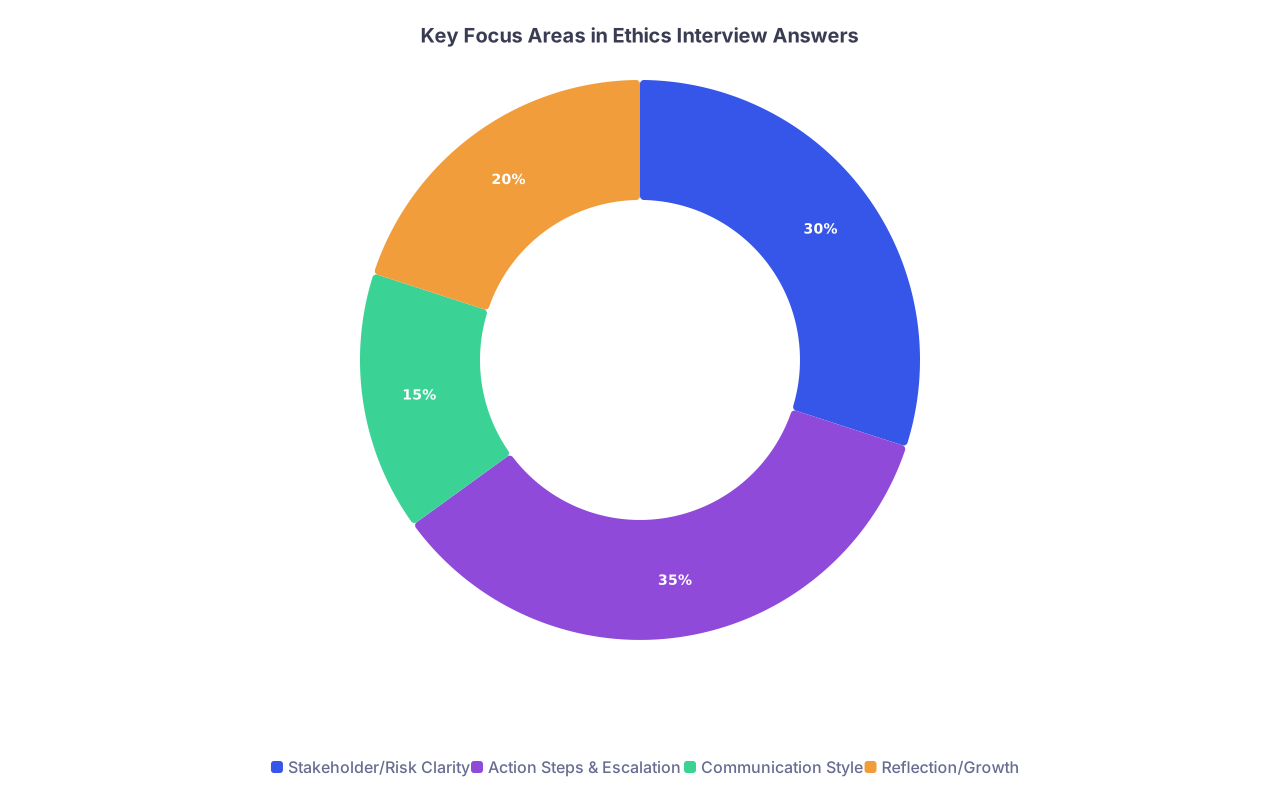
| Category | Value |
|---|---|
| Stakeholder/Risk Clarity | 30 |
| Action Steps & Escalation | 35 |
| Communication Style | 15 |
| Reflection/Growth | 20 |
The difference between a mediocre and a standout answer is rarely “knowing the rule.” It is:
- How fast you map the situation.
- How concretely you act within your role.
- How honestly you talk about your own growth.
Do that consistently, and ethics and professionalism questions stop being landmines. They become some of your highest-yield moments.
FAQ (Exactly 6 Questions)
1. Should I ever admit that I made a mistake in an ethics/professionalism answer?
Yes, if you can show mature reflection and a clear change in behavior. Programs are wary of flawless heroes. Choose a contained mistake (documentation lapse, delayed escalation, hesitating to speak up) where no catastrophic harm occurred, and emphasize what you learned and how your practice changed. If the story still makes you look unsafe now, pick a different one.
2. Is it acceptable to reference “policy” and “institutional guidelines,” or does that sound canned?
You should reference policy, but as one layer—not the whole answer. Saying “I would follow hospital policy” without any sense of stakeholders, risk, or communication is weak. Better: “Given the safety risk and my role as a trainee, I would follow our institution’s policy on impaired providers by contacting the designated supervisor, rather than trying to manage it alone.”
3. How long should my ethics/professionalism answers be in a residency interview?
Aim for 90–150 seconds. Under a minute usually means you were too vague. Over two minutes and you risk rambling. If you use the extended STAR + Reflection structure and keep your Situation/Task tight, you will naturally land in that time frame.
4. What if I have never seen something as dramatic as impairment or cheating? Can I use smaller-scale examples?
Absolutely. Many strong answers use more “mundane” situations: recurrent lateness, dismissive comments about patients, casual HIPAA slips, incomplete handoffs. The key is that the stakes are real and you can show judgment, action, and growth. Do not manufacture drama. Interviewers can tell.
5. Is it okay to say I would report an attending or senior resident if they were unsafe?
Yes, but with nuance. You should emphasize patient safety and appropriate use of hierarchy: trying to clarify first when safe, then going to a trusted attending, chief resident, or program leadership, depending on severity and urgency. Answers that sound like you would publicly confront and humiliate someone in power tend to be viewed as naive rather than courageous.
6. How many ethics/professionalism stories should I prepare before interview season?
Prepare at least 6–8 distinct stories, with some overlap in themes. For example: one about a professionalism lapse on your team, one about a communication failure, one about advocating for a patient, one about confidentiality, one about conflicting values with a family, one about your own near-miss or error, and one about receiving hard feedback. Each can be flexibly adapted to multiple questions.
Key takeaways:
- Treat ethics and professionalism questions as risk assessments, not trivia—identify stakeholders, risks, and your role.
- Use concrete, behavioral answers (STAR + Reflection) with 2–4 specific actions and realistic escalation steps.
- Show growth: you are not selling perfection; you are selling judgment, self-awareness, and reliability under pressure.