
Most applicants talk about burnout in interviews in a way that quietly scares programs.
Let me break this down specifically: programs absolutely want residents who can recognize stress, set limits, and use resources. They do not want residents who sound fragile, resentful, or like a remediation project waiting to happen. The line between those two is thin. Most people trip over it without realizing.
You are being judged on two things at once:
- Your actual experience with burnout / distress.
- Your judgment in how you present that experience.
If you mishandle either, you raise red flags.
This is how you answer behavioral questions about burnout honestly, strategically, and without tanking your application.
1. What Programs Are Really Listening For When You Mention Burnout
Let’s stop pretending this is a casual topic. The second you say “burnout,” interviewers mentally open a risk file.
They are silently asking:
- Does this person have a pattern of crumbling under pressure?
- Are they going to need constant hand-holding?
- Are they likely to complain, blame others, or disengage?
- Will they become a patient safety issue at 2 a.m. on a brutal call night?
- Am I about to sign up for three years of drama?
At the same time, ACGME and hospital leadership are hammering wellness. Programs cannot ignore it. So they are also asking:
- Does this person recognize limits and early warning signs?
- Do they seek help appropriately instead of imploding?
- Do they use healthy coping strategies?
- Can they talk about hard experiences with maturity and perspective?
Your job is to hit that second set of boxes without lighting up the first.
Here is the core principle:
Speak in the language of self-awareness, learning, and systems, not the language of victimhood, chaos, or unresolved pain.
That sounds abstract, so let’s make it concrete.
2. The Behavioral Question Traps Around Burnout
Interviewers rarely say, “Tell me about burnout.” They wrap it inside other behavioral questions. These are the usual culprits:
- “Tell me about a time you felt overwhelmed or stretched too thin.”
- “Describe a time you struggled with work–life balance.”
- “Have you ever felt burned out during medical school?”
- “How do you handle stress during demanding rotations?”
- “Tell me about a time you made a mistake or had a close call.” (often stress-related)
- “How do you maintain resilience during long hours and difficult cases?”
- “What do you do when you realize you are not at your best?”
They are testing:
- Insight: Can you recognize when you are sliding toward burnout?
- Accountability: Do you own your contribution to the situation?
- Process: Do you have repeatable strategies or just vibes?
- Growth: Did you change anything in a stable way?
If your answer is a therapy session, a rant about toxic attendings, or a martyr story where you just “pushed harder” and magically it worked out, you fail that test.
3. The Structure: A Safe, High-Yield Framework For Burnout Stories
You need structure or you will overshare. I suggest a modified STAR specifically for burnout topics:
C – Context
S – Stressors and Signals
A – Actions (internal + external)
R – Result and Reframes
L – Lasting changes
Let me walk you through each piece.
C – Context: Neutral, Brief, Professional
You want a real situation, but not your absolute worst psychological moment.
Safe categories:
- A heavy inpatient month with frequent cross-cover
- Back-to-back exam periods + major family responsibility
- A demanding sub-I where you initially misjudged capacity
- A period of overcommitment: research, leadership, clinical, all at once
Bad categories for most applicants (they can be used, but it is advanced mode and risky):
- Active major depression, suicidality, or hospitalization
- Current unresolved impairment
- Ongoing conflict with a supervisor that never got addressed or resolved
- “I hated everything about this rotation and still do”
You start with something like:
“During my third-year internal medicine clerkship, our team had a stretch of several weeks with high census and multiple very sick patients, while I was also leading a student organization preparing for a large campus event.”
That is enough. No emotional monologue yet.
S – Stressors and Signals: Name It Like a Clinician, Not a Victim
Describe both the external load and your internal early warning signs.
External: volume, schedule changes, competing demands, new responsibilities.
Internal: fatigue, irritability, loss of focus, dread, dropping performance.
What you avoid: “I was totally falling apart,” “I just couldn’t handle it,” “Everything was unfair.”
Better:
“I noticed that I was staying later to finish notes, rereading tasks because I was not processing them as quickly, and feeling more irritable and distracted when I got home. I felt less patient with my family and found myself dreading the next day rather than looking forward to learning.”
That sounds clinical, specific, non-dramatic. You are describing, not catastrophizing.
A – Actions: What You Did – Not What Happened To You
This is the meat of the answer. Split your actions into two buckets:
- Internal strategies: how you changed your habits, mindset, and routines.
- External strategies: how you used resources or adjusted the system around you.
Internal might be:
- Reprioritizing tasks
- Sleep and exercise boundaries
- Study scheduling changes
- Deliberate micro-breaks on call
- Reflection / journaling / mindfulness
External might be:
- Brief check-in with chief resident / clerkship director
- Clarifying expectations with senior/resident
- Swapping non-essential roles in an organization
- Using counseling / student health (presented as early, thoughtful, not crisis-only)
- Delegating or stepping back from one commitment with a plan, not quitting everything in a panic
Example:
“I realized I needed to adjust before my performance slipped. I first sat down and did a very direct time audit for a week—how many hours were going to the wards, to my leadership role, to studying, and to sleep. I saw that I had essentially cut out exercise and was working reactively, responding to every email immediately instead of batching tasks.
I made three changes: I blocked a non-negotiable 30 minutes of exercise three days a week, shifted my event planning emails to one set block in the evening, and created a simple checklist for my daily tasks on the rotation so I could track completion without constantly relying on memory.
I also had a candid but brief conversation with my senior resident about how I was organizing my day. He gave me very concrete suggestions for prerounding and note-writing that saved time.”
Notice: no melodrama, no learned helplessness. You look like someone who intervenes early.
R – Result and Reframes: Concrete Outcome, Not “I Felt Better”
Programs want to hear that your actions produced:
- Better performance
- More stable mood and functioning
- Safer patient care
- Improved communication
Do not exaggerate. You are not “cured.” You are more effective.
Example:
“Within about two weeks, I was leaving the hospital earlier, my notes were more efficient, and I had the bandwidth to actually read about my patients rather than constantly playing catch-up. Subjectively I felt less irritable and more present with patients; objectively I started getting more specific, behavior-based feedback from residents about improvement in my organization and follow-through.”
Tie it back to professional standards, not just feelings.
L – Lasting Changes: This Is Where You Remove The Red Flag
If you skip this, you sound like burnout is waiting to happen again next month.
You must answer, implicitly:
- “Why is this not going to blow up during residency?”
You need 2–3 durable changes you carried forward.
Think: systems, boundaries, habits.
“I have kept the time-audit approach and checklist structure and used them on subsequent busy rotations, which allowed me to take on more responsibility without feeling overwhelmed. I also built a routine of one weekly check-in with a peer or mentor about workload and stress, which helps me catch problems early rather than waiting until I am exhausted.”
That is how you close the loop.
4. Phrases That Quietly Raise Red Flags (And What To Say Instead)
Certain words make interviewers tighten up. They signal risk, lack of judgment, or unresolved resentment.
Here is a quick comparison.
| Risky Phrase | Better Alternative |
|---|---|
| "I was completely burned out." | "I was approaching burnout / felt stretched too thin." |
| "I hit rock bottom." | "I realized my current approach was unsustainable." |
| "The system was toxic." | "The environment had structural challenges / high demands." |
| "My attending was unreasonable." | "Expectations were very high and I initially struggled to meet them." |
| "I just powered through." | "I recognized I needed to change my approach, not just work more hours." |
The substance can be the same. The framing is what matters.
Three rules:
- Avoid diagnostic labels for yourself in the interview (e.g., “I have burnout,” “I was depressed”) unless you are very prepared to navigate the follow-ups. Use descriptive language instead.
- Do not attack specific people or institutions. Critique processes, not personalities.
- Do not glorify self-neglect. “I worked until I collapsed” is not a flex. It is a liability.
5. Two Model Answers: Good vs Red-Flag
Let me show you what this looks like, side by side.
Question: “Tell me about a time you felt burned out or close to it. How did you handle it?”
Problematic answer:
“During my surgery clerkship I was totally burned out. The hours were insane, the attendings were pretty toxic, and I felt like no one cared if we slept or ate. I just kept pushing because I did not want to look weak, but by the end of the rotation I was numb and checked out. Eventually I took a few days off after the rotation ended and tried to reset. I realized that surgery just is not for me and that I need a program that really prioritizes wellness.”
What an interviewer hears:
- Low resilience under high load
- Blaming faculty instead of describing systems
- “Checked out” = potential safety risk
- Only “solution” was time off, no internal framework
- Potentially demanding about “wellness” but without their own structure
Safer, stronger answer using C–S–A–R–L:
“On my surgery clerkship we had a run of long OR days combined with early starts and heavy floor responsibilities. At the same time, I was preparing for Shelf exams and trying not to fall behind on research.
About halfway through the rotation, I noticed that I was becoming less patient, dreading the next day, and needing more effort to stay focused in the OR. I was still performing adequately, but it felt like I was operating at a constant deficit.
I decided I needed to adjust before it affected patient care or team dynamics. I started by tightening my pre-op preparation: I standardized a template for reviewing each case the night before, which reduced my anxiety and mental load in the morning. I also set a very clear sleep cutoff—no studying past 11 p.m.—and shifted some of my Shelf prep to shorter, high-yield question blocks during the day instead of long late-night sessions.
I had a brief conversation with one of the senior residents I trusted, asked for feedback on my performance, and mentioned that I was trying to be more efficient. He gave me tips for prerounding and note templates that saved a surprising amount of time.
Over the next couple of weeks, I felt more stable—less mentally scattered, more engaged in the OR, and better able to anticipate tasks. My evaluations from that rotation specifically commented on improvement in organization and teamwork over time.
Since then, I have kept that approach of early course correction: watching for signs that I am stretching too thin, making concrete adjustments to my routine, and seeking targeted feedback rather than waiting until things feel unmanageable.”
Notice: no denial of stress, no fantasy of perfection, but zero “please worry about me” energy.
6. Handling Direct Questions About “Have You Ever Been Burned Out?”
Sometimes they come right out with it. “Have you been burned out in medical school?” You cannot just say, “Nope, never,” if your entire application and tone say otherwise.
Here is a balanced way to answer:
- Normalize the concept.
- Admit early-stage experiences, not catastrophic collapse.
- Emphasize your current, proactive approach.
Example:
“I would not say I have experienced full burnout as we define it clinically, but I have definitely had periods where I was approaching it—feeling emotionally exhausted, less effective, and less connected to why I went into medicine. One example was early in third year when I first started juggling full clinical days with ongoing responsibilities outside the hospital.
Those experiences pushed me to get much more deliberate about how I manage my time, protect sleep, and build in small routines that reconnect me to patient care and learning. I monitor for those early signs now and adjust, rather than waiting until I am completely drained.”
You validate the concept, you show insight, and you frame yourself as someone who intervenes early.
If you have had a truly significant burnout episode and choose to mention it, you must:
- Anchor it clearly in the past.
- Show that you are not currently in that state.
- Demonstrate specific supports and strategies that are now in place.
- Keep medical details private; focus on function and structure.
7. How To Talk About Formal Counseling or Therapy Without Spooking People
Some of you have used counseling, student mental health, or therapy during tough periods. Good. That is what functional adults do.
The problem is not that you went. The problem is how you present it.
Bad version:
“I totally burned out on my medicine rotation, so I ended up in counseling for a while. It was a really dark time. I am better now but I still struggle sometimes.”
That sounds unresolved and vague. Programs do not know what they are signing up for.
Better version:
“During a particularly demanding period balancing clinical rotations and a family health issue, I decided to meet with a counselor through student health to get some objective feedback on how I was coping and to build better strategies.
We worked on very concrete skills—setting boundaries, managing perfectionism, and restructuring my day. I implemented those changes and have continued to use them. That experience made me more proactive about seeking help early, and I now see it as part of practicing safe, sustainable medicine.”
Notice: no diagnostic drama, no detailed symptom inventory, no hint you are currently decompensated. Just skills and growth.
If you currently see a therapist regularly, you do not need to volunteer that in a residency interview unless directly relevant to a question you intentionally choose to answer that way. It is personal health information. Use judgment.
8. Your Nonverbal Story: Matching Your Face To Your Words
Interviewers notice if your content says “I handled it well” but your body says “I am still barely holding it together.”
Specific things to watch:
- Voice: When you describe hard periods, keep a steady tone. Not flat, not cracking.
- Pace: Do not rush the “actions and results” part. That is the part you want them to really hear.
- Eye contact: Especially when you describe what you learned and how you changed, maintain eye contact. That is where credibility lives.
- Microexpressions: If you still look angry when you mention “that attending” or “that rotation,” interviewers pick up the resentment.
Practice your story out loud. Record yourself. If you look like you are about to cry or vent, rewrite it or pick a different example.
9. Quick Practice Template You Can Fill In Tonight
Use this fill‑in structure to build one or two safe “burnout-adjacent” stories before interview season:
Context:
- “During my ___ year on the ___ rotation / while balancing ___ and ___ …”
Stressors and signals:
- “The workload was high because ___, and at the same time I was ___.”
- “I noticed I was starting to ___ (behavioral early signs) and felt ___ (one or two emotions, not a novel).”
Actions:
- “I realized I needed to adjust before ___, so I did three things:
- Internal change: ___.
- External support: ___.
- System/organization fix: ___.”
- “I realized I needed to adjust before ___, so I did three things:
Results:
- “Over the next ___, I saw that ___. My ___ improved, and feedback from ___ reflected that.”
Lasting changes:
- “Since then I have kept ___ and ___ as part of how I manage busy periods. It means that now, when I start to notice ___, I already have a structure to respond before it escalates.”
Write it. Say it. Trim any extra drama or self-attack. You want clean lines.
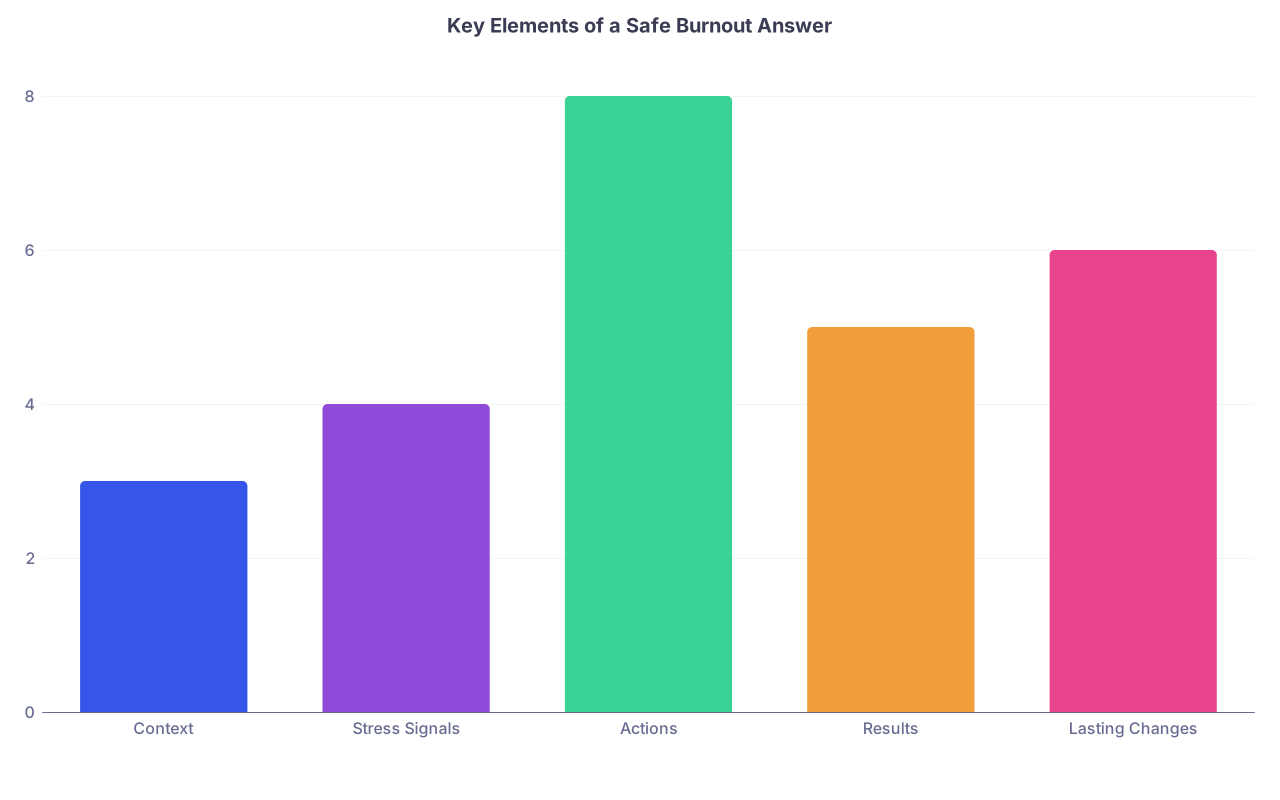
| Category | Value |
|---|---|
| Context | 3 |
| Stress Signals | 4 |
| Actions | 8 |
| Results | 5 |
| Lasting Changes | 6 |

| Step | Description |
|---|---|
| Step 1 | Stressful Situation |
| Step 2 | Notice Early Warning Signs |
| Step 3 | Take Specific Actions |
| Step 4 | Improved Function & Stability |
| Step 5 | Create Lasting Systems |
10. Common Mistakes I See – And How To Fix Each In One Line
I have watched dozens of mock interviews go sideways on this topic. The same patterns repeat.
Here are the frequent errors and a one-line correction strategy for each:
Turning the answer into a therapy monologue.
Fix: Move 70% of your words to what you did and learned, not how bad it felt.Glorifying self-neglect.
Fix: Replace “I just pushed harder” with “I realized that approach was unsafe / unsustainable and changed course.”Blaming individuals or institutions.
Fix: Shift from “they” language to process language: “the structure, expectations, workflow.”No clear resolution or change.
Fix: Add two concrete habits you use now that came directly from that experience.Using the word “burnout” too casually.
Fix: Say “approaching burnout,” “stretched too thin,” or describe the specific dimensions: exhaustion, depersonalization, decreased effectiveness.Admitting impairment without showing containment.
Fix: If you mention serious impairment, you must also describe professional evaluation, treatment, and stable functioning with supports in place.
FAQ: Behavioral Interview Questions About Burnout
1. Should I avoid talking about burnout entirely if I can?
No. Dodging the topic completely makes you look either oblivious or dishonest. You should have at least one story that touches on being overwhelmed or close to burnout, framed with self-awareness and growth. Just do not choose your most catastrophic episode.
2. Is it safe to mention I saw a therapist or counselor?
Yes, if you present it as a proactive, time-limited, skills-focused choice that improved your functioning. Keep clinical details to yourself. Frame it as one resource among several, not the only thing keeping you afloat.
3. What if I genuinely never felt burned out in medical school?
Say so, briefly, but add that you have had demanding periods and have developed concrete strategies for maintaining performance and well-being. Then give an example of heavy workload or stress that you managed effectively.
4. Can I talk about ongoing mental health conditions like depression or anxiety?
You can, but it is high-risk unless you are very clear, concise, and able to demonstrate long-term stability, treatment adherence, and reliable functioning. Many applicants choose to focus instead on stress and overload experiences that are easier to frame without raising fitness-for-duty concerns.
5. How long should my burnout-related answer be?
Aim for 60–90 seconds. Under a minute usually means you are too vague. Over two minutes and you are probably meandering into unnecessary emotional detail. Practice with a timer until the structure feels crisp.
6. What if I get emotional while answering?
A little emotion is human; a full tearful breakdown is a problem. If you feel yourself getting choked up, pause, breathe, and ground in the “actions and lessons” part of your story. You can even say, “It was a meaningful period for me, and what helped the most was…” and pivot quickly back to structure and growth.
Remember three things.
First, programs are not looking for superheroes; they are looking for residents who will not blindside them with preventable crises.
Second, the safest burnout stories are about early recognition, specific actions, and durable systems—less about suffering, more about adaptation.
Third, every answer on this topic should leave them thinking one thing: “This person has been stressed, learned from it, and now manages themselves like a professional.”