
You are here
You are on Zoom with a PD from your top-choice program. You have rehearsed the “Tell me about yourself” opener. You have a decent answer for “Why this program?”
Then she leans back and says:
“Tell me about a time you had a conflict with a team member. How did you handle it?”
Your brain pulls up…nothing organized. A half-memory from third-year, a vague thing from pre-clinical small groups. You ramble. No clear actions. No outcome. You can see her face flatten just slightly.
This is where most otherwise strong applicants lose ground: they treat behavioral questions as random prompts instead of what they really are—competency probes mapped to the ACGME core domains.
Let me be specific: if you are not deliberately building and practicing competency-based behavioral stories around the six ACGME core competencies, you are leaving points on the table in every single interview.
We will fix that.
Step 1: Anchor everything to the six ACGME core competencies
ACGME did you a favor. They told you exactly what programs care about. They literally codified it.
The six core competencies:
- Patient Care (PC)
- Medical Knowledge (MK)
- Practice-Based Learning and Improvement (PBLI)
- Interpersonal and Communication Skills (ICS)
- Professionalism (PROF)
- Systems-Based Practice (SBP)
Most programs structure their evaluation rubrics around these. Many standard interview guides are organized by these domains. Attendings may not say “I am now assessing ICS,” but that is exactly what they are doing.
So your job is not “prepare for endless behavioral questions.”
Your job is “build a small, flexible library of stories, each clearly demonstrating one or more core competencies, and be able to deploy them on demand.”
That is a fundamentally different strategy.
Step 2: Stop winging it – use a precise story structure (STAR+R)
You already know the cliché: use STAR (Situation, Task, Action, Result). The problem is that almost everyone does STAR superficially and ends up with soft, unfocused stories.
I prefer a slightly sharpened variant: STAR+R.
- Situation – concrete, brief context; where/when/who.
- Task – what you were responsible for (your role).
- Action – what you actually did, step by step, with behavioral verbs.
- Result – what changed; objective if possible.
- Reflection – what you learned and how you have applied it since.
That last R is where you show growth. Programs are selecting trainees. If there is no trajectory, you sound static. And static is boring.
Let me break this down into what good vs. weak looks like for each component.
Situation:
Weak: “During third year on my medicine rotation…”
Strong: “During my third-year internal medicine rotation at County Hospital, on the inpatient cardiology service, I was the student following a 62-year-old with decompensated heart failure and limited English proficiency.”Task:
Weak: “I was involved in her care.”
Strong: “My attending asked me to lead the next family meeting with the interpreter to clarify goals of care and ensure we were aligned on the plan.”Action (the core):
Weak: “So I spoke with them and explained the plan.”
Strong: “Before the meeting I reviewed her chart and clarified code status uncertainty with the resident. I met with the interpreter first to align on key terms. During the meeting, I started by asking the family what they understood so far, then used teach-back and visual aids in their language…”Result:
Weak: “They understood better and were happy.”
Strong: “By the end, the daughter correctly explained the plan in her own words, they chose DNR/DNI consistent with prior conversations, and there were no further code status discrepancies during that admission.”Reflection:
Weak: “I learned communication is important.”
Strong: “That case pushed me to standardize my approach to family meetings, and I later created a one-page guide for other students on our service, which my clerkship director now distributes.”
This is the structure you will use to build competency-based stories. But you do not want 50 stories. You want 10–15 high-yield ones that you can bend toward multiple domains.
Step 3: Map classic behavioral questions to ACGME competencies
Almost every behavioral question fits under one or more of the ACGME domains. Once you see the map, the randomness disappears.
| Behavioral Theme | Primary Competency |
|---|---|
| Conflict with team member | ICS / PROF |
| Dealing with an error | PROF / PBLI / PC |
| Working with a difficult patient | PC / ICS / PROF |
| Learning from feedback | PBLI / PROF |
| Managing time / competing priorities | SBP / PROF |
| Leading a project or QI effort | SBP / PBLI / ICS |
You hear: “Tell me about a time you made a mistake.”
They are testing: professionalism, ownership, learning (PBLI), impact on patient care.
You hear: “Describe a time you had to advocate for a patient.”
They are testing: patient care, systems-based practice, willingness to speak up.
You hear: “Tell me about a time you received critical feedback.”
They are testing: PBLI, humility, coachability.
Once you think this way, you can respond with intention instead of just association.
Step 4: Build a story bank explicitly organized by core competency
You should literally have a document with headings: PC, MK, PBLI, ICS, PROF, SBP.
Under each, populate 2–3 stories. Some stories will live under multiple headings. That is good. Those are your power stories.
1. Patient Care (PC)
What programs want to see:
You think in terms of patient-centered outcomes. You can handle complexity appropriate to a student. You are safe, attentive, and you follow through.
Common behavioral question stems:
- “Tell me about a time you went above and beyond for a patient.”
- “Describe a challenging clinical case you were involved in.”
- “Tell me about a time you had to manage a difficult patient or family interaction.”
Strong PC story components:
- Clear description of the clinical challenge (without getting buried in pathophysiology).
- Specific actions you took that influenced safety, experience, or outcome.
- Evidence you grasped the whole-person context (social, cultural, emotional).
- Demonstrated follow-up and reliability.
Example skeleton (you would flesh this out):
- Situation: ICU rotation, patient with repeated extubation failures, family anxious.
- Task: You were assigned to prep for and help lead an extended family meeting to align expectations.
- Action: Reviewed chart and prior notes, connected with RT and nursing beforehand, prepared a simple timeline visual, anticipated key questions, ensured interpreter present, structured meeting with open questions then clear plan.
- Result: Family agreed to trach, team conflict decreased, documented goals written; fewer “hallway” confrontations.
- Reflection: You adopted a standard approach to major family meetings; now you proactively ask, “Who else needs to be at the table?” before they occur.
Tie-in: This single story can flex to PC, ICS, PROF, SBP depending on emphasis.
2. Medical Knowledge (MK)
Programs cannot really test MK in behavioral questions the same way they do via transcripts, exams, and letters. But they absolutely probe how you approach knowledge gaps and uncertainty.
Common stems:
- “Tell me about a time you had to quickly learn something new to care for a patient or complete a task.”
- “Describe a situation where you did not know the answer. What did you do?”
- “What is a clinical topic you became particularly interested in, and how did you pursue it?”
Strong MK story components:
- Humility about not knowing.
- Concrete learning strategies (guidelines, primary literature, consultants, residents).
- Translation of knowledge into action.
- Evidence that you retain and generalize the learning.
Weak answer: “I looked it up on UpToDate.”
Strong answer: “I quickly reviewed guideline X and the recent trial Y, cross-checked dosing with pharmacy, then created a one-page summary for the team for similar patients.”
Use MK stories whenever the question hints at “learning,” “preparing,” or “not knowing.”
3. Practice-Based Learning and Improvement (PBLI)
This is where most applicants are thin. They think PBLI is “I study hard.” Wrong. PBLI is about:
- Seeking and using feedback.
- Identifying your own deficits.
- Making deliberate changes.
- Participating in QI or system improvement.
Common stems:
- “Tell me about a time you received critical feedback.”
- “Describe a time you wanted to improve something on your rotation.”
- “Tell me about a change you made to your own practice based on reflection.”
A robust PBLI story must show a before/after arc.
Example PBLI story outline:
- Situation: Early in surgery clerkship, feedback that your notes were disorganized and too long.
- Task: Improve written communication to meet team expectations.
- Action: Met one-on-one with senior resident to review specific examples. Collected three examples of “good notes” from the team. Built a template; practiced timed note-writing after rounds; asked for re-evaluation one week later.
- Result: Notes accepted without major edits; resident later commented on evaluation that your documentation improved dramatically and was now helpful for sign-out.
- Reflection: You now start each rotation by asking, “How do you like notes and presentations formatted?” and you update your template accordingly.
This single story hits PBLI, ICS (clarifying expectations), PROF (accepting criticism), and SBP (documentation’s role in handoffs and billing, if you mention it directly).
4. Interpersonal and Communication Skills (ICS)
This is the domain most directly hit by classic behavioral questions.
Common stems:
- “Tell me about a time you had a conflict with a team member.”
- “Describe a time you had to deliver bad news or handle an emotionally charged conversation.”
- “Tell me about a time you had to adapt your communication style.”
Good ICS stories are specific about words, listening, and repair.
What programs listen for:
- Do you recognize your own contribution to conflict?
- Do you actually listen, or just wait to talk?
- Can you tailor to patients with low health literacy, language barriers, cultural differences?
- Do you escalate appropriately (not every conflict goes straight to the PD)?
Example high-yield ICS story angle: conflict with a resident about task dumping.
- Situation: On night float, same senior repeatedly assigning scut to you late in the shift, leading to errors and burnout.
- Task: Address the pattern without escalating prematurely; protect patient care and your own performance.
- Action: Chose a calm time, used “I” statements: “I’ve noticed when new admissions come in after midnight, I’m often getting multiple non-urgent tasks at once, and I’m concerned I may miss important clinical details. Can we prioritize tasks together so I can focus on safe admissions?” Documented your responsibilities; offered a compromise system.
- Result: Resident adjusted workflow; you reported fewer near-misses; at end-of-block, resident thanked you for the feedback and mentioned implementing the same approach with future students.
- Reflection: You learned that early, direct communication often prevents bigger conflict, and now you intentionally schedule brief check-ins with residents at the start of a rotation.
That is what a mature ICS story sounds like.
5. Professionalism (PROF)
Programs have been burned enough times by unprofessional residents that this competency is non-negotiable. They will use behavioral questions to sniff out entitlement, blame-shifting, and poor boundaries.
Common stems:
- “Tell me about a time you made a mistake.”
- “Describe an ethical dilemma you faced.”
- “Tell me about a time you had to put patient needs above your own preferences.”
Core professionalism behaviors they want to hear:
- Owning your errors without defensiveness.
- Protecting confidentiality.
- Respect across hierarchy and disciplines.
- Reliability (showing up, following through).
- Integrity when no one is watching.
A strong professionalism story is often about an error or near-miss.
Example structure:
- Situation: On pediatrics, you almost gave incorrect discharge instructions because you misread the EMR med list.
- Task: Prevent harm and correct the process.
- Action: Caught the discrepancy during your pre-discharge review, alerted resident and nurse, corrected the script, then went back to the family to explicitly walk through changes, apologizing for confusion. Afterwards, you met with the clerkship director to discuss how students are taught discharge reconciliation and suggested a quick checklist.
- Result: No harm occurred; the resident began using your checklist for future discharges; ultimately, your clerkship incorporated a 10-minute medication reconciliation mini-session based on that case.
- Reflection: You internalized a simple rule: “Discharge meds are a new prescription, not a copy-paste,” and now you treat them as a separate task requiring its own focused review.
This is far better than, “One time I was late to rounds and so I learned to be on time.”
6. Systems-Based Practice (SBP)
This is the least understood competency by students and one of the most important to PDs. SBP is not just “I know what social work does.”
It is: you understand that patients live inside systems—insurance, EMRs, discharge planning, availability of follow-up, multidisciplinary teams—and you can work within and around those systems to improve care.
Common stems:
- “Tell me about a time you had to advocate for a patient within the healthcare system.”
- “Describe an instance when you used hospital resources or team members to improve patient care.”
- “Tell me about a quality improvement or systems project you were involved in.”
High-yield SBP stories often involve:
- Insurance barriers.
- Discharge delays.
- Inadequate follow-up resources.
- Interdisciplinary coordination (PT/OT, SW, case management, pharmacy).
- QI projects (handoffs, sepsis protocols, order sets).
Example outline:
- Situation: On medicine wards, you noticed frequent delays discharging patients who needed home oxygen, leading to 1–2 unnecessary extra days in the hospital.
- Task: For a QI elective, you decided to target this problem.
- Action: Collected data on 20 recent discharges, timing of O2 orders, case management involvement. Found that consults to DME were often placed day of discharge. Worked with case managers to create a “possible home O2” flag at admission; educated residents in a brief talk; added one EMR checklist item to the admission note.
- Result: In a small pre/post comparison, average delay due to O2 logistics decreased by 0.7 days. Case management reported fewer frantic last-minute calls.
- Reflection: You learned that small process changes at admission can substantially improve downstream flow, and you became more proactive about thinking, “What will this patient need 3 days from now?” in all your admissions.
Programs hear SBP maturity and think, “This person will not just complain about the system—they will work it intelligently.”
Step 5: Build an integrated story matrix, not siloed anecdotes
Here is where you get efficient.
Create a simple matrix: rows are your 10–15 top stories; columns are the six competencies. Put an “X” where each story clearly touches a domain.
| Story ID / Theme | PC | MK | PBLI | ICS | PROF | SBP |
|---|---|---|---|---|---|---|
| #1: Difficult family meeting | X | X | X | X | ||
| #2: Feedback on notes | X | X | X | X | ||
| #3: Medication near-miss | X | X | X | X | X | |
| #4: QI on discharge delays | X | X | X | X | ||
| #5: Conflict with resident | X | X | X |
You only need 10–15 stories because you will emphasize different aspects depending on the question.
Same case, different spin:
Question: “Tell me about a time you made an error.”
Use the med near-miss story, emphasize ownership + professionalism.Question: “Tell me about a time you improved a process.”
Same case, but now focus on how you created a med rec checklist (PBLI + SBP).Question: “Tell me about a time you advocated for patient safety.”
Same case, highlight your insistence on re-counseling the family and adjusting the discharge process (PC + PROF).
This is why rehearsing generic answers (“I work well in teams”) is useless. Rehearse adaptable stories.
Step 6: Make your examples residency-level, not undergrad-level
A lot of applicants sabotage themselves by using stories from college group projects or non-clinical jobs when they already have good clinical material. Those stories may be fine fillers, but if your primary stories are all from undergrad, you look less ready.
Priority order for story sources:
- Clinical clerkships (3rd and 4th year, sub-Is, acting internships).
- Research with direct clinical relevance or team interaction.
- Significant leadership roles in medical school (student run clinics, curriculum committees).
- Pre-med work only if exceptional (paramedic, RN, long-term scribe in high-acuity setting).
You are interviewing for a residency, not an MBA. Your stories should show you operating in patient care environments, making decisions (at your level), interacting with attendings, residents, nurses, and patients.
Non-clinical examples are fine for one or two ICS or SBP questions, especially if you lack clinical variety, but do not let them dominate.
Step 7: Align your stories with how programs actually rate you
Most programs use evaluation forms with Likert scales (1–5) anchored to ACGME domains. A simplified version of how they mentally (or literally) score you:
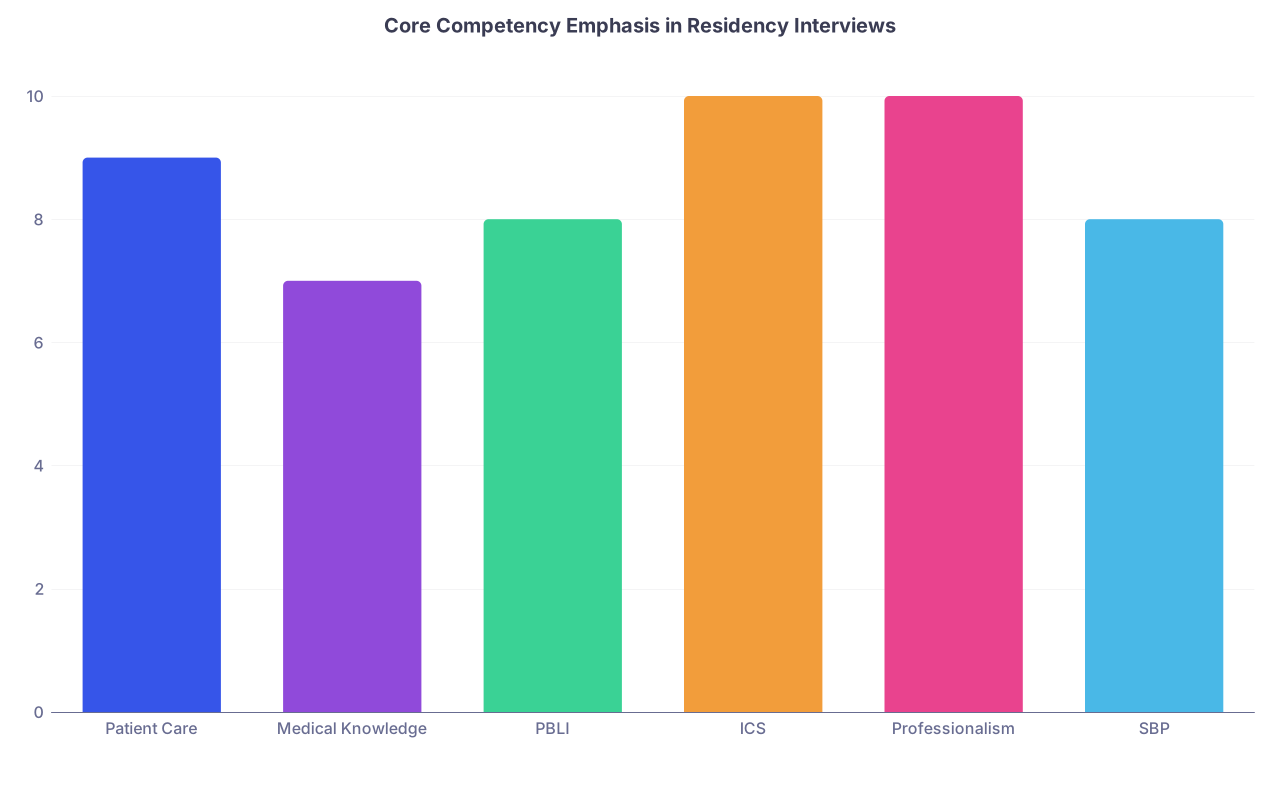
| Category | Value |
|---|---|
| Patient Care | 9 |
| Medical Knowledge | 7 |
| PBLI | 8 |
| ICS | 10 |
| Professionalism | 10 |
| SBP | 8 |
Interpretation (based on what I have seen and heard repeatedly):
- Professionalism and ICS are non-negotiable. A red flag here overrides a Step 270.
- Patient Care and SBP matter more than students realize—they correlate with “can I trust you on call?”
- MK they already assessed via your application; interview can move the needle a little, but not as much as your behavior and judgment.
So when a question is ambiguous and you have multiple stories available, favor:
- One that shows good judgment under pressure.
- One that shows self-awareness and lack of ego.
- One that shows you understand and respect the care team.
Those are the things attendings remember after back-to-back interviews.
Step 8: Rehearse at the right level of detail
Here’s a mistake: students memorize 2-page scripts for each story. Under stress, they either blank or sound robotic. PDs can smell memorized monologues.
Rehearse at the outline level.
For each story, write:
- 1 line for Situation.
- 1 line for Task.
- 3–5 bullet points for key Actions.
- 1 line for Result.
- 1–2 lines for Reflection and how you applied it later.
That fits on an index card or a half-page.
Then practice:
- Saying the story in 60–90 seconds.
- Modulating emphasis depending on domain (PC vs. ICS vs. SBP).
- Answering common follow-up questions: “What would you do differently?” “What surprised you about that case?” “How did the attending respond?”
If your story takes more than ~2 minutes in an interview, you will lose your listener. Pare down details that do not move the competency narrative.
Step 9: Connect your stories to residency and the program in front of you
You are not telling stories as isolated theater. You are building a case that you fit their residency.
After the Result/Reflection, add one bridging line:
“This experience is part of why I am drawn to a program like yours that emphasizes early autonomy with close supervision. I know I thrive when I get direct feedback and can iterate quickly.”
“Seeing that your program has a strong quality improvement curriculum, I would love to build on what I started with discharge processes to look at X or Y in your system.”
“Given your patient population’s language diversity, I know the skills I built in that case with interpreters would translate well here.”
That single sentence signals you are not just performing; you are integrating.
Step 10: Practice with someone who will not spare your feelings
You do not want your first real behavioral interview to be with a PD.
Run your stories with:
- A resident you know who has been on the other side of the table.
- A brutally honest classmate.
- A faculty advisor who will interrupt you and say, “Too long. I still do not know what you did.”
Ask them to specifically critique:
- Did I clearly state what I did, vs. what the team did?
- Did I own my mistakes without over-apologizing?
- Did I sound like a victim in any conflict story?
- Was my reflection real or just generic?
Record yourself on video once or twice. Yes, it is painful. Watch for:
- Overuse of filler (“like,” “you know”).
- Defensive tone when describing feedback.
- Rambling chronology.
Polish until your stories are tight, honest, and flexible.
One concrete example: building one story across domains
Let me show you how a single story can serve as a Swiss army knife.
Story core: Student-led initiative to standardize sign-out on medicine wards after a near-miss.
- Base outline (STAR+R):
- Situation: As an MS3 on a busy internal medicine service, there was no standardized sign-out; each resident had a different style. One night, a patient almost missed a crucial CT scan because it was not in the sign-out.
- Task: As the student, you wanted to improve the reliability of handoffs to protect patients and make cross-cover safer.
- Action:
- Reviewed I-PASS literature and your school’s handoff guidelines.
- Informally interviewed three residents and two night floats about common misses.
- Drafted a short, EMR-compatible sign-out template including “if/then” plans for overnight issues.
- Piloted it with one resident team, solicited feedback, and refined it.
- Presented the mini-project at morning report.
- Result: Within two weeks, three resident teams adopted the template; cross-cover pages about “what do we do if X happens?” decreased according to night float feedback; your attending mentioned it in your letter.
- Reflection: You realized you enjoy small, high-impact systems interventions and plan to engage in resident-level QI, particularly in handoffs and patient safety.
- How to flex this story:
- For PBLI: emphasize how you sought feedback, reviewed literature, iterated based on data.
- For SBP: emphasize understanding that handoffs are a system vulnerability and working across disciplines (night float, nursing).
- For ICS: emphasize clarity of communication, anticipatory guidance (“if BP < X, then…”), and collaboration.
- For PROF: emphasize your response to a near-miss—proactive improvement rather than blame.
One story, four competencies. That is efficient preparation.
Visualizing your prep timeline
Most people cram story-building the week before interviews. That shows.
If you are earlier in the cycle, spread it out:
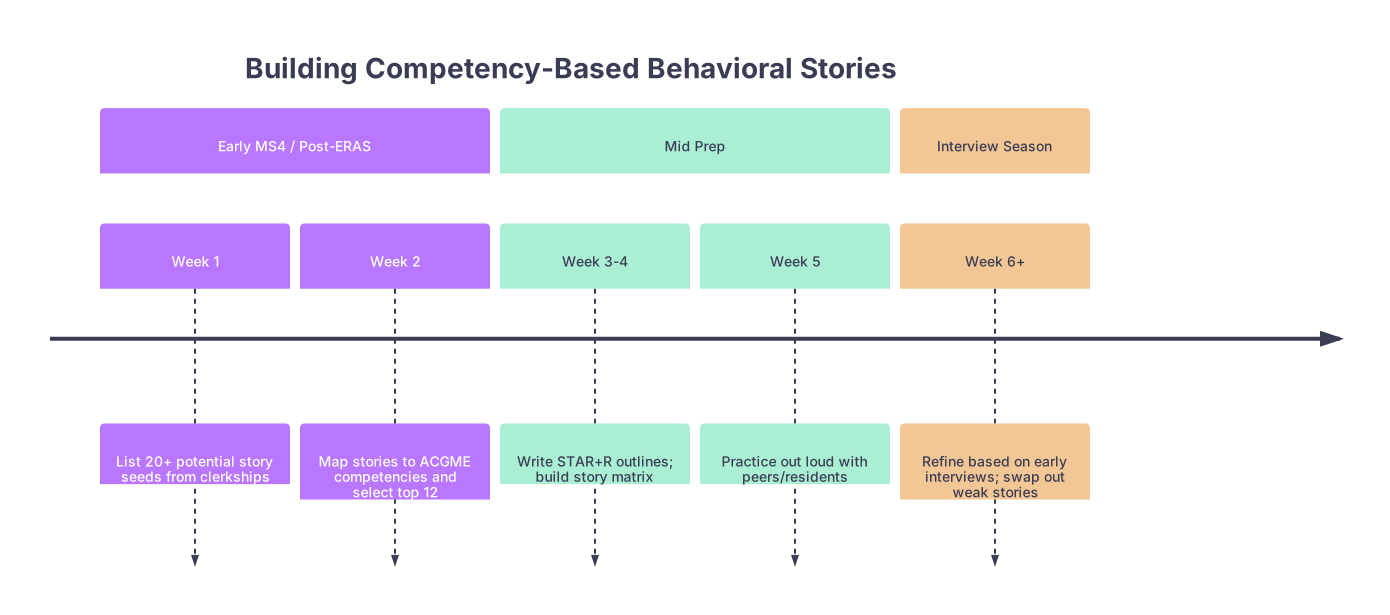
| Period | Event |
|---|---|
| Early MS4 / Post-ERAS - Week 1 | List 20+ potential story seeds from clerkships |
| Early MS4 / Post-ERAS - Week 2 | Map stories to ACGME competencies and select top 12 |
| Mid Prep - Week 3-4 | Write STAR+R outlines; build story matrix |
| Mid Prep - Week 5 | Practice out loud with peers/residents |
| Interview Season - Week 6+ | Refine based on early interviews; swap out weak stories |
Start now. You will not regret having these ready.
Quick reality check: what interviewers remember
After a full day of interviews, attendings sit down to rank. They usually remember 3 things:
- A concrete patient story (for good or bad).
- Whether you seemed teachable and honest.
- Whether you seemed like someone they would want on call with them at 2 a.m.
Competency-based behavioral stories, built around the ACGME cores, directly feed all three.
If your stories show mature patient care, humility about knowledge, active learning, clean communication, integrity, and system-savvy, you will stand out even in a crowded field.
Key takeaways
- Stop treating behavioral questions as random. They are structured probes of the six ACGME core competencies—build your story bank to match those domains.
- Use tight STAR+R stories (with real reflection) drawn primarily from clinical rotations, each mapped to multiple competencies so you can flex them across different questions.
- Practice out loud with critical feedback until you can deliver 10–15 versatile, residency-level stories that show judgment, growth, and fit with the programs you are targeting.