
It is 9:10 a.m. on your interview day. You are on your second interview of the morning. The faculty member glances at your CV, looks up, and says: “Tell me about a time you improved a system or process in the hospital.”
You freeze. You know you care about quality, safety, and systems. But what comes out of your mouth is a rambling story about “helping the team discharge patients faster” that has no clear problem, no data, and no outcome. You see the interviewer’s eyes glaze over.
This is what we are going to prevent.
You are in the category where programs expect more than “I work well in a team.” Systems-based practice (SBP) and quality improvement (QI) are now core competencies. A lot of behaviorals are quietly testing those domains, even when they do not use the jargon.
Let me break this down specifically.
1. What Interviewers Actually Mean by “Systems-Based Practice” and “QI”
Most applicants misunderstand these two words badly.
Systems-based practice is not “I like EMR” and QI is not “I care about patient care.”
You are being tested on:
- Whether you see patterns instead of isolated events
- Whether you think about processes, not just personalities
- Whether you can work within constraints: insurance, EMR, staffing, policies
- Whether you know how to change something in a structured way, not just complain
At the residency interview level, this usually boils down to a few themes:
- Can you recognize a system-level problem (recurrent, affects multiple patients / staff)?
- Do you understand root causes beyond “people should try harder”?
- Can you work with other disciplines (nurses, pharmacists, case managers)?
- Can you use data, even very simple data, to justify a change?
- Can you evaluate whether your change actually worked?
Most behavioral SBP/QI questions fall into one of these buckets:
- “Tell me about a time you improved a process or system.”
- “Describe a time you identified a patient safety risk.”
- “Tell me about a QI project you worked on and your role in it.”
- “Give an example of advocating for a patient within the health-care system.”
- “Describe a time when resource limitations affected care and what you did.”
If you cannot answer these cleanly, with structure, you look naïve about modern medicine. Programs hate that.
2. Core Structure: Upgrading STAR for Systems/QI Stories
You already know STAR (Situation, Task, Action, Result). It is fine for generic leadership questions. It is not enough for SBP/QI.
You need an upgraded template that forces you to talk like someone who understands systems.
Use this:
SPARQ – Situation, Problem (system-level), Analysis, Response, Quantified result.
- Situation – Brief clinical / institutional context
- Problem – Define the system or process failure, not just the incident
- Analysis – What you learned about why it was happening (root causes, constraints, stakeholders)
- Response – Your specific actions, collaboration, and tests of change
- Quantified Result – Data, proxy measures, or clear qualitative outcomes
Here is why this works:
- It forces you to show pattern recognition (Problem).
- It forces you to mention how you thought (Analysis).
- It nudges you to use numbers (Quantified result) instead of “it went better.”
Quick example: weak vs. strong
Weak STAR answer (typical applicant):
“On my IM rotation, I noticed discharges were delayed (Situation). I felt we needed to be more efficient (Task). I started rounding earlier and encouraged my teammates to complete discharge summaries sooner (Action). As a result, our discharges improved and patients got out earlier (Result).”
Strong SPARQ answer (what you should be doing):
“On my IM rotation at a county hospital, I noticed that our average discharge order time was after 3 p.m., which caused bed shortages and ED boarding (Situation).
I realized this was not a one-off issue but a system problem: most patients who were stable early in the day still left after 5–6 p.m. (Problem).
I tracked our service’s discharges over a week and found two patterns: discharge med rec was not started until after rounds, and social work did not see patients until they received that note (Analysis).
I proposed a discharge ‘huddle’ after sign-out where the intern flagged probable next-day discharges, pre-drafted summaries, and messaged pharmacy and social work the evening before. I coordinated with our senior and the charge nurse to trial this for two weeks (Response).
Over those two weeks, the median discharge order time moved from 3:30 p.m. to 11:15 a.m. on our team, and nursing reported fewer last-minute discharges. The senior presented the process at resident report and it was adopted by two other teams (Quantified result).”
Same idea. Different league.
3. Recognizing What Counts as Systems-Based Practice and QI
Most students think they have “no QI experience.” Usually wrong.
You probably have more than enough if you learn to frame it correctly.
Here is what clearly counts as SBP/QI material:
- Formal QI projects (PDSA cycles, M&M-driven interventions, A3, etc.)
- Workflow changes on rotations: handoff, discharge planning, pre-op checklists
- Safety event reporting and following up on a root cause analysis (RCA)
- EMR changes: order sets, smart phrases, nursing communication tools
- Interdisciplinary initiatives: pharmacy-led med rec, case management coordination
- Projects that address resource constraints: uninsured patients, limited imaging access
And “soft” but still very usable examples:
- Creating a shared sign-out or rounding template that reduced errors
- Standardizing how your student team pre-rounded so data were reliable
- Changing how your student-run clinic triaged patients to avoid unsafe backlogs
- Fixing recurrent miscommunications between your team and consultants
Translate your experience into system language. Do not say:
- “I helped out more”
- “I worked harder to get discharges done”
- “I made sure I double checked”
Say things like:
- “There was no standard process for X, which led to Y,”
- “The handoff tool did not capture Z, so this error kept repeating,”
- “We lacked a reliable trigger to involve case management early.”
That is SBP thinking.
4. Building Your Systems/QI Story Bank (Before Interview Day)
You should not be improvising these stories in the chair. You will ramble, miss the outcome, and forget key elements.
You want 4–6 pre-built SBP/QI stories you can flex for multiple questions.
Categories to cover:
- Improving a process (discharge, handoff, consults, clinic flow)
- Addressing a safety issue or near miss
- Working within resource / system constraints
- A formal QI project (if you have it)
- Advocating for a patient at a systems level (insurance, placement, access to care)
Create a simple grid like this:
| # | Category | Rotation / Setting | One-line System Problem |
|---|---|---|---|
| 1 | Process improvement | IM inpatient | Discharge orders consistently after 3 p.m. |
| 2 | Safety / near miss | Surgery | Recurrent wrong-side marking in pre-op |
| 3 | Resource constraint | County ED | No outpatient follow-up for uninsured |
| 4 | Formal QI | Student-run clinic | High no-show rate for chronic disease visits |
| 5 | Interdisciplinary coordination | NICU | Delayed transfer due to unclear criteria |
You do not need all five. But having at least three gives you flexibility.
For each one, write a tight SPARQ outline (not a script; outlines are harder to forget, easier to adapt):
- Situation – 1–2 sentences, max
- Problem – clear system defect, 1–2 sentences
- Analysis – 2–4 sentences explaining what you learned about causes
- Response – 3–6 sentences, sequence of actions, collaborators
- Quantified Result – 2–4 sentences, with numbers or concrete qualitative outcomes
5. Anatomy of a High-Yield Systems/QI Answer
Let me take apart a model answer so you see the moving pieces.
Question: “Tell me about a time you worked on a quality improvement project.”
Answer (annotated):
“During my third year on internal medicine at [Hospital X], I joined a team QI project focused on reducing 30-day readmissions for heart failure (Situation).
Our baseline data showed a 24% 30-day readmission rate on our teaching service, which was higher than the national benchmark and strained bed capacity (Problem – framed with data and system impact).
I helped our resident lead perform a chart review of 30 recent readmissions and found two recurring patterns: inconsistent documentation of discharge weights and no clear follow-up within 7 days for many patients (Analysis – identifies process defects, not “bad patients”).
Based on this, I worked with the discharge nurse and cardiology clinic to design a simple discharge checklist that required: 1) documented target dry weight; 2) explicit diuretic plan; and 3) scheduling a follow-up appointment within 7 days before discharge. I created an EMR smart text that residents could use in their discharge notes to standardize this (Response – interdisciplinary, process + tool).
Over the next 6 weeks, we piloted the checklist on one teaching team. Checklist use compliance reached about 80%. During that time, the 30-day readmission rate on that team dropped from 24% to 16%, while the rest of the service stayed around 23%. Nursing also reported fewer calls from confused patients about their diuretics (Quantified result – numbers + real-world effect).
That project was my first exposure to PDSA cycles, and it taught me to look beyond individual decisions and focus on creating reliable default processes that make the right thing easier to do.”
Quick breakdown of why this works:
- Uses hard numbers early → interviewer feels this person is data-aware.
- Identifies specific process failures (weights, follow-up) → not vague.
- Shows interdisciplinary collaboration → clearly not a solo hero fantasy.
- Includes a tool (checklist + smart text) → concrete artifact programs recognize.
- Demonstrates QI thinking (pilot, comparison group, PDSA idea) → speaks their language.
6. Adapting Stories to Common SBP/QI Question Variants
Here is where most applicants lose points. They use one generic story for completely different questions. You need to shift the lens, not the entire story.
Variant 1: “Tell me about a time you identified a patient safety issue.”
Lens: emphasize risk and prevention, less on efficiency.
Use SPARQ, but:
- Problem focuses on safety hazard (missed labs, wrong patient, delay in antibiotics).
- Analysis digs into how the system made that error likely, not just “nurse forgot.”
- Response highlights speaking up, reporting, and system-level fix.
- Result talks about reduced incidents, new safeguards, or culture change.
Variant 2: “Describe a situation where you had to work within system limitations.”
Lens: emphasize resource constraints and creative workarounds that are still safe.
Same SPARQ backbone:
- Problem framed as limitation (no MRI overnight, no insurance, language barriers).
- Analysis explores why those limitations exist and who is affected.
- Response focuses on advocacy, alternative pathways, and realistic compromise.
- Result reflects improved access, more equitable care, or better use of resources.
Variant 3: “Tell me about a time you advocated for a patient in the health-care system.”
Lens: systems advocacy, not just individual emotion.
- Problem: structural barrier (insurance denial, rehab bed shortage, transportation, immigration status)
- Analysis: who controls the lever? Social work, utilization review, charity resources, legal?
- Response: working through channels, appealing decisions, connecting resources, bringing in team.
- Result: changed outcome for that patient, plus any longer-term change you seeded.
7. Embedding QI Language Without Sounding Like a Textbook
You do not need to sound like a QI consultant. In fact, overusing jargon sounds fake. But a few well-placed terms signal that you know what you are doing.
Use these naturally:
- “We used a simple PDSA cycle” (Plan-Do-Study-Act)
- “We looked at baseline data over X weeks”
- “We did a brief root cause analysis and found…”
- “We standardized X using Y (checklist, order set, template)”
- “We measured process and outcome metrics”
- “We piloted on a small scale before expanding”
- “This improved reliability and reduced variation”
Avoid brainless name-dropping:
- “We applied Lean Six Sigma methodologies” when all you did was put a sign up.
- “We created a multifaceted intervention bundle” for “we reminded people at signout.”
Interviewers who actually do QI will spot that nonsense instantly.
8. Data: What To Say When You “Do Not Have Numbers”
You probably do not have formal QI spreadsheets. That is fine. You still need to approximate impact.
You can use:
- Counts: “We went from seeing this error 3–4 times per week to maybe once a month.”
- Proportions: “Before, almost every discharge was after 3 p.m.; after, roughly half were before noon.”
- Time: “Response time improved from about 30–40 minutes to within 10 minutes.”
- Qualitative feedback: “Nursing reported fewer unsafe handoffs.” “The attending decided to roll it out to the entire team.”
Do not say “I don’t know the impact.” Say, “We did not have formal data collection, but I saw X and Y changes,” and give concrete examples.
9. Common Pitfalls That Sink SBP/QI Answers
I have heard all of these in real interviews. They are painful.
No actual system
Story is about working harder as an individual. No process change, no collaboration, nothing that would remain after you leave. That is not SBP.Blaming individuals
“The nurse kept forgetting.” “The intern was careless.” SBP is about designing systems that do not rely on the perfect behavior of tired humans. Show that you get that.No clear result
Ending with “…and it was better” is lazy. If you want to stand out, you must close the loop with at least one concrete outcome.Overstating your role
Claiming you “led” a multi-department QI project as an M3 is not credible. Say, “I joined a team led by…” or “I piloted the student-facing part of…” Programs value accuracy over ego.Vague context
“On one rotation, we did a project…” No. Tell them the type of hospital (community, academic, county), the service, and the basic constraints. It anchors your story in reality.Getting lost in technical detail
Over-describing the exact EMR clicks, lab names, or ICD codes. You have 2–3 minutes. Focus on the arc: problem → analysis → response → result.
10. Practicing Under Real Conditions
You do not need to rehearse a TED talk. You need 3–4 tight, flexible narratives that you can deliver in 2–3 minutes each, without sounding memorized.
Practical practice protocol:
- Write your SPARQ outlines for 3–5 stories.
- Record yourself answering these prompts:
- “Tell me about a time you improved a process or system in a clinical setting.”
- “Tell me about a QI project you were involved in.”
- “Give an example of advocating for a patient within the health-care system.”
- “Describe a time you identified a safety concern and what you did.”
- Time each answer. Aim for 90–150 seconds. Longer than that, you will get cut off.
- Listen back once. Ask:
- Did I state the system problem clearly?
- Did I explain my analysis, not just jump to action?
- Did I give concrete results?
- Did I avoid blaming and heroic “I saved the day” narratives?
If you want a quick self-check on whether your stories actually touch SBP/QI domains, map them:
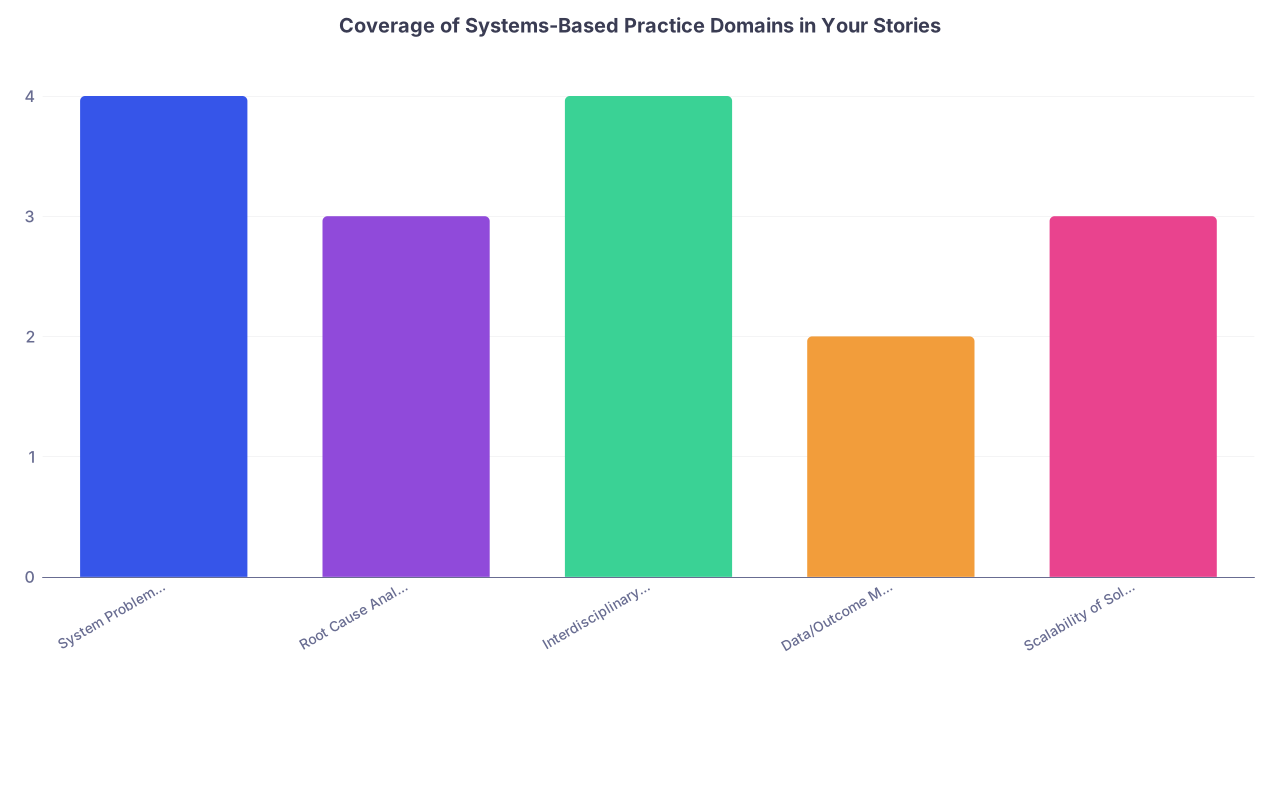
| Category | Value |
|---|---|
| System Problem Defined | 4 |
| Root Cause Analysis | 3 |
| Interdisciplinary Work | 4 |
| Data/Outcome Mentioned | 2 |
| Scalability of Solution | 3 |
If you are below 2 on any dimension, upgrade the story.
11. Example Story Templates You Can Steal and Customize
I will give you stripped-down skeletons. You plug in your specifics.
A. Discharge Process Improvement
- Situation: “On my [medicine/surgery] rotation at a [community/academic/county] hospital, discharges on our team were regularly occurring late in the day, leading to ED boarding and delays for post-op patients needing beds.”
- Problem: “This was a recurring system issue, not just a bad day; patients who were medically ready often stayed an extra 6–8 hours.”
- Analysis: “I tracked 1 week of our team’s discharges and found discharge summaries and med rec were usually started after rounds, and case management did not get notified of expected discharges until early afternoon.”
- Response: “I worked with my resident and our case manager to create a ‘likely discharge’ list during the evening sign-out. We pre-drafted key sections of the discharge summaries, notified case management the day prior, and updated the charge nurse during morning huddle. I built a quick template for the discharge summary to speed charting.”
- Quantified result: “Over the next 2 weeks, our median discharge order time shifted from mid-afternoon to late morning, and we had fewer patients waiting in the ED for beds. The attending asked other teams to test the same process.”
B. Safety Near Miss (Handoff / Lab / Medication)
- Situation: “During my night float sub-I, I noticed that critical lab values drawn overnight were being posted but not always communicated clearly during morning sign-out.”
- Problem: “This created a safety risk: I saw one case where a critical potassium result was delayed in being addressed because it was buried in the chart and not on the sign-out.”
- Analysis: “I reviewed our last week of rapid response calls and flagged those involving abnormal labs. In two of them, the critical lab had been in the system for over an hour without action. There was no standardized place in the sign-out tool to capture new overnight criticals.”
- Response: “I proposed adding a dedicated ‘Overnight Criticals/To-Do Before Rounds’ section to the sign-out template and asked the chief resident to help update the standard format. For a week, I made sure our team consistently used that section and reminded the night nurse to call for certain thresholds.”
- Quantified result: “In that week, we did not have any delays in responding to critical values on our service, and residents reported that they felt sign-out was more reliable. The chiefs then incorporated that section into the template for all teams.”
You get the idea. You are telling the same type of story, but through different lenses.
12. Integrating SBP/QI Into “Tell Me About Yourself” and Other Generic Questions
One more advanced move. Tie your SBP/QI mindset into your overall narrative. Programs like residents who think this way by default.
Examples:
- “I am someone who gets frustrated seeing the same problem recur, so I naturally gravitate toward fixing the process behind it. On medicine, that led me to work on a discharge timing project…”
- “In our student-run clinic, I started out just seeing patients, but I found myself drawn into improving our scheduling system when we noticed high no-show rates…”
That way, when they later ask you about QI, your story does not feel bolted on. It feels like a consistent part of how you practice.
To plan this, it helps to sketch where SBP/QI touches your application narrative:

13. Quick Reality Check: How Programs Evaluate These Answers
Residency faculty are not scoring QI answers with a rubric in front of you, but mentally they are doing something close.
They are asking themselves:
- Does this person see systems, or only individual effort?
- Would I trust them on our wards to raise and help fix process problems?
- Can they work with nurses, social workers, pharmacists without being condescending?
- Are they grounded or are they inflating their contributions?
If your stories show:
- Pattern recognition
- Humility about your role
- Respect for interprofessional input
- Concrete outcomes
You will land in the “this person gets it” bucket.
14. Final Calibration: One Page, Night Before
The night before your interview, you should be able to hand-write, from memory, one page containing:
- 3–5 story names (e.g., “HF readmission project,” “discharge timing,” “clinic no-shows,” “critical lab near miss”)
- For each: 1-line system problem + 1-line result
That is it.
That is your cheat sheet. Anything beyond that will be accessible in your memory once you start talking, because you have built the SPARQ skeleton in advance.
To make sure your stories cover the range programs care about, you can sanity-check domains:
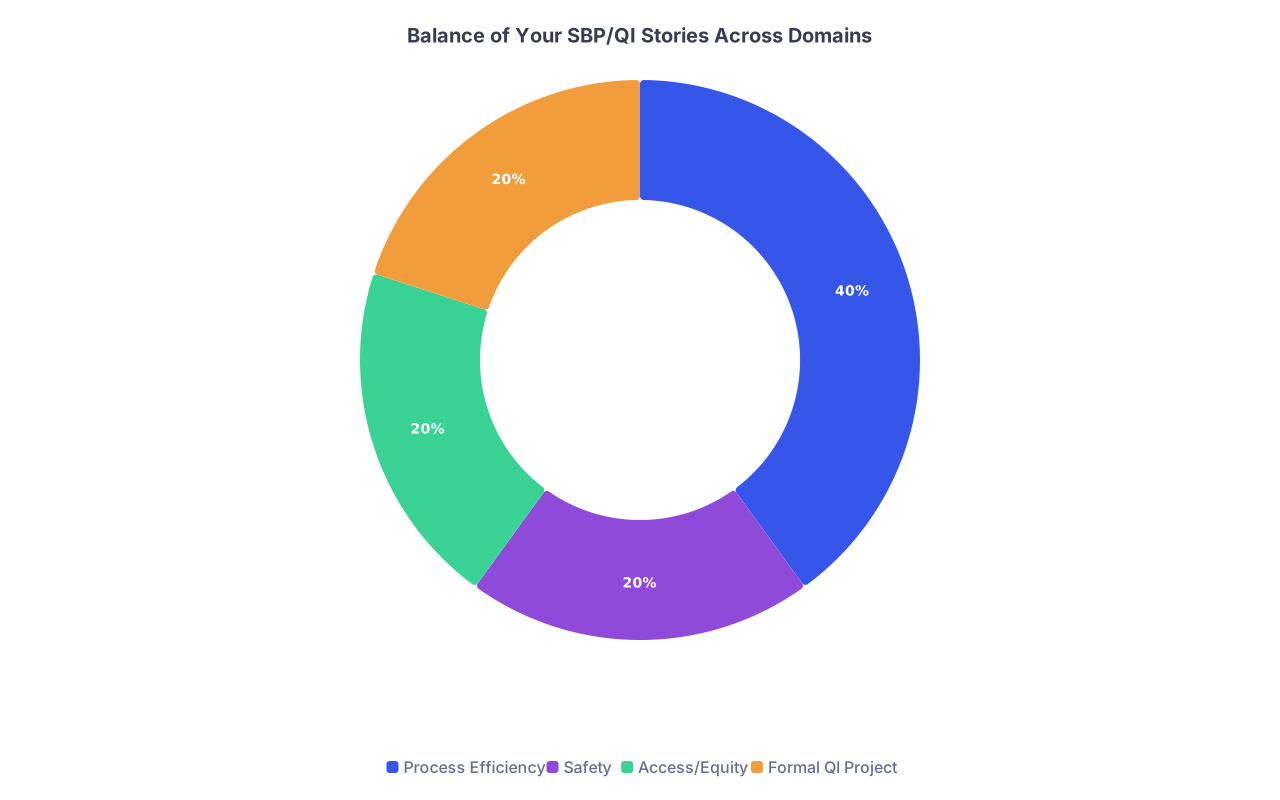
| Category | Value |
|---|---|
| Process Efficiency | 2 |
| Safety | 1 |
| Access/Equity | 1 |
| Formal QI Project | 1 |
If everything is about discharges and nothing touches safety or access, you know what to add.
FAQ (Exactly 4 Questions)
1. What if I genuinely have zero formal QI projects?
You do not need a published QI poster to answer these questions well. Frame informal improvements as QI: a better handoff method on surgery, a more reliable rounding structure on pediatrics, a scheduling fix at a student-run clinic. Use SPARQ, focus on a recurring system problem, your analysis of why it happened, a change you helped implement, and any concrete impact. Programs care more about how you think than whether your name is on a QI abstract.
2. How much detail about QI methodology should I include (PDSA, root cause analysis, etc.)?
Enough to show you understand the ideas, not so much that you sound like you memorized a textbook. One or two phrases per answer is plenty: “We used a small PDSA cycle,” or “We did a brief root cause analysis and found…”. If the interviewer is QI-savvy, they will follow up; if not, they will still recognize that you are using structured thinking rather than guesswork.
3. What if my project failed or had limited impact? Can I still use it?
Yes, and sometimes it is stronger. Many QI efforts stall. If your “result” was that the data did not change or leadership did not adopt the intervention, frame the result as what you learned: maybe your analysis missed a key stakeholder, or your intervention was too burdensome. Programs like residents who can honestly assess failure, refine their approach, and still care about improving systems.
4. How do I avoid sounding arrogant when describing system changes I made as a student?
Stay precise about your role and give credit to the team. Say “I joined a QI project led by our senior resident,” or “I piloted a student-level change that our attending later scaled up.” Describe your contributions clearly—data collection, proposing a template, coordinating with nursing—without pretending you overhauled the hospital. Accuracy plus humility reads as maturity. Exaggeration reads as insecurity.
Key points to carry into the interview chair:
- Use SPARQ (Situation, Problem, Analysis, Response, Quantified result) to force systems-level thinking and concrete outcomes.
- Reframe your real experiences—however small—as system problems with structured responses, not just instances of working harder.
- Build and rehearse 3–5 specific stories you can flex across process, safety, access, and advocacy questions, with at least some approximate data in every answer.