
You can ace every exam in medical school and still blow the “failure” question in residency interviews.
Let me be blunt: walking into interview season saying “Honestly, I’ve never really failed at anything” is the behavioral equivalent of saying “I do not understand myself, feedback, or medicine as a profession.” Programs are not impressed that you have never failed Step 1. They are worried if you think that means you have never failed. Period.
You are in the right place if you are:
- A strong test-taker (high Step/COMLEX, no repeats).
- Genuinely struggling to think of “a real failure.”
- Worried that using a small example (late note, missed email) will sound trivial.
- Afraid that using something bigger (code situation, patient complaint) will make you look unsafe.
Let me break this down specifically.
What Programs Actually Want When They Ask About “Failure”
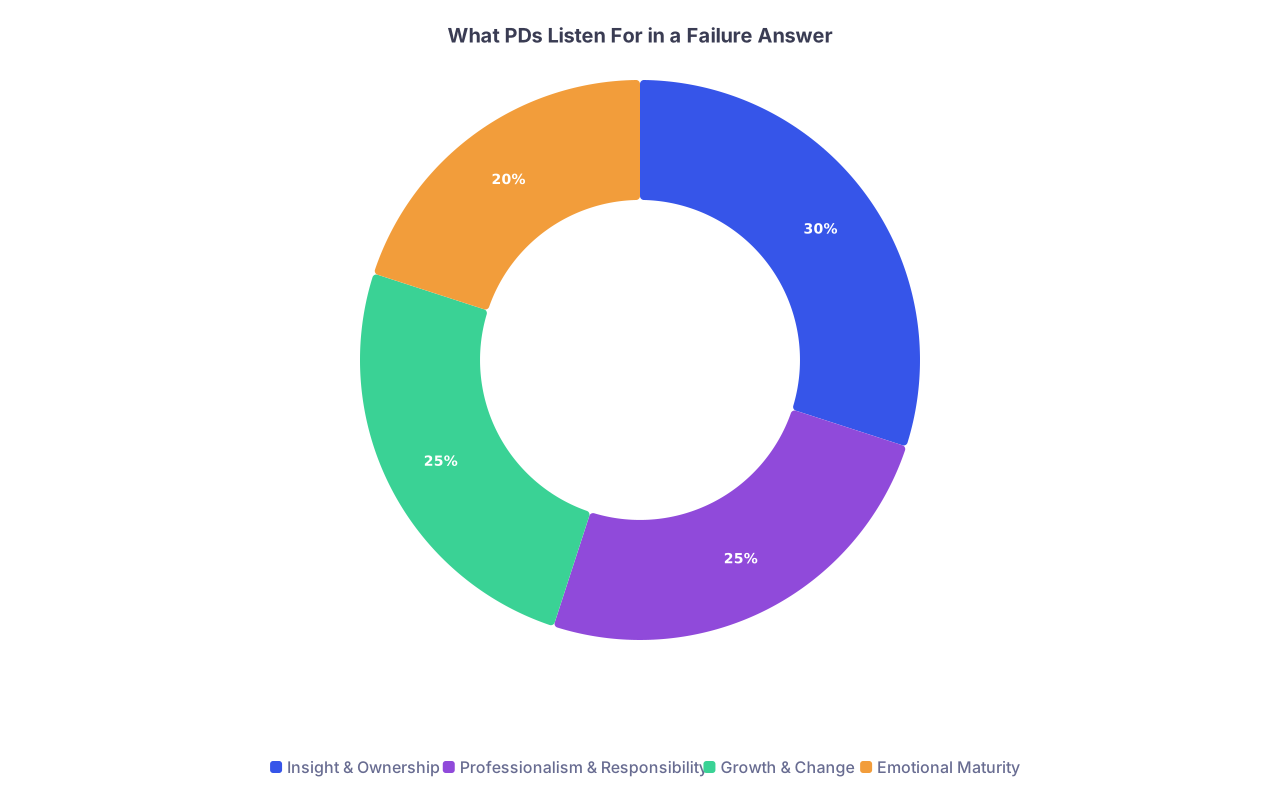
| Category | Value |
|---|---|
| Insight & Ownership | 30 |
| Professionalism & Responsibility | 25 |
| Growth & Change | 25 |
| Emotional Maturity | 20 |
The question is not a trap. “Tell me about a time you failed” is a screening tool. Programs are testing four things.
Do you recognize that failure ≠ exam score?
Residency failure looks like:- Not calling for help soon enough.
- Mishandling an interpersonal conflict.
- Dropping the ball on follow‑up.
- Letting ego override humility.
If you equate “failure” only with “I failed Step 1,” that is a red flag. They want broader, adult-level insight.
Can you own responsibility without collapsing or deflecting?
Interviewers watch for:- “I” statements vs. blaming “the system” or “the nurse” or “the rotation.”
- Clear acknowledgment: “I failed at X,” not “Things could have been a bit better.”
- No defensive body language when you describe being wrong.
Do you learn and change in concrete ways?
If your story does not end with specific behavioral changes, it is useless. Programs want to hear:- A changed workflow.
- A changed communication habit.
- A changed threshold to ask for help / escalate.
Vague “I learned to be more careful” tells them you did not actually change.
Can you talk about emotionally uncomfortable things like an adult?
They are watching how you:- Handle shame, frustration, or embarrassment.
- Talk about patients or colleagues respectfully, even when things went badly.
- Maintain composure under stress.
You do not need a catastrophe. In fact, a genuine mid-level failure with clear insight beats a dramatic near‑malpractice story every time.
First Problem: You Think You Have Never “Really” Failed
If your instinctive answer is “I have never failed a major exam, never failed a rotation, never repeated a year,” you are defining failure way too narrowly.
Let me give you categories that count as legitimate failures for residency interviews, even if they did not appear on your transcript.

1. Process Failures (Not outcomes, but how you got there)
You may have gotten the work done, but the route was poor.
Examples:
- You finished notes, but habitually stayed 2–3 hours late because you could not prioritize.
- You consistently turned in work right at the deadline, creating stress for your team.
- You mishandled cross-cover triage early on and tried to do everything yourself before calling the senior.
These are failures of judgment, workflow, or boundaries. Completely fair game.
2. Communication Failures
Programs love these because they are common and highly fixable.
Examples:
- You gave a chaotic presentation on rounds and your attending pulled you aside: “That was hard to follow.”
- You sent a terse reply to an attending’s email that came across as dismissive.
- You avoided a difficult conversation with a teammate and the conflict simmered until a resident had to step in.
Here the failure is how you communicated, not whether the patient survived.
3. Professionalism / Reliability Failures
The uncomfortable ones. Which is why they work.
Examples:
- You forgot to follow up on a lab you had promised to check.
- You were late to a clinic session twice in one week and got direct feedback.
- You overcommitted to research + volunteering + clerkship and dropped something important.
These demonstrate insight into professional standards. If you own them properly, they show growth, not incompetence.
4. Leadership or Team Failures
Perfect for people with many extracurriculars.
Examples:
- As a student group leader, you delegated poorly and the event nearly fell apart.
- You failed to intervene early in a dysfunctional team dynamic and the project underperformed.
- You did not advocate for a struggling teammate soon enough and they ended up failing the course.
Here you are showing understanding of systems, teams, and responsibility beyond yourself.
5. Personal Boundaries & Well‑Being Failures
Underused, but powerful when done right.
Examples:
- You pushed through severe burnout, performance slipped, and a mentor had to pull you aside.
- You tried to study 14 hours a day for Step and ended up with worse retention and panic.
- You ignored early signs of depression or anxiety; it eventually affected your relationships and academic work.
These work if you are specific about how you now prevent it and maintain function under stress.
The Structure: How to Answer Any Failure Question
Most good answers follow a simple spine. If you memorize anything, memorize this.

| Step | Description |
|---|---|
| Step 1 | Pick a Specific Incident |
| Step 2 | Describe Context Briefly |
| Step 3 | State the Failure Clearly |
| Step 4 | Show Your Emotional + Professional Reaction |
| Step 5 | Walk Through Concrete Actions to Address It |
| Step 6 | Highlight Specific, Lasting Changes |
Translate that into something closer to how you will talk:
Context in 1–2 sentences.
Enough for them to follow, not a saga.The failure, stated explicitly.
“I failed to…” “I mishandled…” “I made a mistake by…”Immediate reaction and accountability.
What you felt. What you did. Who you told.What you changed in the short term.
How did you fix it that day/week?What you changed in the long term.
What is different about your practice / behavior now?
If your answer is missing #2 or #5, it will feel weak, no matter how polished your language is.
Examples For High‑Achieving Applicants (Who Never Failed Exams)
Let us walk through some concrete, interview‑level examples. I will keep them tight but specific, and then dissect what is working.
Example 1: Communication Failure on Rounds
Scenario: Never failed an exam. Strong clerkship grades. But you bombed early presentations.
Answer (spoken style):
“On my first week of medicine wards, I failed at communicating clearly on rounds. I was assigned a complex patient with multiple problems. I tried to include every detail in my presentation.
The attending stopped me halfway through and said, in front of the team, ‘I have no idea what is going on with this patient from that presentation.’ It was blunt, and he was right. I felt embarrassed, and I realized that if my team could not follow my presentation, they could not make safe decisions.
After rounds I asked the senior for feedback. She sat with me and showed me how to structure presentations around one‑liner, problem list, and a focused assessment and plan. I practiced that structure for all my patients, wrote out templates, and rehearsed silently before presenting.
Over the next two weeks, the same attending commented that my presentations had become clear and concise. Since then, I have kept that structure, and I now deliberately coach junior students on the team when I see them making the same mistake I did.”
Why this works:
- Clear failure: “I failed at communicating clearly on rounds.”
- Vulnerability without drama: public correction, embarrassment.
- Concrete actions: asked for feedback, template, rehearsed.
- Lasting impact: still uses structure, now teaches others.
Example 2: Professionalism Failure – Missed Lab Follow‑Up
Scenario: You did not “harm” a patient, but you broke trust.
“During my medicine clerkship, I told a patient I would follow up on a test result and update him before he went home. That afternoon got busy, I did not set a reminder, and I went home assuming someone else had updated him.
The next day my resident asked, ‘Did you ever talk to Mr. K about his imaging?’ He had been discharged without a clear understanding of the result or the follow‑up plan. The resident had to call him at home. I had clearly failed to follow through on a commitment to the patient.
I felt uncomfortable owning that, but I told my resident that I had said I would update him and then dropped the ball. She told me that reliability in small things is how patients learn to trust us.
That week, I started keeping a specific checklist in my pocket, separate from my to‑do list, labeled ‘Promises to patients,’ and I did not leave until each one was resolved or handed off. I have kept that habit, now using an electronic version on my phone during rotations. It has significantly reduced near‑misses like that and made me much more deliberate about what I promise.”
Again:
- No exam failure, no catastrophe. Still a real failure.
- It touches exactly what programs care about: reliability and patient communication.
- The fix is concrete and replicable.
Example 3: Leadership Failure – Student Group
Scenario: You were “successful” eventually, but the process was a mess.
“I led our student‑run free clinic’s flu vaccination campaign. I failed initially at delegating and setting clear expectations. I assumed everyone understood the plan the way I did.
A week before our first event, I discovered that vaccine orders had not been placed, volunteer slots were half empty, and our outreach emails were never sent. This was my fault. I had not assigned owners or deadlines; I had just ‘announced’ tasks in a group meeting and moved on.
I felt anxious and defensive at first, but after a frank conversation with our faculty advisor, I owned that the leadership failure was mine. Over the next 48 hours, I sat down with each committee lead, created a shared spreadsheet with specific tasks, names, and due dates, and set brief check‑in meetings.
The campaign ultimately ran smoothly, and we exceeded our vaccination target, but what changed for me was how I now approach leadership. On rotations, when I act as a point person for students, I assign clear roles—‘you are following labs, you are updating families’—rather than assuming people will self‑organize the way I think they should.”
Notice the pattern: you do not need a tragedy. You need ownership, reflection, changed behavior.
What You Must Avoid Saying (Even If It Is True)
There are a few answers that reliably annoy or worry interviewers. Let’s be specific.

1. “Honestly, I have never really failed at anything important.”
Heard this more than once. It signals:
- Lack of self‑awareness.
- Fragility. If something finally does go wrong PGY‑1, you may fall apart.
- A narrow, grade‑focused understanding of medicine.
If you catch yourself thinking this, stop. You have failed at something. You are just refusing to label it accurately.
2. The “Fake Failure” That Is Actually a Humblebrag
Example: “I care too much” or “My failure is that I work too hard and do all the work on group projects.”
Programs see right through this. It reads as insecure and inauthentic.
If your “failure” could be pasted into a corporate job interview cliché list, throw it out.
3. Throwing Others Under the Bus
Example:
“I failed because the nurse did not do X.”
“The attending was unreasonable.”
“My group members were lazy.”
You can mention contextual factors, but the core story must be about your decisions. If the villain of your story is always someone else, you have not understood the question.
4. Pure Catastrophe With No Processing
Occasionally a student picks an extremely severe event—serious adverse outcome, formal professionalism hearing, near‑malpractice—then describes it flatly, with no clear personal responsibility, insight, or healing.
Outcome: the interviewer wonders whether:
- You are minimizing.
- You are still raw and not ready.
- You are unsafe.
If you pick a heavy story, you must:
- Show what support you sought.
- Show what you changed.
- Demonstrate distance and growth, not open emotional bleeding.
Tailoring Your Failure Answer to Different Programs and Specialties
Failure answers are not entirely one‑size‑fits‑all. The same core story can be framed differently for EM versus Psych versus Radiology.
| Specialty Type | Emphasis Interviewers Listen For |
|---|---|
| Surgical fields | Accountability, decisiveness, response to acute mistakes |
| IM/Primary Care | Communication, follow-up, longitudinal reliability |
| EM/Critical Care | Triage decisions, calling for help, situational awareness |
| Psych/Neuro | Insight, boundaries, managing emotions and countertransference |
| Radiology/Path | Attention to detail, system checks, second-reading errors |
Example: Same Core Failure, Two Emphases
Failure: Delayed asking for help on a deteriorating patient.
For Internal Medicine:
- Focus: how you now monitor trends, communicate early with seniors, and ensure follow‑up.
For EM:
- Focus: your threshold for escalation, checklist use during signout, and rapid re‑assessment habits.
You are not inventing different stories. You are highlighting the aspects that align with that specialty’s risk points.
How To Find Your Own Failure Stories (Systematically)
If you feel blank when you try to recall failures, do this exercise. It works better than staring at a screen waiting for inspiration.
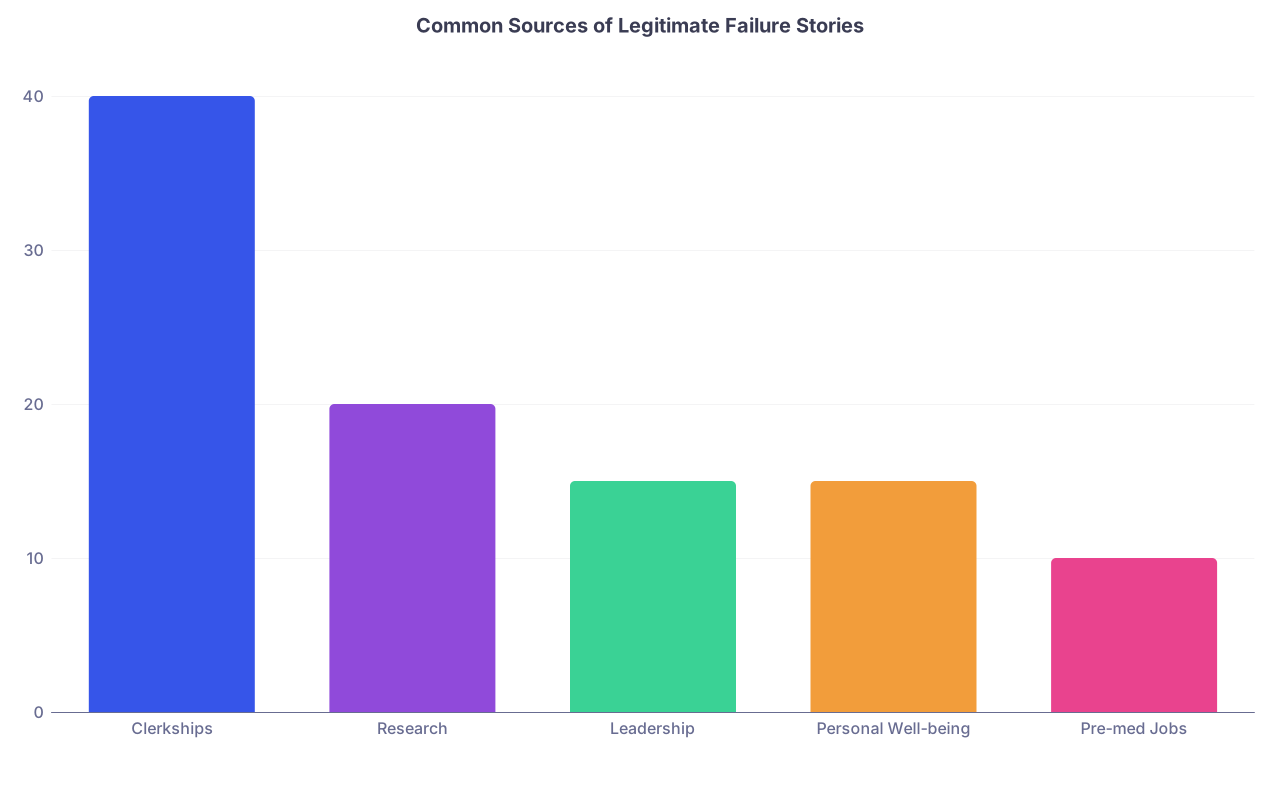
| Category | Value |
|---|---|
| Clerkships | 40 |
| Research | 20 |
| Leadership | 15 |
| Personal Well-being | 15 |
| Pre-med Jobs | 10 |
Take 20–30 minutes with a notebook and run through these domains:
Clerkships
- Times an attending gave you sharp feedback.
- Situations where the team had to redo your work.
- A moment you realized you delayed or forgot something.
Research
- Missed deadlines for abstracts or manuscripts.
- Poor communication with a PI that led to confusion.
- Data entry or analysis errors that required major correction.
Leadership / Organizations
- Events or projects that nearly failed due to your planning.
- Conflicts you did not manage well.
- Overcommitting and having to back out late.
Personal / Academic Process
- Burnout episodes where your performance dipped.
- Study strategies that backfired before Step.
- Time‑management screw‑ups that impacted others.
Pre‑med or Non‑clinical Jobs
- Customer complaints.
- Shift coverage mistakes.
- Miscommunications with supervisors.
Write bullets, not essays. One or two lines per incident. Then ask:
- Where did I actually make a decision or non‑decision that was wrong?
- Where did someone give me feedback that stung, but was accurate?
- Which of these led me to change a real behavior that I still use?
You want 2–3 strong, well‑thought‑out stories by the time interview season starts. You do not need ten.
Calibrating Severity: How Big Should the “Failure” Be?
You are aiming for what I’d call “Level 2–3 failure.” Not trivial. Not career‑ending.
Think of it like this:

Level 1: Tiny misstep
Example: “I once got lost on the way to clinic.”
Too small. Shows nothing about your character.Level 2: Moderate, real failure that primarily affected workflow, communication, or relationships
Example: missed follow‑up, poor presentation, bad delegation, delayed escalation with no lasting harm.
This is your sweet spot.Level 3: Serious incident requiring formal remediation, patient harm, or institutional action
Possible to use, but must be handled very carefully and only if fully resolved and processed.
If you are a high‑performing, no‑exam‑failures applicant, stay mostly in Level 2. It is honest, insightful, and safe.
Polishing Delivery: How You Say It Matters
Even a good story can be undermined by bad delivery. Watch for these patterns in mock interviews.
1. Over‑explaining Context
Symptoms:
- 3–4 minutes of set‑up before the actual failure.
- You sound like you are justifying yourself rather than owning it.
Fix:
- Practice starting with the failure in the first 1–2 sentences:
“I failed to…” / “I mishandled…”
2. Minimizing Language
Phrases that water down your answer:
- “It was just a minor thing…”
- “I mean, it was not really a failure, but…”
- “Some people might not call this a failure…”
Drop those. They tell the interviewer you still do not fully accept responsibility.
3. Emotional Flatness or Over‑Intensity
You want:
- Calm.
- Serious.
- Brief acknowledgment of how it felt.
You do not want:
- Laughing it off: “Yeah, that was kind of hilarious…” (No, it was not.)
- Looking visibly distressed or tearful, like it happened yesterday and you are reliving trauma.
If you still feel raw about an incident, choose a different one.
A Simple Framework You Can Rehearse Out Loud
Here is a talk‑track skeleton you can literally fill in with your own content. Use this as a starting point, not a script.
“A time I failed was when I ________. I was a [role] on [rotation/project], and my responsibility was to ________.
I failed specifically by ________. As a result, ________. I felt ________, and I realized that ________.
Right away, I ________ to address the immediate issue. I also sought feedback from ________ about what I should have done differently.
Since then, I have changed the way I ________ by ________. For example, [current habit or behavior]. That experience has made me much more deliberate about ________.”
Practice this with 2–3 stories until it feels natural and you can adapt it conversationally.
Final Points To Keep In Your Head on Interview Day
Let me close this cleanly.
- Having never failed a major exam is not a problem. Acting like that means you have never failed is.
- Strong failure answers are about ownership, insight, and concrete change, not drama.
- Mid‑level, real failures—communication breakdowns, reliability lapses, leadership mistakes—are exactly what programs want to hear about, if you can show how they reshaped your behavior.
If you walk into interviews ready to talk about those honestly, you will sound more mature and more ready for residency than the “perfect” applicant who insists they have never failed.