
Most residency applicants give competent behavioral answers. Very few show real insight. That is why they blur together and you do not.
Let me be blunt: “Tell me about a time you had a conflict on the team” is not actually about the conflict. It is an x‑ray of how your brain works: how you make sense of events, your capacity for self-critique, and whether you mature after mistakes or just collect war stories.
Programs are drowning in applicants who can describe events but cannot reflect on them.
You are going to do better than that.
Below I am going to walk through, in detail, how to build behavioral answers that scream:
“I understand myself, I learn from experience, and I am safe to put in front of patients at 2 a.m.”
What Programs Are Really Testing With Behavioral Questions
Forget the surface content of the question for a second. Behavioral questions in residency interviews are stress tests of three core capacities:
- Insight: Can you see your own role accurately, not just narrate what everyone else did wrong?
- Self-reflection: Can you extract specific learning and change your behavior?
- Professional judgment: Do you align with the values and realities of residency life?
Programs know full well that you have limited clinical authority as a student. They are not judging whether you single-handedly saved the ICU. They are judging how you think during and after the fact.
Here is what faculty are subconsciously listening for when you answer:
- Do you only talk about external factors? (“The nurses were rude, the attending was unhelpful, the system is broken.”) That is a red flag for low insight.
- Do you ever put yourself under the microscope? Specific, concrete self-critique is gold.
- Can you talk about mistakes without collapsing, over-defending, or blaming?
- Is there a clear “before and after”? I did X → I learned Y → I now do Z.
If your answers do not show those elements, you sound generic. Even if the story itself is dramatic.
The Biggest Mistakes Applicants Make (And Why They Kill Insight)
Let me break down the classic errors I hear every single interview season.
1. Hiding Behind Vague Reflection
You know this one:
- “I realized communication is very important.”
- “I learned the importance of teamwork.”
- “This taught me to be more empathetic.”
These are not reflections. These are slogans.
Real reflection is specific and behavior-linked:
- What precisely did you do that you would not do again?
- What did you change, and how do you know it worked?
- What internal assumption or blind spot got exposed?
If your “insight” could be copy-pasted into a Hallmark card, it is not insight.
2. Making Yourself The Hero In Every Story
The “I stepped in, took charge, and fixed it all” narrative is seductive. It also makes you look oblivious.
Residents are allergic to students who sound like they will bulldoze the team. Attendings can smell overcompensation: students painting themselves as the lone reasonable person while everyone else is difficult.
Strong candidates:
- Acknowledge what they did wrong or almost did wrong.
- Credit others explicitly.
- Show humility without groveling.
3. Dodging Ownership
Watch for your own language. If your answer is full of:
- “There was a miscommunication” (passive)
- “Things could have gone better” (foggy)
- “It was unfortunate that…” (deflecting)
You are distancing yourself from the mess. Programs hear that as: “This person will not own their part when things go bad.”
You need explicit ownership: “I failed to…”, “I misjudged…”, “I initially did…” and then show how you corrected and learned.
4. Picking Stories With No Real Tension
Some experiences are too “clean” to show serious growth.
Example:
“I had two deadlines, so I organized my schedule, communicated with my team, and met both.” That is nice. It does not show much insight. There was no real error, no discomfort, no internal conflict.
Better stories have one of these:
- A misstep or near-miss.
- A value conflict (patient care vs hierarchy, team harmony vs honesty).
- An emotional reaction you had to work through (frustration, fear, embarrassment).
If nothing went wrong, your “growth” will sound contrived.
The Structure That Forces Insight: STAR Is Not Enough
Most applicants know STAR (Situation, Task, Action, Result). For med students, that usually produces tidy narratives and zero reflection.
You need to extend it.
Use this modified structure:
STARR-I
- Situation
- Task
- Action
- Result
- Reflection (deep)
- Implementation (what changed afterward)
Let me show you what that looks like in practice.
Basic STAR (Weak on Insight)
“Tell me about a time you received critical feedback.”
Situation/Task:
“On my third-year medicine rotation, I was responsible for presenting a new admission on rounds.”
Action:
“I presented the patient, but afterwards my senior told me my assessment was too disorganized and lacked a clear plan. I listened carefully, took notes, and reviewed my presentation structure that night.”
Result:
“The next day, I used a more organized format, and my senior said it was much clearer.”
This is functional. It shows you can take feedback. It does not show deeper self-reflection.
STARR-I (What Strong Candidates Do)
Same question, upgraded answer:
Situation/Task:
“On my third-year medicine rotation, I was presenting a complex new admission with multiple problems to the attending and team on morning rounds.”
Action:
“After my presentation, my senior pulled me aside and said, very directly, that my assessment was more of a data dump than a synthesis. He pointed out that I had listed every lab abnormality, but I never clearly stated my top diagnosis or a prioritized plan.”
Result:
“At first I felt defensive because I had worked hard on the presentation, but I realized he was right. If I had been the intern, my presentation would not have helped the team manage the patient. That evening I went back to my notes and rewrote my assessment focusing on: one-line summary, top three problems, and a clear plan for each. The next day when I presented using that structure, the attending actually paused and said, ‘That was much more focused—nice job.’ My senior agreed it was a big improvement.”
Reflection:
“This made me confront that I was still thinking like a student trying to prove I had read everything, not like a clinician trying to help the team make decisions. I realized I was hiding behind details because I was afraid of being wrong in my synthesis.”
Implementation:
“Since then, I have forced myself, in every new patient, to write down one clear problem list and commit to a prioritized differential, even if I am unsure. I still look things up, but now my first step is: ‘If I were the intern, what would my plan be?’ That shift has made my presentations more useful and has actually made me more comfortable admitting uncertainty, because I know my job is to offer a structured starting point, not perfection.”
Notice what changed:
- You exposed your initial emotional reaction (defensiveness).
- You named a cognitive pattern (“thinking like a student, not a clinician”).
- You showed a specific, repeatable change in behavior.
That is insight. That is self-reflection.
How To Show Insight Explicitly (Without Sounding Like A Robot)
Residents and faculty will not “infer” your reflection. You must say it. Directly.
Here are phrases that signal insight, if you use them with real content:
- “I realized that my assumption was…”
- “Initially I interpreted it as X, but later I understood it was actually about Y.”
- “The part I had underestimated was…”
- “Looking back, the key error in my thinking was…”
- “I used to handle situations like this by…, now I…”
Bad: “I realized communication is important.”
Better: “I realized I was communicating to offload my anxiety, not to help the team make a clear plan.”
Bad: “I learned to be more empathetic with patients.”
Better: “I realized I was focusing on getting through my checklist and not noticing that the patient kept circling back to the same fear. Now, I intentionally pause my checklist when I hear that pattern and address the fear directly before moving on.”
You see the difference. The second versions reveal how your mind works.
Building Answer Banks That Naturally Show Reflection
You cannot improvise deep insight on the spot if you have never thought about the experience. You will revert to cliché. So you need a small, well-curated bank of stories, each pre-analyzed.
Aim for 6–8 core experiences that you can flex across different questions:
- A genuine mistake or near-miss.
- A conflict with a peer or nurse.
- A time you disagreed with a supervisor or attending.
- A situation where you advocated for a patient.
- A time you were overwhelmed or at capacity.
- A diversity / cultural / bias-related situation.
- A leadership or teaching experience.
- A time you received hard feedback.
For each one, write out—briefly—the following on paper:
- What actually happened (in one paragraph).
- What you did well.
- Where you fell short, concretely.
- What you realized about yourself, that you had not understood before.
- Exactly what you changed afterward. Not what you “plan” to change. What you already did.
If you cannot fill out #4 and #5 with specific, behavior-level details, it is probably a weak story for insight. Either dig deeper or choose another event.
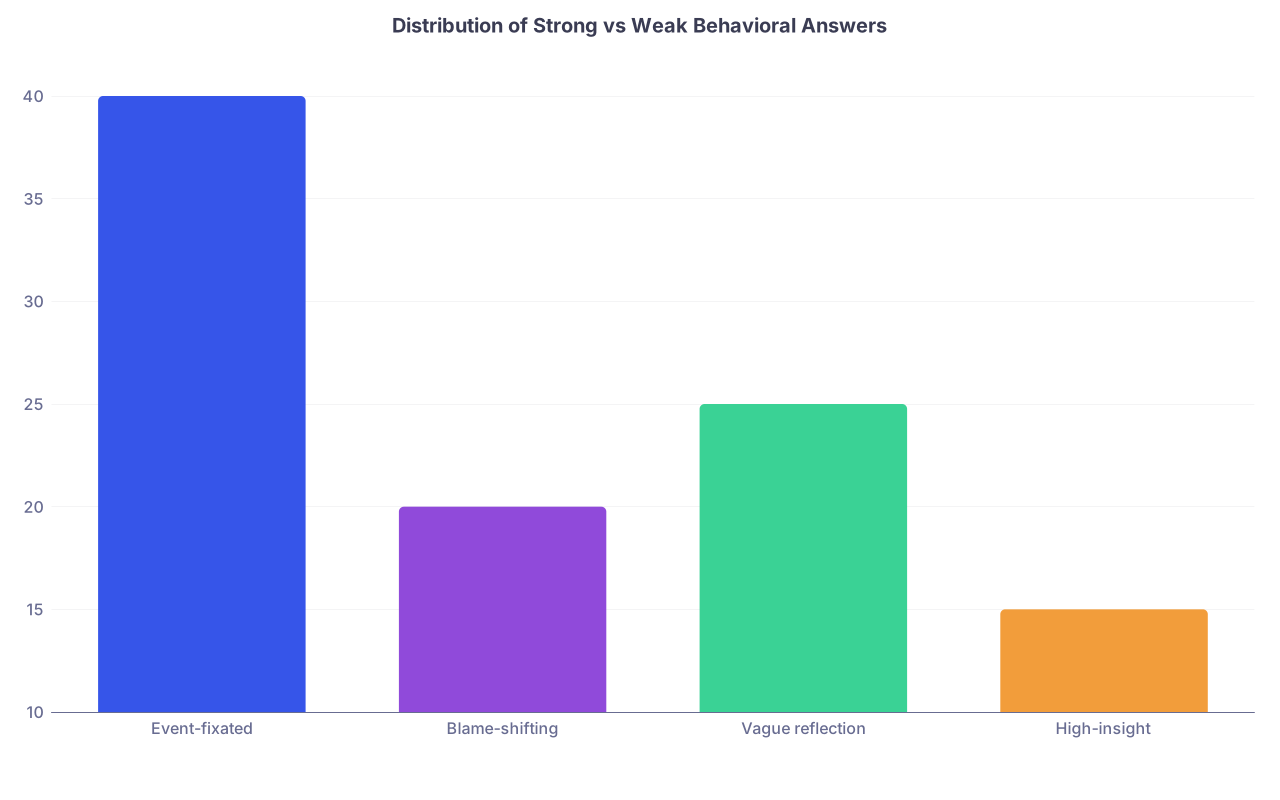
| Category | Value |
|---|---|
| Event-fixated | 40 |
| Blame-shifting | 20 |
| Vague reflection | 25 |
| High-insight | 15 |
Most applicants cluster in the first three categories. You will live in the last one.
Concrete Examples: Weak vs Strong Insight Answers
Let me show you several side-by-side shifts. You will see the pattern.
Example 1: Conflict With a Team Member
Weak:
“I worked with a classmate on a group project who was often late with their part. I calmly talked to them, explained the importance of deadlines, and we agreed on a schedule. After that, things improved and we completed the project successfully. I learned the importance of communication and addressing issues early.”
Strong:
“In my second year, I worked with a classmate on a QI project who repeatedly missed internal deadlines. I initially avoided addressing it directly because I did not want to be seen as difficult. Instead I just silently absorbed more of the work and felt increasingly resentful. Eventually the night before a presentation, when a section was again incomplete, I sent a frustrated message in the group chat that came across as accusatory.
My classmate understandably became defensive and replied that they felt I was micromanaging and not respecting that they had other obligations. At that point we had to have an in-person conversation. I apologized for letting my frustration build silently and then communicating it in a way that felt like an ambush. We clarified expectations and agreed on clearer intermediate checkpoints that worked for both of us. The project got back on track.
The reflection for me was that my conflict-avoidant style was not actually avoiding conflict—it was just delaying it and making it worse. I realized I was more comfortable overworking than having a direct, earlier conversation. Since then, I have forced myself, when I notice resentment building, to schedule a short one-on-one check-in before it spills over. On my medicine rotation, I used that approach with a co-student around prerounding responsibilities, and we had a much more constructive discussion because I caught it earlier and framed it as ‘I want to make sure we are on the same page’ rather than a last-minute complaint.”
See the difference:
- You expose your internal pattern (conflict avoidance).
- You own your misstep (frustrated late-night message).
- You give a second, later example of implementing the learning.
That is how you demonstrate actual growth trajectory.
Example 2: Handling a Mistake
Weak:
“On my surgery rotation, I once forgot to check a lab and the resident pointed it out. I apologized and made sure to double-check labs in the future. I learned to be more detail-oriented.”
Strong:
“On my surgery rotation, I was following a post-op patient whose hemoglobin trend we were watching closely. One morning, I skimmed through the lab results but missed that the new hemoglobin had dropped more than expected. On rounds, the chief pointed it out in front of the team. I felt embarrassed and immediately worried that I had put the patient at risk.
Later that day, I took a moment alone to go back through my pre-rounding notes. I realized I had been rushing and checking boxes rather than pausing to ask, ‘What are the one or two data points that could actually change management today?’ I apologized to the chief, acknowledged that I had been moving too fast, and asked for feedback on how they approached prioritizing key overnight changes.
The big shift for me was moving from a mindset of ‘collect all the data’ to ‘identify the few critical metrics for this specific patient.’ Since then, for each patient, I write at the top of my prerounding sheet: ‘Today’s must-check items’—for example, drains and Hgb for this patient, or oxygen requirement and urine output for another. That simple habit has made my pre-rounds slower in a good way and has helped me catch several issues early, like a creeping oxygen requirement on a medicine patient that prompted us to examine them sooner.”
Again: you are not pretending you now never miss anything. You are showing calibrated self-awareness and specific process change.
Non-Verbal Ways You Signal Insight (Without Saying A Word)
I have watched applicants absolutely kneecap solid content with their delivery. Your words say “I welcome feedback,” but your face says “I am being prosecuted.”
Pay attention to:
Micro-defensiveness
When asked about a mistake, if your posture stiffens, your voice tightens, or you rush into long justifications, interviewers pick up a mismatch between your words and your actual stance.Practice pausing after the question. Nod slightly. Start with, “Yes, I can think of a specific example,” in a calm tone.
Emotional flatness
If everything in your life is described in the same neutral tone, it sounds like you have not really processed it. You do not need to dramatize, but you should show appropriate affect: mild embarrassment when you describe a misstep, satisfaction when you describe growth.Over-rehearsed cadence
Perfectly memorized, monotone answers kill authenticity. Faculty know you prepared; that is fine. But you should sound like you are thinking as you speak, not reciting.Trick: memorize your beats (Situation, key Action, real Reflection, Implementation), not exact wording. Leave yourself room to adjust phrases in real time.

| Step | Description |
|---|---|
| Step 1 | Question Asked |
| Step 2 | Choose Relevant Story |
| Step 3 | Brief Context |
| Step 4 | Key Actions Taken |
| Step 5 | Concrete Result |
| Step 6 | Honest Self-Critique |
| Step 7 | Specific Learning |
| Step 8 | Subsequent Behavior Change |
If you walk through that sequence, you almost cannot help sounding reflective.
Adapting Your Insight To Different Behavioral Questions
Most programs recycle the same core question themes and just dress them up. Once you have 6–8 stories built with STARR-I, you flex them.
Let me map your story bank to common questions:
| Story Type | Fits Questions Like |
|---|---|
| Mistake / near-miss | "Tell me about a mistake", "Time you failed" |
| Conflict with peer / nurse | "Conflict on a team", "Difficult colleague" |
| Feedback that stung | "Critical feedback", "Time you had to change" |
| Overwhelmed / stretched thin | "Handling stress", "Competing priorities" |
| Advocacy for patient | "Advocating for a patient", "Ethical dilemma" |
You do not need a unique story for every micro-variation of a question.
Example: same “conflict with classmate” story can be used as:
- “Tell me about a time you had a conflict”
- “Tell me about a time you worked on a dysfunctional team”
- “How do you handle working with someone whose style is different from yours?”
The surface framing changes. Your core reflection and implementation do not.
How Honest Can You Be? The Line Between Vulnerability And Red Flag
There is a myth that you should never reveal weakness in interviews. That is how you end up sounding like a robot.
Programs want to see vulnerability with judgment. The key is:
- Pick mistakes that show growth in judgment, not in basic professionalism.
- Do not confess to ongoing, unaddressed issues.
- Show clear containment: this happened, I learned, and there is a different pattern now.
Good categories of “safe” vulnerability:
- Early rotation misjudgments.
- Communication missteps.
- Times you were conflict-avoidant, then addressed it.
- Initial difficulty with time management that you restructured.
High-risk to talk about, unless you can show rock-solid remediation and time distance:
- Chronic lateness or unreliability.
- Repeated professionalism concerns.
- Dishonesty.
- Unresolved patient-safety incidents where your role is unclear or still under review.
When in doubt, ask yourself: “Is the growth arc here obvious and plausible, or does this sound like a current liability?”
If it is the latter, pick a different story.
Putting It Together: A Full High-Insight Answer
Let me construct a full, polished answer for a classic question.
Question: “Tell me about a time you had to work with someone who was difficult.”
Answer:
“On my third-year internal medicine rotation, I was paired with another student to cover a busy inpatient team. From my perspective, my partner often disappeared in the afternoons and left a disproportionate amount of the note-writing and follow-up calls to me.
Initially, I did not address it. I just stayed later, finished the work, and quietly felt irritated. I told myself I was being ‘team-oriented’ by not making an issue of it, but in reality, I was avoiding a direct conversation. After about a week, my frustration leaked out when I made a sarcastic comment about ‘some of us being done early’ within earshot of the team. My co-student understandably bristled, and the atmosphere got tense.
That evening, I realized two things. First, my passive-aggressive comment was unprofessional and undermined the team. Second, my avoidance had helped create the problem. I had never actually asked how they were viewing the workload or what else they were balancing.
The next day, I pulled my co-student aside and apologized for the comment. I told them I was feeling overwhelmed and that I should have spoken up sooner in a direct way. When we actually compared our task lists, it turned out they were spending a lot more time than I realized with new admissions and family meetings, which I had been less involved in. From their perspective, I was the one disappearing to ‘just write notes.’ We ended up sitting down with the resident, clarifying expectations, and splitting tasks more explicitly.
What I took from that was that my instinct to preserve surface harmony by avoiding conflict was not actually harmonious; it created resentment and then a blow-up. Since then, when I notice myself feeling that familiar low-level resentment, I use it as a cue to schedule a brief check-in early, frame it around ‘how can we divide this fairly’ rather than accusations, and, if needed, involve the resident before things fester. On my surgery rotation, I used that approach when call coverage felt uneven among students, and it led to a calm discussion and a revised schedule instead of quiet frustration.”
If you give answers like that consistently, you will stand out. Not because the events are extraordinary. Because the thinking is.