
The usual advice about “handling tough interview questions” completely fails when the question itself is biased.
You are not just performing for a rank list. You are also deciding if you want to work with people who say things like, “But who’s going to take care of your kids during residency?” or “Your accent might be hard for patients.”
Let me break this down specifically: you need a strategy that protects your dignity, preserves your options, and gives you control of the moment—without torpedoing your chances.
1. Ground Rules: What You Are Actually Optimizing For
Before we get into scripts and scenarios, you need the objective clear. You are not trying to “win” every interaction. You are trying to do three things simultaneously:
- Maintain professionalism and self-respect.
- Avoid impulsive self-sabotage in a 15‑minute interaction that can affect your career.
- Gather data about the program’s culture and whether you should rank them at all.
Those three often conflict in the moment, especially when you feel blindsided or disrespected. The key is preparation, not improvisation.
Think of biased or microaggressive moments in interviews as falling into three broad categories:
- Clueless / unintentional microaggressions
- Patterned bias that reveals culture
- Outright illegal or wildly inappropriate questions
You handle each differently. But you use the same underlying toolkit:
- Emotional pause (buy time, control physiology)
- Neutral naming or reframing of the issue
- Redirect to your strengths / professional narrative
- Post‑interview documentation and decision‑making
We will walk through each category with real scripts you can actually say out loud without sounding like a robot.
2. Know What Is Out of Bounds (Legally and Ethically)
Let’s be blunt. A lot of residents and faculty have never had formal interview training. Some still think it is fine to ask:
- “Do you plan to have children during residency?”
- “Where are you really from?” after you already answered.
- “Are you married? Your husband is OK with you working nights?”
- “You’re Muslim, will you be able to see male patients?”
- “Do you think you can handle this program at your age?”
These are not just rude. Many are illegal or strongly discouraged in the US context.
| Topic Area | Examples of Problematic Questions |
|---|---|
| Marital/Family | Are you married? Planning kids? Who will watch your kids? |
| Pregnancy | Are you pregnant? Trying to get pregnant soon? |
| Age | How old are you? You look young/old for residency. |
| Religion | What religion are you? Will your beliefs affect care? |
| National Origin | Where are you really from? What country are you from? |
| Health/Disability | Any health problems? Are you disabled? |
Does this mean you must confront every illegal question head‑on? No. You have options. And the “right” choice depends on:
- How egregious the comment is
- Who said it (PD vs resident vs admin)
- Your personality and comfort with directness
- How much you care about matching at that particular program
You should know this though: NRMP and most GME offices take clear, documented patterns seriously. One bad interviewer making a clumsy comment is different from a program where everyone repeatedly crosses lines.
3. Core Skills: What To Do In The Moment
You do not rise to the occasion; you fall to your level of preparation. So you need mental templates you can plug content into.
3.1 The Internal Sequence: Pause → Label → Decide
What you are thinking in those 3 seconds after a biased comment is more important than the comment itself. The sequence looks like this:
- Microaggression or biased comment lands.
- Physiologic spike: heart rate, anger, shame, heat.
- You buy 2–4 seconds: small breath, tiny physical reset (shifting in chair, sip of water, brief smile).
- Internally you label:
- “Clueless but not malicious.”
- or “Red flag, but this room is not safe for confrontation.”
- or “This is beyond the line. I am OK drawing a boundary.”
- Only then do you choose: deflect, reframe, question, or confront.
If you skip this and react purely from emotion, you often either shut down or overcorrect. I have watched brilliant applicants freeze after a “Where are you really from?” line and spend the rest of the interview dissociating.
So you practice the pause as seriously as you practice your “Tell me about yourself.”
3.2 Four Default Moves
Think of these as your basic four tools:
- The Gentle Reframe
- The Boundary + Redirect
- The Clarifying Question
- The “Name It” Response (for when you choose to be direct)
You do not need twenty scripts. You need 2–3 that sound like you.
4. Scenario Library: What To Say, Exactly
Let me give you concrete scenarios I have actually seen on interview days, with scripts that work.
4.1 Scenario: “Where Are You Really From?”
You: “I grew up in Michigan, did undergrad at U of M and med school at Wayne State.”
Interviewer: “Right, but where are you really from?”
You have several options.
Option A – Gentle Reframe (if you want to keep it light, but signal the line)
“Michigan. My parents immigrated from Pakistan, but I was born and raised in Detroit. It has really shaped how I relate to patients from immigrant communities.”
This does three things at once:
- Answers what they probably meant
- Signals that your US identity is valid
- Immediately turns it into a strength
Option B – Boundary + Redirect (if this hits a nerve and you want to steer away)
“I am from Michigan. My background is Pakistani, and it is been a meaningful part of my work with diverse patient populations. In residency what I am most focused on is…”
You mark the question as slightly off without fully confronting it, and you pivot.
Option C – “Name It” (for applicants who are comfortable being more direct)
“I am from Michigan. Sometimes people are asking about my ethnic background when they say that—if that is what you meant, my family is Pakistani. It has been a big driver of my interest in equity in medicine.”
You explicitly name the nature of the question (“ethnic background”) instead of letting “really from” stand, which subtly calls it out.
4.2 Scenario: Gender/Family Planning Questions
Interviewer: “Do you plan on having kids during residency? It can be really disruptive to the schedule.”
This is textbook inappropriate. But whether you confront it depends on your goals.
Option A – Evasive + Professional
“I am fully committed to my training and to carrying my share of the workload. In my prior rotations and sub‑I, I took call, nights, and weekends without issues, and I expect to do the same here.”
You do not answer the illegal bit. You answer the supposed “concern” (commitment, workload).
Option B – Boundary + Reframe
“I tend to keep my family planning private, but I can assure you I am highly committed to my responsibilities and have a strong track record of reliability on rotations.”
Again, you signal a line without a fight.
Option C – Name It (if the environment feels relatively safe)
“Family planning is something I keep private. What I can tell you is that I have consistently managed demanding schedules on surgery and ICU rotations and performed well. Is the program concerned about residents balancing family responsibilities overall?”
Now you put the issue back onto program structure and fairness, which is where it belongs.
If you ever get an explicitly discriminatory follow‑up (“We prefer residents without kids”), you are now in “document and report” territory. More on that later.
4.3 Scenario: Age Bias
Interviewer: “You seem quite young; do you think you can handle the intensity of this residency?”
or
“You changed careers late—do you think you will keep up with the younger residents?”
You can use almost the same template regardless of whether they think you are “too young” or “too old.”
“On paper I may look younger/older than some applicants, but in practice my maturity has been an asset. On my ICU and night float rotations I have been trusted with high‑acuity patients, given positive feedback on my resilience and judgment, and I am very comfortable with the workload and intensity.”
You acknowledge the subtext (“you are different”) and replace it with a performance‑based narrative (“and it has been a strength”).
4.4 Scenario: Accent / Communication Microaggressions
Interviewer: “Your accent is pretty strong; do you think patients will understand you?”
or resident on the tour: “Sometimes older attendings have trouble with accents here, just being honest.”
Option A – Confident Reassurance
“In my clinical evaluations communication has consistently been one of my strengths. I have worked in busy ED and inpatient settings with diverse patient populations, and patients and staff have given me positive feedback on clarity and rapport.”
You do not apologize for existing. You answer as if they asked, “How are your communication skills?”
Option B – Subtle Turn
“I do have an accent. Patients have varied backgrounds and communication styles as well. I have found that being deliberate—slowing down, checking understanding, using teach‑back—matters much more than having a particular accent.”
Far better than defensiveness. You essentially say: I practice high‑quality, patient‑centered communication. Full stop.
4.5 Scenario: Racialized Stereotypes
Interviewer: “You are Black/Latino/Asian—patients from your community will love you. Do you feel comfortable being the go‑to for those patients?”
or
“You could really help us with our ‘Spanish patients’.”
This is the classic “burden of representation” microaggression. It sounds like a compliment but assigns unpaid race‑based labor.
Boundary + Reframe works well.
“I am glad my background can help some patients feel more comfortable. At the same time, I think all residents share responsibility for caring for diverse patients and building cultural humility. What I bring in addition is an interest in system‑level equity work, like [example].”
You acknowledge the potential benefit while rejecting the idea that you are a one‑person DEI solution.
If they push: “So you would be OK being the point person for those patients?” you can say:
“I am always happy to help with language or cultural nuance when appropriate, but it is important that the system does not rely on a single resident for that. My priority is to be an excellent clinician for all my patients.”
4.6 Scenario: Religion and Practice
Interviewer: “You are Muslim/Jewish/Seventh‑day Adventist—will your faith interfere with your work schedule or patient care?”
or
“Would you refuse to participate in certain procedures?”
You need to protect yourself from being painted as “difficult,” but you also do not have to disclose more than you want.
“Across my training I have fully met all my clinical obligations, including weekends, nights, and procedures. When I have had specific observance needs, I have handled them the same way other residents manage personal or family needs—through professional scheduling discussions. My evaluations have not raised any concerns in this area.”
Short, factual, and grounded in actual performance.
If they explicitly target religion (“We have had issues with religious residents before”), that is a sign you probably should not rank them highly.
4.7 Scenario: LGBTQ+ Microaggressions
Some programs ask directly: “Do you have a partner? Are you married?” You are not obligated to out yourself. You also may want to test how safe this place is.
You can answer at three disclosure levels:
- Non‑disclosing: “Yes, I have a partner. They work in [field]. We have talked a lot about this move and are both very supportive of my training.”
- Partially disclosing: “Yes, I have a partner. My wife/husband works in [field] and is very supportive…”
- Fully disclosing with context: “Yes, my husband and I have discussed relocation extensively. We have looked into LGBTQ+ resources in the area, which is something we value in a community.”
If you get microaggressive follow‑ups (“Our town is not very into that lifestyle, is that OK?”), you now have data. You can respond:
“I value working in environments that treat all patients and staff with respect. I have learned to build supportive communities wherever I am, and I would do the same here. How does the program handle discrimination or bias incidents among staff or patients?”
You flip their discomfort into a question about their policies. Their answer often tells you everything you need to know.
5. Strategy: Choosing Your Response Style
You cannot treat every comment the same. The same applicant might handle a microaggression differently at a dream program vs a backup.
5.1 The Three “Response Modes”
Think of it as a slider with three positions:
Self‑Protection Mode
- Priority: keep doors open, minimize emotional energy spent
- You use: deflection, reframing, minimal confrontation
- You document and decide later if you will rank them
Assertive but Strategic Mode
- Priority: maintain dignity and test culture
- You use: boundaries + redirects, clarifying questions
- You are willing to mildly challenge, without burning bridges
Principle‑First Mode
- Priority: integrity over matching at that site
- You use: “name it” responses, and you are comfortable if they do not like it
- You consider reporting, and you rank them low or not at all
None of these are morally superior. They are different risk‑benefit calculations. You do not owe anyone a “teachable moment” at the cost of your own safety or match prospects.
6. Reading the Room: Individual vs Culture
You are not just evaluating that one interviewer. You are trying to figure out: is this a one‑off or is this the norm here?
Look for patterns during the entire interview day:
- Do multiple people make comments about “fit” that sound like “people like us”?
- Do residents of color, women, or LGBTQ+ residents seem guarded, or do they describe real support?
- Does the PD talk about wellness and equity only in vague buzzwords? Or do they cite concrete policies and changes?
- When someone mentions a difficult situation (e.g., harassment by a patient), do they describe strong institutional backing, or “we just try not to rock the boat”?
One off‑color question from a 70‑year‑old emeritus attending is not the same as an entire day of coded bias.
7. After the Interview: Document, Debrief, Decide
Most applicants do the worst possible thing: they leave the day, feel vaguely gross, and then gaslight themselves into thinking they are “overreacting.” Do not do that.
7.1 The 15‑Minute Debrief
As soon as you get back to your car / hotel / couch, write down:
- Exact wording of any biased or inappropriate comment
- Who said it (name, role: PD, APD, resident, faculty, coordinator)
- Who else was present
- Your response, and how they reacted
- Overall vibe of the program before and after that moment
You think you will remember verbatim later. You will not. Interview season blurs together.
7.2 Deciding Whether to Report
You have a few reporting pathways:
- Email the program director (if the offender was not the PD)
- Contact the institution’s GME office / Designated Institutional Official
- Use NRMP’s anonymous reporting tools if it appears systemic or coercive
Reserve formal reporting for:
- Repeated, blatant discrimination
- Coercive questions (asking you to reveal rank list, promising positions, etc.)
- Retaliation when you set a very reasonable boundary
If it was a single clumsy comment that you handled and the rest of the day was excellent, you may choose not to escalate. That is a valid choice.
But if a program shows you who they are, believe them. I have seen more than one resident spend three miserable years somewhere they knew was toxic from interview day, because they convinced themselves it was “just one person.”
8. Preparing Ahead: Do the Reps
You would never walk into Step 2 CK without practice questions. Treat this the same way.
8.1 Build Your Personal Scripts
Take 15 minutes and write out:
- A “where are you from” script that feels true to your background
- A family/relationship answer that maintains your privacy level
- A communication/“accent” strengths answer
- A one‑sentence boundary phrase you like, for any question that crosses a line
Examples of boundary phrases:
- “I usually keep that part of my life private, but what I can say is…”
- “I am not comfortable discussing that in detail, though I can reassure you that…”
- “I am not sure that question is appropriate, but I am happy to talk about…”
You want these phrases in your muscle memory.
8.2 Practice With a Real Person
You need realistic discomfort. Ask:
- A co‑resident, chief, or faculty mentor who is blunt and cares about equity
- A friend not in medicine who is unafraid to ask awful questions for practice
Have them role‑play as the “difficult interviewer.” Tell them to:
- Interrupt you
- Ask where your husband/wife is
- Comment on your appearance, accent, race
- Ask about kids, pregnancy, religion
Practice until you can:
- Feel the initial sting
- Pause and breathe
- Choose one of your scripts
- Answer calmly without a shakiness in your voice
That is the skill.
9. Subtle Nonverbal Control: How You Hold the Room
Verbal responses are only half the story. The rest is body language and tone.
Three practical points:
Face and voice
- Avoid nervous giggles after a biased question; they signal compliance.
- Aim for a calm, slightly serious tone when setting boundaries.
- Maintain eye contact; do not look down when you push back.
Posture
- Do not collapse into yourself. Keep shoulders open, feet grounded.
- Tiny moves—leaning in slightly, uncrossing arms—project self‑possession.
Silence
- A 1–2 second pause before answering a problematic question can be powerful.
- It signals that what was said required processing. That alone can reset the interviewer’s tone.
You want your nonverbals to say: “I am composed, I heard what you said, and I am choosing how to respond.”
10. When You Decide You Are Out
Sometimes the correct response is internal: “I will not work here.”
That decision is easier if you formalize a rough “no‑go” list before interview season. For example:
- Any program where the PD personally makes explicitly sexist or racist remarks → Do not rank.
- Any program where multiple residents privately warn you about homophobia, racism, or retaliation for reporting → Bottom of the list or off entirely.
- Any program where your safety feels at risk (geographically, culturally, institutionally) → Respect that instinct.
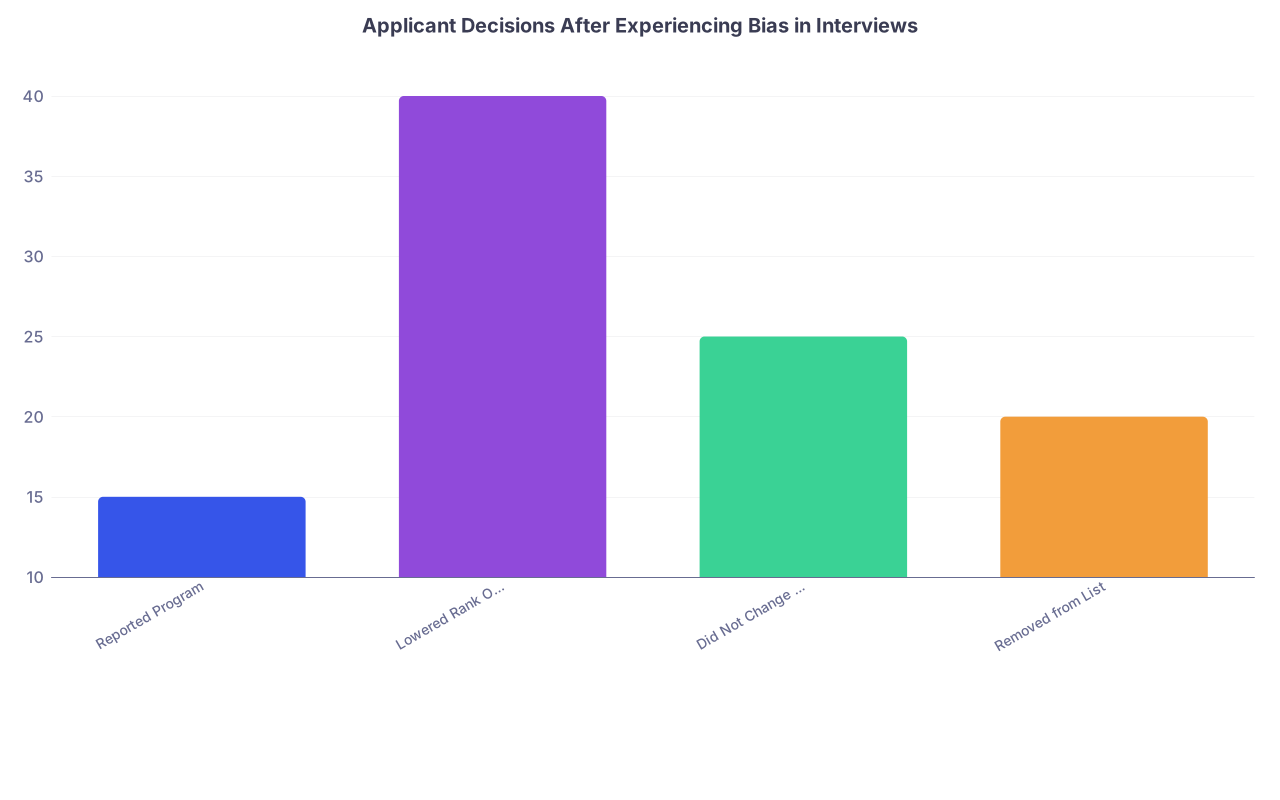
| Category | Value |
|---|---|
| Reported Program | 15 |
| Lowered Rank Only | 40 |
| Did Not Change Rank | 25 |
| Removed from List | 20 |
Most applicants do not report. Many quietly drop programs down the list. That is rational. Just be intentional about it instead of drifting into a decision.
11. Microaggressions From Residents vs Faculty
Bias from faculty and from residents mean different things.
- Biased faculty question, respectful residents: often indicates an individual outlier or generational gap. I have seen programs where the PD later apologized for a specific faculty member with a known issue.
- Biased residents on the tour, thrilled faculty: more concerning. Residents reflect daily culture more accurately than the 30‑minute PD slide deck.
Pay special attention when residents say things like:
- “We joke about…” certain patient groups
- “You have to have thick skin here; the attendings are old school”
- “The women in our program have to really fight for procedures; you look tough, you’ll be fine”
They are trying to warn you. Listen.
12. Tactical Phrases You Can Borrow
To make this extremely practical, here is a small set of phrases you can almost copy‑paste into reality.
For setting a boundary:
- “I tend to keep that private, but I can tell you that…”
- “I am not sure that question is appropriate, though I am very comfortable discussing…”
- “I prefer to focus on my clinical performance, which has been…”
For reframing a biased assumption:
- “Actually, I have found that…”
- “In my experience on rotations, what has mattered more is…”
- “The feedback I have received has been that…”
For turning the focus back on them:
- “How does your program support residents who…”
- “Can you tell me more about how the program approaches…”
- “What systems are in place if a resident experiences…”
Use them bluntly. They work.
13. You Are Interviewing Them Too
I have sat in on too many pre‑rank meetings where programs obsess over “fit” and “professionalism” without once asking whether they were professional to the candidate.
You are not obligated to endure disrespect to get trained. There are many programs. There is one you.
Two or three key points to walk away with:
- You need pre‑rehearsed scripts and a practiced pause for biased or inappropriate questions. Do not improvise under stress.
- Respond strategically: protect yourself in the moment, then use documentation and your rank list to hold programs accountable in reality, not just rhetorically.
- Microaggressions during interviews are not just “awkward moments”; they are diagnostic tests of a program’s culture. Believe what you see.