
Most residency applicants talk about being “team players.” The smart ones prove they are teachable.
Programs are not hunting for the finished product. They are hunting for residents who can take a hit to the ego, adjust, and get better—fast. That is what “teachability” and “growth mindset” look like in real clinical life, and that is exactly what behavioral questions are trying to smoke out.
Let me break this down specifically: if your behavioral answers sound like canned leadership quotes, you will blend into the pile. If your answers show concrete, humbling, trajectory-changing moments, you will stand out.
This is the difference between:
- “I welcome feedback and always try to improve.” vs.
- “Mid-ICU rotation my intern told me I was slowing down pre-rounds by rewriting all the notes. I felt defensive. The next day I tried a new workflow and cut my preround time by 40 minutes. She later commented my presentations were sharper. Since then, I…”
Same intent. Totally different signal to the committee.
The Core Idea: Programs Are Selecting for Trajectory, Not Perfection
Here is the unspoken rule: attendings assume you will be wrong. Often. What they care about is what you do right after you are wrong.
A “growth mindset” answer in residency interviews shows three things:
- You recognize when you are out of your depth or have messed up.
- You seek and absorb feedback without melting down or getting defensive.
- You implement change and can articulate what is different now.
Teachable residents lower risk. They:
- Make fewer repeated errors.
- Respond better when the service is on fire.
- Are safer to give autonomy to.
Your behavioral answers need to telegraph this. Not with abstract values, but with small, specific, almost embarrassingly concrete stories.
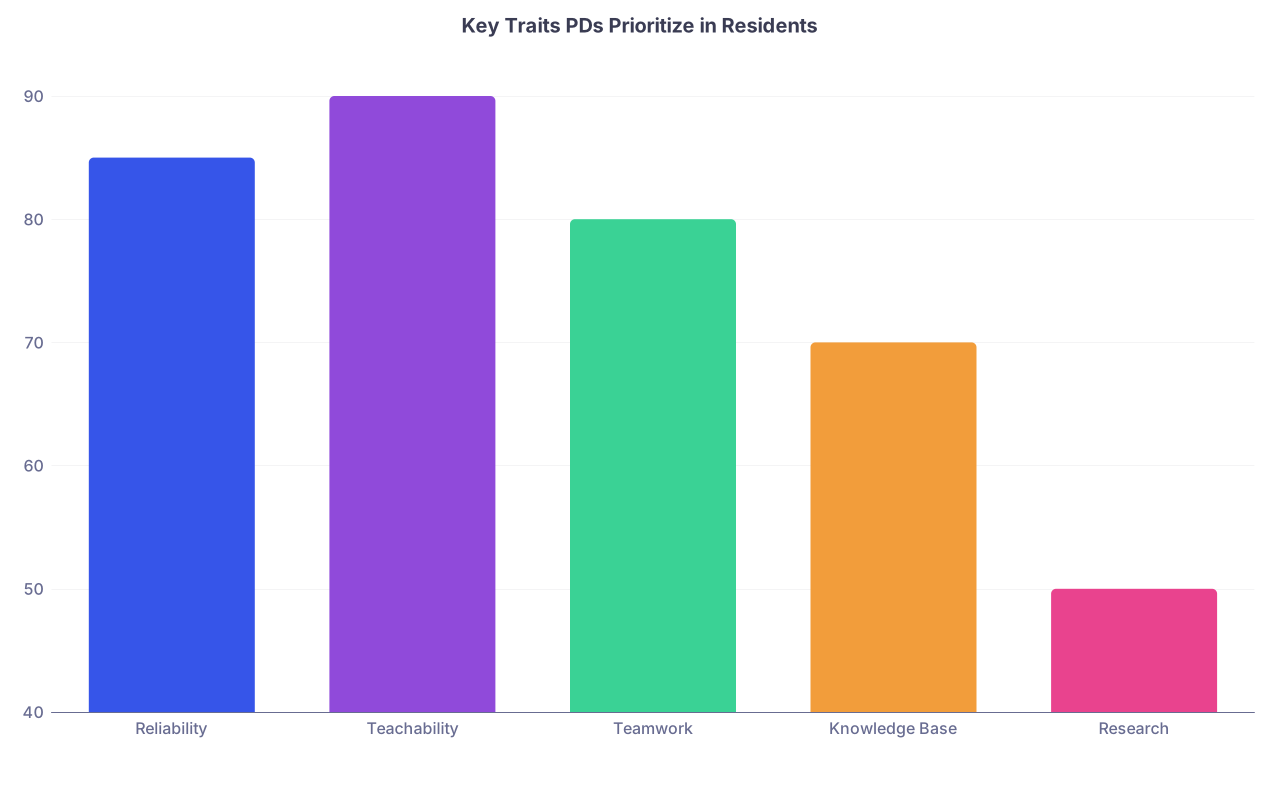
| Category | Value |
|---|---|
| Reliability | 85 |
| Teachability | 90 |
| Teamwork | 80 |
| Knowledge Base | 70 |
| Research | 50 |
(Yes, knowledge and research matter. But programs get burned much more by uncoachable people than by someone who needs a bit more pathophysiology.)
The Behavioral Question Patterns You Must Own
Most “growth mindset” and teachability questions are recycled variations of a few core prompts. If you master these, you cover 80% of what you will actually hear.

Common patterns (with what they are really testing):
“Tell me about a time you received critical feedback.”
- Can you handle ego injury?
- Do you actually change behavior?
“Describe a time you made a mistake.”
- Do you recognize clinical fallibility?
- Do you own your role without excuse-blaming?
“Tell me about a time you struggled or failed at something academic or clinical.”
- Do you quit? Plateau? Or adapt strategy?
“Tell me about a time you changed your mind.”
- Intellectual humility.
- Willingness to abandon a wrong plan.
“Describe a time you had to quickly learn something new in a high-stakes setting.”
- How you learn under pressure.
- How you structure feedback and follow-up.
Programs do not want perfection stories with a pretty “lesson” stamped on at the end. They want:
- Vulnerability without chaos.
- Responsibility without self-flagellation.
- Improvement that is specific and believable.
The Anatomy of a Teachability Answer (Beyond Generic STAR)
You have heard of STAR (Situation, Task, Action, Result). Overused and usually delivered as a monotone script.
For residency, you need a modified structure that emphasizes change over time:
S – Snapshot: Very brief context. One or two sentences. C – Challenge / Conflict: What was actually hard about this? Ego, time pressure, knowledge gap, miscommunication. F – Feedback or Failure: The key moment. What you heard, or what went wrong. A – Adjustment: The specific change in your behavior, system, or mindset. R – Result and Ripple: Concrete outcome and what stuck long-term.
I will call it SCFAR, because medicine loves ugly acronyms.
Example for “Tell me about a time you received critical feedback”:
- S (Snapshot): “On my third-week of inpatient medicine, I was presenting to an attending known for being very direct with feedback.”
- C (Challenge): “I was trying to be thorough, but my presentations frequently ran long and unfocused.”
- F (Feedback): “After one rounds day, he told me plainly that my presentations were ‘buried in data’ and that my assessments were ‘unclear,’ and that this was unsafe on a busy service.”
- A (Adjustment): “That evening I asked him for one example of a ‘clear’ presentation. I rewrote my template into ‘overnight events / system-based subjective / objective highlights / one-sentence assessment / prioritized plan’ and practiced out loud before rounds. I also asked my resident to stop me the next day if I drifted into irrelevant detail.”
- R (Result and Ripple): “Within three days, he commented that my presentations were ‘much tighter.’ I noticed I was identifying problems earlier because my assessment forced me to commit to a main issue. Since then, I use a similar mental structure in sign-out and even in my notes, which has helped me keep sick patients front of mind.”
Notice the emphasis:
- The feedback is concrete and somewhat harsh.
- The adjustment is behavioral and specific.
- The result is both short-term (attending comment) and long-term (changed workflow).
That is what teachability sounds like.
What Growth Mindset Actually Looks Like in Residency Stories
“Growth mindset” is one of those buzzwords that everyone throws in their personal statement. Program directors have heard “I am a lifelong learner” enough times to last several careers.
In the residency context, growth mindset has three practical behaviors:
You treat weaknesses as trainable skills, not fixed traits.
Example: “I used to think I was just ‘bad at procedures.’ During surgery clerkship I logged my first five central line attempts with specific notes on what I did poorly, then watched one video each night targeting that step. By the tenth attempt, my attending said my needle control had noticeably improved.”You change your study / work process in response to results.
Example: “After scoring low on my first shelf, I stopped passively rereading notes and switched to 80-question days with forced recall, plus a 24-hour error review cycle. My next two shelves improved by ~1 SD.”You persist after setbacks with a different strategy, not just more effort.
Example: “I failed my first OSCE counseling station because I rushed through shared decision-making. For the next one, I built a literal 4-step checklist in my margin: check understanding, elicit concerns, offer options, confirm plan. I used it out loud. I passed that OSCE and have stuck with that script in real clinic.”

These are the habits you want to surface in your answers. Not the phrase “growth mindset” itself.
Language That Signals Growth Mindset (Without Saying the Phrase)
Certain words and structures signal fixed mindset:
- “I am just not a ____ person.”
- “That attending did not understand my style.”
- “The nurse was overreacting.”
And certain phrases signal teachability:
- “At first I felt defensive, but…”
- “I asked for a concrete example of what ‘better’ would look like.”
- “I built a small checklist / template / system to fix that.”
- “Now I try to do X whenever Y happens.”
Use more of the second group. It subtly tells a committee, “Give this person feedback and they will not waste two weeks brooding about it.”
High-Value Example Answers for Common Questions
Let me give you specific, med-appropriate examples you can adapt—not copy. If you copy, it will sound staged. Use these as blueprints.
1. “Tell me about a time you received difficult feedback.”
Strong structure:
- Start with a real sting.
- Acknowledge the emotional reaction briefly.
- Show how you went back, requested clarification, and changed behavior.
Example:
“During my sub-I in internal medicine, my senior resident told me midway through the month that my notes were ‘borderline unusable’ for cross-cover, because my assessment and plan were buried in long narrative paragraphs. I was embarrassed and initially a bit resentful, because I felt I was being thorough.
That evening I cooled down and asked him to show me a note he thought was high quality. We compared side by side—his had clear problem-based headings and bullet plans; mine was continuous text. I took his structure and rewrote my template that night, forcing each problem into ‘status / data / plan.’
For the rest of the rotation, I asked the night float once whether my notes were clearer, and he said cross-covering my patients was ‘way easier’ compared with the first week. Since then I always write with the assumption that someone at 2 a.m. will need to quickly understand my plan.”
Why this works:
- Admits negative feedback with real words (“unusable”).
- Owns the initial emotional hit, then pivots.
- Shows a concrete skill change and an external validation.
2. “Describe a time you made a clinical mistake.”
You need to thread the needle: show enough seriousness without suggesting you are unsafe.
Key moves:
- Pick a low- to moderate-risk error that is common (missed lab, late order, inefficient communication).
- Emphasize supervision and that there was no patient harm, or that harm was minimal and addressed.
- Focus on system and habit changes afterward.
Example:
“On my first week of surgery, I was responsible for following up post-op labs. For one patient, I saw a new creatinine bump on afternoon labs and assumed the team had already noticed, since it was a complicated ICU case. I did not explicitly bring it up on sign-out.
Overnight, there was further renal decline. The fellow managed it appropriately, but during morning rounds it came out that no one had actually discussed the earlier creatinine rise, and my senior pointed out that I had seen the result but not escalated it.
I felt awful, because I realized I had implicitly decided for the team what warranted conversation. After rounds I asked my senior how he thought about lab follow-up. He told me his rule: ‘If it changes management or could surprise the next team, say it out loud.’
Since then, I have used a simple two-column list on my sign-out sheet: ‘labs/results’ and ‘discussed Y/N.’ If I see an abnormal result, it goes on the list and does not get checked off until I have explicitly told someone. It has made me more systematic and less likely to assume others have seen what I saw.”
This answer:
- Shows a real, believable oversight.
- Highlights learning from senior’s mental model.
- Demonstrates a concrete new workflow.
3. “Tell me about a time you changed your mind about a patient or plan.”
Programs are testing intellectual humility and diagnostic flexibility.
Example:
“In my EM rotation, a middle-aged man came in with what I thought was straightforward musculoskeletal back pain after lifting. Normal vitals, no red flags on first pass. I presented a simple discharge plan.
My attending asked a few more detailed questions about urinary symptoms and perineal sensation. The patient hesitated and then mentioned some intermittent numbness, which he had minimized. The attending pushed for an MRI, which showed cauda equina compression. He went to emergent surgery.
On the way back, my attending told me, ‘Your story was too tidy. You decided on mechanical back pain before you finished the history.’ That stuck. I realized I was trying to fit patients into neat patterns rather than genuinely testing my hypothesis.
Since then, I have forced myself to ask, ‘What would make me wrong here?’ for every chief complaint and to add at least one disconfirming question. It slows me down a bit, but I have already caught atypical presentations that I might have otherwise brushed off.”
That last line—“What would make me wrong here?”—is pure growth mindset. You are not attached to being right; you are attached to getting it right.
How to Select and Shape Your Own Stories
You do not need 30 different stories. You need 6–8 flexible stories that you can bend toward multiple questions.

| Step | Description |
|---|---|
| Step 1 | Brainstorm Experiences |
| Step 2 | Group by Theme |
| Step 3 | Select 6-8 Core Stories |
| Step 4 | Map Stories to Common Questions |
| Step 5 | Refine with SCFAR Structure |
| Step 6 | Practice Out Loud |
Start with a raw brainstorm:
- Times you got negative feedback.
- Times you struggled (exam, rotation, OSCE, language barrier).
- Times you had to rapidly level up (new service, off-service rotation).
- Times you clashed with someone and then worked better together.
- Times you realized you were wrong clinically.
Then categorize:
- Feedback story.
- Mistake story.
- Conflict story.
- Initiative / self-improvement story.
- Adaptation story.
Now build your SCFAR versions.
| Core Story | Primary Use | Secondary Use |
|---|---|---|
| Harsh feedback on presentations | Feedback / teachability | Communication improvement |
| Missed abnormal lab in sign-out | Mistake / accountability | Systems thinking / safety |
| Low score on first shelf exam | Academic struggle / growth mindset | Study strategy / resilience |
| Conflict with nurse over discharge plan | Conflict management / teamwork | Listening / interprofessional respect |
| Adapting to new EMR on away rotation | Adaptability / learning curve | Efficiency / process improvement |
| Difficult OSCE counseling failure | Communication / patient-centered care | Performance under pressure |
You want to see, at a glance, which stories can flex to which questions. That is how you avoid going blank on interview day.
Delivery: How You Sound Matters as Much as What You Say
You can destroy a good story with the wrong tone. Two main traps:
Over-defensive tone.
“The attending said my note was unclear, but honestly I think he just likes a very specific style.”
Translation to PD: “Will argue with my evaluations.”Over-confessional tone.
“I am always messing things up, I overthink everything, I am terrible at time management.”
Translation: “Will be a remediation project.”
Aim for calm, matter-of-fact:
- Own the problem.
- Do not attack the evaluator.
- Do not glorify your suffering.
- Move relatively quickly to what you changed.
Practice out loud:
- You should be able to tell each story in 90–150 seconds.
- If you are crossing 3 minutes, you are rambling.
- If you are under 45 seconds, you are leaving out the growth arc.
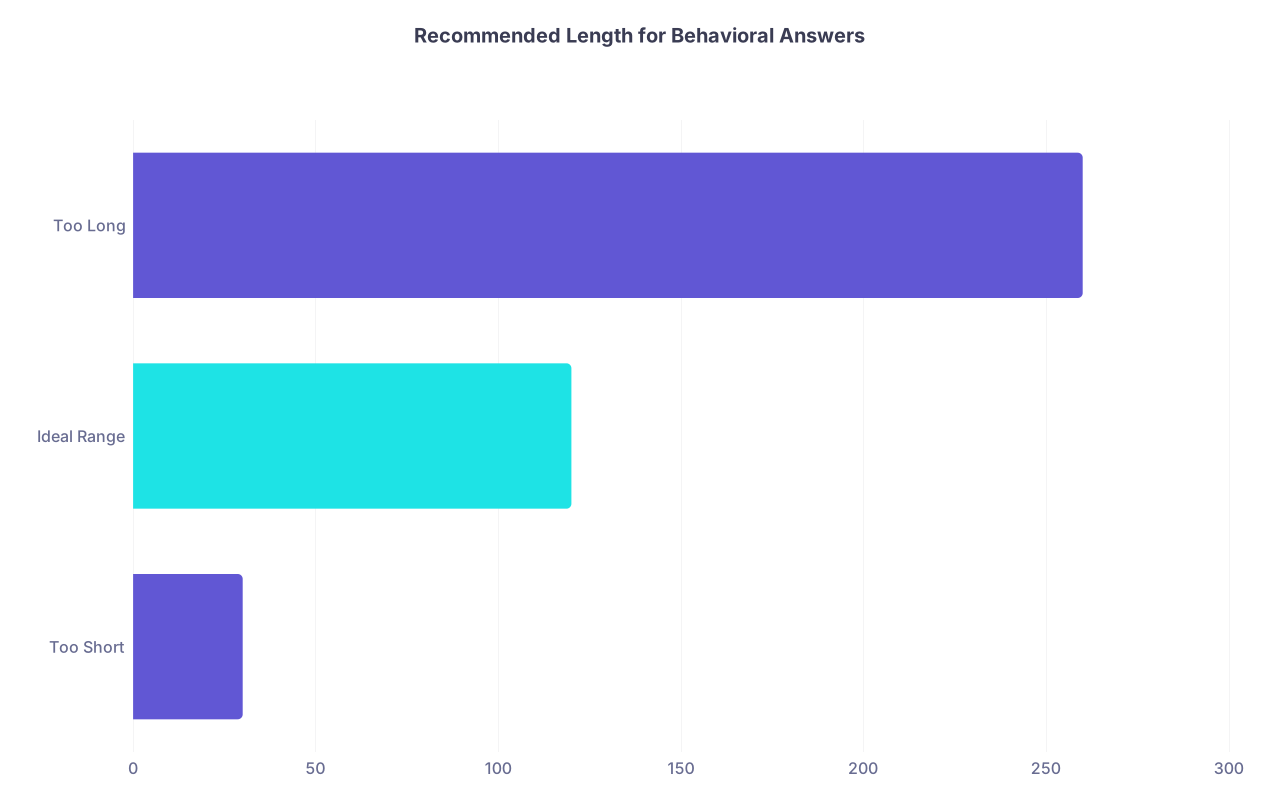
| Category | Value |
|---|---|
| Too Short | 30 |
| Ideal Range | 120 |
| Too Long | 260 |
(Values approximate seconds, just to drive the point home: programs do not want 5-minute monologues.)
Red Flags That Quietly Kill Teachability
Let me be blunt. There are certain phrases that set off alarms in faculty minds. Avoid them or reframe them heavily.
Common red-flag moves:
- Throwing nurses, other students, or residents under the bus.
- “The nurse freaked out about nothing.” (You just failed.)
- Blaming systems for everything with zero self-reflection.
- “If the EMR were better designed, it would never have happened.”
- Turning every “weakness” into a humblebrag.
- “I just care too much and work too hard.” Please do not.
- Over-psychoanalyzing yourself without a clear adjustment.
- “I realize that stems from childhood perfectionism…” then no concrete change.
Instead, do this:
- Assign responsibility where it belongs, but include your part.
- Talk about what you control: your checklists, your asking for help, your documentation habits, your pre-rounding structure.
- Name a real weakness, then describe a current process you are using to improve it.
Example reframes:
- Instead of: “I am bad at time management.”
Use: “I used to consistently underestimate how long prerounds would take. Now I time the work for 1–2 patients on day one, then scale that estimate, and build in a 15-minute buffer. It has reduced how often I am rushing into rounds.”
That is teachability in plain language.
Putting It All Together: A Mini Script Library
Here is a compact set of fill-in-the-blank structures you can adapt to your own stories:
Feedback Script:
“During [rotation/setting], my [attending/resident/nurse] told me that my [specific behavior] was [concrete critique]. I initially felt [brief emotion], but I asked for [example / clarification]. Based on that, I changed [specific workflow or behavior] by [how]. Over the next [time frame], [external person] noticed [improvement]. I still use [modified habit] now in [current setting].”Mistake Script:
“On [service], I [describe mistake succinctly]. There was [no / minimal] patient harm, but it highlighted that I had [flaw in assumption / system]. After discussing it with [supervisor], I started [new check / checklist / communication habit]. Since then, I have [evidence you have not repeated the same error].”Growth After Struggle Script:
“I struggled with [exam/skill/rotation] because [underlying issue]. My initial strategy of [old strategy] was not working: I was still [outcome]. I spoke with [mentor/peer] and decided to change [specific part of process] by [new approach]. Over the next [time frame], my [scores/feedback/performance] improved from [baseline] to [new level]. More importantly, I learned that when I hit a wall, I should [meta-level lesson].”Changed Mind Script:
“I was initially convinced that [diagnosis/plan] was correct in a patient who had [key features]. My [resident/attending] raised concern about [alternative]. At first I thought [my assumption], but after [new data / further questioning], I realized [I had been anchoring / missing red flag]. We changed the plan to [new plan], and the outcome was [result]. Since then, when I see [similar scenario], I always force myself to consider [differential / red flag / alternative path].”
Practice these out loud and swap in your details. The structure will keep you focused when adrenaline is high in the interview room.
FAQ: Behavioral Answers, Teachability, and Growth Mindset
Can I use a non-clinical story (e.g., research or sports) to show growth mindset?
Yes, but with caution. Programs prioritize clinical and team-based examples because they map directly onto residency. A research setback or athletic injury story can work if the lesson clearly translates to clinical practice (discipline, feedback, learning a complex skill). I would keep non-clinical stories to no more than 1–2 of your main examples and have them ready as backup, not your lead.Is it safe to talk about a really serious mistake or near-miss?
If it is truly high-risk—significant patient harm, gross negligence—no. You do not need to incriminate yourself on interview day. Choose situations where you clearly had supervision, where harm was prevented or minimal, and where your learning is obvious. The point is not to shock them; it is to show your error-processing style.What if I have not received much direct negative feedback?
You have; it may just have been phrased as “suggestions” or “areas for improvement.” Go back through written evaluations, end-of-rotation comments, or OSCE checklists. Even subtle lines like “could be more concise on rounds” count. Use those as anchors and build stories around when you noticed the pattern and what you did differently.How honest should I be about my emotions (embarrassed, anxious, frustrated)?
Moderately honest. Briefly naming an emotion—“I felt defensive at first”—humanizes you. Dwelling on it or dramatizing your distress makes you sound unstable. Mention the feeling, then quickly move to what you did with it. That shift from reaction to response is the heart of teachability.Should I actually use the words “growth mindset” or “teachable” in my answers?
You can, but sparingly. If you say, “That experience really cemented a growth mindset for me,” once in the whole interview, fine. If every answer starts with “This shows my growth mindset,” you will sound coached and superficial. Better: let the story demonstrate the mindset and let interviewers name it themselves.How many behavioral stories should I prepare specifically for teachability and growth?
I would have at least three that clearly center on feedback, mistake, or struggle:- One strong “feedback” story.
- One “mistake / near-miss” story.
- One “struggle and improvement over time” story (exam, skill, or rotation).
Each of these can be bent toward multiple questions. Combine those with 3–5 additional stories about leadership, conflict, and teamwork, and you will be ready for almost anything they throw at you.
With these stories sharpened and your structure solid, you are not just “ready for behavioral questions.” You are ready to show programs the one trait they bet their call schedule on: that you will get better every month you are there. The next step is pairing this with sharp, specific answers to clinical and fit questions—but that is a conversation for another day.