
Night-call stories can win you an interview… or quietly sink you. Most applicants use them badly.
Let me break this down very specifically.
You are applying in a high‑stakes environment. Behavioral interview questions are no longer fluff; many programs use structured scoring rubrics. Those “Tell me about a time…” questions are essentially mini-OSCEs for your professionalism, judgment, and self‑awareness.
And the biggest trap? Overusing, misusing, or sloppily deploying night-call and cross-cover stories.
Night float and cross-cover can be gold mines: acute crises, uncertainty, competing priorities, conflict with seniors, systems problems, angry families—all the stuff behavioral interviews are built to probe. But if you lean on these stories without discipline, you come off as unsafe, melodramatic, or oblivious.
This is how to use night-call and cross-cover stories wisely during residency interviews.
Why Night-Call Stories Are So Tempting (And So Dangerous)
Night-call and cross-cover experiences feel obvious for behavioral questions because they tick multiple boxes at once:
- High acuity
- Time pressure
- Limited supervision
- Multiple patients competing for attention
- Systems failures exposed in full daylight (or rather, at 3 a.m.)
Which is exactly why programs are suspicious of them.
Attendings and PDs have heard the same template 500 times:
“It was 3 a.m., I was alone on night float, my pager went off nonstop, and suddenly two patients were crashing…”
You think you are showcasing resilience and triage. They are hearing:
- “This person might overstep without calling for help.”
- “This story is way beyond the expected scope for a student.”
- “This sounds like unsafe care.”
- “Everything is passive voice and ‘the patient deteriorated’ with zero self-reflection.”
The most important mental shift:
The night-call story is not about drama. It is about judgment under constraint.
If you cannot show calm, structure, and humility in telling it, they correctly assume you did not have those things during the event either.
When You Should (and Should NOT) Use Night-Call or Cross-Cover Stories
You do not need a night-call story for every single behavioral prompt. Often, using too many makes you sound one-dimensional.
Let’s be precise.
Good fits for night-call / cross-cover examples
Use them when the question explicitly targets:
- Triage or prioritization under pressure
- Working with limited resources / supervision
- Dealing with uncertainty / incomplete information
- Managing multiple stakeholders at once (nurses, consultants, patients, families)
- Ethical tension or scope-of-practice boundaries at odd hours
- Owning an error or near-miss and fixing the system
Examples of questions where a night-call story is actually appropriate:
- “Tell me about a time you had to manage competing priorities with limited time or resources.”
- “Describe a situation where you had to make a difficult decision with incomplete information.”
- “Tell me about a time when you were concerned about patient safety and had to escalate.”
- “Describe a time you felt overwhelmed clinically. What did you do?”
These are built for tightly constructed night-call scenarios.
Poor fits where night-call stories are overused
You should not reflexively default to call stories for questions like:
- “Tell me about a conflict with a colleague and how you resolved it.”
- “Describe a time you received critical feedback.”
- “Tell me about a time you worked in a team.”
- “Describe a situation where you demonstrated leadership.”
Could you force-fit a night-call story here? Yes. Should you? Usually no.
For conflict/feedback/teamwork/leadership questions, examples from:
- Longitudinal clinics
- Research labs
- Student-run free clinics
- Interdisciplinary QI projects
- Clerkship team dynamics
…often give a much cleaner, safer, and more nuanced view of your interpersonal functioning.
If 80% of your examples are 2 a.m. cross-cover firefights, your interviewers start quietly wondering if you recognize that residency is 90% routine professionalism, not nonstop crisis.
The Non-Negotiable Ground Rules Before You Tell Any Night-Call Story
There are a few rules here that are not optional. You break them, you lose points.
1. You must be operating within your level of training
As a student, you do not “manage a GI bleed alone.” You do not “decide to intubate.” You do not “start pressors on your own judgment.”
If you describe actions that sound like unsupervised resident-level autonomy, red flags go up. Faculty do not think, “Wow, so advanced.” They think, “Boundary issues. Unsafe. Does not understand their role.”
You can describe:
- Recognizing deterioration
- Gathering key data
- Stabilizing within your scope (positioning, basic ABCs, fluids if already ordered, etc.)
- Calling for help early and effectively
- Communicating succinctly using SBAR
- Anticipating next steps for the team
If your story does not include an early, explicit escalation—“I called my senior / the cross-cover resident / the attending”—you have already lost.
2. No hero narratives
If the emotional tone of your story is “Nobody else handled it right and I saved the day,” you sound naïve or arrogant.
Good night-call stories:
- Give credit to nurses, RTs, residents, and consultants
- Acknowledge system issues honestly, not theatrically
- Show that you see your role as part of a team, not the star
If the hero of your story is “my clinical reasoning and my grit,” you missed the assignment. The hero should be: appropriate escalation, teamwork, and safe patient care.
3. No gore. No voyeurism. No “war stories.”
Interviewers are not your intern friends at 2 a.m. Night-call horror stories often devolve into excessive detail that adds zero behavioral value:
- Graphic descriptions of codes
- Wildly unstable vital signs for shock value
- Long lists of procedures someone else did
You gain nothing and risk sounding desensitized or performative. Keep the clinical details just enough to establish the stakes. Then focus on your behaviors and decisions.
4. HIPAA and identifiability: zero tolerance
This should be obvious, but I have heard applicants slip:
- Specific ages + super rare diagnoses + unique circumstances = identifiable
- Detailed dates, locations, or personal descriptors (occupation, hometown, etc.)
No names, no unique descriptors. If your story would make the patient or their family recognize themselves in three seconds, you went too far.
Structuring a Night-Call Story So It Actually Scores Well
Residency programs love structure. They often score behavioral responses along predictable domains:
- Situation clarity
- Appropriateness of actions
- Insight / reflection
- Impact / learning
Classic frameworks like STAR (Situation–Task–Action–Result) are fine but tend to produce robotic answers if you cling to them. For night-call and cross-cover, I find a slightly modified approach more natural:
SCARF: Situation – Challenge – Actions – Result – Future
Let’s dissect each piece, using a real-style example.
1. Situation: set the scene with restraint
Thirty seconds, max.
Bad:
“I was on my third week of nights, at 2:47 a.m., I remember looking at the clock. The hospital was silent, lights dim, there was only one other intern…”
Better:
“On my medicine sub-internship night float, I was covering nine general medicine patients with a PGY-2 supervising me.”
Concrete. Level-appropriate. Establishes scope.
Include:
- Your role (MS4 sub-I, MS3, prelim intern)
- Setting (general medicine, surgery floor, stepdown, etc.)
- Who was available (senior, attending, night float resident, nurses)
You do not need cinematic buildup. This is not Netflix.
2. Challenge: what made this call behaviorally interesting?
Identify the tension clearly. Not “the patient was sick,” but:
- Competing demands
- Unclear goals of care
- Disagreement between team members
- Limited supervision
- Communication barriers
Example:
“Two new issues came up at the same time: a nurse paged for new chest pain in a patient I did not know well, and another nurse was calling repeatedly about uncontrolled pain in a different patient whose family was upset.”
Now the interviewer can see the behavioral problem: triage, communication, prioritization.
3. Actions: this is where most applicants either ramble or under-deliver
You need to show three things:
- Clinical reasoning appropriate to your level
- Explicit communication and escalation
- Respect for systems and people
Use action verbs, and keep procedures/resuscitation details tight.
Example (student-level):
“I quickly reviewed the chart and recent vitals of the chest pain patient and called the bedside nurse to clarify symptoms and stability. Because there was any concern for unstable angina, I prioritized seeing that patient first and told the nurse with the pain control issue that I would come by in about ten minutes but to call back if vitals changed.
At the bedside, I did a focused history and exam to assess for high-risk features, confirmed they were hemodynamically stable, and immediately called my senior with a concise SBAR: the patient’s history, current symptoms, ECG and troponin status, and my concern level. Together, we decided to obtain a stat ECG, troponin, and give nitroglycerin with close monitoring.
I then went to the second patient and addressed the uncontrolled pain, apologizing for the delay, reassessing, and updating the family. I communicated our plan—adjusting medications within the existing orders—and again escalated to my senior for guidance on optimizing the regimen and involving palliative care in the morning.”
Notice:
- Multiple explicit escalations.
- Clear triage logic.
- Clear communication with both nurses and family.
- Zero pretending to independently manage ACS as a student.
4. Result: outcomes, both clinical and relational
You need to show that something changed because of your actions. It does not have to be miraculous.
Example:
“The chest pain patient’s ECG was unchanged from baseline, and serial troponins remained negative. We monitored them overnight and cardiology saw them in the morning. The second patient’s pain improved with the adjusted regimen, and the family specifically thanked our team the next day for taking their concerns seriously, despite the delays overnight.”
Avoid overly dramatic outcomes like “I saved their life.” Stick to realistic, credible endpoints.
5. Future: what did you learn, and how has it changed your behavior?
This is where almost everyone underperforms. You must explicitly state:
- What you learned
- How your practice changed
- How this maps to residency
Example:
“That night reinforced two things for me. First, that clear triage and early escalation are critical, and you can still communicate transparently with the lower-priority patient or family so they do not feel abandoned. Second, I realized my SBAR handoffs to seniors could be more structured, so after that rotation I started writing a brief triage checklist for myself at the top of my call sheet: vitals, trend, worst-case diagnosis, and specific question for my senior. I plan to keep that habit as an intern so I can communicate succinctly when things are busy or chaotic.”
This “future” piece is where you earn maturity points.
Choosing the Right Night-Call Story for Each Behavioral Domain
Let’s match common behavioral questions with specific types of night-call / cross-cover scenarios that do and do not work.
| Behavioral Domain | Good Night-Call Use Case | Bad / Risky Use Case |
|---|---|---|
| Triage & Prioritization | Two simultaneous pages, one unstable | Multi-code superhero narrative |
| Communication & Teamwork | Escalating to senior + negotiating tasks | Blaming overnight consultant |
| Ethics & Boundaries | Refusing to exceed scope, calling for help | Performing unsupervised procedures |
| Coping with Stress | First busy night, sought support & debrief | “I powered through without sleep” |
| Systems Thinking | Near-miss → created checklist/trigger tool | Generic rant about “bad sign-out” |
1. Triage and prioritization
Good example:
Two pages, one about hypotension, one about pain meds. You prioritized the unstable vital signs, communicated transparently with the other nurse, escalated quickly, and circled back appropriately.
Bad example:
“Three patients were crashing at once and everyone else disappeared.” This almost always sounds exaggerated and unsafe.
2. Communication and teamwork
Good example:
You coordinated with limited staff, asked RT to see one patient while you assessed another, called your senior with a structured update, and collaborated with nursing.
Bad example:
You tell a story that subtly blames an on-call consultant, the ED, or nursing for “not listening.” Interviewers pick up that tone instantly.
3. Ethics and boundaries
Good example:
You were asked to perform something beyond your level (e.g., write a discharge alone at 3 a.m. with no senior). You respectfully pushed back, sought supervision, and protected the patient.
Bad example:
You brag about “doing the LP/intubation/central line myself because nobody else was available.” As a student, that is a devastating red flag.
4. Coping with stress / resilience
Good example:
Your first night on call was overwhelming. You missed an early sign that a patient was getting worse, felt terrible about it, discussed it with your senior, and developed a pre-round checklist or a way of scanning the list to catch trends before bed.
Bad example:
Glorifying exhaustion. “I stayed 18 hours post-call, did not sit down once, but still wrote all my notes and went straight to lecture.” PDs do not find this inspiring. They hear “does not know limits,” “likely to burn out or make errors.”
5. Systems thinking / QI
Good example:
Near-miss because of poor cross-cover sign-out. You participated in changing the sign-out template, creating a “watch list” section, or instituting a standardized escalation protocol—with faculty oversight.
Bad example:
Angry rant about “terrible handoffs at this hospital” with no ownership, no solution, and no acknowledgment of your small role as a student.
Avoiding Common Pitfalls: The Red Flags Interviewers Actually Talk About
I have sat in rooms where we debriefed applicants after interview days. Specific phrases from night-call stories stick with people—for the wrong reasons.
Here are patterns that consistently hurt applicants:
1. Vague responsibility: “We managed…”
If you say “We did X, we decided Y” for the entire story, interviewers assume you did nothing meaningful. You must own your specific contribution:
- “I noticed…”
- “I suggested…”
- “I called…”
- “I documented…”
- “I clarified…”
But again, within scope.
2. Missing supervision: no mention of calling anyone
If your night-call story has no senior, no attending, no sign of hierarchy, the unspoken question is: “Why did you not call for help?”
You should nearly always include:
- “I alerted my senior early because…”
- “I asked the nurse to call the RRT while I…”
- “I discussed options with my senior and we decided…”
3. Blame and contempt
Any hint of:
- “The nurse kept paging me about…”
- “The ED dumped this patient on us…”
- “The consultant refused to come see them…”
…without a counterbalancing acknowledgment of context and your own communication limitations, is deadly. Program leadership will not put someone with that attitude into their call pool.
4. Overcompensation: fake perfection
If your story suggests you acted flawlessly under extreme pressure with no emotional impact and no learning points, it is not believable.
You can say:
- “I initially underestimated how worried I should be.”
- “I hesitated longer than I should have before calling my senior.”
- “I realized afterward that my explanation to the family was too technical.”
Then show what changed.
Integrating Night-Call Stories Across the Whole Interview Day
The smartest applicants do not rely on night-call examples exclusively. They distribute them strategically.
A rough strategy that works:
- 1–2 night-call / cross-cover stories total, used for high-stakes, triage, or stress-management questions.
- 2–3 stories from team projects, clinics, research labs for leadership, conflict, and communication.
- 1 story explicitly about feedback and growth (often not from call).
Think of your stories like a portfolio. If someone read only your answers, they should see:
- You function on teams.
- You accept feedback.
- You understand scope.
- You can prioritize under pressure.
- You care about systems and safety.
Night-call stories should only be the backbone of that last one or two domains, not the entire skeleton.
Rapid Practice Template: Build One Excellent Night-Call Story
Use this to craft one anchor story you can adapt.
Write a 1–2 sentence Situation:
- Role, setting, number/type of patients; who was supervising.
Define the Challenge in 1–2 sentences:
- Where was the tension? Competing pages, unclear stability, unhappy family, limited resources.
List 4–6 concrete Actions:
- How you triaged.
- What information you gathered.
- Whom you called, in what order.
- How you communicated with nurses/family.
- What you did to stay within scope.
State the Result in 2–3 sentences:
- Outcome for patient(s).
- Outcome for relationships.
- Any immediate feedback you received.
Write the Future in 2–3 sentences:
- What you learned.
- One concrete behavior you changed.
- How this will make you safer / more effective as a resident.
Then, practice out loud and trim. Your total answer should be around 2 minutes. If it stretches past 3 minutes, you are indulging in details that do not affect your behavioral score.
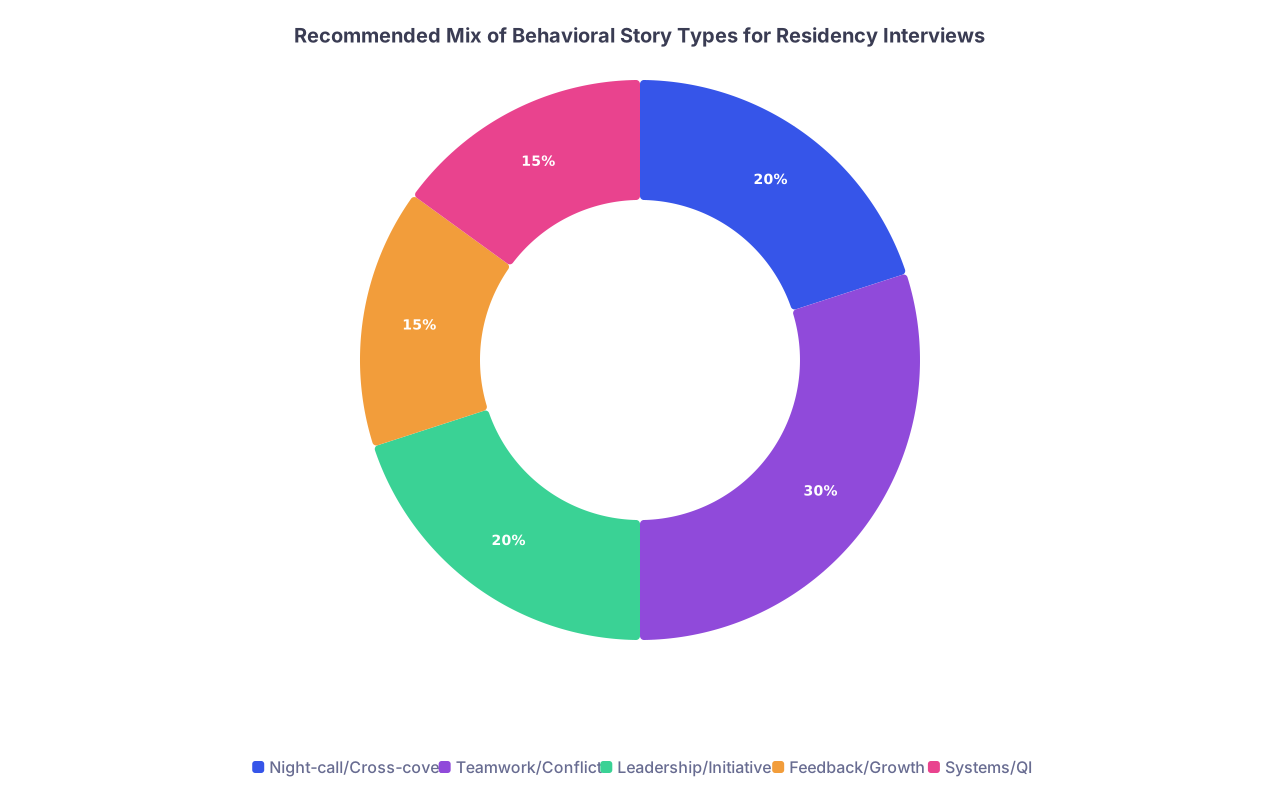
| Category | Value |
|---|---|
| Night-call/Cross-cover | 20 |
| Teamwork/Conflict | 30 |
| Leadership/Initiative | 20 |
| Feedback/Growth | 15 |
| Systems/QI | 15 |

| Step | Description |
|---|---|
| Step 1 | Prompt: High-pressure situation |
| Step 2 | Choose appropriate night-call story |
| Step 3 | State Situation & Challenge briefly |
| Step 4 | Describe Actions with clear scope & escalation |
| Step 5 | Summarize Result for patient & team |
| Step 6 | Highlight Learning & Future behavior |

Final Check: A Quick Self-Audit Before You Use Any Night-Call Story
Run your planned answer through this filter:
Scope check:
- Am I clearly acting at student level?
- Do I explicitly show early escalation?
Blame check:
- Do I attribute failure primarily to “the system” or “others” without mentioning my own limitations?
Drama check:
- Am I relying on gore, intensity, or heroism to make the story interesting?
Insight check:
- Do I clearly state what I learned and how I changed my behavior?
Balance check:
- Across my whole interview prep, are night-call stories < 30% of my examples?
If you cannot answer “yes, clean” to all of those, rework the story or pick another.
Use night-call and cross-cover stories as sharp instruments. Not bludgeons.

FAQ (Exactly 5 Questions)
1. Is it a problem if my best story is from being a sub-intern on night float, not regular days?
No, that is fine, as long as you are crystal clear about your role and supervision. Say “on my medicine sub-internship, I was on night float with a PGY-2 resident supervising.” Then anchor all your actions to student-level responsibilities: recognizing problems early, gathering data, calling your senior, and communicating with nurses and families.
2. What if my night-call story involves a bad outcome or a patient death? Will that hurt me?
Not inherently. In fact, those can be powerful if told with maturity. You must avoid graphic details, avoid implying error without ownership, and focus on: how you supported the team, how you communicated with the family, and what you learned about coping and debriefing. If the tone feels like trauma porn or a tragedy monologue, you will lose points. If it feels like sober reflection about being part of a serious situation, it can be extremely strong.
3. Can I reuse the same night-call story for multiple different questions?
Yes, but with limits. You can have one anchor story that you adapt—emphasizing triage for one question, communication for another, systems learning for a third. However, if you recycle the same 2 a.m. scenario for five different prompts during one interview, it starts to look like you have a narrow range of experiences or that you are overly attached to that one night. Aim to use that anchor story one or two times per interview day.
4. I never had an official “night float” as a student. Can I still answer these questions well?
Absolutely. The concept here is less about the clock time and more about limited supervision + competing demands + stress. An ED shift, late evening on surgery, or even a very busy day on wards where your senior was scrubbed in and you had to manage multiple nurses’ requests all fit. Do not manufacture a “3 a.m.” setting if it was actually 5 p.m. Just tell the truth and highlight the behavioral elements.
5. How do I handle it if an interviewer pushes back on my judgment in the story?
Do not get defensive. That is another behavioral test. A good response sounds like: “That is a fair point. At the time, my thinking was X because of Y. Looking back, and hearing your perspective, I agree that earlier escalation / different triage could have been safer. One change I have already made in my practice is Z.” You are not being graded on being omniscient; you are being graded on your ability to reason, accept critique, and adjust.
Key takeaways:
- Use night-call and cross-cover stories sparingly, for the right behavioral domains—triage, uncertainty, stress, systems—not as your default answer to everything.
- Anchor every story ruthlessly to your actual level of training, explicit supervision, and concrete learning; hero narratives and unsupervised heroics are automatic red flags.
- Structure your answers: clear situation, visible challenge, scoped actions with escalation, realistic outcomes, and explicit future change—that is how night-call stories help you, not hurt you.