
The biggest mistake strong research applicants make in residency interviews is hiding their best asset behind vague, boring stories.
You did hard things: designed experiments, handled failed projects, navigated IRB, wrangled datasets big enough to crash your laptop. Then on interview day you say, “I worked in a lab studying XYZ and presented a poster,” and wonder why it falls flat.
The behavioral interview is not anti‑research. It is anti‑vagueness. Anti‑buzzword. Anti‑monologue.
Let me show you how to translate your research experience into sharp, residency‑relevant behavioral stories that actually move the needle.
Step 1: Reframe Your Research as Behavioral Raw Material
You are not telling “research stories.”
You are telling behavioral stories that happen to be set in a research environment.
Interviewers care much less about your western blot protocol and much more about:
- How you handled failure when your hypothesis fell apart
- How you worked with a difficult post‑doc or PI
- How you balanced deadlines for a manuscript with clerkships
- How you responded when an error in your dataset almost went to publication
- How you took initiative rather than waiting for instructions
Research gives you unusually rich material for the classic behavioral domains:
| Behavioral Domain | Research Angle Example |
|---|---|
| Conflict management | Disagreement with co‑author or PI |
| Adaptability | Project pivot after negative results |
| Leadership | Mentoring juniors or coordinating a team |
| Integrity | Handling data errors or questionable practices |
| Perseverance | Long project with repeated failures |
If you walk into interviews thinking, “I need to talk about my project on cytokine signaling,” you will give a weak answer.
If you walk in thinking, “I need at least one sharp story for conflict, failure, leadership, initiative, and ethics—and I can pull most of those from my research”—you are on the right track.
Step 2: Know the Behavioral Question Patterns You Will Actually Face
Program directors do not say: “Tell me about your R01‑funded project.”
They say things like:
- “Tell me about a time you had a conflict on a team.”
- “Describe a time you made a mistake.”
- “Tell me about a time you had to learn something quickly.”
- “Describe a time you showed leadership without formal authority.”
- “Tell me about a time you had to manage competing priorities.”
Your job is to pre‑map your research experiences to these question types.
Here is a clean mapping I have seen work repeatedly:
- Conflict → disagreement over authorship, experimental approach, division of work, or interpretation of data
- Failure → experiment that repeatedly failed, grant rejection, abstract not accepted, manuscript rejected
- Leadership → organizing data collection, setting timelines for a multi‑site chart review, mentoring undergraduates
- Mistake / Integrity → data entry error, near‑miss in analysis, realization that inclusion criteria were misapplied
- Adaptability → project canceled (COVID, funding), pivot to new method, switch from bench to clinical research
- Time management → juggling clinical rotations with abstract deadline or IRB revision
Stop trying to invent “hospital drama” for these questions if you already have clean, authentic research situations that show how you behave under pressure.
Step 3: Use a Rigid Story Spine (STAR or PAR, but Tight)
If your stories meander, the content does not matter. You will lose your listener.
For residency behavioral interviews, I prefer a slightly compressed STAR:
- Situation – one sentence, maybe two.
- Task – your specific responsibility or goal.
- Action – granular behaviors you took.
- Result/Reflection – the outcome and what you learned or changed.
Or the PAR variant:
- Problem
- Action
- Result
The key is discipline. Research applicants overshare background and underdevelop the action.
Bad pattern I hear constantly:
“So I was in a lab that studied microRNAs in heart failure. We used both in vitro and in vivo models and had a large collaboration with cardiology and genetics, and my PI was very well known in the field. My role was mostly to help with…”
Three minutes later, the interviewer still has no idea what you did in the situation relevant to the question.
Let me show you the right density.
Example: Conflict Story from a Chart Review Project
Question: “Tell me about a time you had a conflict on a team.”
Notice the shape:
- Situation/Problem – 2–3 lines
- Action – 5–8 lines
- Result/Reflection – 2–3 lines
Story:
“During my third year I joined a retrospective chart review project on anticoagulation in atrial fibrillation. Halfway through data collection, another student and I realized we had very different interpretations of one of the inclusion criteria, and our datasets no longer matched.
I first sat down on my own and pulled a random sample of 20 charts that we had both reviewed. That confirmed the discrepancy was systematic, not random. I then emailed the other student proposing a brief meeting with just the two of us to understand where our interpretations diverged before escalating it. During that meeting I listened first, had us walk through 3 borderline charts together, and we flagged specific phrases in the notes that were ambiguous.
Once we understood the difference, I suggested we bring a concrete proposal to the fellow and PI rather than just a problem. We drafted two possible operational definitions with pros and cons, plus the time estimate to re‑abstract the affected charts under each option. In the meeting with our PI, we presented both and recommended the more conservative definition, even though it meant more rework, because it aligned better with prior literature.
Our PI appreciated that we caught the issue early and came with options. We re‑abstracted about 120 charts over two weeks, then built a brief checklist to standardize future data collection. For me the main learning was to front‑load clarity on definitions, and to address disagreements early and privately, with data, before they turn into interpersonal conflict.”
Notice what this story does:
- It answers a “conflict” question while staying in a research frame.
- It shows initiative, communication, respect for hierarchy, and problem‑solving.
- It never drowns in methods or jargon.
That is the bar.
Step 4: Identify 6–8 Research Moments and “Spin” Them
You probably do not need 20 different stories. You need 6–8 robust stories that can answer multiple questions with minor edits in emphasis.
Start by listing out discrete “moments” from your research career. Not years. Not labs. Moments.
Look for:
- A major setback (experiment fails, IRB delay, dataset corruption)
- A conflict or tension (with PI, fellow, co‑author, coordinator)
- A mistake or near‑miss (data error, wrong version, misapplied criteria)
- A leadership moment (you coordinated, mentored, drove a project)
- A moment you advocated for something (patient safety, ethical issue, workload fairness)
- A time you handled multiple commitments (Sub‑I + manuscript deadline)
- A moment of intellectual humility (you were wrong, changed mind, learned a new method)
Then map them. Not hypothetically. On paper.
| Research Moment | Can Answer These Questions |
|---|---|
| Data entry error discovered before submission | Mistake, Integrity, Attention to detail |
| Disagreement about authorship order | Conflict, Communication, Professionalism |
| IRB denial and protocol rewrite | Adaptability, Perseverance, Problem-solving |
| Leading med student team for chart review | Leadership, Delegation, Motivation |
| Retrospective project during busy clerkships | Time management, Prioritization, Resilience |
You want overlap. One strong story should serve 2–3 question types if you slightly tweak the framing.
For instance, that data entry error story can emphasize:
- Integrity → how you handled the urge to “fix it quietly” vs transparency
- Attention to detail → the system or checklist you built afterward
- Handling stress → what you did when your PI was angry or stressed
Same event. Different angle. That is efficient preparation.
Step 5: Strip Out Technical Noise and Translate to Clinically Relevant Skills
Academic applicants love jargon. Interviewers tolerate it. Barely.
You are not trying to impress a grant panel; you are trying to show a residency program how you behave on a team.
Translate as you go:
Instead of:
- “We used a mixed‑effects logistic regression with…”
Say: - “We adjusted for patient‑level factors like age and comorbidities so that the effect we saw was not just due to sicker patients in one group.”
Instead of:
- “I developed a custom Python script to preprocess…”
Say: - “I built a script to automate the data cleaning, which cut our error rate and made the process reproducible for future team members.”
Instead of rattling off:
- “Our main outcome was a 0.12 difference in standardized effect size…”
Say: - “Clinically, it meant about a 10% higher chance of avoiding readmission for patients in the intervention group.”
This translation does two things:
- Keeps the listener awake.
- Shows you can bridge research and clinical decision‑making—hugely attractive in residents.
If you want to keep yourself honest, use this rule: if a smart internist who has not read your paper would be lost, you went too far into the weeds.
Step 6: Build Specific Stories for the “Big Five” Behavioral Themes
Let me walk you through 5 core behavioral areas and model sharp, research‑based stories for each. Steal the structure, not the content.
1. Failure / Setback
Question: “Tell me about a time you failed.”
Story skeleton:
- Situation: Manuscript rejection, failed experiment, negative study.
- Task: Your role and your stake.
- Action: How you responded (not how you felt for five minutes—what you did over weeks).
- Result: Concrete outcome + what changed in your behavior.
Example outline (condensed):
“Second year, I led a small clinical project on reducing unnecessary daily labs in general medicine. After months of chart review and analysis, we submitted our abstract to a major meeting. It was rejected with feedback that our methods did not adequately control for illness severity.
I met with our biostatistician to dissect the critique, then spent several weeks learning and applying a more rigorous risk adjustment model. I also reviewed 3 highly cited similar studies to understand how they handled confounding. We re‑ran the analysis, rewrote the manuscript to be explicit about our limitations, and targeted a more appropriate journal for a quality‑improvement audience.
The paper was accepted there, and on our service the attending actually used the revised data in a resident teaching session. For me the key shift was reframing ‘failure’ from a verdict on my ability to an external signal that my methods or framing needed to improve.”
Note what this shows: coachability, persistence, humility, ability to seek and implement expert feedback.
2. Conflict / Difficult Person
Question: “Describe a time you worked with someone difficult.”
Classic research situations:
- Overcommitted PI
- Co‑author who does not pull their weight
- Senior resident who wants data yesterday
You must walk the line: honest about difficulty, not character assassination.
Example shape:
“In our multi‑center chart review on COPD readmissions, one site PI consistently submitted incomplete data and missed deadlines, which put our timeline at risk.
I first reviewed exactly what was missing and organized it into a concise one‑page summary with specific gaps highlighted. I then emailed to request a brief call, framing it as wanting to understand barriers on their end. During the call, I learned their coordinator had left unexpectedly, and they were struggling with limited staff.
I proposed a simplified data collection form that captured our primary endpoints without some of the secondary variables, and offered to have our own team handle a portion of the abstraction remotely if they could provide de‑identified records. They agreed, and we reset the deadline with explicit, realistic milestones.
In the end, their site contributed complete primary outcome data, and the collaborative relationship remained intact. I learned that ‘difficult’ behavior often signals capacity issues, and addressing those directly can be more effective than repeated reminders or escalation.”
You have now demonstrated conflict management in a mature, systems‑aware way. Stronger than any generic “I talked to them and we compromised” story.
3. Leadership / Initiative
Question: “Tell me about a time you took initiative.”
Research gives you obvious entry points here. The trick is to show systems thinking, not just “I did extra work.”
Example:
“When I joined a neurology outcomes lab, I noticed that every new student was informally taught the chart abstraction process, and error rates were high in early data pulls.
I asked our fellow if I could review the first 50 charts from the last three students and quantify the most common issues. The majority were around misclassifying functional status scores and missing certain time stamps.
I drafted a 3‑page step‑by‑step abstraction guide with screenshots and specific examples of borderline cases. I also created a 10‑chart ‘training set’ with an answer key reviewed by the fellow. New students now abstract those charts first, compare their coding, and review discrepancies in a short meeting.
Over the next two projects, the re‑abstraction error rate in our random checks dropped by about half, and the fellow kept the guide as a standard onboarding tool. It taught me that small, boring‑sounding process improvements can save enormous time downstream.”
That is leadership without a title. Very appealing in a resident.
4. Ethics / Integrity
Question: “Tell me about a time your integrity was tested.”
Do not make this hypothetical. Pull from reality, even if the stakes feel small.
Classic research scenarios:
- Pressure to “massage” data
- Inclusion/exclusion decisions that could benefit results
- Data errors right before submission
Example:
“On a surgical outcomes project, I was responsible for finalizing a dataset for submission. The night before our deadline, I noticed that an inclusion criterion had been applied inconsistently early in data collection, which affected about 5% of our sample. Removing those charts slightly weakened our primary result.
I debated quietly adjusting the affected rows to match the stricter interpretation, which would have preserved both our sample size and the stronger result. Instead, I emailed our fellow and PI that evening with a summary of the issue, the exact number of charts affected, and three options: keep them with transparent reporting, exclude them, or delay submission to re‑abstract.
In the morning, we met briefly and agreed to exclude those charts, mention the issue in the limitations, and still submit. The effect size was smaller but still meaningful.
What stayed with me was how quickly a ‘small’ decision under time pressure could have crossed into misrepresentation. Having gone through this, I am much more proactive about building checks earlier in the process rather than relying on last‑minute judgment calls.”
This is how you reassure programs you will not fudge a progress note or hide a near‑miss.
5. Time Management / Burnout Risk
Question: “Describe a time you had too much on your plate. What did you do?”
Research during clerkships is fertile ground here. The key: avoid making yourself sound chronically overextended and unsafe.
Example:
“During my medicine clerkship, I was also working toward a deadline for a quality‑improvement abstract. Two weeks before the deadline, I realized that my plan to work on the project in the evenings was not realistic given our patient load and call schedule. I was falling behind on both.
I listed out the remaining project tasks with honest time estimates, then looked at my clinical calendar. I saw that the week before the deadline included both a call day and a shelf exam review session. I first spoke with the resident on my team, explained the situation, and asked if there was any flexibility in my timing for nonessential tasks like writing daily problem lists, as long as notes and patient care were completed on time. There was not much.
I then met with my research mentor, presented a concrete update and the realistic timeline, and asked whether we could shift the abstract to the next conference without harming the project’s momentum. She agreed and actually appreciated the transparency rather than a last‑minute scramble.
I used that as a forcing function to set firmer limits on concurrent big commitments. It also made me more comfortable communicating early when trade‑offs are unavoidable, which I know will be important as an intern.”
You have now framed yourself as self‑aware, safe, and honest about limits—not as the “I never sleep; I can do everything” liability.
Step 7: Tighten Delivery: Timing, Hooks, and Reflection
Content is half the game. Delivery is the other half.
A few non‑negotiables:
- Keep stories to 1.5–2 minutes. Anything longer and you lose them.
- Open with a clear hook. “During X, I faced Y problem…”—so they know where this is going.
- Name your role early. Were you leading? Assisting? That context matters.
- End with a specific reflection. Not “I learned a lot,” but “Now I do X differently.”
If you want a simple checklist while you practice, it looks like this:
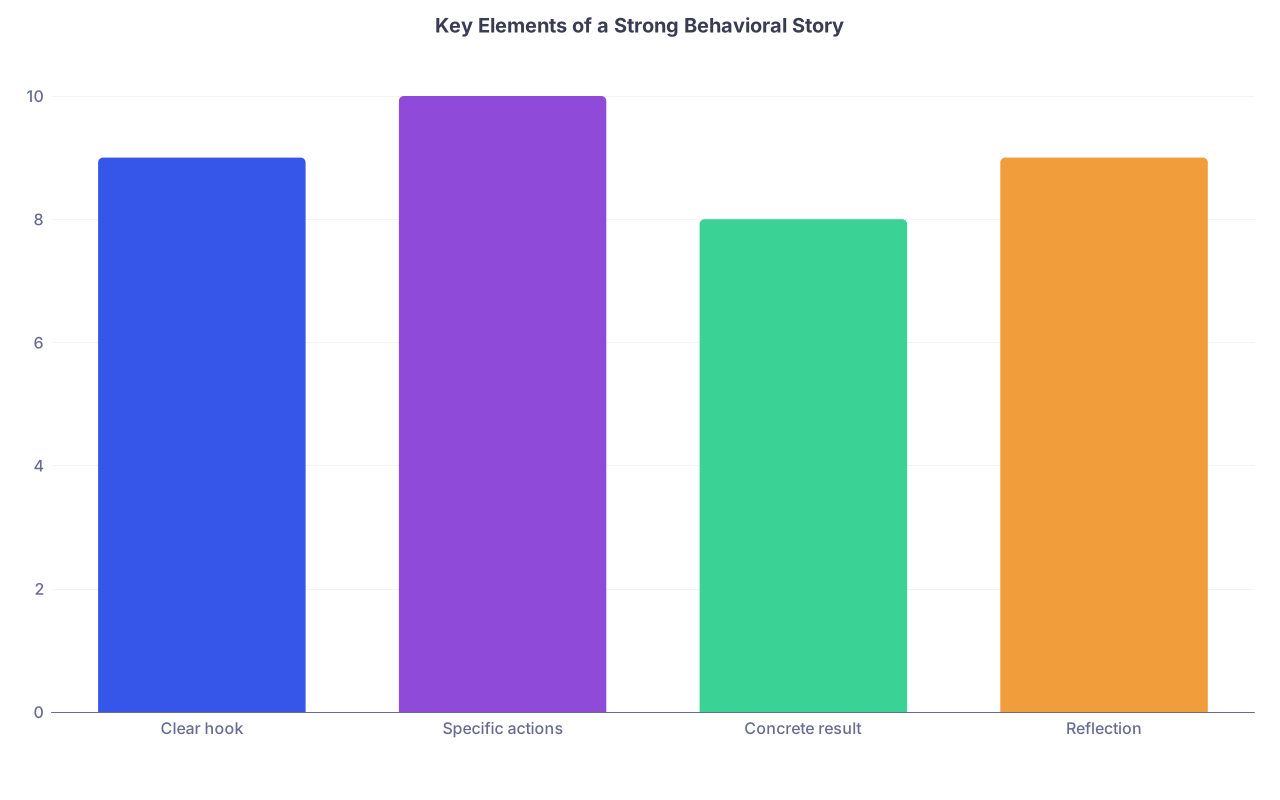
| Category | Value |
|---|---|
| Clear hook | 9 |
| Specific actions | 10 |
| Concrete result | 8 |
| Reflection | 9 |
Higher “scores” here correlate very strongly with how often faculty mention a candidate positively in post‑interview meetings. I have heard the back‑room commentary:
- “She had really clear examples.”
- “He actually answered the question with specifics.”
- “That integrity story stuck with me.”
Nobody says, “Did you hear how detailed his methods section was?”
Step 8: Align Your Stories With the Specialty’s Culture
One more nuance sophisticated applicants get right: they tune which stories they tell based on the specialty.
Same base story, different emphasis.
- For surgery: highlight decisiveness, accountability, ownership of outcomes, dealing with hierarchy.
- For internal medicine: highlight systems thinking, communication, working with complex data.
- For pediatrics: emphasize team collaboration, family‑centered thinking, patient safety.
- For psychiatry: focus on communication, listening, dealing with ambiguity, ethical nuance.
Example: That integrity/data error story?
- Surgery spin: emphasize speaking up despite hierarchy, owning the mistake under time pressure.
- IM spin: emphasize methodologic rigor and transparency in how you handle data.
- Psych spin: draw parallels to being honest about diagnostic uncertainty and not over‑interpreting limited information.
Mos t applicants do a one‑size‑fits‑all version. You can do better.
Step 9: Cross‑Check Your Stories With Your Application
Programs hate inconsistency.
Before interviews:
- Re‑read your ERAS experiences and personal statement.
- Highlight any research you have emphasized heavily (first‑author papers, major projects).
- Make sure you have at least one polished behavioral story attached to each major project you highlighted.
If you wrote, “Led a multi‑institutional study on sepsis outcomes” and then cannot answer, “Tell me about a time you led a team,” you have a credibility problem.
Likewise, if you described a major setback in your personal statement, be prepared to talk about it verbally with more detail, not less.
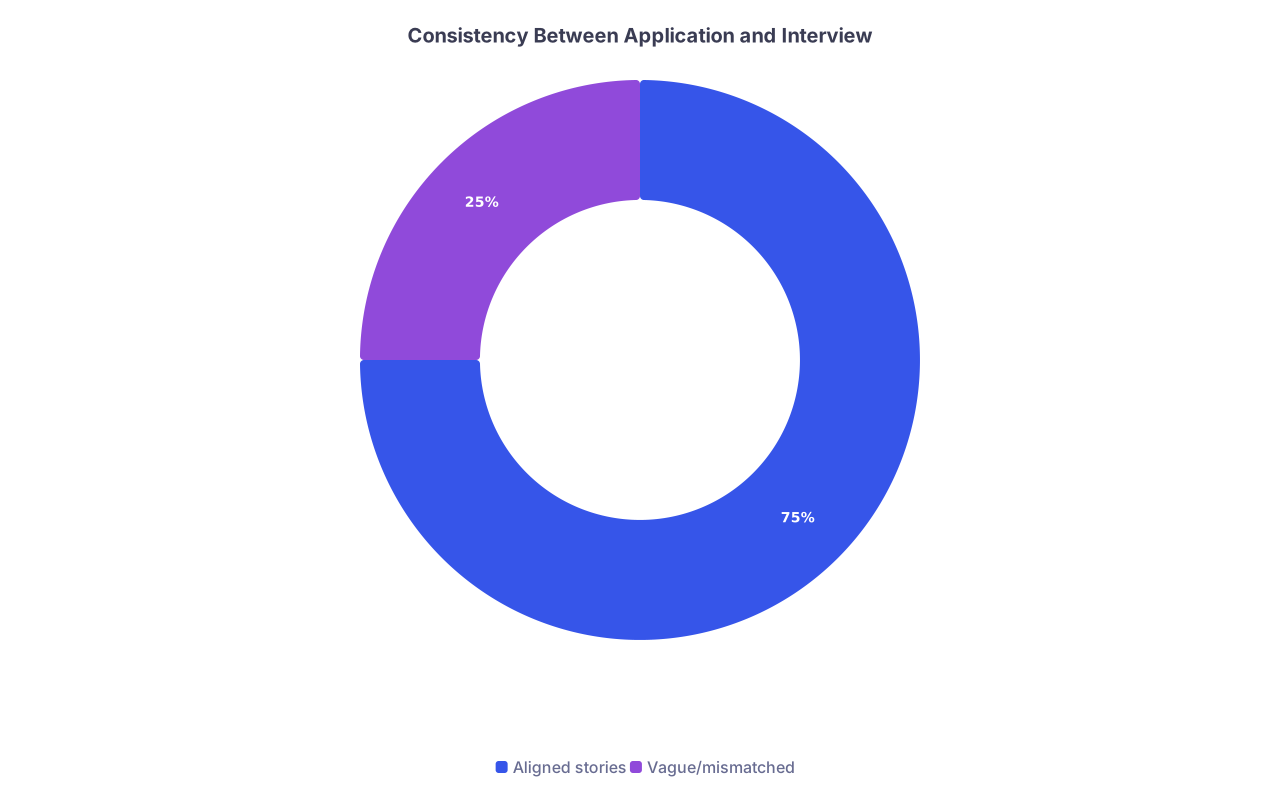
| Category | Value |
|---|---|
| Aligned stories | 75 |
| Vague/mismatched | 25 |
Programs subconsciously “score” you on this alignment. High alignment reads as maturity and self‑awareness. Low alignment reads as either embellishment on paper or poor insight in person.
Step 10: Practice Like a Clinician, Not Like a Student
Last piece. How you practice matters.
Do not just “think through” your stories while walking to the gym. Say them out loud. It will feel awkward. Good. That is how you catch:
- Sentences that are too long to say.
- Jargon that sounds ridiculous outside your head.
- Missing context that leaves the listener confused.
Better yet, record yourself answering 5–6 common behavioral questions using your research stories.
Then listen with one brutal question in mind: “Would I rank this person based on this answer?”
You will notice patterns:
- You start too far back in time (“Second year of undergrad…”).
- You mumble the result.
- You never clearly state what you learned.
Fix them. Script your first and last line for each story if you need to. Fill the middle with flexible detail so you do not sound robotic.
If you want a structured way to track which research stories you have ready, build a simple chart for yourself:
| Story Name | Primary Question Type | Ready Y/N | Needs Work Area |
|---|---|---|---|
| Anticoagulation conflict | Conflict | Yes | Tighten reflection |
| Lab test overuse QI | Failure/Setback | Yes | Shorten background |
| Chart review leadership | Leadership | No | Clearer results |
| Data error integrity | Ethics/Mistake | Yes | Specialty‑specific spin |
| Clerkship + abstract | Time management | No | Stronger outcome |
That is a better use of one hour than reading yet another generic “top 50 residency questions” list.
With this structure, your research stops being a laundry list of abstracts and publications and becomes what programs actually care about: evidence of how you think, act, and recover when things get messy.
You have already done the hard part—the research itself. Now the task is translation and refinement. Once your stories are sharp, you will find that almost every behavioral question is just another doorway back into the same handful of well‑built narratives.
Get those in place, practice them until the edges are smooth, and you will walk into interview season with something most applicants never have: control over the story the room tells about you after you leave.
The next step, once your stories are solid, is learning how to pivot in real time—how to adapt a research story on the fly when an interviewer throws you a curveball you did not script for. That improvisation skill is its own muscle. And that, frankly, is a conversation for another day.