
Most couples blow the behavioral interview questions. Not because they’re bad applicants, but because they walk in thinking, “We’ll just be honest and it’ll be fine.” That’s how you end up rambling about your relationship instead of proving you’re two residents worth ranking highly—together.
If you’re couples matching, your interviews are not the same game as everyone else’s. Same questions on the surface. Different stakes underneath.
This is how you handle it.
1. Understand What Programs Are Really Testing
Programs do not ask about your couples match “to get to know you better.” They’re running a risk–benefit calculation in the back of their minds:
- If we rank one of them and not the other, will we lose both?
- Are they stable enough that this won’t turn into drama mid-year?
- Are they using couples match to force us into a hostage situation?
- Will this complicate our rank list and be worth the headache?
Your job in every behavioral answer is to quietly answer those questions without sounding like you’re delivering a rehearsed PR statement.
There are three things you must signal, over and over:
- Each of you is a strong, independent applicant on your own.
- You handle logistics, stress, and compromise like grown adults.
- Your couples match plan doesn’t hold the program hostage.
If you miss any of those, your couples match becomes a liability. Not an asset.
2. Build a Shared Story Before You Walk Into Any Room
If you and your partner have not sat down and literally compared your answers to key questions, you’re asking for trouble. I’ve watched this play out:
Program director: “So how are you two approaching your couples match list?”
Partner A: “We want to be in the same city, but we’re flexible about program type.”
Partner B (in a different room, 30 minutes later): “We’ll only rank programs where we’re both very excited and feel it’s a top choice.”
Those are not compatible answers. One sounds flexible, one sounds rigid. Guess what the program remembers? The risk.
You need a shared framework. Not scripts—but clear, aligned concepts.
Sit down and agree on your core themes:
- Why you’re couples matching (short, mature, non-dramatic)
- How you make joint decisions
- How you’ve handled big disagreements in the past
- What your flexibility actually is (geography, prestige, shift schedule, etc.)
- What you’ll do if only one of you matches at a given program
(See also: What Program Directors Hear When You Answer ‘Tell Me About Yourself’ for more details.)
Then build your own personal ways of saying the same core ideas.
3. The Core Question: “Tell Me About Your Couples Match”
This one (or a version of it) is guaranteed.
Bad answers sound like:
- A love story
- A stress dump
- A laundry list of logistics
- A threat (“We won’t rank anywhere that doesn’t rank us both highly”)
You want a 3-part structure:
- Brief context: who you are as a couple (10–15 seconds)
- The principle: what guides your couples match decisions
- The reassurance: what this means for the program
Example:
“We’ve been together since second year and we’ve seen each other through Step exams, clinical rotations, and sub-Is. We’re couples matching because we’ve learned we function best when we can support each other in person, especially with the demands of residency. Our approach has been to build a list that balances each of our career goals and program fit, and then look for cities where there are multiple strong options for each of us.
For any program we interview at, we make sure we’d each be genuinely happy there on our own, so you’re not taking on extra risk by ranking one of us—you’re getting two residents who are both committed to making it work.”
That answer hits all the checkboxes:
- Stable relationship
- Rational planning
- Independent enthusiasm for the program
- No implied hostage situation
4. The Behavioral Trap Questions You’ll Actually Get
Programs rarely say, “Tell me about a time your couples match was challenging.” They use standard behavioral formats and let you reveal whether you’re a mess or not.
Here are the ones that matter and how to handle them.
4.1 “Tell me about a time you had a conflict with someone important to you and how you handled it.”
They’re trying to see:
- How you manage conflict with your partner without oversharing
- Whether you can describe relationship issues without drama
- If you default to blame or responsibility
You don’t have to use your partner as the example. But if you do, keep it professional and clean.
Structure (classic but it works): Situation – Your role – Action – Outcome – What you learned. Fast and tight.
Example (using your partner, but maturely):
“During third year, my partner and I realized we had very different study styles. I like schedules and checklists; they’re more intuitive and flexible. At first, I was frustrated because I interpreted their approach as less serious, and that came out in a couple of tense conversations.
I suggested we sit down and actually lay out what each of us needed, instead of trying to make the other person study ‘my way.’ We agreed on shared quiet hours but separate study plans, and we checked in weekly to make sure no one felt resentful.
It taught me to separate my own anxiety from how I interpret other people’s behavior, and I’ve carried that into working with very different co-residents and nurses on the team.”
Notice what’s missing: no blow-by-blow, no venting, no “they always” or “they never.”
If you’d rather avoid talking about your partner, use a conflict with a co-intern, nurse, or attending and then draw a quick line at the end like:
“That same approach—naming the problem early and separating facts from emotion—is what my partner and I use when we’ve disagreed about couples match decisions this year.”
Subtle. But it connects the dots.

5. The Planning & Logistics Questions
These are where most couples either overshare or under-prepare.
5.1 “How have you two approached building your rank list?”
If your answer starts with, “Well, it’s been really stressful…,” you’re done. Everyone knows it’s stressful. Programs want to know if your stress becomes their problem.
Use a process-focused answer:
“We started by each independently ranking our programs based on fit, training, and city—ignoring the couples match for the first pass. Then we compared lists and looked for natural overlaps and regions with multiple strong options.
From there, we created ‘tiers’ of combinations: ideal pairings, strong but not perfect options, and acceptable backups in larger cities where one of us might have more than one good choice.
We’ve tried to keep the conversation structured: we review the list after each interview wave instead of every night, so we don’t make reactive decisions based on one strong or weak day.”
That answer screams: organized, rational, not driven by anxiety.
5.2 “What will you do if you don’t match together or if only one of you matches here?”
This is the question that makes people sweat. You need a calm, non-panic answer that doesn’t sound like:
- “If we don’t match together, it would be devastating and we haven’t thought beyond that.”
- “We wouldn’t rank any program where that could happen.” (Wrong. It can always happen.)
Better approach:
“We’re realistic that the Match isn’t guaranteed to put us in the same institution, even with couples matching. We’ve talked through contingencies.
If one of us matched here and the other matched at a different program in the same city or nearby, we’d commit to that plan for PGY-1 and then reassess options like transfers or reapplying only if appropriate and supported by our programs.
We’re not expecting programs to solve that for us; we see it as our responsibility to make whatever outcome we get work professionally and personally.”
Translation for the program: We’re adults. We won’t show up on July 1 as a crisis.
6. Relationship Stability Without Oversharing
Programs absolutely care whether you’re likely to break up mid-residency. They’re not supposed to say that out loud, but I’ve heard the sidebar comments in committee meetings:
“Great candidate, but they’ve only been dating 6 months…” “They met on the interview trail.” “They started dating after ERAS went out.”
Is it fair? Not always. Is it reality? Yes.
You don’t need to present a fairy-tale relationship. You do need to convey three things through your behavioral answers:
- You’ve weathered actual stress together already.
- You handle conflict constructively.
- Your academic and professional identities are not fused into one blob.
When answering anything that touches your relationship:
- Avoid “we” for everything. Use “I” when talking about your work, your growth, your decisions.
- Drop in small, subtle markers of stability: “over the last three years,” “since early in medical school,” “through board exams and away rotations.”
- Don’t dramatize. “We’ve had our share of disagreements like any couple, but we’ve learned to…” is better than “we’ve been through so much.”
What you must avoid: romantic monologues, talking about breakups/makeups, or implying you’d give up your career choice for them (or vice versa).
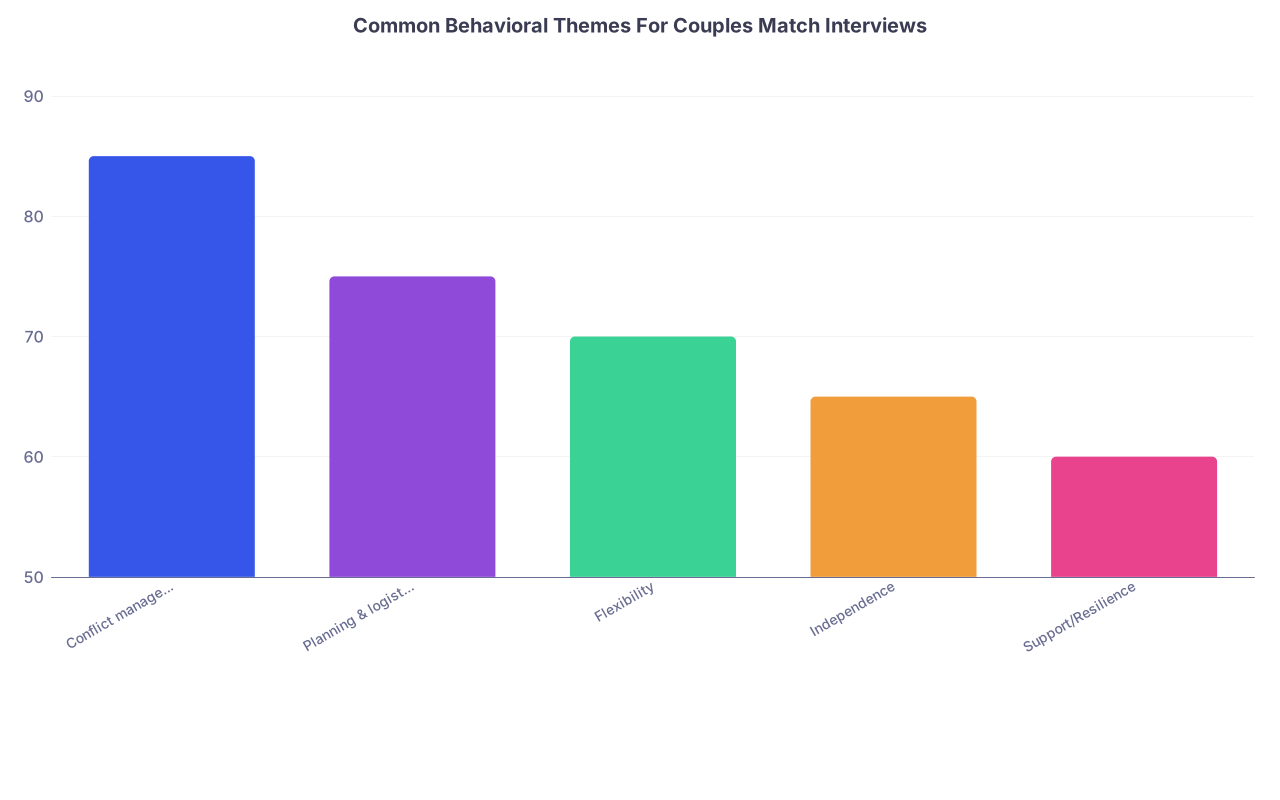
| Category | Value |
|---|---|
| Conflict management | 85 |
| Planning & logistics | 75 |
| Flexibility | 70 |
| Independence | 65 |
| Support/Resilience | 60 |
7. Answering Standard Questions With a Couples Match Lens
You’ll get normal behavioral questions. You just need to answer them with quiet awareness that the interviewer knows you’re couples matching, even if they don’t say it every time.
7.1 “Tell me about a time you had to balance competing priorities.”
You could talk about clerkships + research. Or you could intelligently weave in couples match once, and then let it go.
Example:
“This year, balancing sub-internship performance with couples match logistics was a real test. I had a heavy inpatient month while also trying to coordinate interview dates in multiple cities with my partner.
I made a rule for myself: patient care and team responsibilities first, then applications. I blocked specific times twice a week for application logistics and we used shared documents so that I didn’t have to constantly text back and forth during the day. When a conflict did arise—like an interview invite on a call day—I brought it to my senior with possible solutions rather than last-minute requests.
The result was I was able to maintain strong evaluations on service while still handling the couples match planning in a structured way.”
That tells them: this person will not use “couples match” as an excuse for being distracted or unreliable.
7.2 “Describe a time you supported someone else through a stressful period.”
Perfect place to mention your partner once—but it cannot turn into a therapy session.
“During my partner’s ICU month, they were dealing with a steep learning curve and some heavy cases. I could tell they were starting to question whether they were doing enough for patients.
Instead of just saying ‘you’re doing great,’ I asked if they wanted help breaking down specific cases and feedback they were getting. A couple of nights a week, we’d spend 20–30 minutes walking through their notes and plans—not so I could ‘fix’ anything, but so they could hear themselves reason it out.
That experience reminded me how powerful it is to have someone who can listen without jumping straight to solutions. I’ve used that same approach on rotations with classmates who are struggling with confidence.”
You showed emotional support, boundaries, and transferability to residency. Good.

| Step | Description |
|---|---|
| Step 1 | Clarify shared story |
| Step 2 | Align on key themes |
| Step 3 | Draft personal examples |
| Step 4 | Mock interviews together |
| Step 5 | Refine answers individually |
| Step 6 | Final check for consistency |
8. When Programs Ask About Your Partner Directly
Sometimes they’ll ask outright in your individual interview:
- “What do you see as your partner’s strengths?”
- “Why do you think your partner will be a good resident?”
- “How would your partner describe you?”
These are cross-check questions. They’re looking for:
- Consistency with what your partner actually said.
- Whether you respect each other professionally.
- Any red flags—resentment, competition, condescension.
Rules for answering:
- Lead with professional, not romantic, qualities.
- Be specific and grounded in examples.
- Avoid backhanded compliments (“They’re a perfectionist but sometimes too much…”)
Example:
“One of my partner’s biggest strengths is how thorough they are with patients while still moving efficiently. On their surgery sub-I, I watched them pre-round and they had a system for reviewing overnight events, labs, and imaging that made their presentations crisp and accurate.
They’re also very good at reading team dynamics. On a tough rotation with a demanding attending, they helped set the tone for the junior learners so no one took feedback personally. I think that combination of attention to detail and emotional intelligence will make them a strong resident anywhere.”
You’re not just saying “they’re hardworking and caring.” You’re giving the program a reason to want them.

9. Practicing Without Sounding Scripted
If you sound like you memorized a couples match blog post, you’ll lose credibility. But if you don’t practice at all, you’ll ramble.
Here’s a sane approach:
Write bullets, not scripts. For each expected question, write:
- 1–2 key points you must hit
- 1 short example you can use
- 1 closing line that reassures the program (if couples-match-related)
Practice separately, then together.
- First, each of you answers questions alone (record yourself if you can).
- Then do a joint session where you listen for contradictions:
- Are you describing your decision-making similarly?
- Are you using wildly different timelines?
- Are you signaling different levels of flexibility?
Do one “worst case” mock. Have a friend or advisor aggressively ask:
- “What if you break up during residency?”
- “Why should we take the risk of ranking two people instead of one?”
- “If we can only rank one of you highly, what happens?”
You will probably never get these exactly this blunt. But if you can answer them calmly, the real questions will feel easy.
| Step | Focus | Who Leads |
|---|---|---|
| 1 | Define shared story and priorities | Both |
| 2 | Draft individual behavioral examples | Individual |
| 3 | Align on rank list strategy explanation | Both |
| 4 | Mock interviews with peer/faculty | Both |
| 5 | Final consistency check week before interviews | Both |
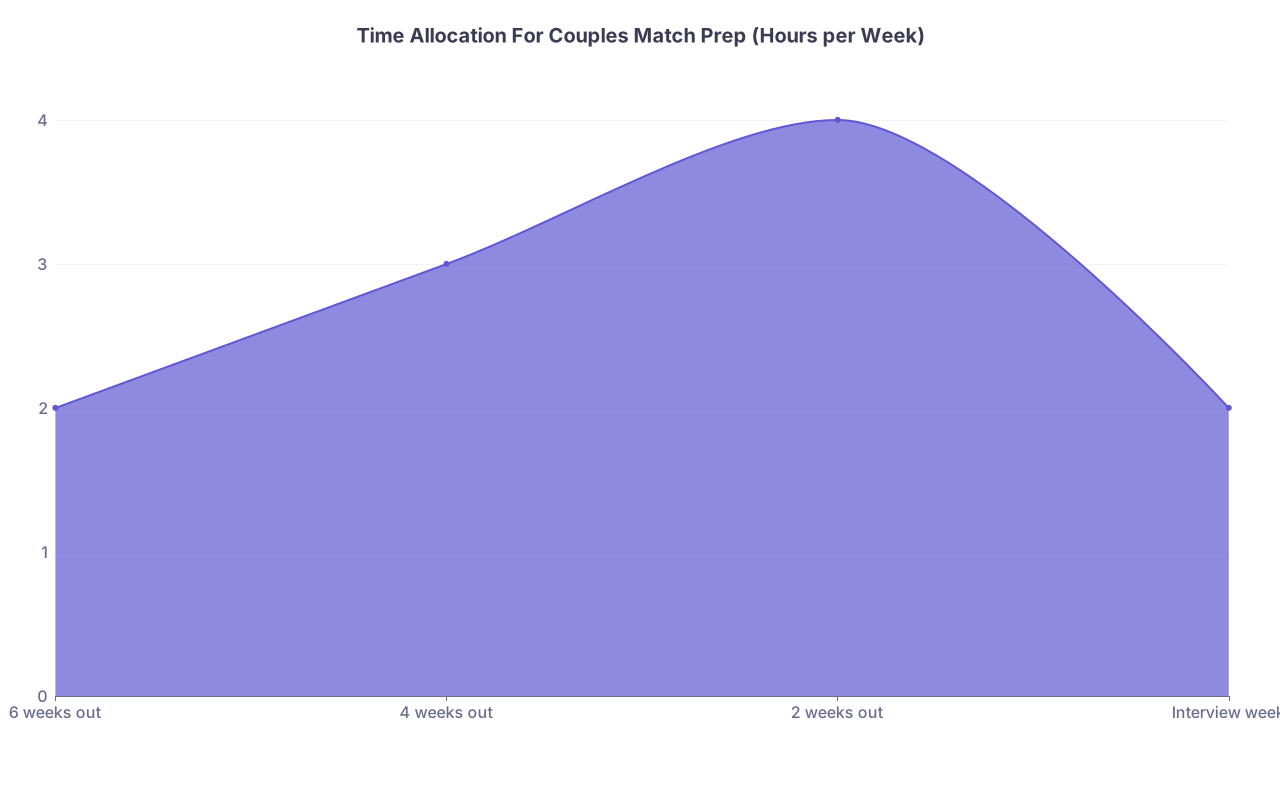
| Category | Value |
|---|---|
| 6 weeks out | 2 |
| 4 weeks out | 3 |
| 2 weeks out | 4 |
| Interview week | 2 |
10. Red Flags to Avoid (That I See Constantly)
You can do everything above and still tank if you wander into these traps:
Turning every answer into “we.”
You’re not applying as a two-headed resident. Use “I” for your work, your growth, your mistakes.Using couples match as an excuse.
“We couldn’t really do X because of couples match…” Stop. You chose this. Own it as a constraint you handled, not a burden you carry.Over-sharing relationship drama.
If you start telling a story and it feels like something you’d only tell a close friend over wine, back off. The interviewer is not your therapist.Making programs feel cornered.
Any hint of “we won’t consider you unless you take both of us” lands badly. You can be honest about priorities without sounding like you’re issuing demands.Totally ignoring the couples match.
Pretending it doesn’t exist makes you look naive. You don’t need to bring it into every answer, but when they open the door, walk through it with something intelligent.

11. Final Tightening Before Interview Day
The week before your interviews, sit down together for 30–45 minutes and run through these questions out loud, each answering individually:
- Why are you couples matching?
- How are you building your rank list?
- How do you handle conflicts with each other?
- What would you do if you didn’t match together?
- What do you see as your partner’s strengths as a resident?
If the answers feel:
- Wildly different → fix the underlying misalignment.
- Slightly different but compatible → good, that sounds human.
- Identical down to the phrasing → loosen up; you sound rehearsed.
You’re not trying to be perfect. You’re trying to be consistent, mature, and relatively predictable under stress.
Boil It Down
If you remember nothing else:
- Treat couples match as a professional planning challenge, not a romantic saga, in every behavioral answer.
- Align your shared story and contingency plans before interviews so your independent answers tell the same underlying truth.
- Use behavioral questions to prove two things: you’re strong on your own, and you handle conflict, logistics, and uncertainty together without turning it into drama.
Do that, and couples match stops being a red flag—and starts looking like what it should be: two high-functioning adults who chose to take residency seriously enough to plan their lives around doing it well.