Clinical informatics is a relatively new and rapidly evolving specialty, and for a DO graduate, planning an away rotation strategy can feel very different from preparing for more traditional residencies. Unlike surgery or internal medicine, there are far fewer formal clinical informatics rotations, and the osteopathic residency match pathways and expectations can still seem opaque. Yet away rotations and visiting student rotations can be a powerful lever—both for building skills (especially health IT training) and for signaling serious interest in the field.
This guide walks you through how to think about away rotations and related experiences as a DO graduate interested in clinical informatics, including practical timelines, what to prioritize, and how to align these experiences with a clinical informatics fellowship down the road.
Understanding the Landscape: DO Graduate, Clinical Informatics, and Away Rotations
Before planning away rotations, it helps to clarify three overlapping but distinct pieces: your status as a DO graduate, the structure of clinical informatics training, and the role of away rotations in the residency and fellowship landscape.
DO Graduate and the Modern Match Environment
Since the AOA and ACGME merger, DO graduates participate in a predominantly unified residency match process. Most clinical informatics pathways are now through ACGME-accredited programs, largely at academic medical centers.
Key realities for a DO graduate:
- Perception: Many clinical informatics leaders are MDs, but DO graduates are increasingly visible in informatics roles, especially in quality improvement, population health, and primary care–related IT projects. You may need to advocate for your osteopathic background by highlighting systems thinking, whole-person care, and interprofessional collaboration.
- Competitiveness: Clinical informatics fellowships are competitive but niche. Your initial residency match (often in IM, EM, FM, peds, path, or anesthesia) is the main gate to fellowship eligibility.
- Osteopathic signal: If you are coming from an osteopathic school or a historically osteopathic program, away rotations at large academic centers can reassure programs that you can thrive in high-volume, data-driven environments.
How Clinical Informatics Training Is Structured
Clinical informatics is not typically an entry-level residency specialty. Instead:
- You complete a primary residency (e.g., internal medicine, family medicine, emergency medicine, pediatrics, pathology, anesthesia, etc.).
- You then apply to a clinical informatics fellowship, usually 2 years, ACGME-accredited.
- Your informatics career may involve clinician-analyst roles, CMIO/ACIO pathways, digital health leadership, or research and innovation in health IT.
Because of this sequence, most of your formal away rotations happen during medical school as visiting student rotations, and are focused on your clinical base specialty (e.g., IM, EM). However, you can and should integrate informatics exposure into those rotations wherever possible.
Where Away Rotations Fit In for Clinical Informatics
For a DO graduate targeting informatics:
- Primary purpose of away rotations:
- Strengthen your candidacy for your chosen base specialty.
- Demonstrate that you can function in large, complex, highly digital environments.
- Build relationships with informatics-minded faculty or program leadership.
- Secondary purpose:
- Gain early exposure to EHR optimization, data analytics, and digital health initiatives.
- Identify residency programs that have strong clinical informatics tracks, electives, or embedded health IT training.
Even though there may not be a formal "clinical informatics-away-rotation" at every institution, you can turn a traditional clinical rotation into a tech-forward experience with the right questions and projects.
Building a Timeline and Strategy: When and How Many Away Rotations?
One of the most common questions is how many away rotations you should do and where they should be. For a DO graduate aiming at a clinical informatics pathway, your strategy should be deliberate, not simply “as many as possible.”
Preclinical and Early Clinical Years (M1–M3, or Early DO Graduate Phase)
If you are still transitioning from medical school into graduation, or you have some flexibility as a recent DO graduate engaging in gap time:
- Clarify your base specialty (e.g., IM vs EM vs FM), because away rotations will primarily be in that field.
- Seek introductory informatics exposure:
- Join quality improvement (QI) or EHR optimization projects.
- Ask IT/clinical informatics departments if students can shadow.
- Attend hospital committees related to clinical decision support, patient safety, or EHR change control.
- Start documenting your work:
- Keep a running list of projects, outcomes, and your role.
- Save screenshots (de-identified), project charters, and improvement metrics where appropriate.
Core Visiting Student Rotations (Typically M4 / Final Clinical Year)
In the context of the osteopathic residency match, your fourth year rotations (or late clinical year as a DO graduate if you have not yet matched) are pivotal. Plan for:
- Total number of away rotations:
Generally, 2–3 away rotations is a balanced, sustainable target for most applicants.- 1–2 in your base specialty at institutions that are likely fellowship homes or high-informatics centers.
- 0–1 additional selective (e.g., a research elective or an informatics-adjacent experience).
Going beyond 3 can dilute your impact and strain finances, especially if you are traveling frequently. Instead of asking “how many away rotations is ideal,” ask “how many can I do well and strategically?”
Strategic Priorities When Selecting Sites
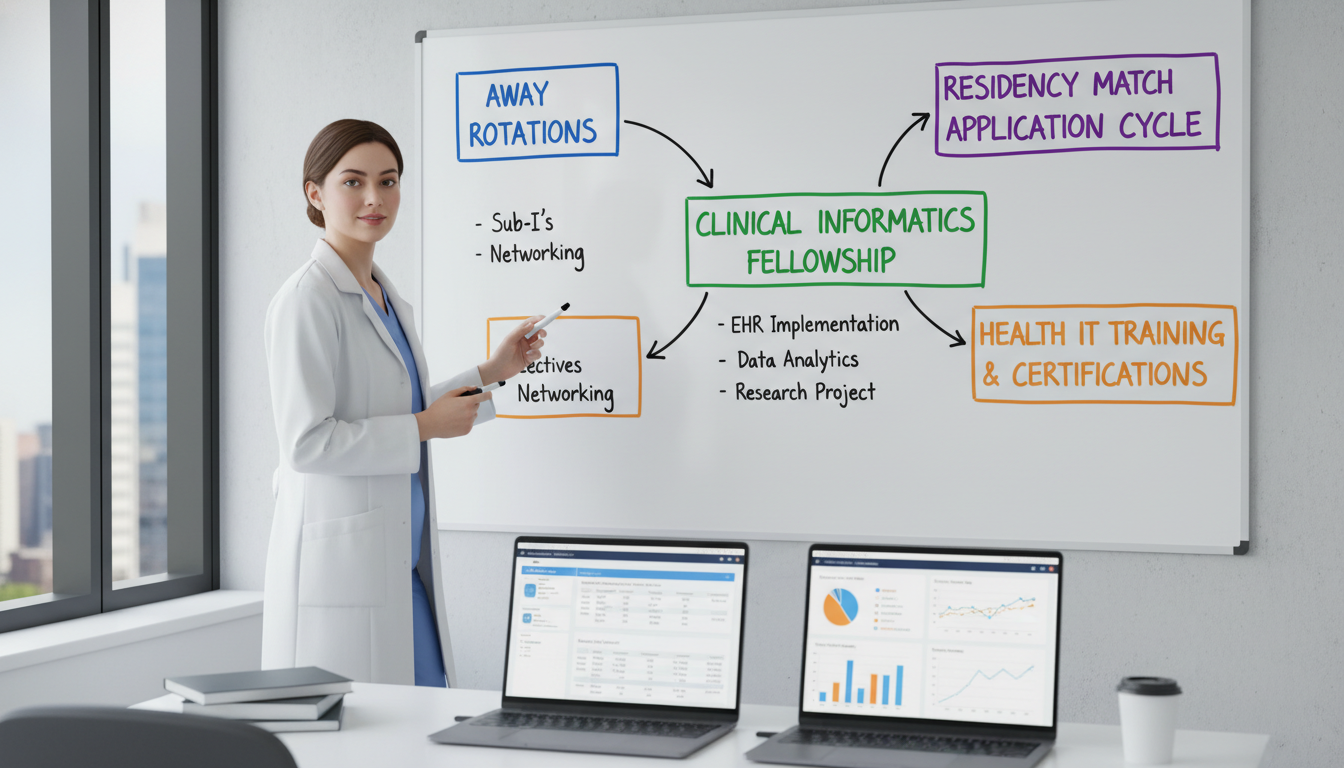
When ranking potential away rotation sites, prioritize the following:
Institutions with a clinical informatics fellowship
- These hospitals often have mature EHR systems, robust data warehouses, and visible CMIO/CNIO leadership.
- Even if you are rotating in a clinical unit, informatics is often everywhere—from order sets to dashboards.
Residency programs with established informatics tracks or electives
- Look for descriptions like “clinical informatics pathway,” “health systems leadership track,” “digital health curriculum,” or “EHR optimization electives.”
- Many internal medicine and EM programs now offer optional informatics rotations for their residents.
Health systems with strong health IT infrastructure
- Large integrated health systems (e.g., multiple hospitals, ambulatory network, telehealth, advanced analytics).
- Hospitals known for quality metrics, Lean/Six Sigma, or robust clinical decision support.
Geographic or personal considerations
- Places where you realistically might want to live for residency or eventual fellowship.
- Regions where DO graduates are welcomed and have matched successfully, particularly in specialties like IM, FM, or EM.
Balancing Clinical and Informatics Focus
Each away rotation should satisfy two parallel goals:
Goal 1 – Be an outstanding, reliable clinician
- Professionalism, solid medical knowledge, strong work ethic.
- Letters of recommendation (LORs) still hinge mostly on your bedside skills and team behavior.
Goal 2 – Signal sincere, informed interest in clinical informatics
- Ask informed questions about how the EHR and data systems support care.
- Volunteer for small informatics-flavored tasks (e.g., testing a new note template, helping with order set feedback, drafting project proposals with your attending).
- Express interest in meeting informatics faculty or IT leaders.
Designing Informatics-Rich Away Rotations (Even When They’re “Standard” Clinical Rotations)
You might not find a catalog slot labeled “Osteopathic Clinical Informatics Elective,” but you can make almost any rotation informatics-rich with planning and initiative.
Step 1: Identify Local Informatics Champions
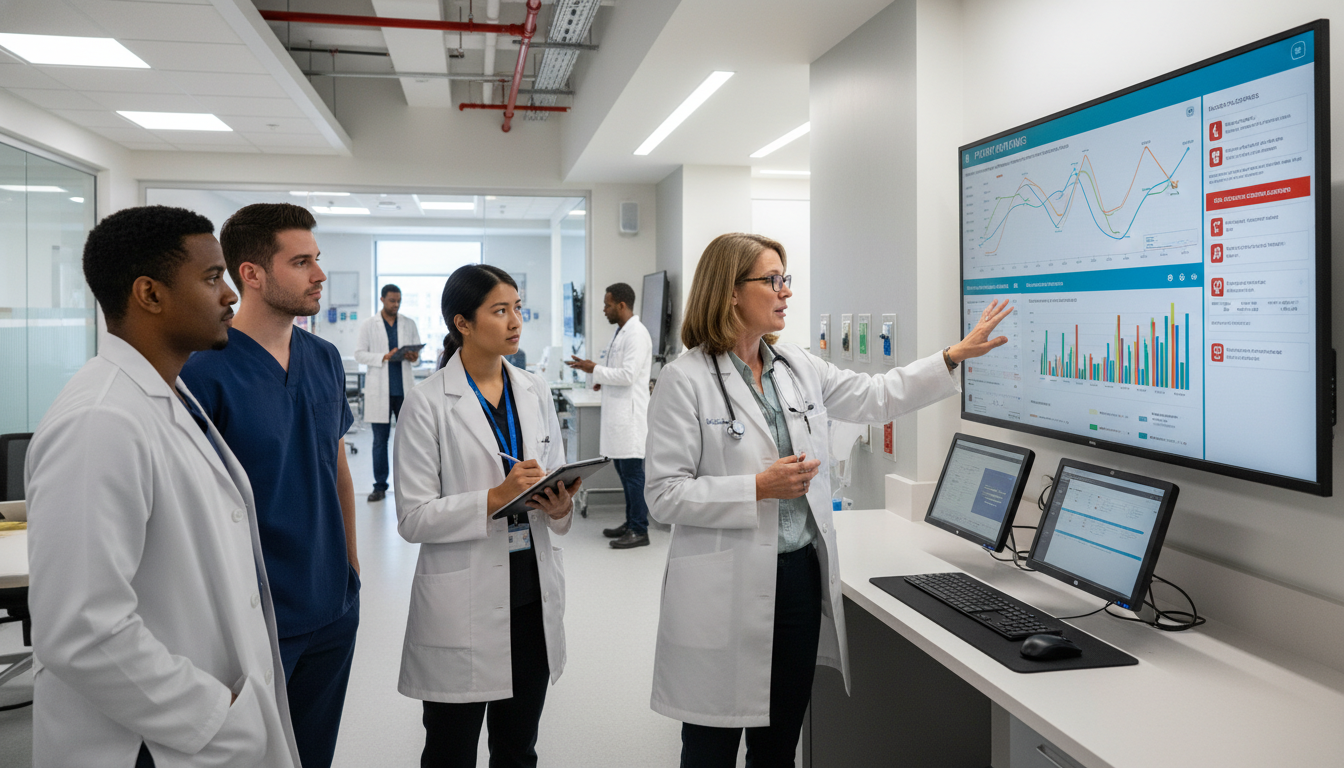
At the start of your away rotation:
- Ask your chief resident, attendings, or clerkship director:
- “Is there a clinician here who works in clinical informatics or with the EHR team?”
- “Are there any ongoing QI or data projects that residents can get involved in?”
- Request a brief meeting (15–30 minutes) with:
- The CMIO or associate CMIO.
- A physician leader for quality, data analytics, or clinical decision support.
- A fellow or resident who’s done informatics projects.
You’re not asking for a full-time research project; you are signaling interest and exploring small, manageable contributions.
Step 2: Observe the EHR Through an Informatics Lens
On daily rounds and documentation:
- Notice how order sets are structured and ask:
- “Is this order set based on an internal guideline?”
- “How often do these pathways get updated?”
- When you see alerts or BPA (Best Practice Alerts):
- Ask how they were designed, what data they use, and whether physicians can give feedback.
- Track small workflow pains:
- Copy-paste risks, documentation burden, duplicate data entry.
- Think critically about how technology is helping or hindering patient care.
You can later reference these observations in personal statements or interviews to demonstrate nuanced understanding of real-world informatics issues.
Step 3: Volunteer for a “Micro-Project”
Examples of low-burden, high-yield micro-projects during an away rotation:
Order set feedback summary:
Over the course of a block, you gather anecdotes from your team about what works and doesn’t work with a commonly used order set or note template, and summarize them in a one-page report or email for the informatics team.Testing a new clinical decision support tool:
If your site is piloting a new sepsis alert or anticoagulation tool, ask if students can provide structured user experience feedback.Data-informed case conference:
For morning report or a case presentation, incorporate a simple data pull or literature-based comparison of local practice vs. guidelines, highlighting the potential role of data dashboards.Patient portal or telehealth review:
Evaluate how patients interact with the portal (e.g., message volume, readability of notes) and offer a short reflection or proposal for improvement.
These efforts, if done thoughtfully, can become tangible bullets on your CV and conversation pieces for residency and later clinical informatics fellowship interviews.
Step 4: Convert Rotation Experiences Into Career Narrative
After each away rotation, take 30–60 minutes to debrief with yourself:
- What specific informatics or health IT issues did you encounter?
- Did you impact a process, even in a small way?
- Which mentors or contacts did you meet who might later support your development?
Write these as 3–5 bullet points in a living document. Later, they can become:
- Lines on your ERAS application (“Participated in EHR-based workflow optimization on inpatient medicine service”).
- Content for your personal statement (e.g., describing a moment when a flawed alert or data gap affected patient care).
- Talking points for interviews (“At Hospital X, I worked with Dr. Y, a CMIO, to understand how they redesigned antibiotic order sets to reduce C. diff rates.”).
Integrating Health IT Training and Clinical Informatics Preparation Outside Formal Rotations
Away rotations are only one component of your broader informatics trajectory. As a DO graduate, you can strengthen your clinical informatics profile with parallel health IT training and extracurricular engagement.
Formal and Informal Training Opportunities
Consider layering on:
Online courses and certificates
- Coursera, edX, or institutional programs on topics like:
- Health informatics
- Data science for health care
- Population health analytics
- Short courses or micro-credentials in:
- SQL basics
- R or Python for healthcare data
- Human factors and usability
- Coursera, edX, or institutional programs on topics like:
Institutional health IT exposure
- Ask to attend:
- EHR governance meetings
- Quality/safety committee meetings
- Change control board sessions (where new tools and alerts are approved)
- Request permission to shadow:
- Clinical informatics analysts
- EHR trainers and super-users
- Ask to attend:
Research and quality improvement
- If you have a gap year or research time, seek projects that:
- Use EHR-derived data.
- Evaluate clinical decision support.
- Enhance documentation efficiency or patient portal engagement.
- Emphasize metrics: pre/post intervention data, adoption rates, readmission changes, or safety metrics.
- If you have a gap year or research time, seek projects that:
Linking Away Rotations to Clinical Informatics Fellowship Aspirations
While you are still years away from applying to a clinical informatics fellowship, you can start building a clear trajectory:
Document longitudinal growth:
Show that your interest in informatics didn’t just appear abruptly; it evolved from exposure during rotations, followed by targeted training and roles.Stay in touch with informatics mentors from away sites:
- Periodic email updates about your progress.
- Ask for advice about residencies that feed into strong clinical informatics programs.
- Later, these contacts may become Letter of Recommendation writers or collaborators.
Select residencies with strong informatics ecosystems:
- During your residency interviews, ask:
- “Are there resident-level electives in clinical informatics or data analytics?”
- “Do residents participate in EHR optimization or digital health innovation projects?”
- “Have past graduates gone on to clinical informatics fellowships?”
- During your residency interviews, ask:
The goal is that each away rotation and experience fits into a coherent story: DO graduate → informed choice of base specialty → consistent informatics engagement → clinical informatics fellowship candidate.
Practical Logistics and Pitfalls for DO Graduates Planning Away Rotations
Even the best strategy can be derailed by logistical oversights. DO graduates sometimes face additional hurdles with visiting student rotations, especially at historically allopathic institutions. Planning ahead is crucial.
Application Systems and Requirements
VSLO/VSAS:
Many institutions use the AAMC Visiting Student Learning Opportunities (VSLO) system. Ensure:- Your school or alma mater is VSLO-participating.
- Your immunizations, BLS/ACLS, and background checks are current.
- You meet any specific requirements (COMLEX/USMLE scores, malpractice coverage).
Non-VSLO institutions:
Some hospitals manage their own visiting student applications. Check each department’s website early and contact coordinators if DO students are not clearly mentioned.DO-specific considerations:
- Some programs will explicitly state they welcome DO students; prioritize these.
- Where not stated, a polite email from you or your dean’s office can clarify eligibility.
Financial and Time Considerations
Away rotations are expensive:
- Travel, lodging, parking/transport.
- Potential extra health or malpractice insurance costs.
- Application fees through VSLO or local systems.
To manage this:
- Cluster rotations geographically if possible.
- Share housing with other students or look into short-term rentals near hospital campuses.
- Apply early for travel scholarships or diversity/inclusion stipends some institutions offer for visiting students.
Avoiding Common Mistakes
- Overscheduling away rotations:
- Doing 4–5 away rotations can exhaust you and dilute your performance. Again, 2–3 targeted rotations aligned with your goals are usually sufficient.
- Ignoring base specialty strength:
- Even if your heart is in informatics, you still need an excellent foundation in your clinical specialty. Don’t choose a program solely because of its EHR or data reputation if the clinical training is weak or a poor fit.
- Under-communicating your DO background:
- Be upfront and confident about your osteopathic training. Highlight osteopathic principles that align with informatics:
- Systems-based, holistic thinking.
- Focus on function, environment, and patient experience.
- Be upfront and confident about your osteopathic training. Highlight osteopathic principles that align with informatics:
- Failing to ask for letters early:
- At the end of a successful away rotation, ask for a letter of recommendation while your performance is fresh in the attending’s mind.
- If they have informatics involvement, that can add a unique angle to your letter.
Frequently Asked Questions (FAQ)
1. Do I need a dedicated clinical informatics away rotation to match into a clinical informatics fellowship later?
No. Most DO graduates who pursue clinical informatics fellowships did not have a formal “clinical informatics” visiting student rotation. What matters more is:
- Strong performance and solid letters in your clinical base specialty.
- Demonstrated and documented interest in informatics (projects, QI, health IT training).
- A coherent narrative linking clinical work, systems thinking, and informatics problem-solving.
Using standard away rotations to build informatics experience and connections is often just as effective as a labeled informatics elective.
2. How many away rotations should I complete if I’m a DO graduate interested in informatics?
For most applicants, 2–3 away rotations are sufficient and appropriate:
- 1–2 in your base specialty at hospitals with strong informatics presence or fellowships.
- Optionally, 1 additional elective that’s research- or QI-focused.
Doing more rotations does not guarantee a better osteopathic residency match and may spread your time, finances, and energy too thin. Focus on quality and fit, not sheer quantity.
3. Should I prioritize programs with existing clinical informatics fellowships for my away rotations?
It is advantageous but not mandatory. Prioritizing such programs can help you:
- Experience mature EHR and data infrastructures.
- Meet clinical informatics fellows and faculty early.
- Learn what fellowship directors value.
However, you can still build a strong profile at hospitals without fellowships if they have robust digital health initiatives, data-driven QI projects, and leaders engaged in health IT.
4. What can I do if my home institution has limited informatics exposure?
If your home site lacks formal informatics opportunities:
- Seek visiting student rotations at larger academic centers with strong IT departments or fellowships.
- Pursue online courses or certificates in health informatics, analytics, or programming.
- Get involved in small-scale QI projects using whatever data is available (e.g., clinic performance reports, paper-based audits).
- Network virtually with CMIOs, informatics fellows, or DO graduates in informatics via professional organizations (e.g., AMIA) and LinkedIn.
These strategies can effectively compensate for a more limited local infrastructure and still prepare you for a future in clinical informatics.
By approaching away rotations as part of a deliberate, longitudinal plan, a DO graduate can turn a relatively small window of time into a powerful foundation for both a strong osteopathic residency match and a future clinical informatics fellowship. Focus on choosing rotations wisely, excelling clinically, and layering in informatics exposure and health IT training wherever possible. Over time, these experiences will add up to a compelling narrative—and a well-prepared clinical informatician.